1875
Measuring Spatiotemporal Resolution in Real-Time MRI1Signal and Image Processing Institute, Ming Hsieh Department of Electrical and Computer Engineering, University of Southern California, Los Angeles, CA, United States
Synopsis
Keywords: Image Reconstruction, Image Reconstruction, local perturbation responses, point-spread functions, resolution analysis, dynamic imaging, real-time MRI
Motivation: Real-time MRI can provide powerful insights into dynamic processes, but practical experimental limitations have led to the widespread use of undersampled data. While advanced reconstruction methods can mitigate undersampling artifacts, these methods are unlikely to be perfect, and their rigorous validation has been a longstanding open problem.
Goal(s): To introduce a new reference-free approach for evaluating real-time MRI results.
Approach: We introduce a framework for measuring spatiotemporal resolution in real-time MRI, based on the propagation of spatiotemporal perturbations through image reconstruction.
Results: The proposed approach is sensitive to spatiotemporal resolution features, and provides valuable new information for the interpretation of real-time MRI results.
Impact: The proposed framework enables measurement of spatiotemporal resolution, providing new information that is important for the interpretation of real-time MRI results, and can also be useful for the development/tuning of acquisition and reconstruction methods.
Introduction
Real-time MRI is an important technology for observing dynamic biological processes.1 However, due to the slow speed of MRI data acquisition, achieving high spatiotemporal resolution often requires highly-undersampled data acquisition and constrained image reconstruction. Such approaches can be quite complicated to analyze theoretically, and are often based on potentially-imperfect assumptions. It is also quite challenging to validate real-time MRI empirically, since it is often impractical to measure fully-sampled reference data with high spatiotemporal resolution.In this work, we propose a new framework that can be used to assess the spatiotemporal resolution characteristics of real-time MRI methods. This can be used as a tool to help inspire confidence in real-time imaging results when resolution characteristics are encouraging, and may also identify scenarios where caution is needed. Our approach is based on recent work that uses local perturbation responses (LPRs) to measure spatial resolution,2 but with appropriate adaptations to fit the needs of real-time MRI.
Theory and Methods
Suppose we have noisy spatiotemporal data measurements $$$\mathbf{d}$$$ that we have obtained from some (unknown) true spatiotemporal image $$$\rho(\mathbf{x},t)$$$, with data acquisition modeled as $$$\mathbf{d}=\mathcal{E}\{\rho(\mathbf{x},t)\}+\mathbf{n}$$$, where $$$\mathbf{n}$$$ represents noise. Also suppose that we perform image reconstruction using $$$\hat{\rho}(\mathbf{x},t)=\theta(\mathbf{d})$$$ for an arbitrary (blackbox) image reconstruction method $$$\theta(\cdot)$$$. If the acquisition/reconstruction process were linear and shift-invariant, then a classical approach to assessing spatiotemporal resolution would be to calculate the point-spread function (the spatiotemporal impulse response) or the modulation transfer function (the spatiotemporal frequency response).Unfortunately, modern reconstruction methods are usually not linear or shift-invariant, necessitating the use of alternative tools. Previous work in MRI2,3 and other modalities4-6 has demonstrated that it can be insightful to instead calculate "local" versions of the point-spread function or modulation transfer functions, by adding small perturbations to the image and observing how well the perturbations are reconstructed. This approach is easy to deploy because it does not require knowledge of the true image, since perturbations can be added directly to the noisy undersampled data via $$$\mathbf{d}_{\mathrm{perturb}}=\mathbf{d}+\mathcal{E}(\mathbf{p})$$$, where $$$\mathbf{p}$$$ denotes the perturbation. And due to local linearity (which is satisfied by virtually all reconstruction approaches), adding very-small perturbations ensures that the results will still provide meaningful dataset-specific resolution insights even when $$$\theta(\cdot)$$$ is nonlinear,5 without diverging from the distribution of the original data.
The perturbed reconstruction can be obtained as $$$\theta(\mathbf{d}_{\mathrm{perturb}})$$$, and subtracting the original reconstruction enables isolation of the reconstructed perturbation (i.e., the LPR): $$LPR=\theta(\mathbf{d}_{\mathrm{perturb}})-\theta(\mathbf{d}).$$ Observing $$$LPR\approx\mathbf{p}$$$ is an indication that the acquisition/reconstruction is capable of reconstructing image features that match the characteristics of the perturbation, while substantial LPR error indicates a lack of sensitivity to that type of feature.
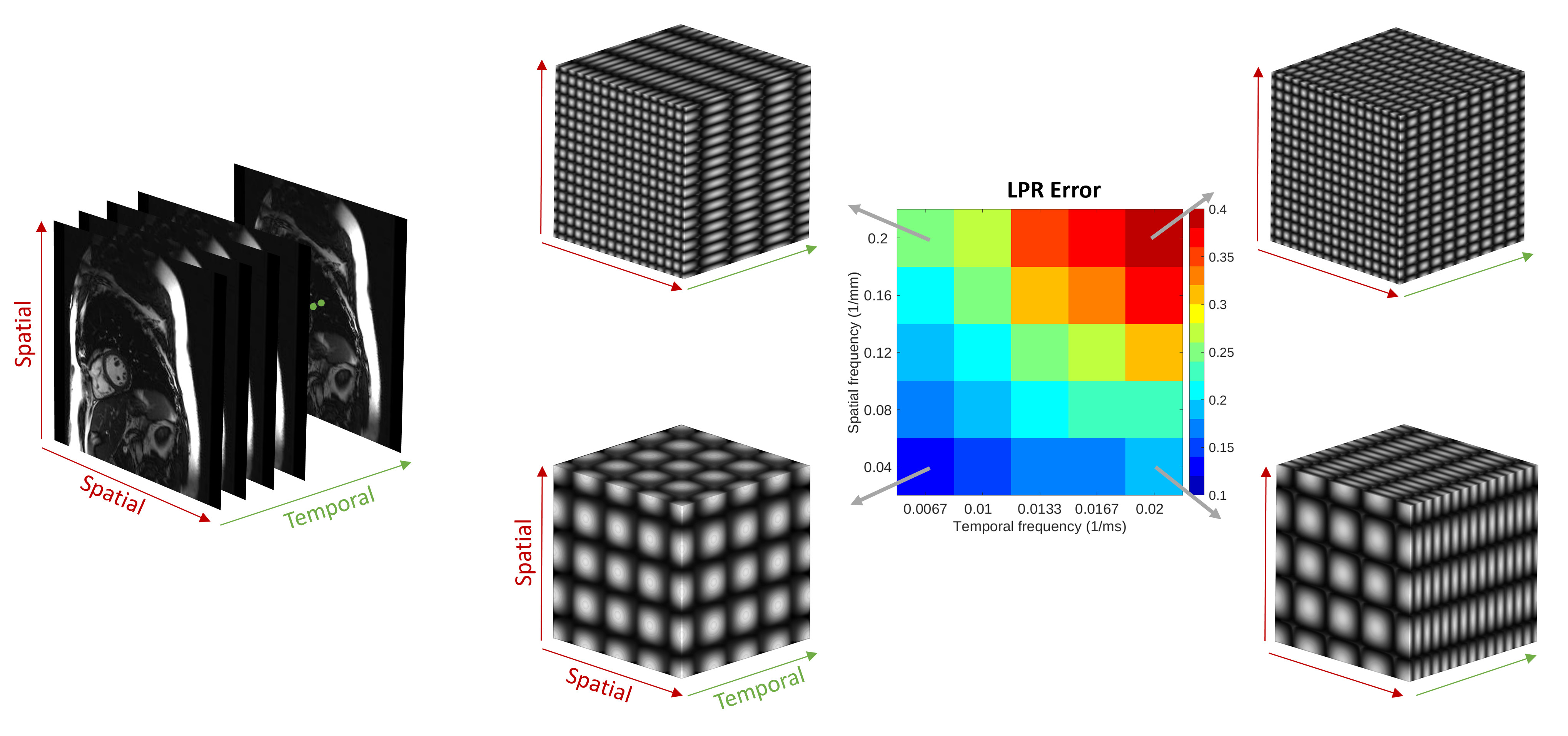
The choice of perturbation has a major impact on the information that the LPR provides. Previous work on dynamic MRI7 has chosen Dirac-like perturbations to provide information about the local spatiotemporal impulse response. This characterization is potentially insightful, but can be hard to interpret if the local impulse response varies substantially as a function of spatiotemporal position. In this work, we use spatially-distributed sinusoidal patterns (similar to checkerboards2) to gain insight into the local frequency-response characteristics of the acquisition/reconstruction process, providing information akin to a local modulation transfer function. Specifically, as illustrated in Figure 1, we can construct perturbations with varying spatial and temporal frequencies, and test how well these perturbations are recovered. As the figure depicts, the LPR errors can then be plotted as a function of spatial and temporal frequency to summarize the resolution characteristics across different spatiotemporal scales. Seeing large errors in this plot is an indication of poor resolving power at the corresponding spatiotemporal frequencies.
Results
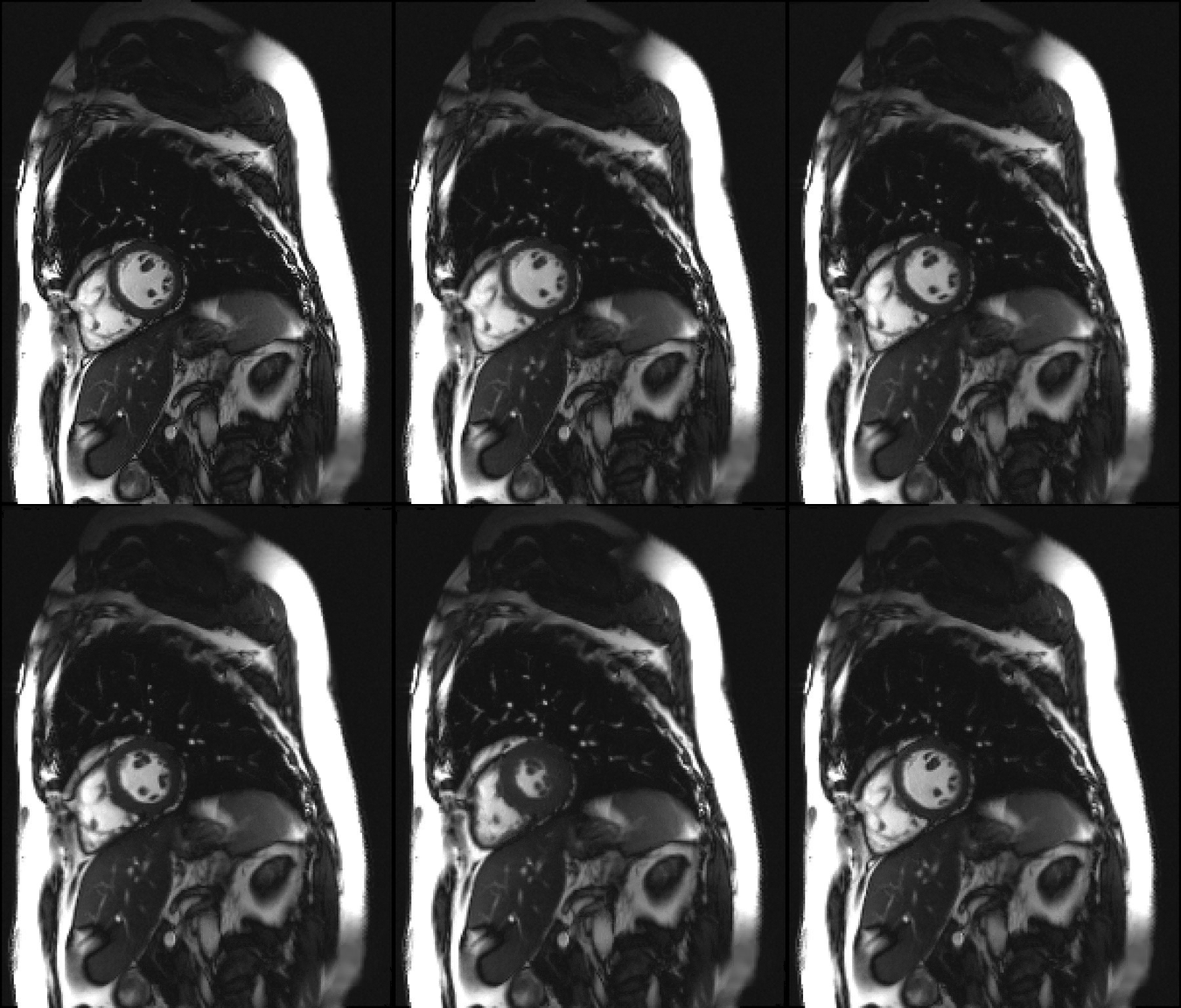
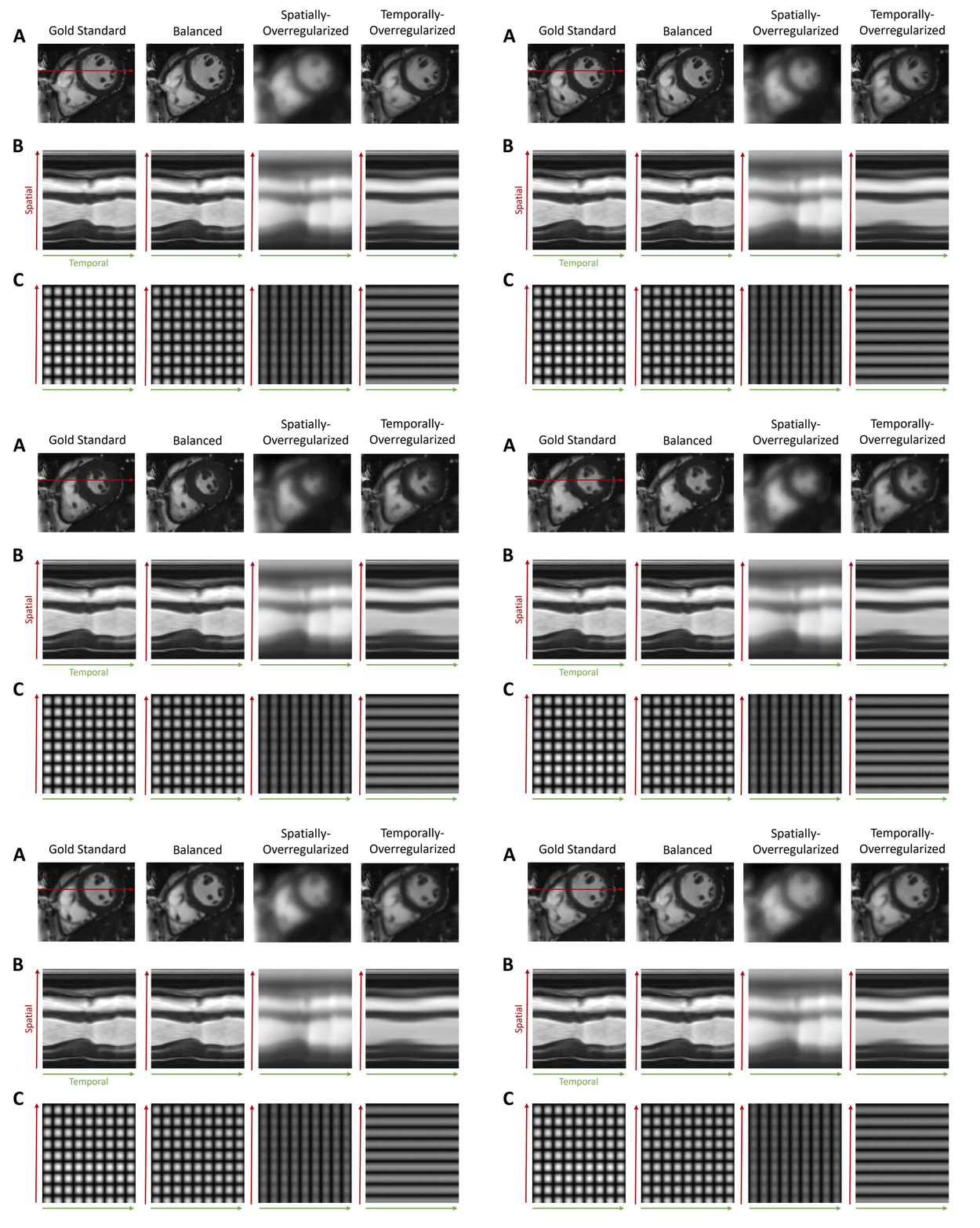
Figure 2 shows simulated full-FOV real-time cardiac MRI data that is used as the basis for later illustrations.Figure 3 shows the use of LPRs to evaluate spatiotemporal resolution in controlled scenarios with reconstructions that possess poor spatial or poor temporal resolution, demonstrating the ability to accurately capture known spatiotemporal resolution characteristics.
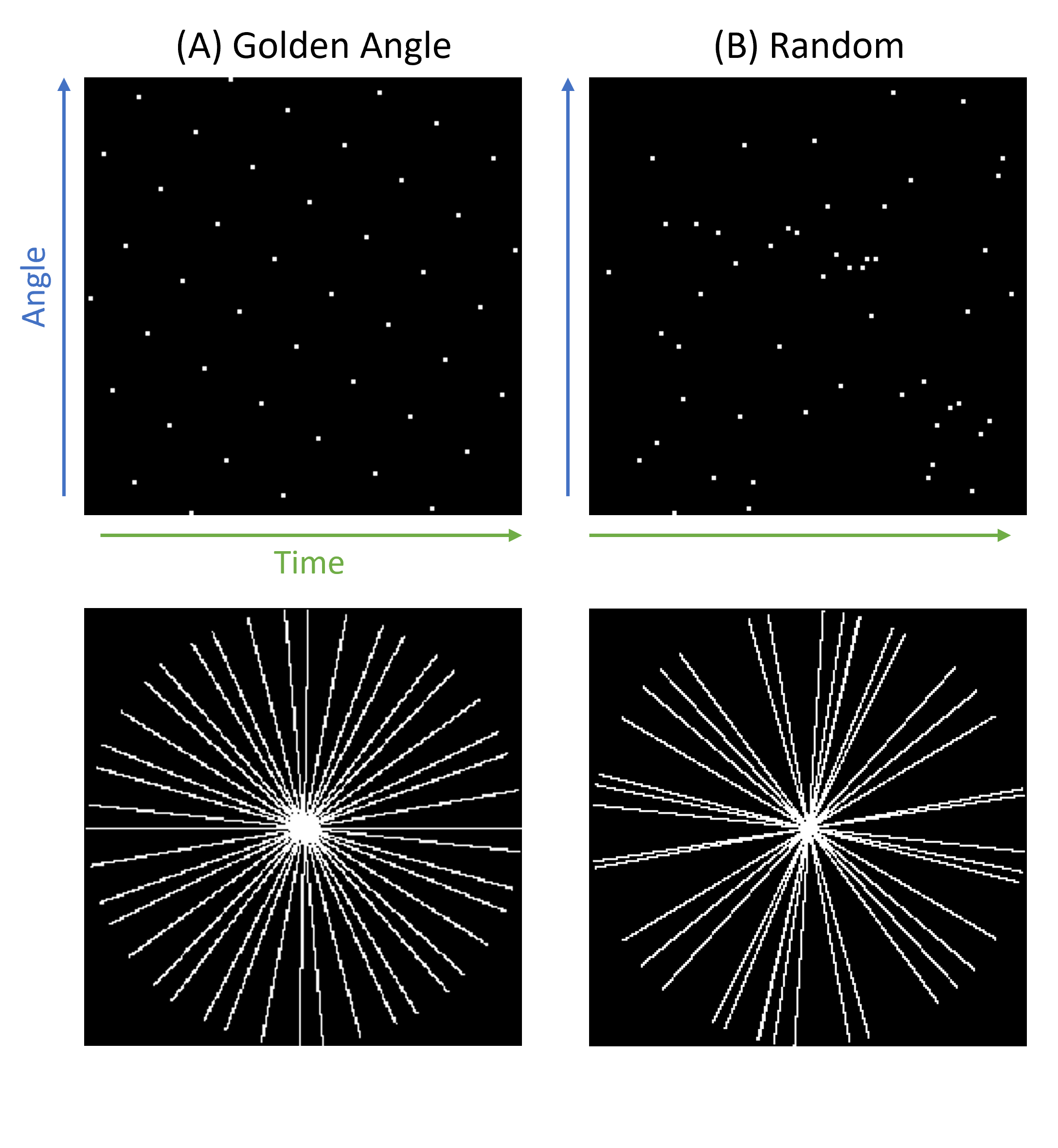
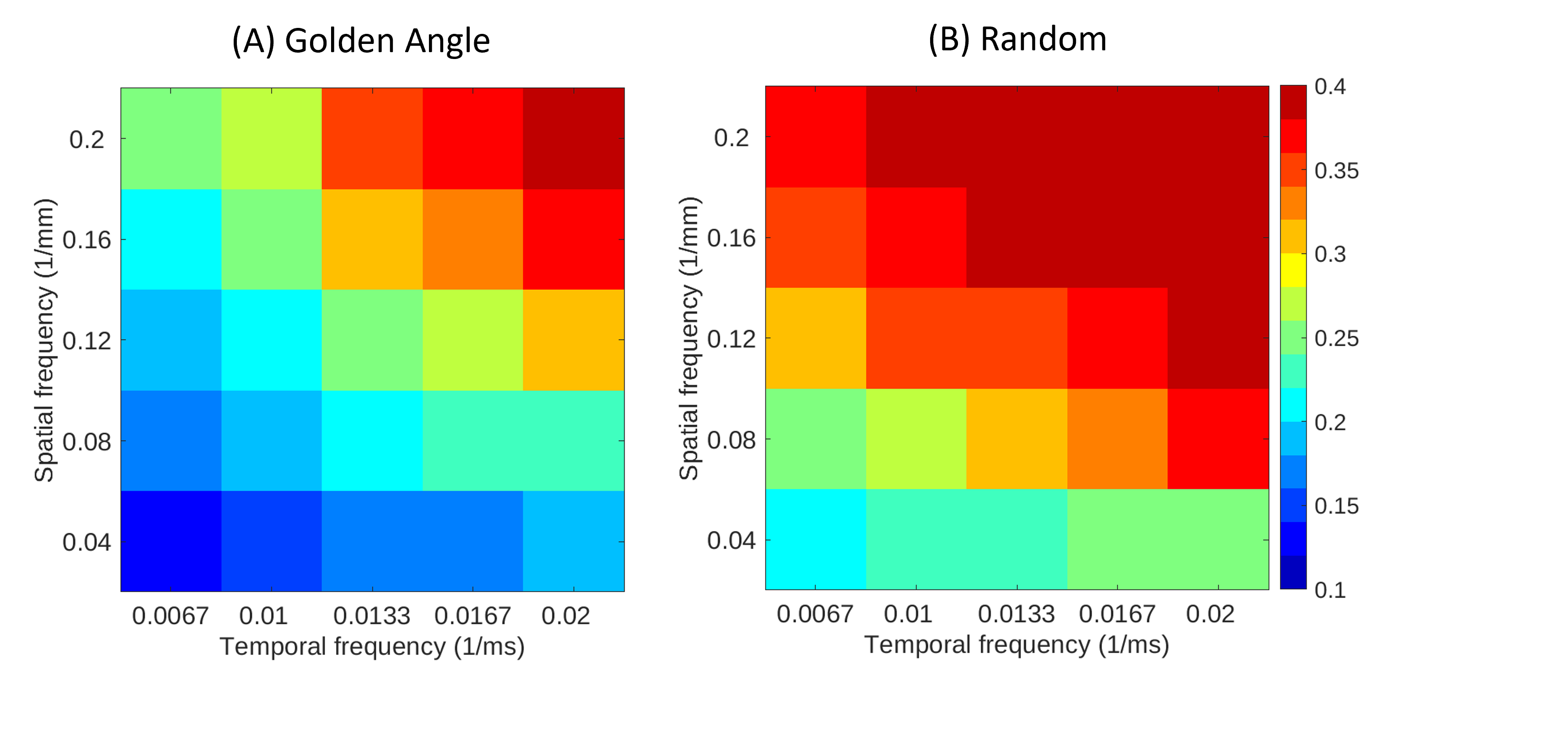
To illustrate a practical use case, we use the proposed framework to analyze the spatiotemporal resolution characteristics offered by different $$$k-t$$$ sampling patterns (as shown in Figure 4). The LPR error plots shown in Figure 5 demonstrate that one sampling pattern offers generally better spatiotemporal resolution than the other.
Conclusions
The proposed framework offers new capabilities for assessing the spatiotemporal resolution of advanced real-time MRI methods, offering powerful new insights into the expected sensitivity of an image acquisition/reconstruction method to various types of image features. This is not only useful for building confidence in real-time imaging results, but can also be used during acquisition/reconstruction development and parameter tuning.Acknowledgements
This work was supported in part by NIH research grants U01-HL167613, and R01-MH116173, the USC Provost's Strategic Directions for Research Award, a USC Viterbi/Graduate School Fellowship, and computing resources from the USC Center for Advanced Research Computing.References
[1] Nayak KS, Lim Y, Campbell-Washburn AE, Steeden J. Real-time magnetic resonance imaging. J Magn Reson Imaging 2022;55:81-99.
[2] Chan C-C, Haldar JP. Local Perturbation Responses and Checkerboard Tests: Characterization tools for nonlinear MRI methods. Magn Reson Med 2021;86:1873-1887.
[3] Wech T, Stab D, Budich JC, Fischer A, Tran-Gia J, Hahn D, Kostler H. Resolution evaluation of MR images reconstructed by iterative thresholding algorithms for compressed sensing. Med Phys 2012;39:4328-4338.
[4] Rawlinson N, Spakman W. On the use of sensitivity tests in seismic tomography. Geophys J Int 2016;205:1221-1243.
[5] Fessler JA, Rogers WL. Spatial resolution properties of penalized-likelihood image reconstruction: Space-invariant tomographs. IEEE Trans Image Process 1996;5:1346-1358.
[6] Ahn S, Leahy RM. Analysis of resolution and noise properties of nonquadratically regularized image reconstruction methods for PET. IEEE Trans Med Imaging 2008;27:413-424.
[7] Khalsa KA, Fessler JA. Resolution properties in regularized dynamic MRI reconstruction. IEEE ISBI 2007, pp. 456-459.
Figures