1874
Dynamic Latent Variable Modeling for Improved Cardiac MRI Reconstruction1Shenzhen Institute of Advanced Technology,Chinese Academy of Sciences, Shenzhen, China, 2Chinese Academy of Sciences, Beijing, China
Synopsis
Keywords: Image Reconstruction, Heart
Motivation: The beating of the heart is predictable, and existing methods mainly focus on sparsity and low rank, ignore the predictability.
Goal(s): Our goal is to improve the quality of dMRI reconstruction through predictability.
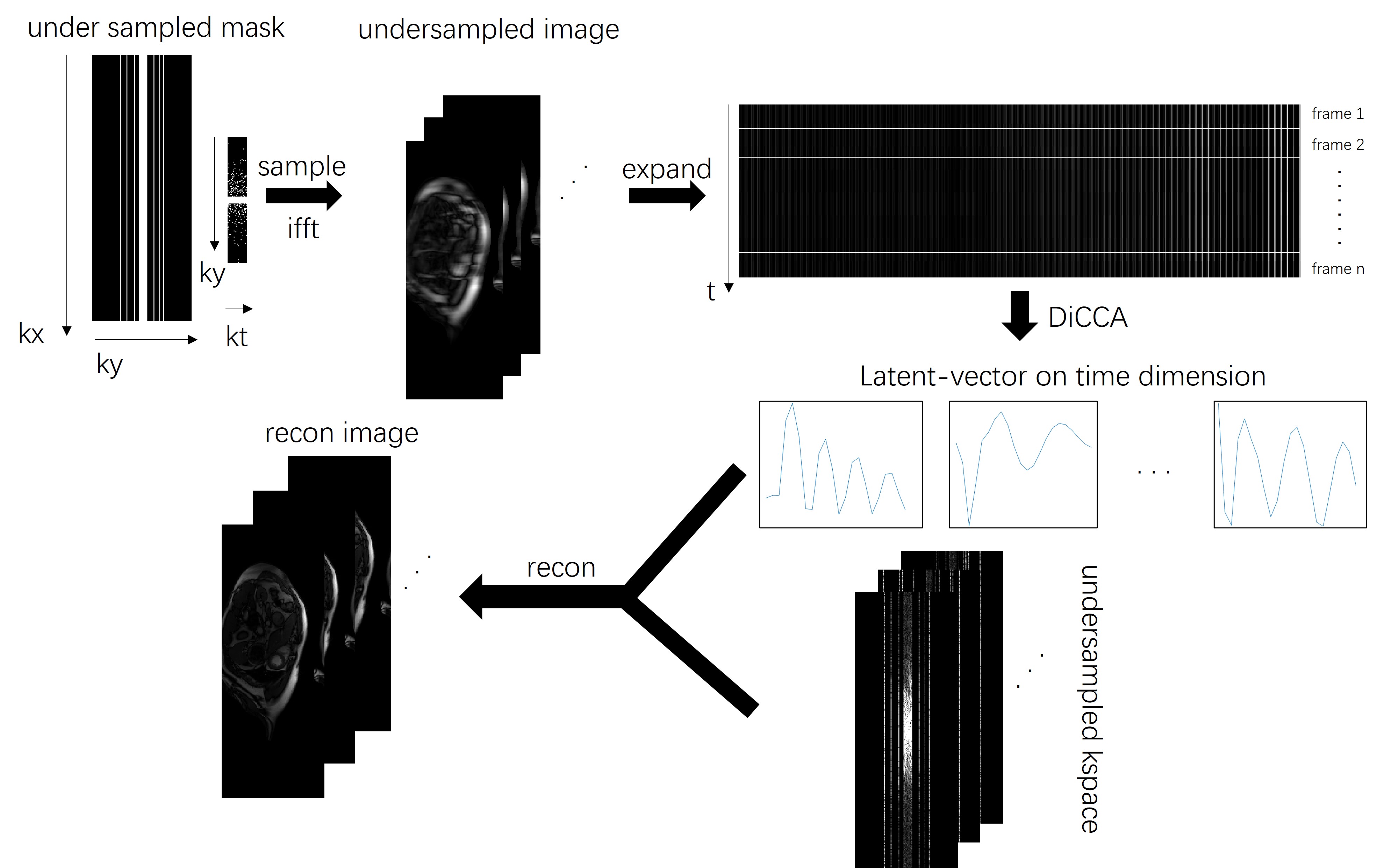
Approach: Introduced a method to extract predictability latent vectors and reconstruct images based on it.
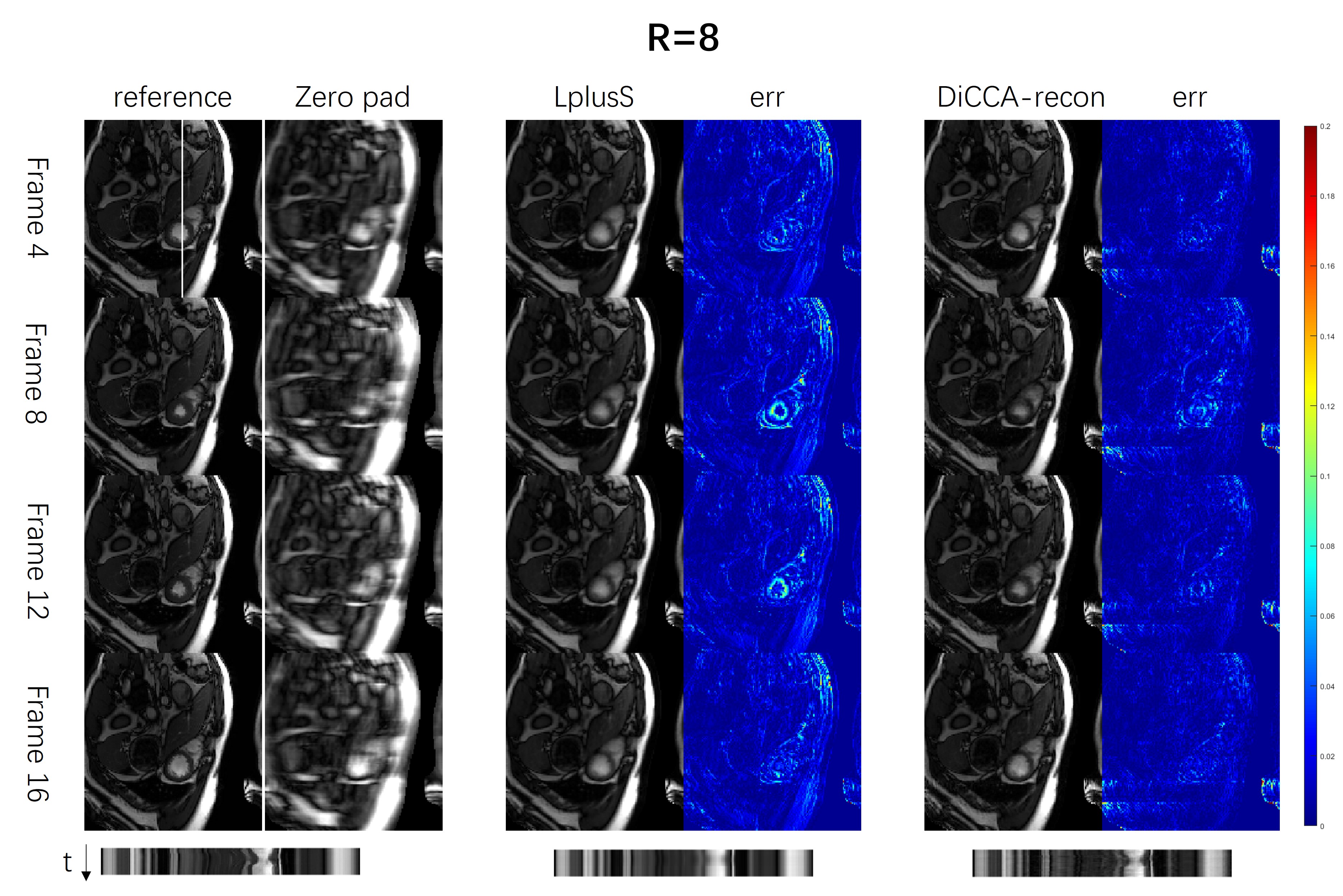
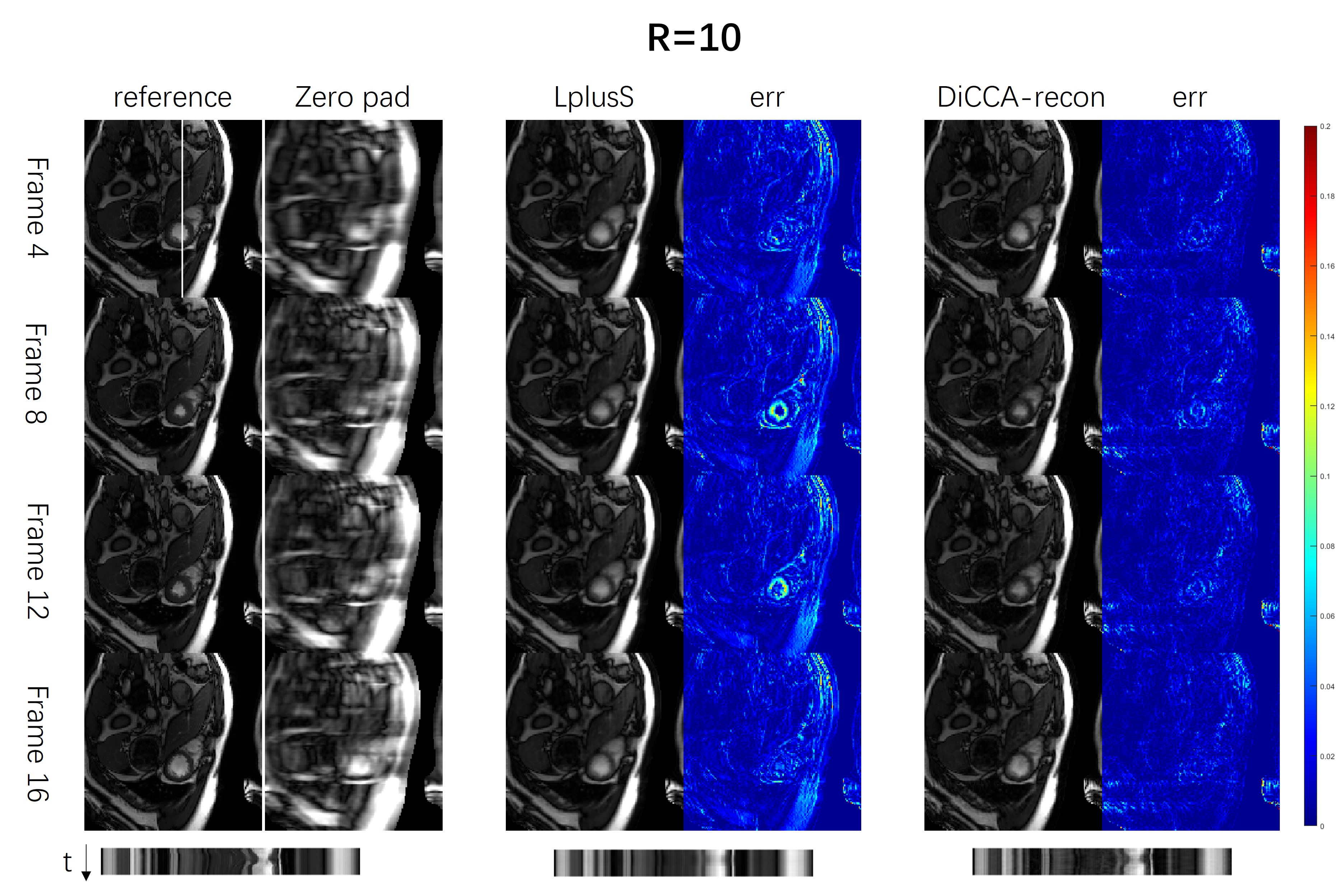
Results: We used highly undersampled data for reconstruction and compared it with L+S,the experimental results indicate that we have achieved better reconstruction results than L+S.
Impact: This work use predictability for dMRI reconstruction without the use of sparsity and low rank.It is possible to introduce a new perspective for the reconstruction of dynamic images.
Introduction
Dynamic magnetic resonance imaging (MRI) plays a pivotal role in the real-time visualization of moving organs, necessitating rapid imaging to accurately capture motion dynamics. To achieve accelerated acquisition of dynamic MRI data, various strategies have been employed, focusing on the exploitation of spatiotemporal redundancies by representing data in a lower-dimensional manifold where the projected information exhibits maximum variance1,2,3,4. While these techniques have proven effective in many scenarios, their applicability to cyclic motions, such as cardiac imaging, is inherently limited due to the additional temporal predictability constraints imposed by the periodic nature of the cardiac cycle. Recent advances5,6,7 have been proposed to maximize the covariance between these latent variables and their predictions from historical data points, and have shown promising results to significantly reduce the data dimension when the data is cross and auto-correlated. Leveraging this notion, in this work, we propose a novel reconstruction framework utilizing a predictive model, capable of forecasting future phases based on past phases, as a constraint to better regularize the reconstruction of cardiac cine MRI from highly undersampled k-space data.Method
To mathematically formulate the predictability in the cyclic dynamic cardiac cine image series, we let $$$\boldsymbol{x}_t$$$denote the mage acquired at time $$$k$$$, and$$$\boldsymbol{X}=\{\boldsymbol{x}_t\}_1^{N+s}$$$denote the time series data of $$$N+s$$$ frames. A latent variable $$$t_k$$$ is defined as a linear combination of the original variables $$$t_k=\boldsymbol{x'w}$$$. We make the assumption that $$$t_k$$$ could be approximately represented by the latent variables $$$t_{k-i}$$$ obtained from its historical images using an auto-regression model:$$
t_k=\sum \beta_it_{k-i}+r_k
$$
Where $$$s$$$ is the order of dynamics. The residual $$$r_k$$$ is zeros mean and uncorrelated in time for a high enough order $$$s$$$. Let the predication $$$t_k$$$ is
$$
\hat{t_k}=\sum^s_{i=1}\beta_it_{k-i}=\sum^s_{i=1}\beta_i \boldsymbol{x}_{k-i}'\boldsymbol{w}
$$
By maximizing the correlation between the latent variable $$$t_k$$$ and its predictions $$$\hat t_k$$$, we may obtain the most predictable latent variables in the current time series data $$$\boldsymbol{X}_k$$$ by
$$
\max_{\boldsymbol{w},\beta} \frac{\boldsymbol{t}_k' \boldsymbol{ \hat t}_k }{||\boldsymbol{t}_k||\ ||\hat{\boldsymbol{t}_k}||}
$$
By solving $$$w$$$ and $$$\beta$$$, we can obtain one latent vector $$$\boldsymbol{t}_k$$$ with the highest predictability for the current time series data $$$\boldsymbol{X}_k=\sum^s_{i=1}\beta_i \boldsymbol{x}_{k-i}'$$$. To extract another latent variable, the abovementioned procedure can be applied to the deflated matrix $$$\boldsymbol{X}_{k+1}$$$, with $$$\boldsymbol{X}_{k+1}:= \boldsymbol{X}_k-\boldsymbol{t}_k\boldsymbol{p}$$$, where $$$\boldsymbol{p}$$$ is the loading vector $$$\boldsymbol{p}=\boldsymbol{X}_k'\boldsymbol{t}_k/\boldsymbol{t}_k' \boldsymbol{t}_k$$$. Assume this process iterates $$$j$$$ times until $$$\boldsymbol{X}_{k+1}$$$ is smaller than a certain threshold, then current time series could be represented by $$$\boldsymbol{X}=\sum_j\sum_{i=1}^s\beta_i \boldsymbol{x}_{i=1}^s$$$.
Motivated by the abovementioned algorithm, we formulate the reconstruction of dynamic cardiac cine image series from highly undersampled k-space data using the most predictable latent variable in the following form:
$$
\min_{\boldsymbol{w},\beta}||\boldsymbol{X}-\boldsymbol{tp}||_2,\quad s.t.\ ||\boldsymbol{y}-F_u\boldsymbol{X}||_2
$$
Where $$$\boldsymbol{y}$$$ is the acquired k-space data, $$$F_u$$$ is the Fourier transform with downsample pattern. We use ADMM to solve it.
Result
We validated our proposed method using the OCMR public dataset. A set cardiac cine image data was acquired on a 3T scanner, using a SSFP sequence (image matrix size = 384x144x38x22, FOV = 800×300mm,flipAngle = 37, TE = 1.5ms, TR = 35.88ms). To simulate the reduced acquisition retrospectively, the k-space data was randomly undersampled along the phase encoding direction at each echo time with net reduction factors of 8 and 10, respectively. Compressed sensing with L+S model4 was used as comparison. The reconstruction results were shown in Figure 2,3. Specifically, our proposed method showed superior reconstructed image quality than the L+S model, in terms of artifacts removal and preservation of image details and temporal variations, than the L+S model.Conclusion
In this work, we propose a novel algorithm to reconstruct dynamic cardiac cine image data from its highly undersampled k-space measurements. Our method takes advantage of the cyclic nature of the data, where the current frame can be represented as a prediction based on historical frames. By extracting the most predictable latent vectors from the time series data, our proposed method is superior to state-of-the-art compressed sensing methods using L+S models. The proposed method may serve as a new perspective for dynamic magnetic resonance reconstruction.Acknowledgements
This work was partially supported by the National Natural Science Foundation of China (62271474), the National Key R&D Program of China (2023YFB3811400), the High-level Talent Program in Pearl River Talent Plan of Guangdong Province (2019QN01Y986) and the Shenzhen Science and Technology Program (KQTD20180413181834876 and JCYJ20210324115810030).References
1.Lustig M, Donoho D, Pauly J M. Sparse MRI: The application of compressed sensing for rapid MR imaging[J]. Magnetic Resonance in Medicine: An Official Journal of the International Society for Magnetic Resonance in Medicine, 2007, 58(6): 1182-1195.
2.Jung H, Sung K, Nayak K S, et al. k‐t FOCUSS: a general compressed sensing framework for high resolution dynamic MRI[J]. Magnetic Resonance in Medicine: An Official Journal of the International Society for Magnetic Resonance in Medicine, 2009, 61(1): 103-116.
3.Lingala S G, Hu Y, DiBella E, et al. Accelerated dynamic MRI exploiting sparsity and low-rank structure: kt SLR[J]. IEEE transactions on medical imaging, 2011, 30(5): 1042-1054.
4.Otazo R, Candes E, Sodickson D K. Low‐rank plus sparse matrix decomposition for accelerated dynamic MRI with separation of background and dynamic components[J]. Magnetic resonance in medicine, 2015, 73(3): 1125-1136.
5.Dong Y, Qin S J. Dynamic-inner canonical correlation and causality analysis for high dimensional time series data[J]. IFAC-PapersOnLine, 2018, 51(18): 476-481.
6.Qin S J. Latent vector autoregressive modeling and feature analysis of high dimensional and noisy data from dynamic systems[J]. AIChE Journal, 2022, 68(6): e17703.
7.Dong Y, Qin S J. A novel dynamic PCA algorithm for dynamic data modeling and process monitoring[J]. Journal of Process Control, 2018, 67: 1-11.
Figures