1873
Improving reconstruction of multiband real-time MRI1School of Physics, Engineering and Technology, University of York, York, United Kingdom, 2School of Psychology, University of Nottingham, Nottingham, United Kingdom, 3Department of Sport and Exercise Sciences, Manchester Metropolitan University, Manchester, United Kingdom, 4York Cross-disciplinary Centre for Systems Analysis, University of York, York, United Kingdom
Synopsis
Keywords: Image Reconstruction, Image Reconstruction
Motivation: Static sequences cannot capture movement and current real-time MRI sequences cannot provide volumetric coverage. Our motivation is too bridge this gap.
Goal(s): This work aims to extend a standard real-time MRI sequence to use multiband excitation to improve real-time volumetric coverage for diagnostic purposes.
Approach: Development of a radial sequence incorporating multiband excitation. A compressed sensing reconstruction algorithm is also implemented. Phantom and in-vivo images are acquired and analysed to assess image quality and reconstruction times.
Results: We present both phantom and in-vivo images acquired using this approach. The proposed reconstruction approach results in a higher SNR compared to conventional reconstruction.
Impact: We present improvements in real-time MRI by adding multiband excitation, allowing for the dynamic imaging of complex movements across a volume. This will improve the monitoring and diagnostic capabilities of real-time MRI, for example in maxillofacial surgery or orthopaedics.
Introduction
Real-time MRI permits dynamic study of the moving human body1,2. For example, it can be used to track speech formation or joint movement. Real-time sequences generally use highly under-sampled non-Cartesian trajectories (e.g. radial or spiral), with short repetition times (TR) to achieve a high temporal resolution. Such approaches prevent, if temporal resolution is to be maintained, interleaving of slices, and suffer from limited volumetric coverage. Here we implement multiband excitation into a radial FLASH sequence delivering multiple slices simultaneously3. This improves the real-time MRI capabilities for monitoring and studying body movements. Multiband real-time MRI requires complex, computationally expensive iterative reconstruction. We use a reconstruction scheme, based on the Alternating Method of Multipliers (ADMM) algorithm4 and compare this against a conjugate gradient reconstruction, aiming for higher signal-to-noise (SNR) at high undersampling factors.Methods
SequenceRadial multiband images are acquired using an adapted radial FLASH pulse sequence2. Multiband RF pulses are generated at runtime using a superposition of RF pulses. The phase of the RF pulses are modulated to improve slice separation3.
A segmented ordering scheme was used to acquire the radial data2. This allows a sliding window approach to be used, increasing the apparent temporal resolution. In this scheme the set of $$$N$$$ radial spokes are separated into $$$S$$$ segments, each segment thus contains $$$K = \frac{N}{S}$$$spokes. The angle,$$$\theta_{i,s}$$$, of spoke $$$i \in [0,K-1]$$$ in segment $$$ s \in [0,S-1]$$$ is then given by eq.1.
$$\theta_{i,s} = \frac{2\pi}{K} \cdot i + s\cdot \frac{2\pi}{N} \qquad eq.1$$
Images are acquired on a Siemens 3T MAGNETOM Vida system. Structured phantom scans used a 20-channel head coil; in-vivo imaging used a 64-channel head/neck coil. The sequence parameters were TR/TE = 2.5ms/1.4ms, flip angle = 10o, bandwidth = 1444 Hz/pixel, slice thickness = 8mm and 288 points per read line (including 2x oversampling), three slices are acquired simultaneously. The number of repetitions was chosen to obtain a 20 second video of movement.
Reconstruction
The image reconstruction model (eq.2), reconstructs slices $$$\mathbf{\hat{x}}$$$, from measured k-space data $$$\mathbf{y}$$$.
$$\hat{x} = argmin\left(\frac{1}{2} \left|\left|\sum_{i=1}^{NSli}\left(\boldsymbol{\phi_{i}FS_{i}x_{i}}\right)-\mathbf{y}\right|\right|_{2}^{2} + \left|\left|\boldsymbol{TV_{1}x}\right|\right|_{1} + \left|\left|\boldsymbol{TV_{2}x}\right|\right|_{1}\right) \qquad eq.2$$
Where $$$\mathbf{F}$$$ is the non-uniform FFT, $$$\boldsymbol{\phi_{i}}$$$ and $$$\mathbf{S_{i}}$$$ are the CAIPIRINHA3 phase modulation and coil sensitivity maps for slice $$$i$$$ respectively. A short FLASH prescan was used to calculate the coil sensitivity maps. For regularisation, the spatial ($$$\boldsymbol{TV_{1}}$$$) and temporal ($$$\boldsymbol{TV_{2}}$$$) Total Variation transforms were applied to each slice5.
Using this model, image reconstruction is performed using the ADMM algorithm4. It was compared to the Conjugate gradient SENSE (CG-SENSE) style reconstruction3.
Results and Discussion
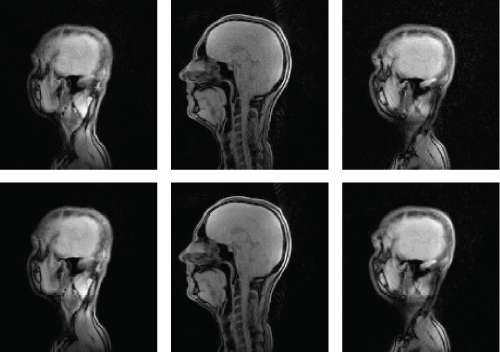
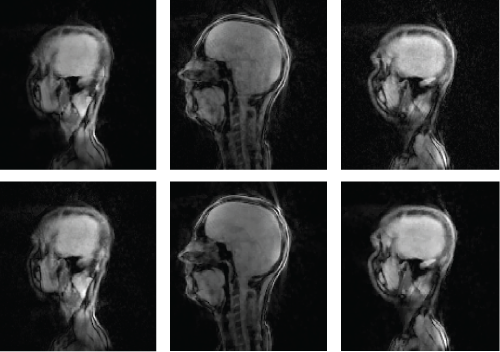
Reconstruction outputs using a CG-SENSE and ADMM approach are shown in Figure 1 (top and bottom row, respectively). Interslice leakage is present in the central slice of the data when CG-SENSE is used. Image quality is improved and the leakage artefact is reduced (improving SNR) using ADMM.Single frame examples of in-vivo images (temporal mandibular joint, midsagittal) are shown in Figure 2 for CG-SENSE and ADMM reconstructions. With good k-space coverage (95 spokes, 19 segments), increasing the number of coil elements improves image quality for CG-SENSE (over the phantom images acquired with 20 elements) and make outputs comparable to the ADMM approach.
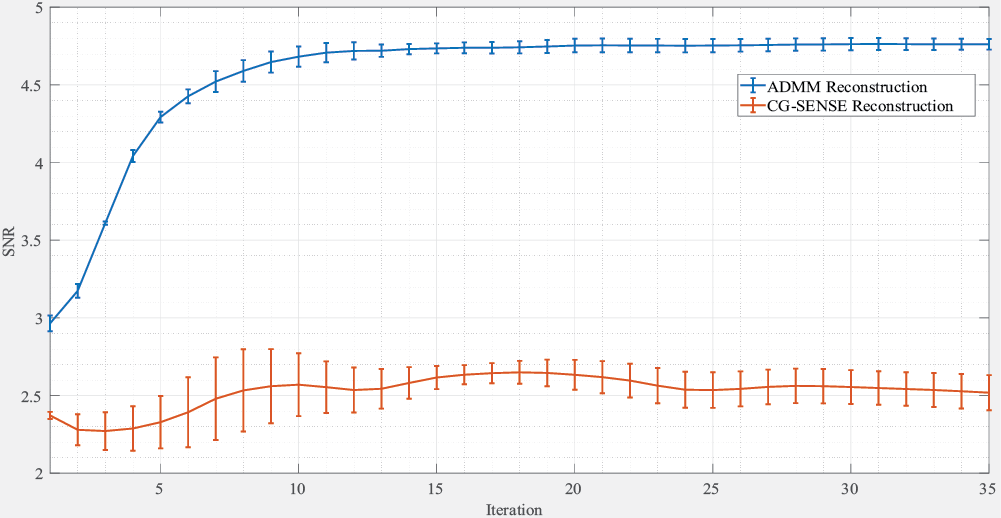
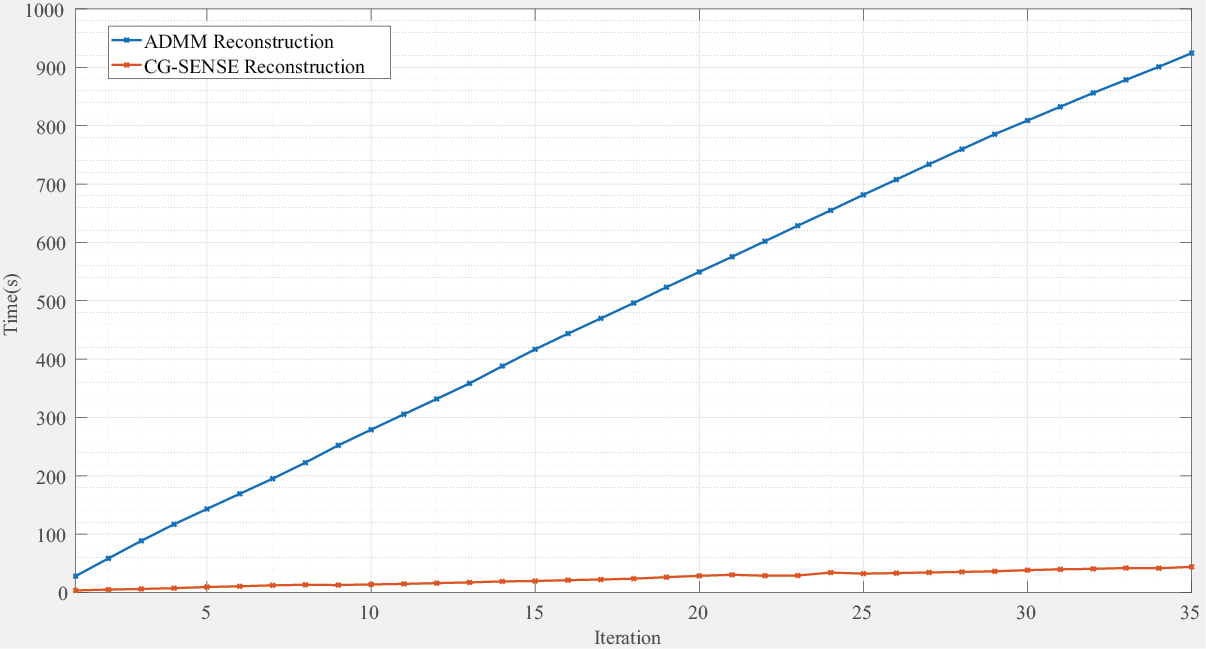
To push the temporal resolution of real-time MRI one can reduce the number of acquired spokes. Reducing the number of spokes from 95 to 35 spokes increases the temporal resolution from 237.5ms to 87.5ms. Even at this high level of undersampling both CG-SENSE and ADMM can separate the slices. The ADMM algorithm combined with the multiband radial sequence is able to separate the slices and reconstruct the undersampled images with a higher SNR compared to the CG-SENSE approach (Figure 4). The ADMM algorithm comes at an increase in computational cost, the per iteration computation time is shown in Figure 5. In this work the ADMM algorithm was run for 5 iterations and the CG-SENSE algorithm was run for 10 iterations, these values were selected to balance reconstruction time and image quality. The reconstruction times for both algorithms can be reduced by parallel computing, for example using GPUs.
Conlusion
We have shown that real-time MRI capabilities for monitoring and studying body movements can be improved using multiband excitation combined with iterative reconstruction. It has been demonstrated that this technique can be used to record non-periodic dynamics, in this case jaw and tongue movements. Future work should attempt to improve the estimation of coil sensitivity maps because the maps will vary due to movements. Joint estimation methods such as JSENSE6 or Non-linear Inverse Reconstruction7 (NLINV) are promising tools for this purpose.Acknowledgements
IW acknowledges a PhD scholarship by the School of Physics, Engineering and Technology, University of York.References
[1] Nayak KS, Lim Y, Campbell-Washburn AE, Steeden J. Real-Time Magnetic Resonance Imaging. J Magn Reson Imaging. 2022 Jan;55(1):81-99.
[2] Niebergall A, Zhang S, Kunay E, Keydana G, Job M, Uecker M, Frahm J. Real-time MRI of speaking at a resolution of 33 ms: undersampled radial FLASH with nonlinear inverse reconstruction. Magn Reson Med. 2013 Feb;69(2):477-85.
[3] Yutzy SR, Seiberlich N, Duerk JL, Griswold MA. Improvements in multislice parallel imaging using radial CAIPIRINHA. Magn Reson Med. 2011 Jun;65(6):1630-7.
[4] S. Boyd, N. Parikh, E. Chu, B. Peleato, and J. Eckstein. Distributed optimization and statistical learning via the alternating direction method of multipliers. Foundation and Trends in Machine Learning. 2011;3(1):1-122
[5] Lustig M, Donoho D, Pauly JM. Sparse MRI: The application of compressed sensing for rapid MR imaging. Magn Reson Med. 2007 Dec;58(6):1182-95.
[6] Ying L, Sheng J. Joint image reconstruction and sensitivity estimation in SENSE (JSENSE). Magn Reson Med. 2007 Jun;57(6):1196-202.
[7] Uecker M, Hohage T, Block KT, Frahm J. Image reconstruction by regularized nonlinear inversion--joint estimation of coil sensitivities and image content. Magn Reson Med. 2008 Sep;60(3):674-82
Figures
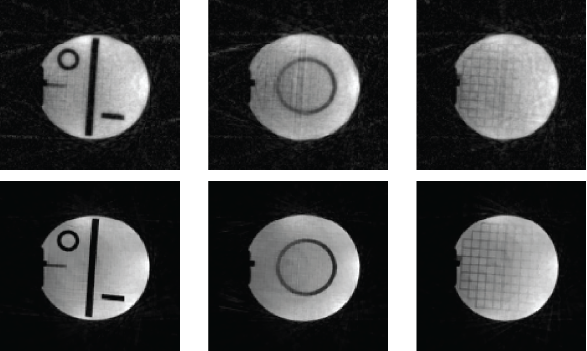
Three slices of phantom (30 mm apart) acquired simultaneously using a multiband radial FLASH sequence (95 spokes). Top: CG-SENSE reconstruction, (SNR: 1.9, std error in the centre of slice 2: 4.7$$$\times$$$10-6). Bottom: ADMM reconstruction (SNR 3.3, std error in the centre of slice 2: 1.7$$$\times$$$10-6).