1872
Cartesian spirals: An alternative to radial imaging for 4D-MRI in MR-guided radiotherapy1Joint Department of Physics, The Institute of Cancer Research and the Royal Marsden NHS Foundation Trust, Sutton, United Kingdom, 2Computing, Imperial College London, London, United Kingdom, 3The Royal Marsden NHS Foundation Trust, Sutton, United Kingdom, 4Center for Advanced Imaging Innovation and Research (CAI2R), Department of Radiology, New York University Grossman School of Medicine, New York, NY, United States
Synopsis
Keywords: Image Reconstruction, Pancreas
Motivation: 4D-MRI could improve online MR-guided radiotherapy treatments on the MR-Linac, but long reconstruction times hinder clinical implementation.
Goal(s): To reconstruct and evaluate respiratory-correlated and time-resolved 4D-MRIs from different acquisitions.
Approach: We reconstructed 4D-MRIs using the XD-GRASP and GRASP-Pro algorithms from a clinical protocol (stack-of-stars) and a new Cartesian spiral sequence. We compared the reconstructions regarding diaphragm motion.
Results: Respiratory-resolved 4D-MRIs were reconstructed under 4 minutes from current acquisitions. Time-resolved 4D-MRIs from clinical acquisitions showed significant artefacts limiting the achievable temporal resolution which can be overcome by using a different acquisition.
Impact: Respiratory-correlated 4D-MRIs reconstruction times were compatible with online radiotherapy constraints for pancreatic cancer patients on the MR-Linac. Reaching high temporal resolutions in reconstructing time-resolved 4D-MRIs is not currently possible from the current clinical protocol.
Introduction
Respiratory-correlated 4D-MRI depicting the anatomy through the respiratory cycle was proposed to improve radiotherapy protocols by measuring the motion of the tumour and the surrounding organs1. A particular application is online adaptive MR-guided radiotherapy2.Similarly, time-resolved 4D-MRI where the anatomy is represented throughout time with temporal resolutions below a second could be used to validate the treatment delivery, for example using offline dose reconstruction2.
Multiple methods relying on radial acquisitions were proposed3,4, but their long reconstruction times, which stem from iterative calculations of the non-uniform fast Fourier transforms (NUFFT), have limited their use in clinical settings5. AI6, high-performance programming7 and interpolation onto an equivalent Cartesian k-space8 were proposed to reduce reconstruction time.
4D-MRI reconstructed from Cartesian data could offer faster reconstructions as they do not require NUFFT operations. Cartesian sampling with spiral profile ordering (CASPR) was proposed to resolve cardiac 9,10 and respiratory motions 11. In a CASPR acquisition, the acquired profiles are organised in a “spiral-like” trajectory regularly sampling the central profile to offer self-gating. Our work aims at evaluating 4D-MRIs reconstructed from both stack-of-stars and CASPR acquisitions.
Methods
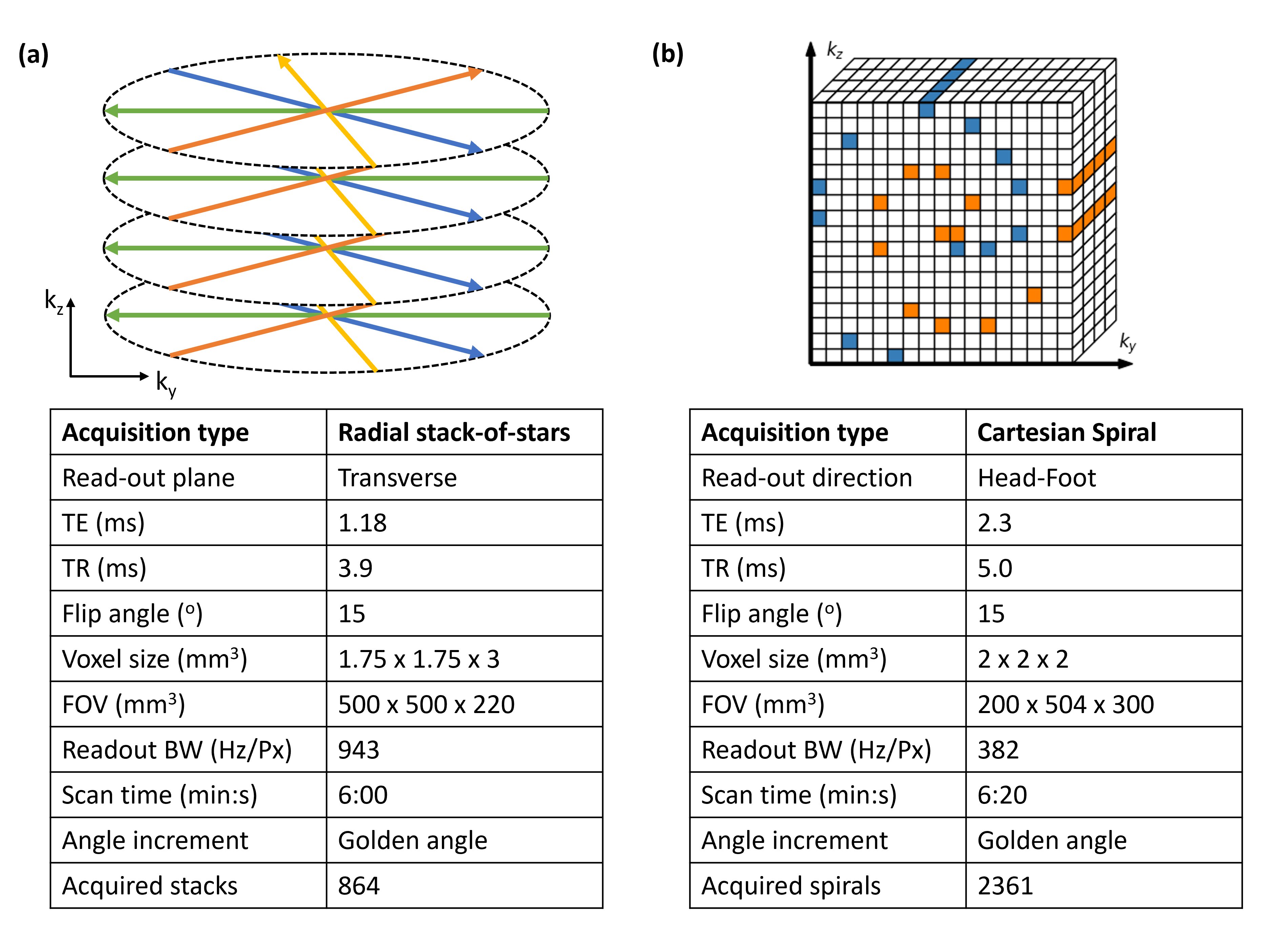
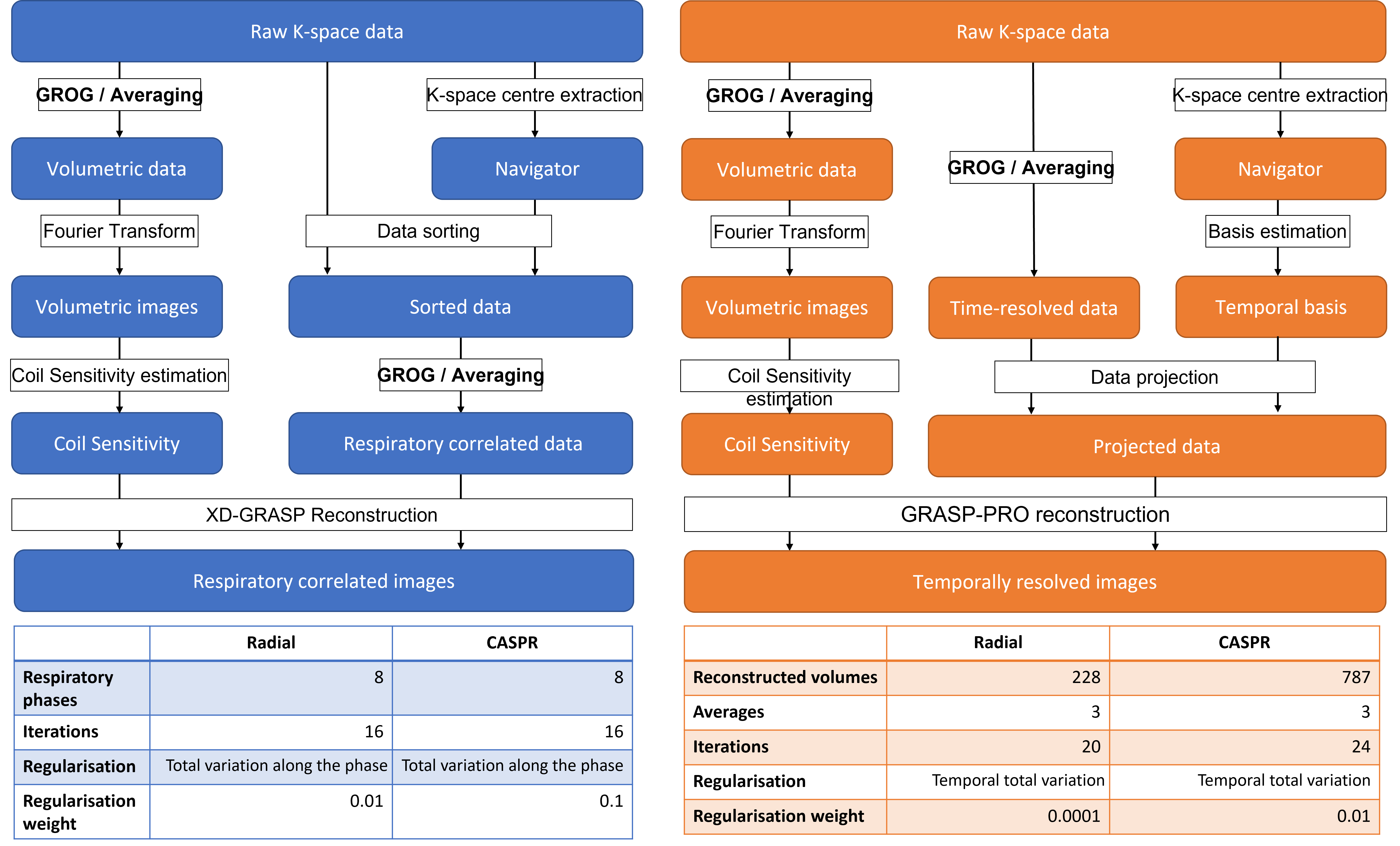
We acquired images in 3 healthy volunteers participating in the PRIMER trial (NCT02973828)12 on a 1.5T MR-Linac with 8 coil channels (Unity, Elekta AB, Stockholm). For each volunteer we acquired two volumetric gradient echo sequences (Figure 1). One used CASPR profile ordering, while the other used radial stack-of-stars sampling and followed the current clinical protocol for pancreatic cancer patients at our hospital.The readout direction of the CASPR acquisition matched the slice direction of the stack-of-stars acquisition, so that self-gating signals could be extracted along the same axis for both acquisitions. Based on these surrogate signals, data were sorted into 8 non-overlapping respiratory bins spanning from end-inspiration to end-expiration. Respiratory-correlated 4D-MRI were reconstructed using the XD-GRASP algorithm4.
The self-gating signal was further used to estimate the temporal signal basis for time-resolved 4D-MRI reconstruction with the GRASP-Pro algorithm13,14 averaging 3 consecutive CASPR spirals (480ms per volume) and 3 consecutive spokes (1.25s per volume).
To accelerate the reconstruction, both algorithms were implemented in Julia with GPU support15 . To avoid computationally expensive iterative NUFFTs for the stack-of-stars acquisition, the data was interpolated onto a Cartesian grid prior to the iterative reconstruction using the GROG algorithm16 (see Figure 2 for the detailed reconstruction pipelines).
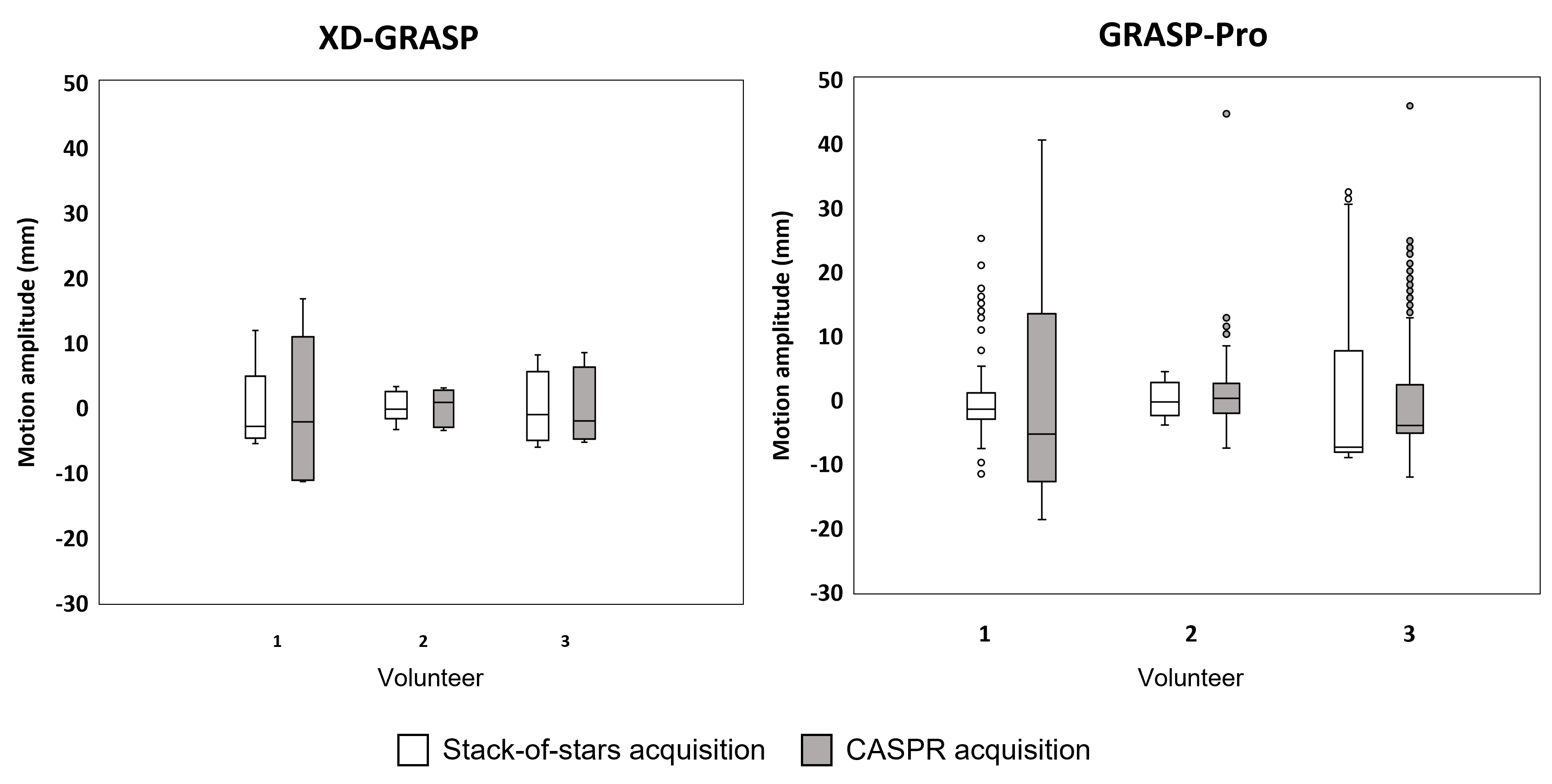
For each acquisition we measured the reconstruction time and the amplitude of the respiratory motion using a semi-automated algorithm to determine the top of the liver motion across different phases17.
Results
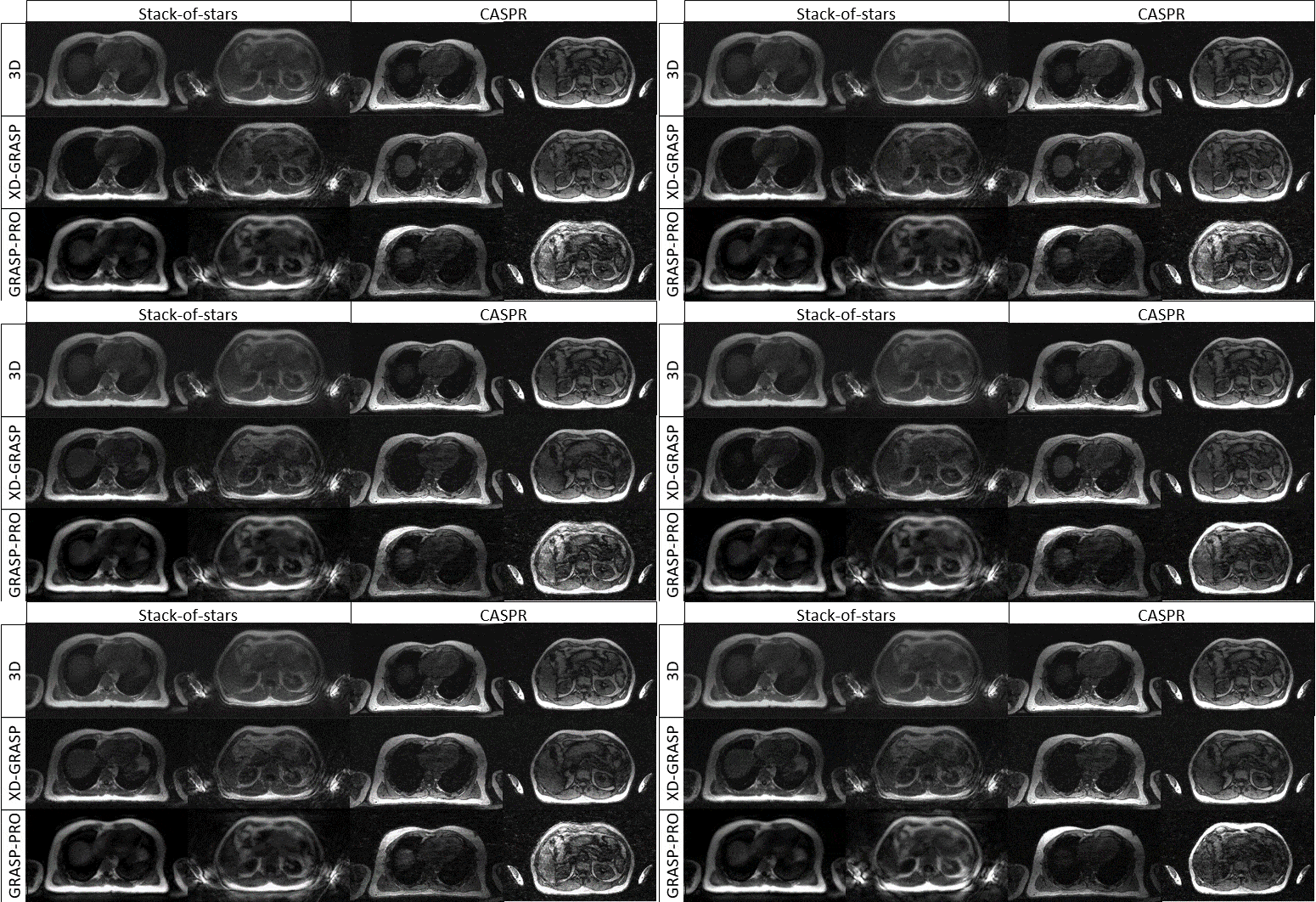
While respiratory-correlated 4D-MRIs presented no increased blurring compared with the 3D reconstructions, images acquired with CASPR appeared sharper than using the radial acquisition. Time-resolved 4D-MRIs reconstructed from stack-of-stars sampled data presented contrast changes, blurring. Visual artefacts were visible outside the body (Figure 3).The reconstruction times for the respiratory-correlated 4D-MRIs were 65s for the CASPR acquisition and 212s for the stack-of-stars. The conjugate gradient descent accounted for most of the reconstruction time. Time-resolved 4D-MRIs took longer to reconstruct (880s for CASPR, 644s for stack-of-stars) with the throughput bottleneck being the GROG interpolation and the data averaging.
The extent of the respiratory motion was coherent for the respiratory-correlated 4D-MRIs with similar motion amplitude between the radial and CASPR acquisitions. The average motion amplitude is lower than the extremum values from the time-resolved reconstruction (Figure 4).
Discussion
With reconstruction times of under 4 minutes, respiratory-correlated 4D-MRIs could be reconstructed in the online clinical setting.Reconstructing time-resolved 4D-MRIs from the current clinical radial acquisition required to limit the temporal resolution, which could explain some of the blurring. The temporal resolution could be improved by reducing the repetition time for a stack.
We attempted to increase the temporal resolution of volumes reconstructed with CASPR, we found that the memory requirements of manipulating the 4D MRIs significantly slowed down the reconstruction algorithm particularly during the initial data averaging. We mitigated this by projecting the data into the temporal basis early in the reconstruction pipeline14.
Validating 4D-MRI reconstructions is difficult without a ground-truth. Here we compared the extent of the respiratory motion across acquisitions / reconstructions for the diaphragm. For applications in MR-guided radiotherapy validation of the motion of tumours and organs-at-risk is required.
Conclusion
While reconstructing respiratory-correlated 4D-MRI is achievable in a clinical setting, reconstructing time-resolved 4D-MRI still present significant challenges to overcome for clinical translation.Acknowledgements
This research was supported by the CRUK Convergence Science Centre at The Institute of Cancer Research, London, and Imperial College London (A26234).
The Institute of Cancer Research and The Royal Marsden NHS Foundation Trust are members of the Elekta MR-Linac Research Consortium. We acknowledge research support from Elekta and Dave Higgins (Philips MR) for providing MR source code, research licences, and support.
References
1. Stemkens, B., Paulson, E. S. & Tijssen, R. H. N. Nuts and bolts of 4D-MRI for radiotherapy. Phys Med Biol 63, (2018).
2. Goodburn, R. J. et al. The future of MRI in radiation therapy: Challenges and opportunities for the MR community. Magn Reson Med 88, 2592–2608 (2022).
3. Mickevicius, N. J. & Paulson, E. S. Investigation of undersampling and reconstruction algorithm dependence on respiratory correlated 4D-MRI for online MR-guided radiation therapy. Phys Med Biol 62, 2910–2921 (2017).
4. Feng, L. et al. XD-GRASP: Golden-angle radial MRI with reconstruction of extra motion-state dimensions using compressed sensing. Magn Reson Med 75, 775–788 (2016).
5. Paulson, E. S. et al. 4D-MRI driven MR-guided online adaptive radiotherapy for abdominal stereotactic body radiation therapy on a high field MR-Linac: Implementation and initial clinical experience. Clin Transl Radiat Oncol 23, 72–79 (2020).
6. Terpstra, M. L., Maspero, M., Verhoeff, J. J. C. & van den Berg, C. A. T. Accelerated respiratory-resolved 4D-MRI with separable spatio-temporal neural networks. Med Phys 50, 5331–5342 (2023).
7. Lecoeur, B. et al. Accelerating 4D image reconstruction for magnetic resonance-guided radiotherapy. Phys Imaging Radiat Oncol 27, 100484 (2023).
8. Benkert, T. et al. Optimization and Validation of Accelerated Golden-angle Radial Sparse MRI Reconstruction with Self-Calibrating GRAPPA Operator Gridding. Magn Reson Med 80, 286 (2018).
9. Usman, M., Ruijsink, B., Nazir, M. S., Cruz, G. & Prieto, C. Free breathing whole-heart 3D CINE MRI with self-gated Cartesian trajectory. Magn Reson Imaging 38, 129 (2017).
10. Prieto, C. et al. Highly efficient respiratory motion compensated free-breathing coronary mra using golden-step Cartesian acquisition. Journal of Magnetic Resonance Imaging 41, 738–746 (2015).
11. Lecoeur, B. et al. Cartesian Spiral acquisitions for radiotherapy on an MR-Linac. in Proc. Intl. Soc. Mag. Reson. Med. 31 4802 (2023).
12. Study Details | PRIMER: Development of Daily Online Magnetic Resonance Imaging for Magnetic Resonance Image Guided Radiotherapy | ClinicalTrials.gov. https://www.clinicaltrials.gov/study/NCT02973828?id=NCT02973828&rank=1.
13. Feng, L. et al. GRASP-Pro: Improving GRASP DCE-MRI through self-calibrating subspace-modeling and contrast phase automation. Magn Reson Med 83, 94–108 (2020).
14. Feng, L. Live-view 4D GRASP MRI: A framework for robust real-time respiratory motion tracking with a sub-second imaging latency. Magn Reson Med 90, 1053–1068 (2023).
15. Besard, T., Foket, C. & De Sutter, B. Effective Extensible Programming. IEEE Transactions on Parallel and Distributed Systems 30, 827–841 (2019).
16. Seiberlich, N., Breuer, F., Blaimer, M., Jakob, P. & Griswold, M. Self-calibrating GRAPPA operator gridding for radial and spiral trajectories. Magn Reson Med 59, 930–935 (2008).
17. Freedman, J. N. et al. T2-Weighted 4D Magnetic Resonance Imaging for Application in Magnetic Resonance-Guided Radiotherapy Treatment Planning. Invest Radiol 52, 563–573 (2017).
Figures