1857
Hyperpolarized 13C MRS acceleration via SABRE-Hyperpolarization and a DIY perfusion system1Radiology - Medical Physics, University Medical Center Freiburg, Freiburg im Breisgau, Germany, 22. German Cancer Consortium (DKTK), German Cancer Research Center (DKFZ), Heidelberg, Germany, 3University Medical Center Freiburg, Freiburg im Breisgau, Germany, 4German Cancer Consortium (DKTK), German Cancer Research Center (DKFZ), Heidelberg, Germany, 5Wayne State University, Detroit, MI, United States, 6Albert-Ludwigs-University of Freiburg, Freiburg im Breisgau, Germany, 7German Cancer Research Center (DKFZ), Heidelberg, Germany, 8Faculty of Medicine, University of Freiburg, Freiburg, Germany
Synopsis
Keywords: Hyperpolarized MR (Non-Gas), Perfusion
Motivation: Hyperpolarized (HP) in vitro MRS procedures have limited throughput e.g. for drug effect monitoring and longitudinal studies.
Goal(s): Our Objective is to facilitate longitudinal HP in vitro MRS studies through rapid delivery of hyperpolarized molecules and integration of a cost-effective, continuous-flow perfusion system.
Approach: We have merged fast 13C SABRE-Hyperpolarization of [1-13C]-pyruvate-d3 with a, budget friendly DIY system, allowing for continuous NMR tube perfusion and batch-mode injection of hyperpolarized agents.
Results: Our work demonstrates the successful detection of multiple highly polarized pyruvate injections at repetition times as short as 6 minutes, holding potential for HP agent development and studying cell metabolism under therapies.
Impact: By combining rapid 13C agent hyperpolarization through SABRE with a cost-effective DIY perfusion system, our approach significantly increases the throughput and temporal resolution of hyperpolarized 13C MRS, unlocking new avenues for imaging agent development, metabolic studies and drug effect monitoring.
Introduction
Modern healthcare aims to personalize treatment to patient’s disease biology for improving outcomes. As cancer causes characteristic changes on the metabolome and tumor microenvironment, selection of therapies should be guided by precision diagnosis that characterize these hallmarks of cancer. Hyperpolarized (HP) [1-13C]-pyruvate MRI has shown promise as a technique for grading and monitoring cancer, e.g through pyruvate metabolism being a powerful surrogate marker for treatment efficacy and early response 1–3. To expand the applications of HP MRI to other pathologies, metabolic changes and imaging probes, ground truth is needed to interpret the MRI data. Hence, it has been proposed to characterize the metabolome of cancer models in vitro using HP MRS with spectrometer compatible bioreactors for longitudinal investigations, which was demonstrated using dissolution dynamic nuclear polarization (dDNP). However, dDNP currently suffers from long polarization times and elevated cost and complexity 4. For high-throughput studies and widespread research, rapid and low footprint techniques are desirable. Parahydrogen-induced polarization (PHIP) techniques have emerged as promising candidates to address this need 5. Here we present a combination of our fast (6 min) and effective (P>20%, c=50mM) production of HP [1-13C]-pyruvate-d 3 using Signal Amplification By Reversible Exchange (SABRE) and Spin-Lock Induced Crossing (SLIC-SABRE) at microtesla fields 6 with an in-house-build perfusion system, yielding a powerful and easy to operate instrument for high-throughput HP-MRS which can be used to investigate hydrogel embedded cells.Methods
We built an NMR-tube based continuous-flow perfusion system enabling simultaneous injections of HP agent solutions. It comprises two peristaltic pumps run at different flow rates (200µl/min in; 500µl/min out) to prevent the NMR tube from overflowing. As depicted in Fig.1, the inlet tube has a second catheter inserted going down to the bottom of the NMR tube to allow the introduction of HP [1-13C]-pyruvate-d3 which was prepared by rapid SLIC-SABRE as described in our previous work 6,7. To the outlet tube we added a three way valve, allowing to switch between medium circulation (if no HP solution is added) or medium disposal to remove the added HP solution from the circuit. During the experiments, the pefusion system was held in a 1T benchtop NMR spectrometer (Spinsolve 43 Carbon, Magritek). The perfusion system was tested by adding 20mM HP pyruvate solution hyperpolarized to P13C≈ 30% to a constant perfusion stream of methanol. Note that in contrast to our previous work 6 we administered SABRE solutions in methanol containing 6mM Iridium catalyst without purification to obtain this proof-of-concept data. Hence, methanol was chosen as flow medium to prevent the precipitation of the catalyst and possible clogging of the tubes. During and between the four injections, 13C NMR spectra were acquired at a repetition time of 2s using a 13C flip angle of 10°.Results
Upon all four injections of freshly HP pyruvate, strong 13C NMR signal where detected originating from free and catalyst-bound pyruvate. Additionally, pyruvate hydrate was detected, whose signal first increased, before decreasing along with the signals of free and bound pyruvate. The decrease of the signals was attributable to T1 relaxation, consumption of 13C signals due to the excitation pulses, and solution being flushed from the NMR perfusion system. The shortest time interval between two injections was ≈ 6 min.Discussion
The recorded spectra demonstrate the ability of the presented perfusion system to repeatedly apply medium exchange while allowing HP solution application. Furthermore the possibility of rapid sample preparation and administration is demonstrated by acquiring four HP spectra in under 40 minutes, showcasing the superior speed of the SABRE hyperpolarization method. The detection period of 13C signal can be increased if needed in the future by temporarily turning off the inlet pump after injection resulting in the signal decay being only influenced by T1 relaxation, which is over three minutes for [1-13C]-pyruvate in CD3OD and D2O at 1T6,7 and consumption of 13C signals due to the excitation pulses. By demonstrating the possibility to administer multiple injections of HP solutions in short time intervals during constant medium exchange, new perspectives to investigate metabolic processes in vitro will emerge. Using hydrogel embedded cells, this system will enable us to monitor metabolic changes caused by drug application or environmental changes (e.g. temperature, pH) in unprecedented temporal resolution. We aim to administer HP [1-13C]-pyruvate, purified in PBS buffered D2O as described in previous work6 to hydrogel embedded cells during cell culture medium perfusion as a next step.Acknowledgements
Research reported in this publication was supported by the German Federal Ministry of Education and Research (BMBF) in the funding program “Quantum Technologies – from Basic Research to Market” under the project “QuE-MRT” (contract number: 13N16448), the German Cancer Consortium (DKTK), the Research Commission of the University Medical Center Freiburg, B.E.S.T. Fluidsysteme GmbH I Swagelok Stuttgart, and the German Research Foundation (DFG #SCHM 3694/1-1, #SCHM 3694/2-1, #SFB1479 Project ID: 441891347SFB1160, #423813989/GRK2606). ABS and EYC thank Wayne State University for a Postdoctoral Fellow award.References
(1) Wang, Z. J.; Ohliger, M. A.; Larson, P. E. Z.; Gordon, J. W.; Bok, R. A.; Slater, J.; Villanueva-Meyer, J. E.; Hess, C. P.; Kurhanewicz, J.; Vigneron, D. B. Hyperpolarized 13C MRI: State of the Art and Future Directions. Radiology 2019, 291 (2), 273–284. https://doi.org/10.1148/radiol.2019182391.(2) Sushentsev, N.; McLean, M. A.; Warren, A. Y.; Benjamin, A. J. V.; Brodie, C.; Frary, A.; Gill, A. B.; Jones, J.; Kaggie, J. D.; Lamb, B. W.; Locke, M. J.; Miller, J. L.; Mills, I. G.; Priest, A. N.; Robb, F. J. L.; Shah, N.; Schulte, R. F.; Graves, M. J.; Gnanapragasam, V. J.; Brindle, K. M.; Barrett, T.; Gallagher, F. A. Hyperpolarised 13C-MRI Identifies the Emergence of a Glycolytic Cell Population within Intermediate-Risk Human Prostate Cancer. Nat. Commun. 2022, 13, 466. https://doi.org/10.1038/s41467-022-28069-2.
(3) Woitek, R.; McLean, M. A.; Ursprung, S.; Rueda, O. M.; Manzano Garcia, R.; Locke, M. J.; Beer, L.; Baxter, G.; Rundo, L.; Provenzano, E.; Kaggie, J.; Patterson, A.; Frary, A.; Field-Rayner, J.; Papalouka, V.; Kane, J.; Benjamin, A. J. V.; Gill, A. B.; Priest, A. N.; Lewis, D. Y.; Russell, R.; Grimmer, A.; White, B.; Latimer-Bowman, B.; Patterson, I.; Schiller, A.; Carmo, B.; Slough, R.; Lanz, T.; Wason, J.; Schulte, R. F.; Chin, S.-F.; Graves, M. J.; Gilbert, F. J.; Abraham, J. E.; Caldas, C.; Brindle, K. M.; Sala, E.; Gallagher, F. A. Hyperpolarized Carbon-13 MRI for Early Response Assessment of Neoadjuvant Chemotherapy in Breast Cancer Patients. Cancer Res. 2021, 81 (23), 6004–6017. https://doi.org/10.1158/0008-5472.CAN-21-1499.
(4) Mathiassen, T. B. W.; Høgh, A. E.; Karlsson, M.; Katsikis, S.; Wang, K.; Pennestri, M.; Ardenkjær-Larsen, J. H.; Jensen, P. R. Hyperpolarized 13C NMR for Longitudinal In-Cell Metabolism Using a Mobile 3D Cell Culture System. J. Magn. Reson. Open 2023, 16–17, 100131. https://doi.org/10.1016/j.jmro.2023.100131.
(5) Schmidt, A. B.; Bowers, C. R.; Buckenmaier, K.; Chekmenev, E. Y.; de Maissin, H.; Eills, J.; Ellermann, F.; Glöggler, S.; Gordon, J. W.; Knecht, S.; Koptyug, I. V.; Kuhn, J.; Pravdivtsev, A. N.; Reineri, F.; Theis, T.; Them, K.; Hövener, J.-B. Instrumentation for Hydrogenative Parahydrogen-Based Hyperpolarization Techniques. Anal. Chem. 2022, 94 (1), 479–502. https://doi.org/10.1021/acs.analchem.1c04863.
(6) de Maissin, H.; Groß, P. R.; Mohiuddin, O.; Weigt, M.; Nagel, L.; Herzog, M.; Wang, Z.; Willing, R.; Reichardt, W.; Pichotka, M.; Heß, L.; Reinheckel, T.; Jessen, H. J.; Zeiser, R.; Bock, M.; von Elverfeldt, D.; Zaitsev, M.; Korchak, S.; Glöggler, S.; Hövener, J.-B.; Chekmenev, E. Y.; Schilling, F.; Knecht, S.; Schmidt, A. B. In Vivo Metabolic Imaging of [1-13C]Pyruvate-D3 Hyperpolarized By Reversible Exchange With Parahydrogen. Angew. Chem. Int. Ed. 2023, n/a (n/a), e202306654. https://doi.org/10.1002/anie.202306654.
(7) Schmidt, A. B.; Eills, J.; Dagys, L.; Gierse, M.; Keim, M.; Lucas, S.; Bock, M.; Schwartz, I.; Zaitsev, M.; Chekmenev, E. Y.; Knecht, S. Over 20% Carbon-13 Polarization of Perdeuterated Pyruvate Using Reversible Exchange with Parahydrogen and Spin-Lock Induced Crossing at 50 μT. J. Phys. Chem. Lett. 2023, 14 (23), 5305–5309. https://doi.org/10.1021/acs.jpclett.3c00707.
(8) Schmidt, A. B.; de Maissin, H.; Adelabu, I.; Nantogma, S.; Ettedgui, J.; TomHon, P.; Goodson, B. M.; Theis, T.; Chekmenev, E. Y. Catalyst-Free Aqueous Hyperpolarized [1- 13 C]Pyruvate Obtained by Re-Dissolution Signal Amplification by Reversible Exchange. ACS Sens. 2022, 7 (11), 3430–3439. https://doi.org/10.1021/acssensors.2c01715.
Figures
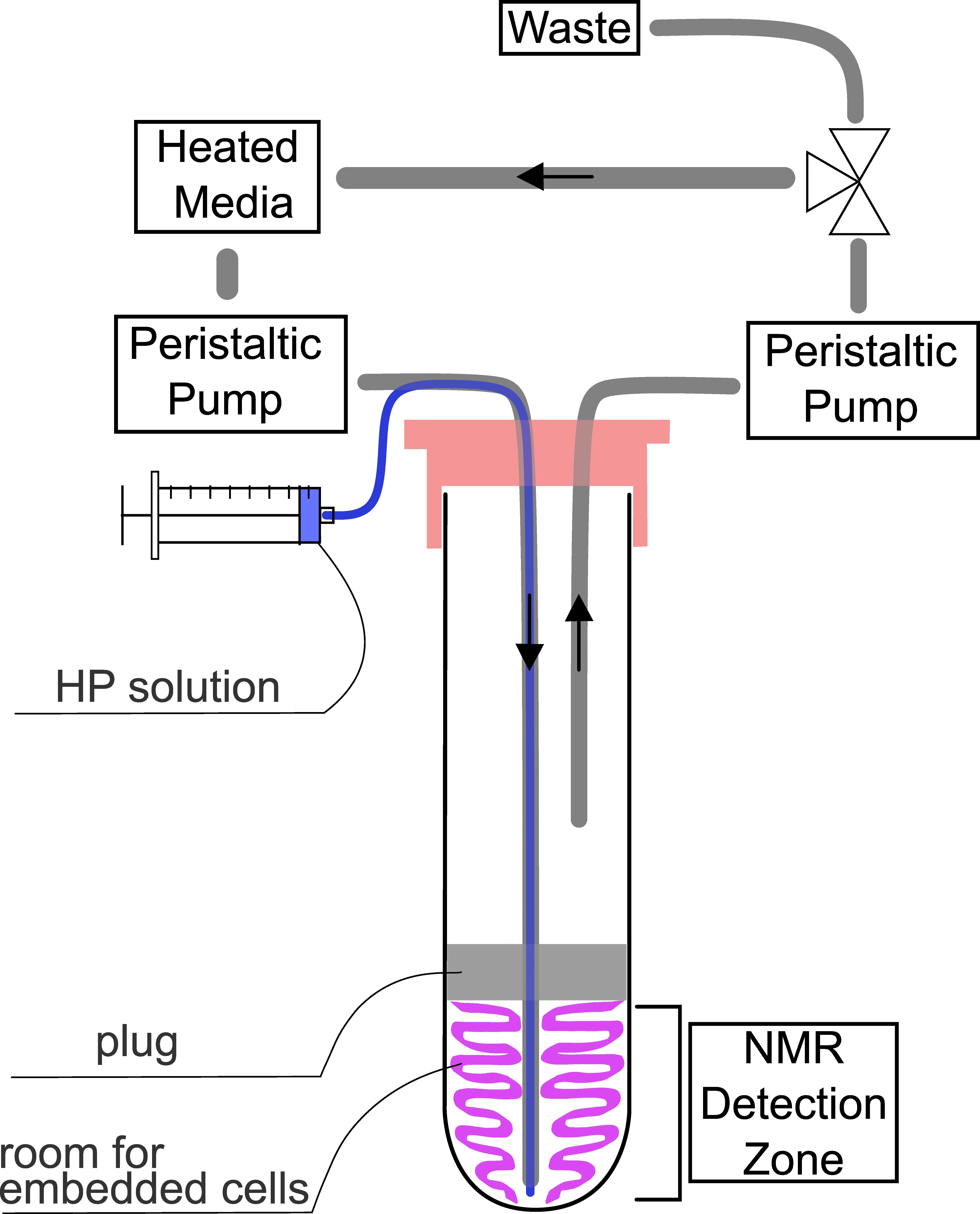
Figure 1: Schematic depiction of the DIY perfusion system. The system is comprised of a standard 5mm NMR tube equipped with an inlet and outlet tube. The tubes are connected to peristaltic pumps allowing media circulation which can be heated in a water bath. A secondary catheter, inserted into the inlet tube allows for a HP solution application. The outlet tube contains a switchable three way valve allowing medium circulation or disposal.
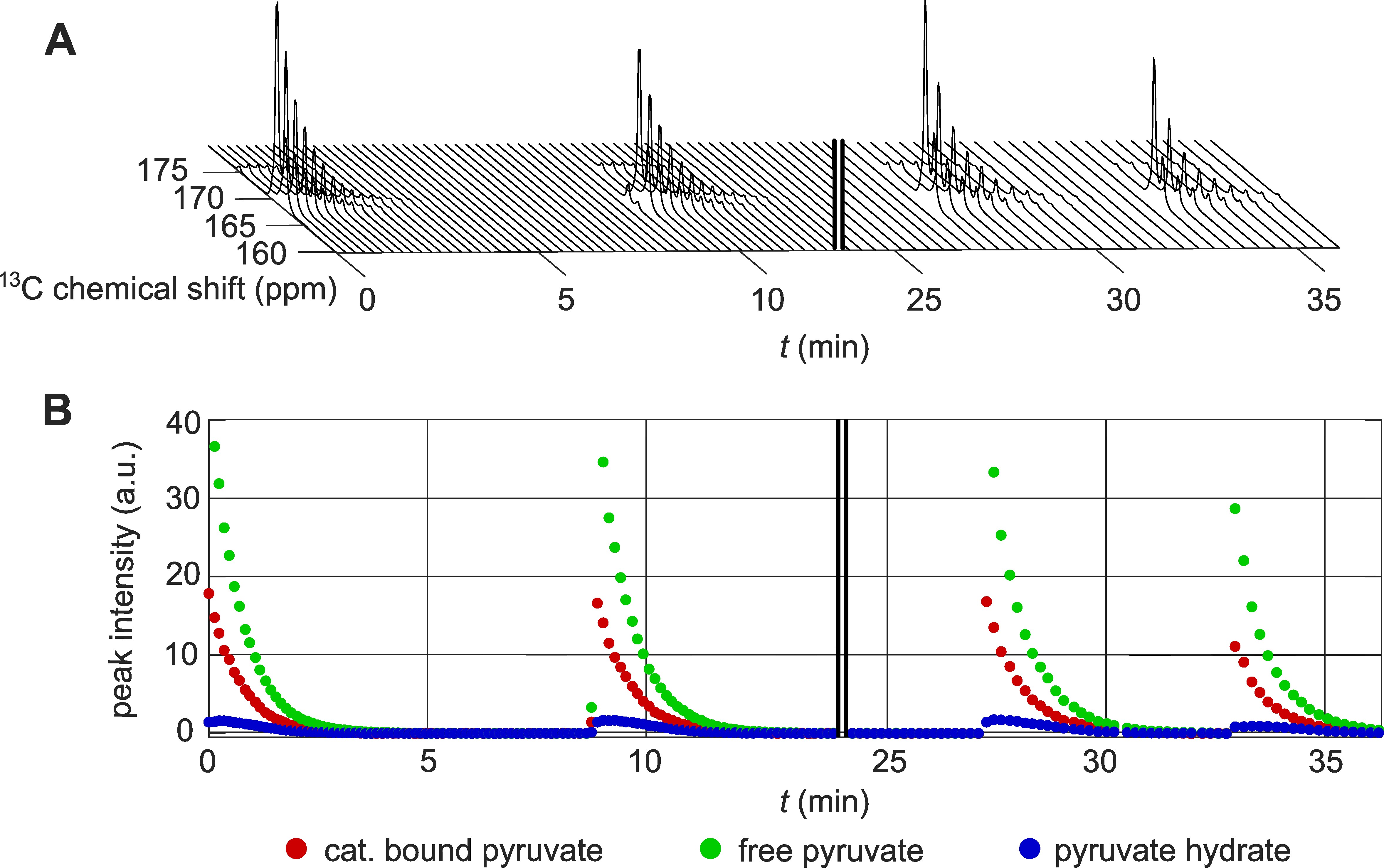
Figure 2: High-throughput NMR monitoring over repeated HP pyruvate injections. A: Waterfall plot of 13C NMR spectra acquired over 39 min during which four boli of ~500µl 20mM HP [1-13C]-pyruvate-d3 were administered. B: AUC as a measure of peak intensity of the individual peaks over time showing free pyruvate (green), catalyst-bound pyruvate (red) and pyruvate hydrate which was formed upon injection into the reactor over the testing period. The peak assignment was done based on the literature 8.