1848
Water-cycled STEAM spectroscopy in the liver at 7T1Department of Physics, University of Oxford, Oxford, United Kingdom, 2OCMR, RDM Cardiovascular Medicine, University of Oxford, Oxford, United Kingdom, 3The MR Research Centre and the PET Centre, Aarhus University, Aarhus, Denmark, 4Department of Imaging Methods, Institute of Measurement Science, Slovak Academy of Sciences, Bratislava, Slovakia
Synopsis
Keywords: Spectroscopy, High-Field MRI
Motivation: Hepatic choline-containing compounds (CCC) are an important biomarker of metabolic health.
Goal(s): The aim of this work is to measure the concentration of fat and choline-containing compounds in the liver using water-suppression cycled (WSC) and water suppressed (WS) spectroscopy at 7T.
Approach: Livers of seven healthy volunteers were scanned using water-suppression cycling and the results were compared with standard water-suppressed acquisitions.
Results: Similar concentrations of CCC were reported for both techniques, with WSC providing somewhat narrower line widths. Hepatic fat fractions were also very close using each method validating WSC as a method for use at 7T.
Impact: Frequency-aligned spectra from water-suppression cycled acquisitions enable the quantification of low-concentration metabolites in vivo at 7T.
Introduction
Magnetic resonance spectroscopy at 7T carries the double benefit of increased SNR and improved spectral resolution compared to clinical field strengths (i.e. 3T). Thus, performing 1H-MRS measurements at 7T can offer a unique insight into liver metabolism beyond the typical characterisation of triacylglyceride content. Choline and choline-containing compounds (CCC) also play an important role in liver metabolism via phospholipid synthesis, aiding lipoprotein secretion and regulating mitochondrial function. It has been shown that symptomatic choline deficiency leads to the development of metabolic dysfunction associated steatotic liver disease (MASLD) (1). MRS with stimulated echo acquisition mode (STEAM) has long been established as a probe into the metabolism of various organs and water-suppressed versions of this sequence have been used extensively. However, frequency shifts introduced in spectra due to field homogeneity variations during scans (e.g. due to motion) may be detrimental to spectral quality. Lately, a water suppression-cycled acquisition method has been described (2), which allows frequency alignment using strong water peak to improve quantification of low-concentration metabolites. The aim of this work was thus to compare the performance of water-suppressed (WS) and water suppression-cycled (WSC) STEAM pulse sequences in the measurement of fat fraction and choline concentration in the livers of healthy subjects at 7T.Methods
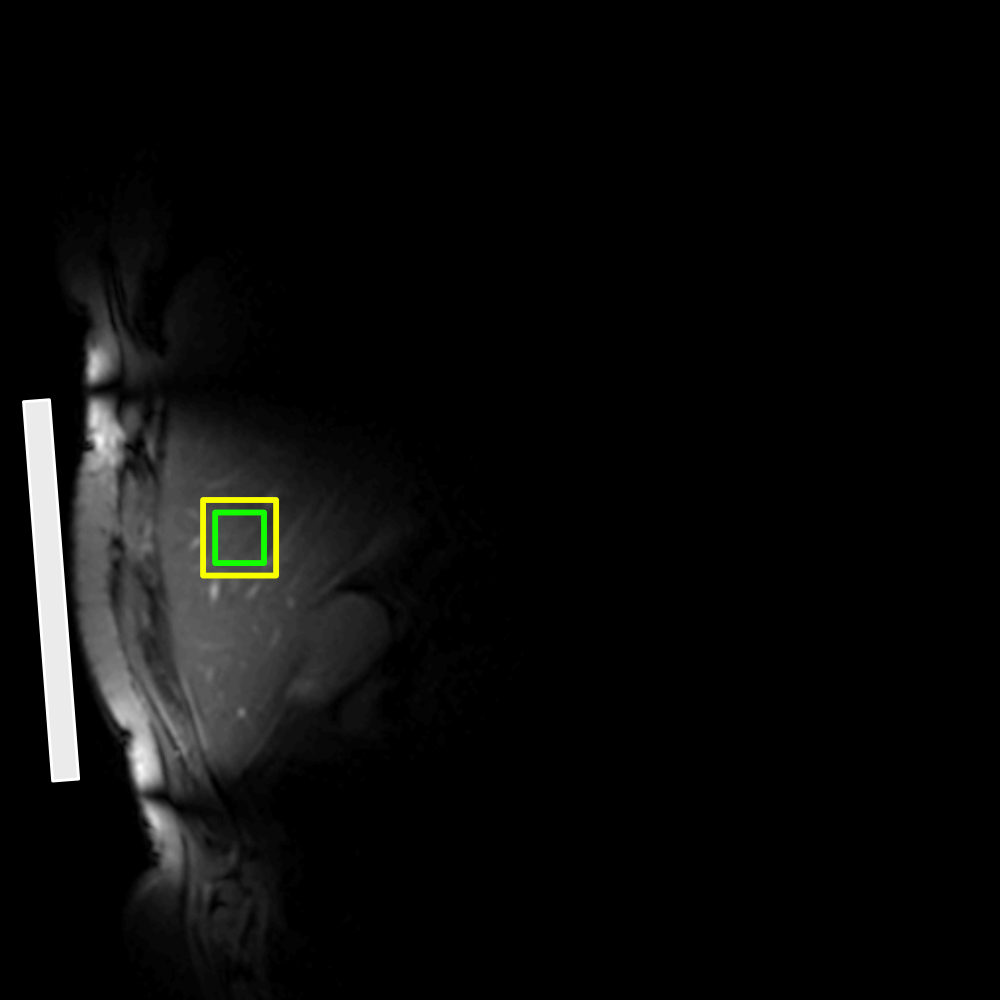
WSC-STEAM involves an alternating 180° inversion pulse within the water-suppression RF train preceding the main STEAM pulse sequence, centred on the water peak. The use of this inversion pulse allows for the elimination of the water resonance once even- and odd-ordered spectra are combined (2). Seven healthy volunteers (3 females, mean age 31±5 years) were scanned in a 7T Siemens Magnetom Plus scanner (Siemens Healthineers, Erlangen, Germany) using a 10 cm single loop surface coil (RAPID Biomedical, Rimpar, Germany). Participants were scanned in a head-first right lateral position, with the coil placed under their liver (3) (Figure 1). Volunteers were asked to fast overnight, and scans took place in the morning. Multiple breath-held STEAM acquisitions were performed in each participant: 3 breath-holds for non-water-suppressed acquisitions, and 5 breath-holds for each water-suppressed and water-cycling acquisitions. Each breath-hold comprised 6 measurements, yielding a total of 18 water data sets, and 30 metabolite data sets from each sequence. Repetition times of 4000 ms and echo times of 35 ms were used, voxel size was 20×20×20 mm3, receiver bandwidth was set to 4000 Hz for a vector size of 1024. Each scan session took approximately 40 minutes to complete. Spectra were analysed in MATLAB using the AMARES algorithm implemented in the OXSA toolbox (4). Spectra from water-suppression cycled acquisitions were frequency-aligned and summed, while spectra from water-suppressed acquisitions were summed. T2-corrected (3) fat fractions were determined as the ratio of the sum of the lipid peaks (methyl, methylene, diacyl, and α-olefinic) and the sum of water and the same lipid peaks. T2-corrected choline concentration was determined as the ratio of the choline peak to that of the water peak. Agreement between fat fractions derived from the two pulse sequences was assessed using Pearson's correlation coefficient as well as with Bland-Altman plots. In addition, paired t-tests were used to compare line widths, Cramér-Rao lower bounds (CRLB), and concentrations between the water-suppressed and water-suppression-cycled sequences. P-values lower than α=0.05 were considered significant.Results and Discussion
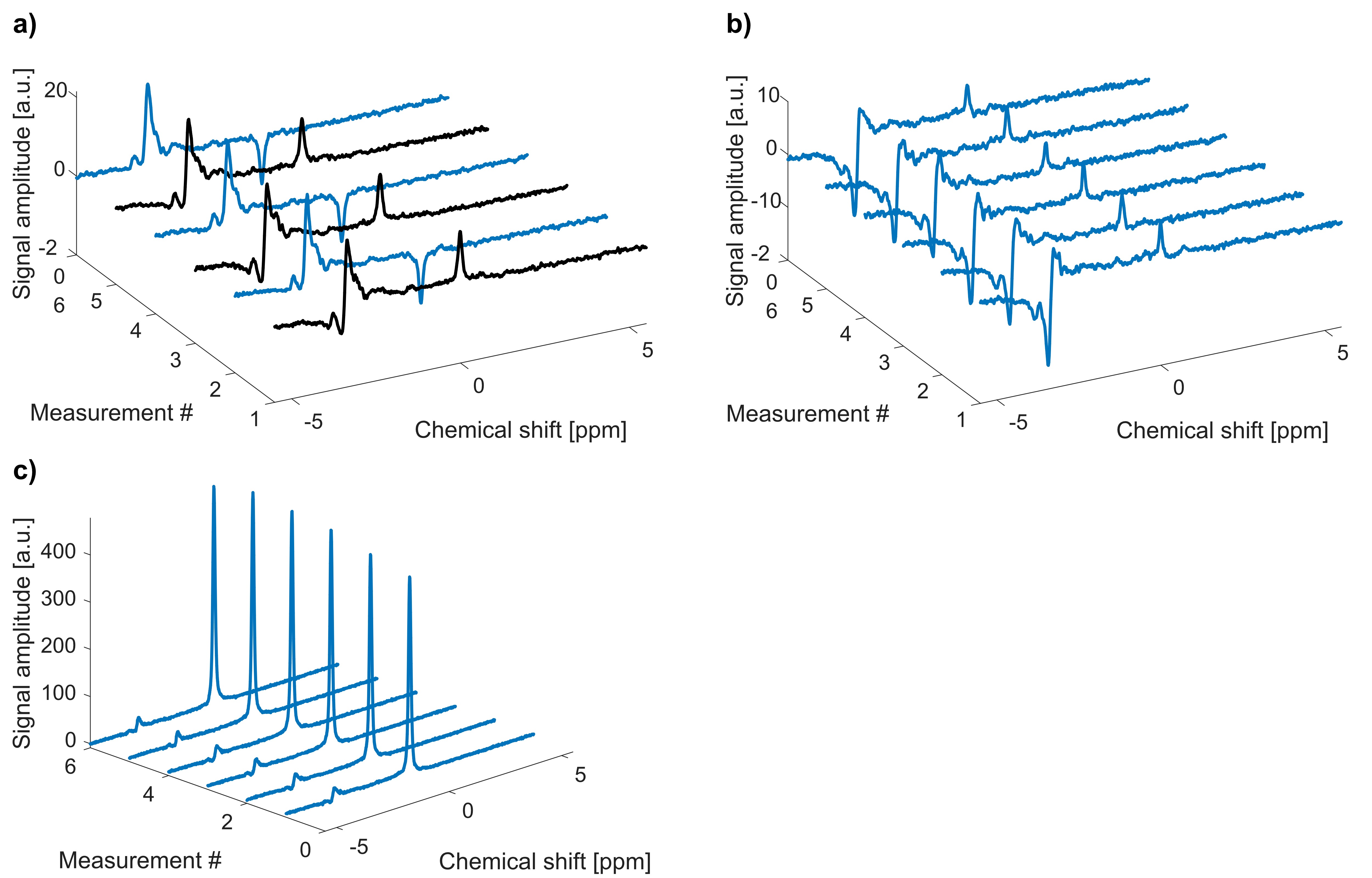
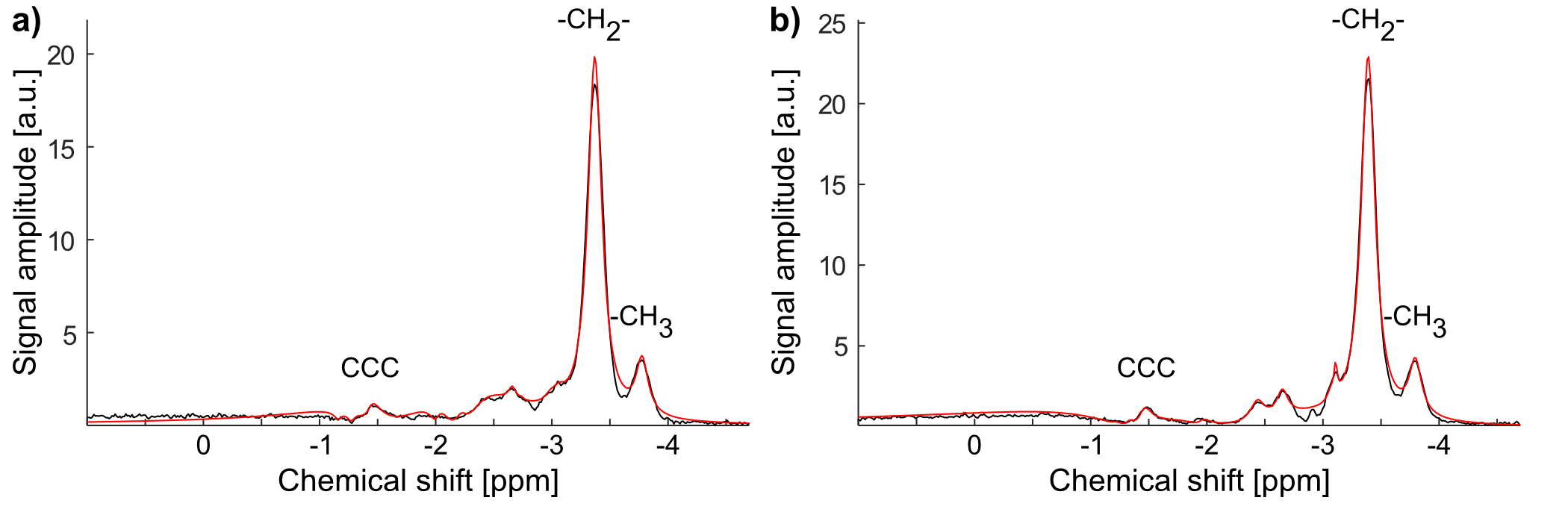
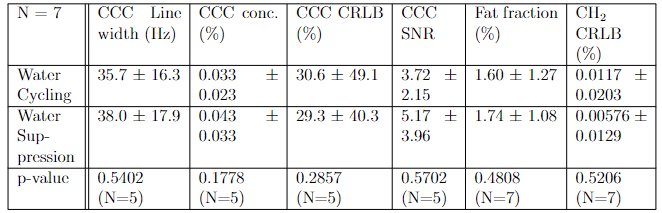
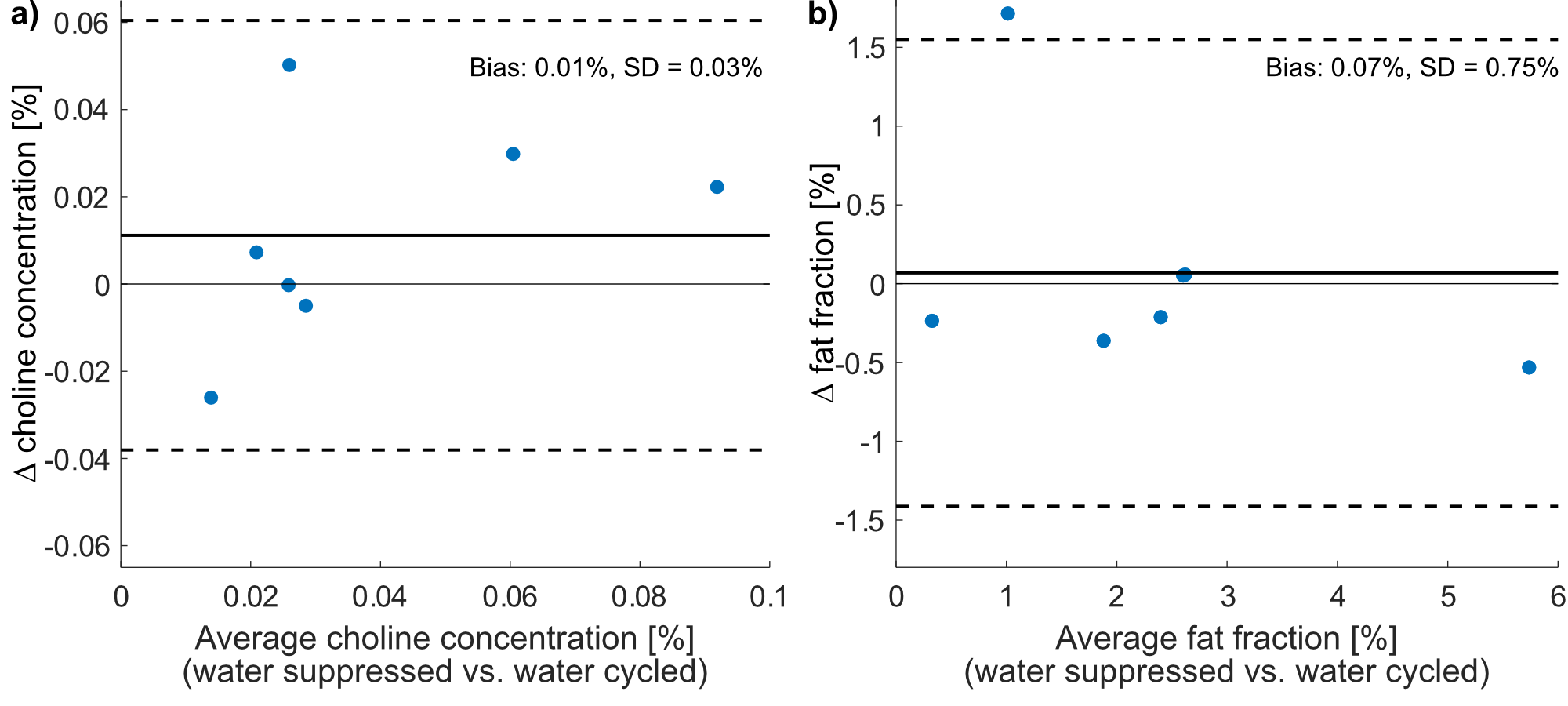
A set of unprocessed water-suppression cycled and water-suppressed spectra, as well as non-water-suppressed spectra are shown in Figure 2, while Figure 3 shows a processed and fitted spectrum acquired with each of the two studied methods. Choline could not be reliably quantified (CRLB>50%) from one water-suppressed spectrum and one water-suppression cycled spectrum. All pair-based analyses were conducted in the remaining 5 cases. Estimates of choline concentration and fat fraction had excellent correlation between the two techniques (ρcholine=0.95, ρfat=0.92). As Table 1 shows, choline line widths, and concentration were marginally lower, while CRLBs were higher when using water-cycling compared to water-suppression for the 5 paired datasets. However, paired t-tests did not find any of these differences significant. Similarly, there was no difference between the fat fraction and CRLB of the methylene resonance determined from the two techniques. Bland-Altman plots (Figure 4) provide further evidence for the agreement between choline concentration and fat fractions measured by WS-STEAM and WSC-STEAM, without any obvious biases.Conclusions
We tested the feasibility of a WSC-STEAM sequence in the human liver at 7T and found good agreement in quantified choline concentrations and fat fractions compared with WS-STEAM. Our work paves the way for other applications in need of frequency-aligned spectra provided by water cycling at 7T, e.g. cardiac MRS with the aim of quantifying low-concentration metabolites such as creatine.Acknowledgements
EMM was supported by an Undergraduate Research Bursary from the Analytical Chemistry Trust Fund, administered by the Community for Analytical Measurement Science, and by St Hugh's College in the University of Oxford. LV and FEM are supported by a Sir Henry Dale Fellowship of the Wellcome Trust and the Royal Society [221805/Z/20/Z]. LV would also like to acknowledge the support of the Slovak Grant Agencies VEGA [2/0004/23] and APVV [21–0299].References
1. Corbin KD, Zeisel SH. Choline metabolism provides novel insights into nonalcoholic fatty liver disease and its progression. Curr Opin Gastroenterol 2012; 28. https://journals.lww.com/co-gastroenterology/fulltext/2012/03000/choline_metabolism_provides_novel_insights_into.11.aspx.
2. Ding B, Peterzan M, Mózes FE, Rider OJ, Valkovič L, Rodgers CT. Water-suppression cycling 3-T cardiac 1H-MRS detects altered creatine and choline in patients with aortic or mitral stenosis. NMR Biomed 2021; 34: e4513.
3. Gajdošík M, Chmelík M, Just-Kukurová I, et al. In vivo relaxation behavior of liver compounds at 7 tesla, measured by single-voxel proton MR spectroscopy. J Magn Reson Imaging 2014; 40: 1365–74.
4. Purvis LAB, Clarke WT, Biasiolli L, Valkovič L, Robson MD, Rodgers CT. OXSA: An open-source magnetic resonance spectroscopy analysis toolbox in MATLAB. PLoS One 2017; 12: e0185356.
Figures