1816
Accelerated and Accurate Myocardial Multi-Parametric Quantitative Mapping using Bloch Equation Simulation-based Fitting1School of Biomedical Engineering, ShanghaiTech University, Shanghai, China, 2Shanghai Clinical Research and Trial Center, ShanghaiTech University, Shanghai, China
Synopsis
Keywords: Myocardium, Quantitative Imaging
Motivation: Motivated by the time-consuming process of dictionary matching in quantitative cardiac MRI, this study aims to develop a faster and more accurate method for myocardial multi-parametric quantitative mapping.
Goal(s): The goal is to overcome the limitations of discretization errors and incomplete inversion pulses, which lead to inaccurate parameter estimation.
Approach: The proposed approach utilizes Bloch equation simulation-based fitting, enabling rapid reconstruction of T1, T2, and T1ρ maps simultaneously.
Results: Experimental results demonstrate excellent quality of fit and significant acceleration (100x) compared to the traditional method.
Impact: This novel method has the potential to revolutionize myocardial quantitative mapping, offering improved efficiency and precision in clinical applications.
INTRODUCTION
Dictionary matching is an advanced technique used in quantitative cardiac MRI, allowing for the quantification of multiple cardiac relaxation time parameters. However, the process of establishing a dictionary for signal pattern matching after image acquisition is time-consuming. Currently, the primary approach to saving time is by reducing the data volume through adjustments in parameter step sizes [1]. However, this method can introduce discretization errors, leading to inaccurate parameter estimation. Additionally, the lack of consideration for the incompleteness of the inversion pulse results in underestimated T1 estimation [2] . In this study, we propose a multi-parametric fitting method based on Bloch equation simulation, which enables rapid and more accurate reconstruction of T1, T2, and T1ρ maps simultaneously. By utilizing this approach, we address the limitations of dictionary matching, providing a more efficient and precise method for myocardial quantitative mapping.METHODS
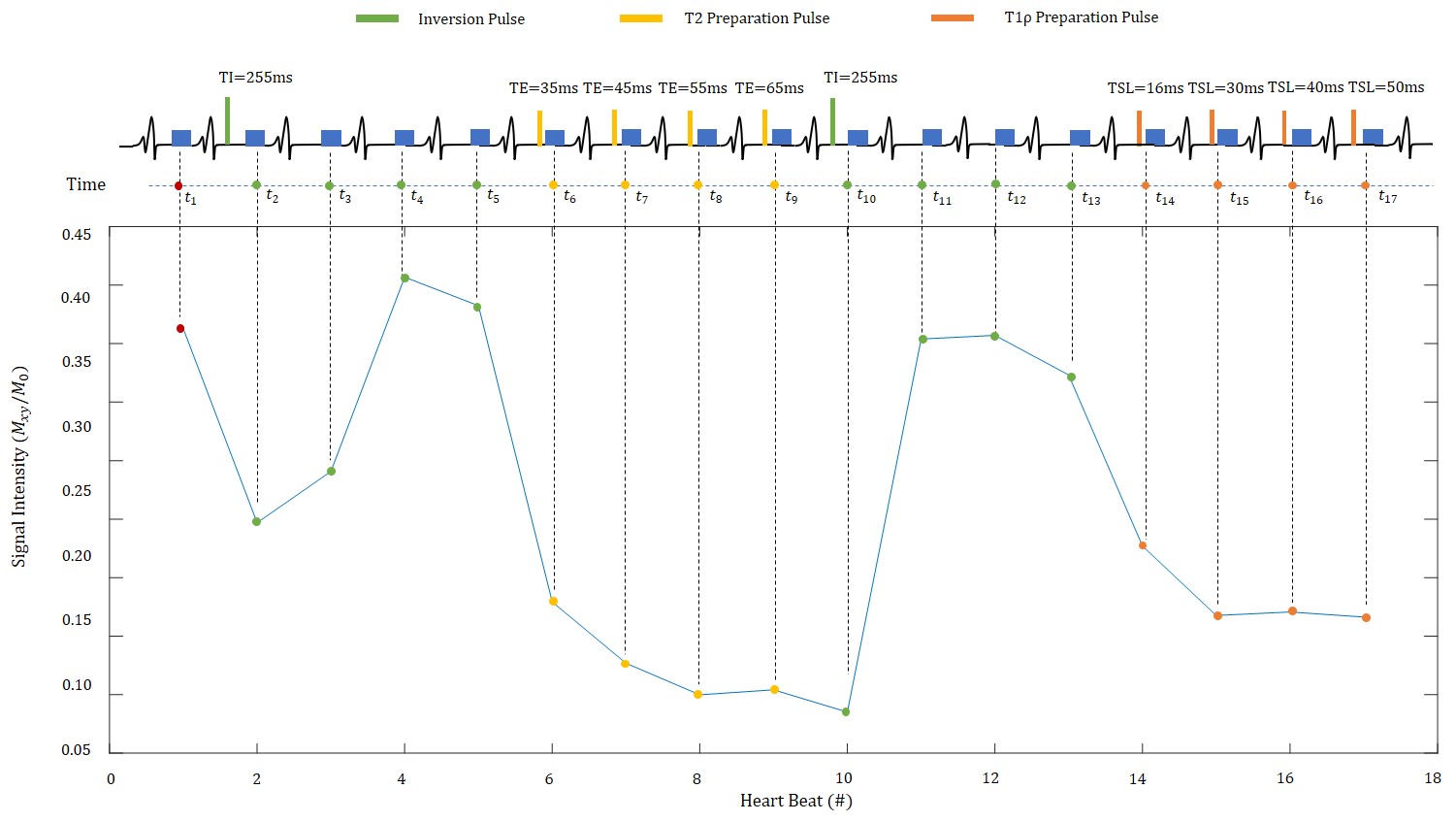
Based on a previously proposed free-breathing multi-parametric mapping sequence (FB-MultiMap) [3], we replaced the bSSFP readout with FLASH to simplify the readout simulation and accelerate the multi-parametric fitting process, this change was motivated by the fact that in FLASH readout, the transverse magnetization is fully spoiled before the next RF pulse. Furthermore, we introduced an extra proton density-weighted image prior to the original sequence. This additional M0 image allows our method to estimate the imperfections of the two inversion pulses in order to make corrections to the estimated T1 values. The sequence design, depicted in Figure 1, utilizes Bloch equation simulation to provide a comprehensive longitudinal magnetization evolution for each pixel [4]. The simulation consists of two parts: relaxation of longitudinal magnetization and FLASH readout during the image acquisition. Specifically, the relaxation process involves longitudinal magnetization recovery after the inversion pulse and attenuation after the T2 or T1ρ preparation pulses. Assuming instantaneous excitation pulses and imperfect inversion pulses due to physical effects, the inversion efficiency is denoted as δ. By considering the TR and K-space lines, the longitudinal magnetization after applying multiple RF pulses can be calculated as the result of a single-shot FLASH readout. Moreover, a variable flip angle strategy is adopted in FLASH readout and a B1 factor is included to correct for the impact of B1 non-uniformity on parameter estimation. To determine the five unknown parameters, namely T1, T2, T1ρ, B1, and δ, we employed the Levenberg-Marquardt (LM) algorithm. In each pixel, the transverse magnetization value acquired at the center of the K-space is directly proportional to the actual signal intensity in each single shot. The LM algorithm uses the mean square error between the simulated signal and the measured signal to identify the best matching result for these five parameters. This method achieves a remarkable 100x acceleration, reducing the calculation time of multi-parameter maps to 1.2 seconds.RESULTS
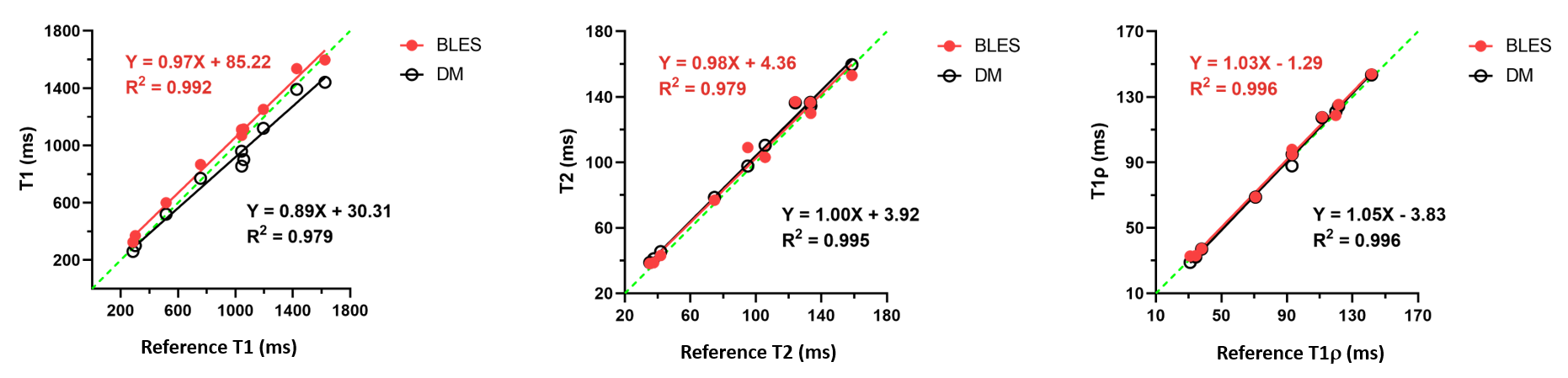
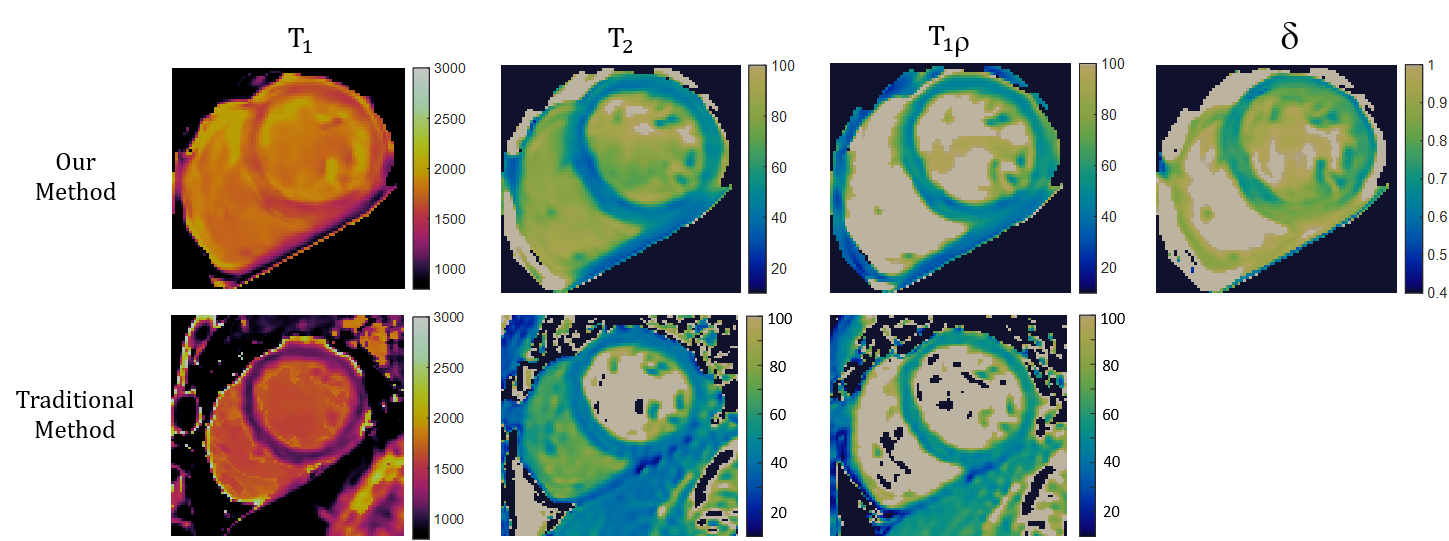
Correlation analyses (Fig. 2) were performed in phantom studies. Both methods, the proposed method and dictionary matching method, exhibited excellent quality of fit in all cases. The linear correlation coefficient for the two compared methods with the ground truth values were 0.97 vs 0.89 for T1, 0.98 vs. 1.00 for T2, and 1.03 vs. 1.05 for T1ρ. But for T1, the proposed method demonstrated higher linear correlation coefficient than the dictionary matching method, presumably thanks to the inversion efficiency correction technique used in the proposed method. Informed consent was obtained from six subjects (two females) who participated in the study. For each subject, MR images were acquired in the short-axis view at the basal, middle, and apical slices of the left ventricle. Fig. 3 illustrates representative T1, T2, and T1ρ maps obtained using the proposed method and three conventional methods (MOLLI 5(3)3), T2-pre bSSFP and T1ρ-Prep bSSFP). For six healthy volunteers, average T1 values were 1623.72 ± 52.75 ms and 1124.53 ± 40.73 ms, respectively. Compared with MOLLI, the proposed method showed higher T1 mean values. Average T2 values were 45.72 ± 3.01 ms and 42.56 ± 2.45 ms, respectively. T1⍴ quantification showed average values of 49.65 ± 3.51 ms and 51.28 ± 4.27 ms, for the proposed and the T1ρ-Prep bSSFP technique, respectively.DISCUSSION
In this study, we demonstrate a Bloch equation simulation-based fitting method as a replacement for the original dictionary-matching approach. Additionally, the improved M0+FB-MultiMap sequence, along with the consideration of imperfect inversion pulses, enhanced the accuracy of T1 estimation.CONCLUSION
The Bloch equation simulation-based fitting method, combined with the improved M0+FB-MultiMap sequence, has successfully enabled rapid and highly accurate quantitative mapping of multiple myocardial relaxation time parameters, demonstrating significant potential for clinical applications.Acknowledgements
NoneReferences
[1] Henningsson M. Cartesian dictionary- based native T1 and T2 mapping of the myocardium. Magn Reson Med. 2022;87:2347– 2362. doi:10.1002/mrm.29143.
[2] Kellman P, Herzka DA, Hansen MS. Adiabatic inversion pulses for myocardial T1 mapping. Magn Reson Med 2014;71:1428–1434.
[3] Lv, Z., Hua, S., Guo, R., Shi, B., Hu, P., & Qi, H. Free-Breathing Simultaneous Native Myocardial T1, T2, and T1ρ Mapping with Cartesian Acquisition and Dictionary Matching. ISMRM annual meeting, 03-08 June 2023, Toronto, ON, Canada. Abstract ID: 2887.
[4] Shao, J., Rapacchi, S., Nguyen, K. L., & Hu, P. (2016). Myocardial T1 mapping at 3.0 tesla using an inversion recovery spoiled gradient echo readout and bloch equation simulation with slice profile correction (BLESSPC) T1 estimation algorithm. Journal of magnetic resonance imaging: JMRI, 43(2), 414–425.
Figures