1799
Characteristics of myocardial tissue triglyceride content detected by MRS in Duchenne muscular dystrophy1Key Laboratory of Obstetric & Gynecologic and Pediatric Diseases and Birth Defects of Ministry of Ed, West China Second University Hospital, Chengdu, China, 2West China Second University Hospital, Sichuan University, chengdu, China
Synopsis
Keywords: Myocardium, Myocardium
Motivation: Myocardial fat infiltration is the key pathological features of Duchenne muscular dystrophy associated cardiomyopathy. Magnetic resonance spectroscopy is a valuable method for detecting the in vivo changes of cardiac metabolism noninvasively.
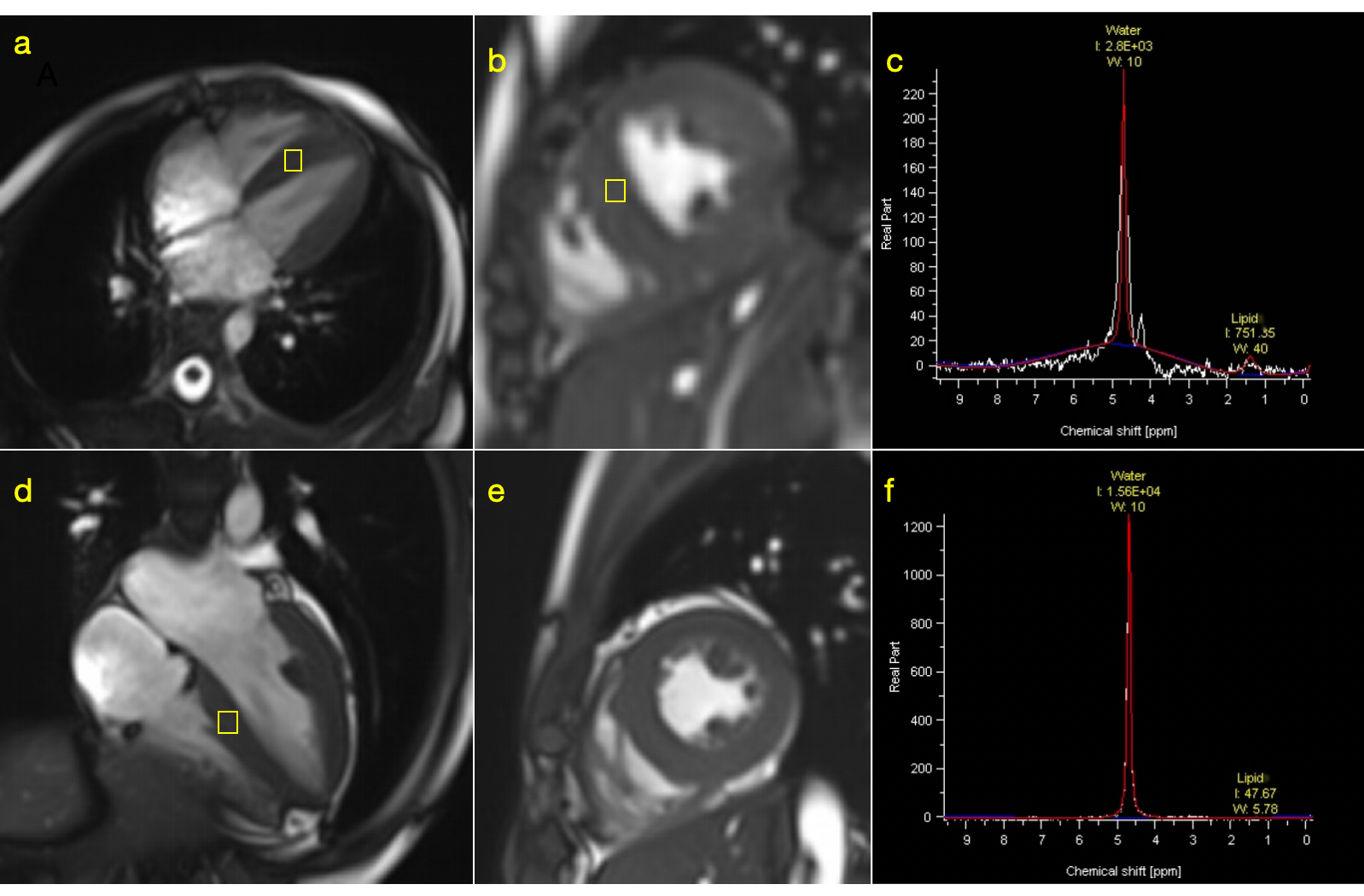
Goal(s): To investigate the characteristics of myocardial tissue triglyceride content in DMD by non-invasive MRS.
Approach: Twenty patients with DMD and Controls underwent cardiac MRI, including spectral sequence. The peak area and the area under the peak of H2O and TG in each voxel were calculated. The t-test whether the sample mean was significant.
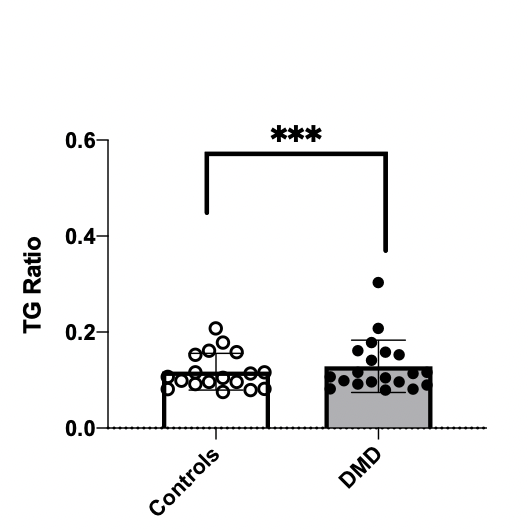
Results: The difference of TG content between DMD children normal group and the two groups was statistically significant.
Impact: Cardiac magnetic resonance spectrum can reflect myocardial triglyceride relative quantity for myocardial lipid content in the different stages of disease on how to change.
Introduction
Duchenne muscular dystrophy (DMD) is a severe, progressive muscle wasting disorder caused by mutations in the DMD gene that lead to the absence of the functional protein dystrophin1. Cardiac involvement has emerged as the main reason of death2. The pathological features of DMD include muscle degeneration and necrosis, inflammation/edema, and eventually fat infiltration3, which may lead to progressive loss of muscle tissue and function. Defects in cardiac energy metabolism, especially fatty infiltration, are associated with cardiomyopathies3, 4. MRS can be used to study in vivo changes in cardiac metabolism noninvasively, which can predict clinical heart failure and death5.Methods
Twenty patients with DMD were enrolled in this study, and all patients were diagnosed with DMD by genetic testing and/or skeletal muscle pathology. Controls were age-matched healthy men without evidence of cardiovascular disease. All subjects underwent cardiac MRI, including cine sequence and spectral sequence. The peak area and the area under the peak of H2O and TG in each voxel were calculated by Siemens post-processing software, and the percentage TG /(H2O+TG) x100% was calculated. SPSS version software was used for statistical analysis, t-test whether the sample mean was significant; A difference of 0.05 was considered significant.Results
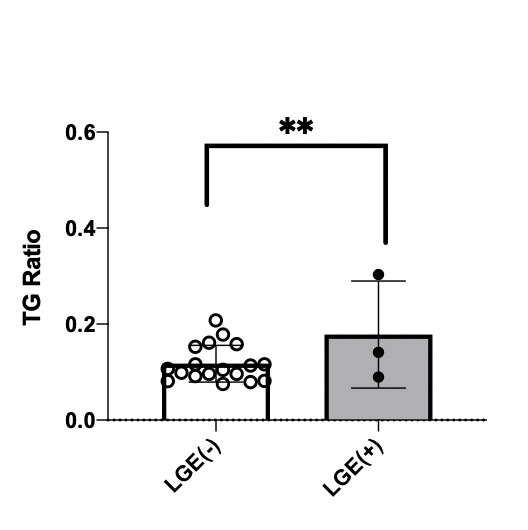
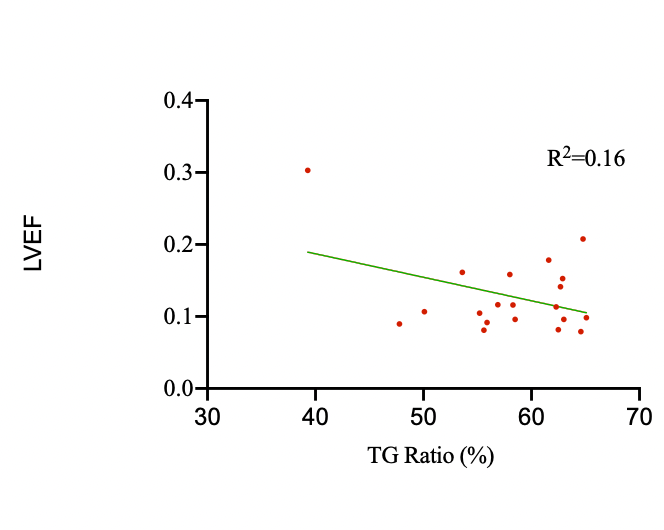
The TG content of DMD children was 12.88%, and that of normal group was 10.77%. The difference between the two groups was statistically significant(P<0.05).TG ratios in patients with LGE(+) DMD(11.76%) are statistically significant different from LGE(17.81%) DMD(P<0.05).However, TG ratios in patients with DMD are not associated with left ventricular ejection fraction (LVEF).Discussion
Previous studies have shown that the determination of lipid content in skeletal muscle and cardiomyocytes by MRS is very similar to that by direct biochemical methods5. The results of this study indicate that the semi-quantitative measurement of 1H-MRS can reflect the degree of DMD and provide a basis for clinical detection in vivo6.Myocardial fatty infiltration may be associated with myocardial fibrosis., but not associated with left ventricular ejection fraction (LVEF).Conclusion
Myocardial triglyceride is indeed increased in DMD children compared with normal children.Acknowledgements
The authors are grateful to all the participants who volunteered for the study and the medical investigators.References
1. Duan D, Goemans N, Takeda S, Mercuri E, Aartsma-Rus A. Duchenne muscular dystrophy. Nat Rev Dis Primers 2021;7:13.2. Feng Q, Wilke RA. Statin-Induced Muscle Toxicity. In: Muscle, 2012:945-954.3.
2.Feng Q, Wilke RA. Statin-Induced Muscle Toxicity. In: Muscle, 2012:945-954.
3.Kamdar F, Garry DJ. Dystrophin-Deficient Cardiomyopathy. J Am Coll Cardiol 2016;67:2533-2546.4.
4.Schultz TI, Raucci FJ, Jr., Salloum FN. Cardiovascular Disease in Duchenne Muscular Dystrophy: Overview and Insight Into Novel Therapeutic Targets. JACC Basic Transl Sci 2022;7:608-625.5.
5.Gupta A, 4.Houston B. Cardiac (1)H MR spectroscopy: development of the past five decades and future perspectives. Heart Fail Rev 2021;26:839-859.6.
6.Chang KF, Lin G, Huang PC, et al. Left Ventricular Function and Myocardial Triglyceride Content on 3T Cardiac MR Predict Major Cardiovascular Adverse Events and Readmission in Patients Hospitalized with Acute Heart Failure. J Clin Med 2020;9.
Figures