1795
Incremental Diagnostic Value of CMR-derived Myocardial Strain in Different Stages of Heart Failure in Hypertensive Patients1Central Hospital of Dalian University of Technology, Dalian, China, 2Department of Graduate School, Dalian Medical University, Dalian, China, 3GE HealthCare MR Research, Beijing, China
Synopsis
Keywords: Heart Failure, Hypertension, Heart, Heart Failure
Motivation: Myocardial strain has been poorly studied in different stages of heart failure in hypertensive patients.
Goal(s): This study assessed the clinical utility of Cardiac Magnetic Resonance (CMR) Feature Tracking technology in evaluating left atrium and left ventricle strain parameters in hypertensive patients at different stages of heart failure.
Approach: The study compared the differences in left atrial and left ventricular strain parameters in hypertensive patients at different stages of heart failure.
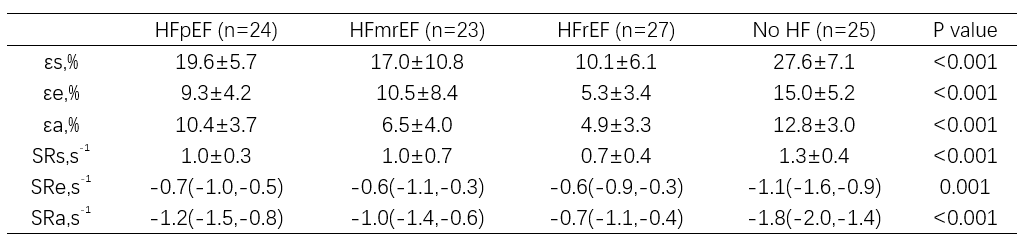
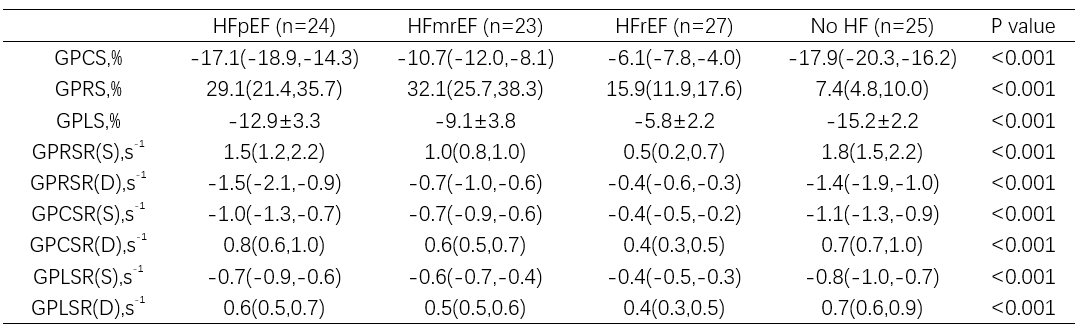
Results: The results revealed varying degrees of impairment in left atrial and left ventricular strain parameters in hypertensive heart failure patients , along with a significant correlation between these parameters.
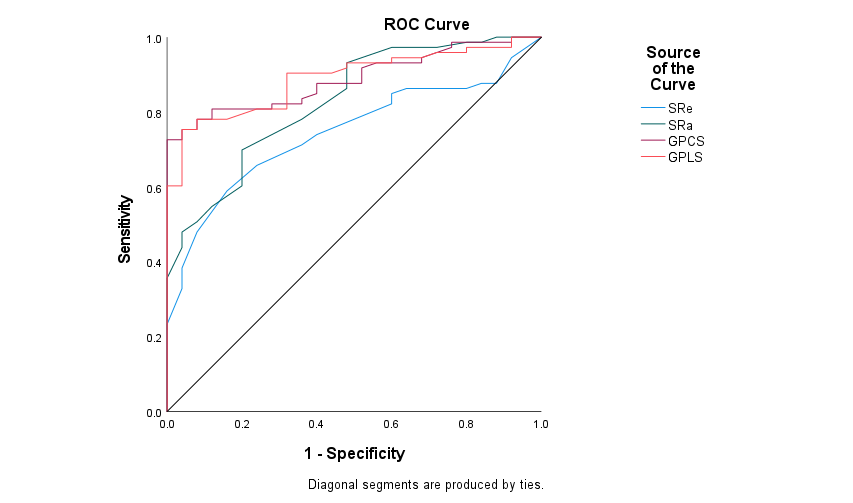
Impact: Among hypertensive patients at different stages of heart failure, the GPCS and GPLS parameters demonstrated superior diagnostic value.
Introduction
Hypertensive heart disease (HHD) is characterized by structural remodeling due to chronic hypertension, including myocardial hypertrophy, myocardial fibrosis, and changes in the left atrial structure, ultimately leading to heart failure. Quantitative evaluation of this structural remodeling holds crucial importance in clinical treatment asessment and prognosis prediction. The purpose of this study is to employ cardiac magnetic resonance feature tracking (CMR-FT) technology to investigate changes in left ventricular myocardial mechanics at different stages of heart failure in hypertensive patients.Methods
A retrospective study was conducted on 99 hypertensive patients, including those without heart failure (n=25), those with heart failure and preserved ejection fraction (n=24), those with heart failure and mid-range ejection fraction (n=23) and those with heart failure and reduced ejection fraction (n=27). All participants underwent CMR examination, and left atrial and left ventricular myocardial strain and strain rate were independently measured by two physicians using standard 2CH and 4CH cine sequences. Impaired myocardial strain at different heart failure stages was compared, and correlations between left atrial strain and left ventricular strain parameters, as well as NT-proBNP, were analyzed. Receiver operating characteristic (ROC) curves were employed to assess the diagnostic efficiency of various parameters.Results
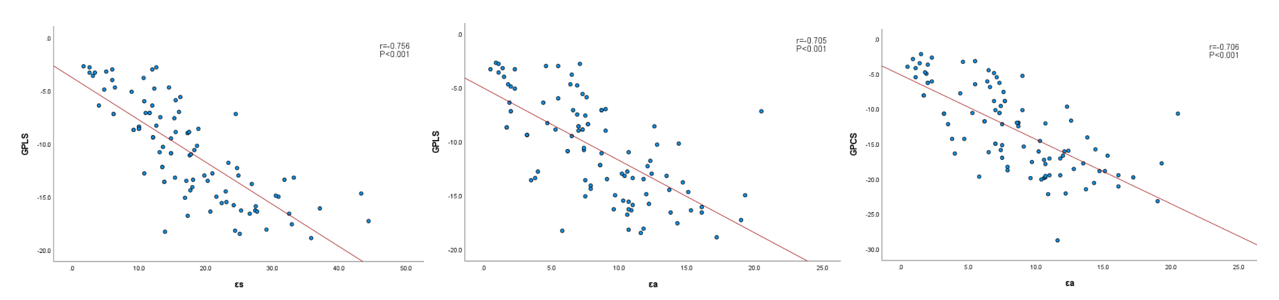
Compared with the non-heart failure group,the heart failure group exhibited impaired left ventricular ejection fraction (LVEF), εs, εe, εa, SRs, SRe, SRa, GPCS, GPRS, and GPLS. Significantly, εs, εa, GPCS, GPRS, and GPLS in the HFrEF group differed from the HFpEF group (P<0.001), and in LVEF, εe, GPCS, GPRS, and GPLS in the HFmrEF group differed from the HFmrEF group (P<0.001). A moderate correlation was observed between εs and GPLS (r=-0.756, P<0.001), εa and GPLS (r=-0.705, P<0.001), and εa and GPCS (r=-0.706, P<0.001). Notably, GPCS and GPLS were found to be the best parameters for discriminating heart failure from non-heart failure group (GPCS, area under curve, AUC = 0.888; GPLS, AUC=0.889; both P < 0.001). They were also the optimal parameters for discriminating HFpEF from HFmrEF (GPCS, AUC = 0.914; GPLS, AUC= 0.757; both P < 0.05), HFpEF from HFrEF (GPCS, AUC = 0.986; GPLS, AUC= 0.963; both P < 0.001),and HFmrEF from HFrEF (GPCS, AUC = 0.820; GPLS, AUC= 0.757; both P < 0.05). The Bland-Altman analysis confirmed strong inter-physician agreement.Conclusion
CMR-FT derived myocardial strain exhibits promising diagnostic potential for assessing different stages of heart failure in hypertensive heart disease. Importantly, GPCS and GPLS emerge as superior diagnostic indicators.Acknowledgements
This work is supported by Central Hospital of Dalian University of Technology.References
1、Tadic M, Cuspidi C, Plein S, Milivojevic IG, Wang DW, Grassi G, Mancia G.Comprehensive assessment of hypertensive heart disease: cardiac magneticresonance in focus. Heart Fail Rev. 2021 Nov;26(6):1383-1390. doi:10.1007/s10741-020-09943-x. PMID: 32170529.2、Yao B, Wu R, Chen BH, Wesemann LD, Xu JR, Zhou Y, Wu LM. Cardiovascularmagnetic resonance myocardial feature tracking for the determination of leftatrial strain in hypertensive left ventricular hypertrophy and hypertrophiccardiomyopathy. Clin Radiol. 2023 May;78(5):e409-e416. doi:10.1016/j.crad.2022.12.016. Epub 2023 Jan 22. PMID: 36746719.3、Koike H, Kishi S, Hosoda N, Takemoto S, Tomii D, Ninomiya K, Tanaka T, AsamiM, Yahagi K, Komiyama K, Tanaka J, Yuzawa H, Nakanishi R, Fujino T, Aoki J,Venkatesh BA, Lima JAC, Tanabe K, Ikeda T. The impact of tissue-tracking strainon the left atrial dysfunction in the patients with left ventriculardysfunction. Int J Cardiol Heart Vasc. 2020 Jan 5;26:100453. doi:10.1016/j.ijcha.2019.100453. PMID: 31921972; PMCID: PMC6948228.4、Cau R, Bassareo P, Suri JS, Pontone G, Saba L. The emerging role of atrialstrain assessed by cardiac MRI in different cardiovascular settings: an up-to-date review. Eur Radiol. 2022 Jul;32(7):4384-4394. doi:10.1007/s00330-022-08598-6. Epub 2022 Apr 22. PMID: 35451607; PMCID: PMC9213357.5、Rimbas RC, Visoiu IS, Magda SL, Mihaila-Baldea S, Luchian ML, Chitroceanu AM,Hayat M, Mihalcea DJ, Dragoi-Galrinho-Antunes-Guerra R, Stefan M, Velcea A,Andronic AA, Lungeanu-Juravle L, Nicula AI, Vinereanu D. New insights into thepotential utility of the left atrial function analysis in heart failure withpreserved ejection fraction diagnosis. PLoS One. 2022 May 4;17(5):e0267962. doi:10.1371/journal.pone.0267962. PMID: 35507565; PMCID: PMC9067684.6、Shi R, Shi K, Huang S, Li X, Xia CC, Li Y, He S, Li ZL, He Y, Guo YK, YangZG. Association Between Heart Failure With Preserved Left Ventricular EjectionFraction and Impaired Left Atrial Phasic Function in HypertrophicCardiomyopathy: Evaluation by Cardiac MRI Feature Tracking. J Magn ResonImaging. 2022 Jul;56(1):248-259. doi: 10.1002/jmri.28000. Epub 2021 Nov 19.PMID: 34799953.7、Zhou D, Yang W, Yang Y, Yin G, Li S, Zhuang B, Xu J, He J, Wu W, Jiang Y, SunX, Wang Y, Sirajuddin A, Zhao S, Lu M. Left atrial dysfunction may precede leftatrial enlargement and abnormal left ventricular longitudinal function: acardiac MR feature tracking study. BMC Cardiovasc Disord. 2022 Mar 13;22(1):99.doi: 10.1186/s12872-022-02532-w. PMID: 35282817; PMCID: PMC8919633.8、.Songsangjinda T, Krittayaphong R. Impact of different degrees of leftventricular strain on left atrial mechanics in heart failure with preservedejection fraction. BMC Cardiovasc Disord. 2022 Apr 9;22(1):160. doi:10.1186/s12872-022-02608-7. PMID: 35397510; PMCID: PMC8994220.Figures