1783
Preliminary study of myocardial substance metabolism in amateur athletes - Based on 1H-MRS1The Affiliated Hospital of Southwest Medical University, Luzhou, China, 2Department of Radiology,, The Affiliated Hospital of Southwest Medical University, Luzhou, China, 3MR Research Collaboration, Siemens Healthineers, Chengdu, China
Synopsis
Keywords: Myocardium, Machine Learning/Artificial Intelligence
Motivation: Exploring metabolic markers for detecting cardiac remodeling (CR) in athletes to differentiate adaptive from harmful changes.
Goal(s): To use 1H-MRS for identifying metabolites predictive of CR in athletes.
Approach: Recruitment of male athletes and controls for CMR examination, analysis of myocardial metabolites using 1H-MRS, and application of machine learning algorithms to construct predictive models for CR.
Results: Discovery of a correlation between increased myocardial creatine levels and lipid ratios in athletes with CR, with 1H-MRS proving effective in predicting CR, highlighting MYCL-CH3/W as a particularly predictive metabolite, and positioning the KNN algorithm as a robust predictive tool.
Impact: The study advanced sports cardiology by identifying myocardial metabolites as noninvasive markers for differentiating between healthy and adverse cardiac remodeling in athletes, enhancing training strategies and early detection of cardiac risk.
Introduction
Cardiac remodeling (CR) in athletes can manifest as an adaptive response to consistent physical training; however, it bears a striking resemblance to maladaptive or pathological remodeling (adverse CR), posing diagnostic challenges1. Given that exercise-induced cardiac growth is often accompanied by coordinated changes in cardiac metabolism, there is a growing interest in metabolic profiling as a tool for differentiation.1H-Magnetic Resonance Spectroscopy (1H-MRS) provides a direct, noninvasive assessment of cardiac metabolites, including creatine (Cr), and lipids represented by methylene (MYCL-CH2), and methyl (MYCL-CH3) spectral resonances2. At present, there were few studies for exploring the relationship between CR and myocardial metabolite content3,4 particularly concerning on the prediction of CR based on the cardiac metabolites. In this study, we aimed to use myocardial metabolites to predict the occurrence of CR in athletes.Methods
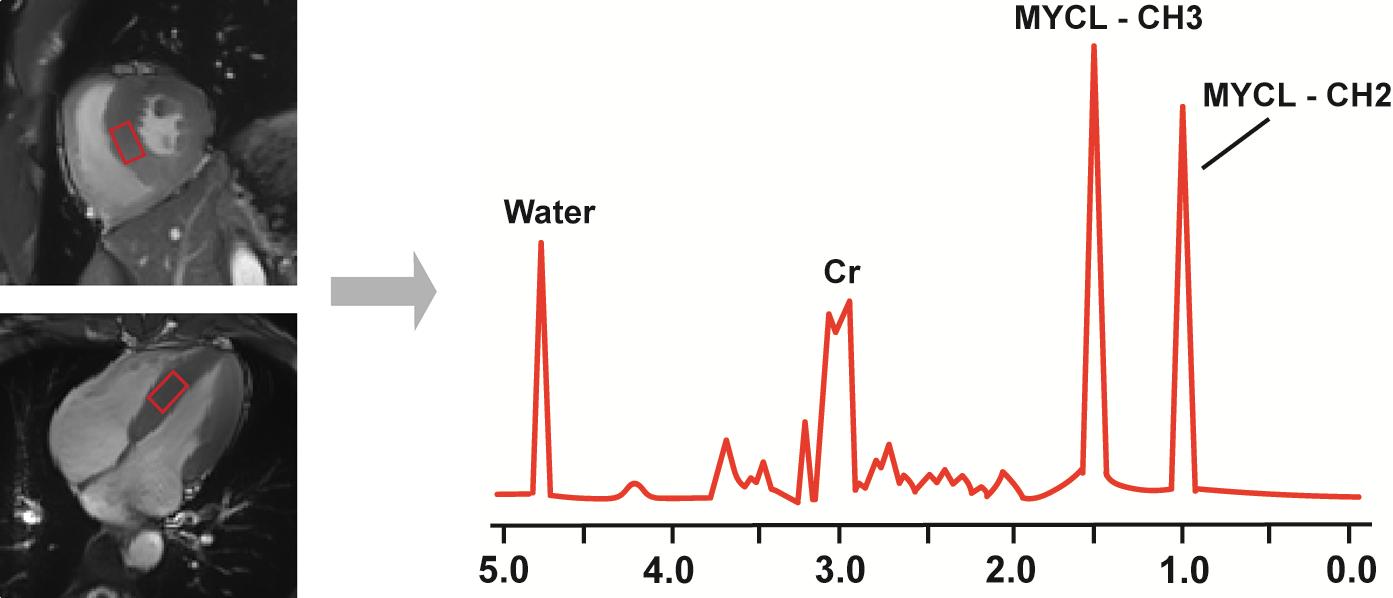
109 male athletes (median age, 24 years) and 25 male controls (median age, 26 years) were recruited in our study. All volunteers were conducted cardiac magnetic resonance (CMR) examination on a clinical 3T system (MAGNETOM Prisma, Siemens Healthcare, Erlangen, Germany) equipped with an 18-channel body coil. The cine sequences performed using true fast imaging with steady-state precession sequence, and the following parameters: repetition time (TR) = 66.20 ms; echo time (TE) = 1.46 ms; flip angle = 42°; number of averages = 1; slice thickness = 5 mm; phase = 25; and phase = 20 per segment view. The respiratory-triggered cardiac-gated point-resolved spectroscopy (PRESS) was employed to obtain 1H-MRS spectra. A volume of interest (VOI) measuring 1.0×1.0×1.0 cm3 was carefully positioned within the septal myocardial tissue, utilizing guidance from the four-chamber and short axial images(Figure 1). Its acquisition parameters were set as follows: TR /TE = 2000 ms / 20 ms, 5 average = 5, points = 1024, bandwidth = 2000 Hz. Water suppression and non-water suppression spectra were acquired to capture the water and myocardial lipid, as well as the Cr signals, respectively. The cardiac function were automatically obtained by using commercially available software (CVI42, version: Release 5.12.4 Circle Cardiovascular Imaging Inc., Calgary, Canada) and metabolite contents were obtained by utilizing the Syngo.via software (VE11, Siemens Healthineers, Erlangen, Germany). The Mann-Whitney U test and Student's t-test were used to compare the clinical characteristic data and all the parameters of 1H-MRS between the athletes’ group and control group, and within the athletes' cohort, between those exhibiting CR and those without. The machine learning (ML) algorithms, including k-nearest neighbors (KNN), support vector machine (SVM), logistic regression (LR), and classification and regression tree (CART), were constructed to establish the models for predicting CR in athletes. All the statistical analysis were performed using the R software version 4.3.1 (https://www.r-project.org).Results
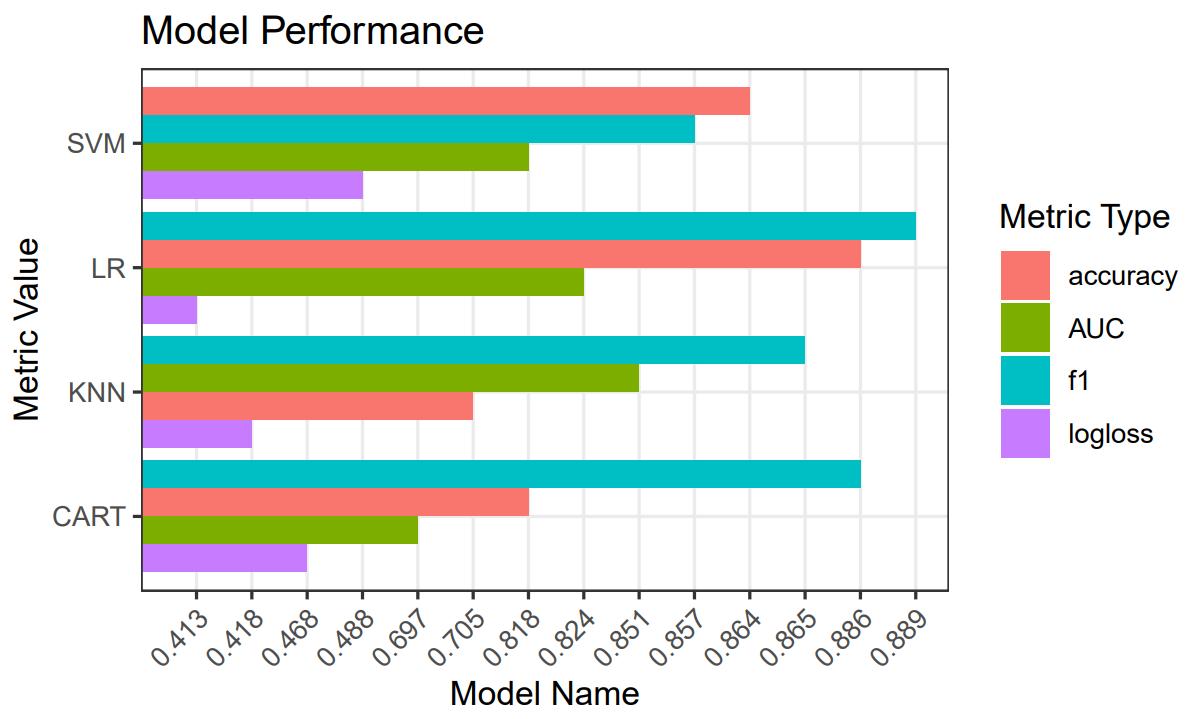
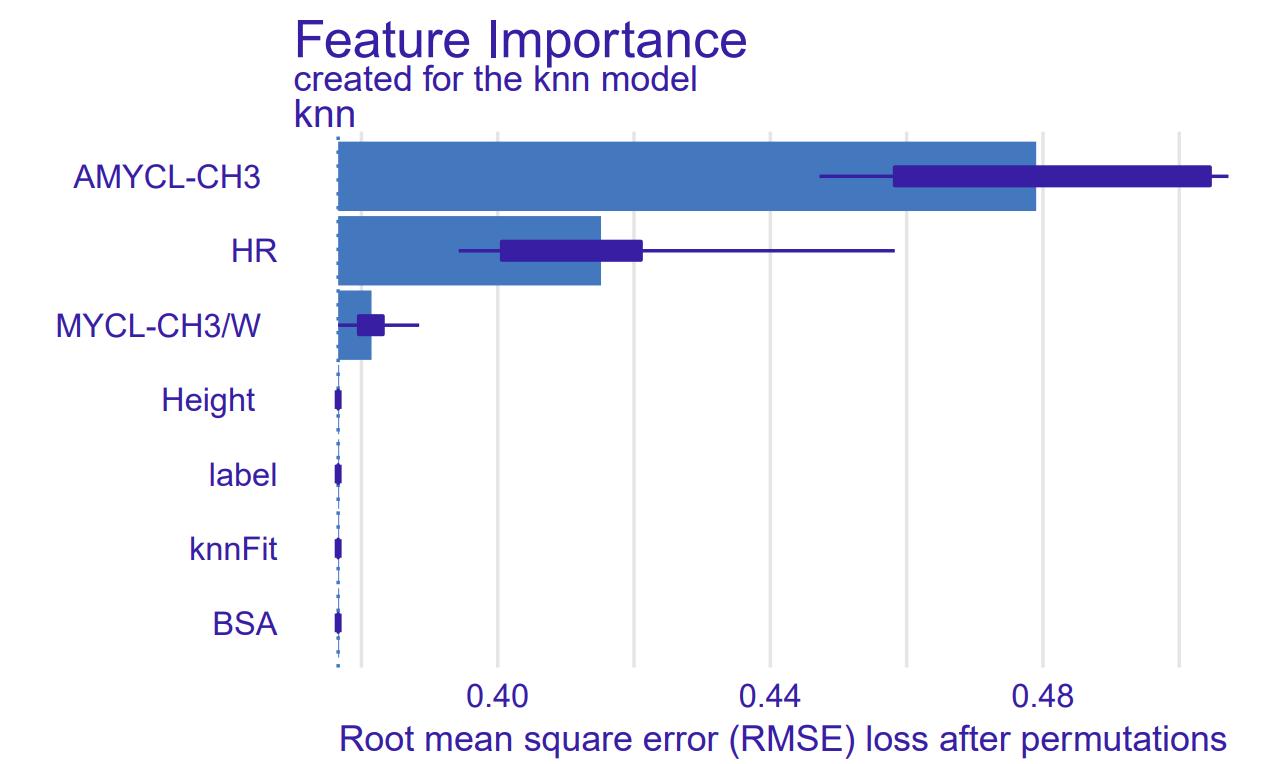
In the evaluation of myocardial metabolism using 1H-MRS in athletes, we observed a significant increase in the creatine-to-water ratio (Cr/W) of the septal myocardium in athletes as compared to the control group(p<0.05). Further metabolic distinctions were noted within the athletes' cohort: those exhibiting CR showed a significant elevation in both methylene-to-water (MYCL-CH3/W) and allyl methyl-to-water (AMYCL-CH3) ratios, along with a decrease in the ratio of methylene to methyl (MYCL-CH2/MYCL-CH3) (all p<0.05).The k-nearest neighbors (KNN) algorithm demonstrated the most promising performance for predicting CR, achieving an area under the curve value of 0.851, logloss values of 0.418(Figure 2). Within the KNN model, the ranked features based on their importance in predicting CR were identified(Figure3). The most significant predictor was the AMYCL-CH3, followed by heart rate (HR), and the MYCL-CH3/W ratio.Discussion
Our findings revealed a significant elevation in Cr/W in the septal myocardium of athletes versus sedentary individuals. This supports the hypothesis that exercise augments myocardial creatine levels5. Paradoxically, while regular exercise typically reduces cardiac lipid content, we observed increased levels of myocardial lipids (MYCL-CH3/W and AMYCL-CH3) in athletes with CR, a deviation from the expected decrease. These lipid accumulations are posited to be both a result of prolonged elevated plasma fatty acid levels and a potential early marker for adverse cardiac events6.Conclusion
1H-MRS has emerged as a valuable tool for monitoring athletes, with MYCL-CH3/W standing out as a significant metabolite for predicting CR, which could profoundly influence training protocols and early detection of adverse cardiac events.Acknowledgements
NoneReferences
1. La Gerche A, Burns AT, Mooney DJ, et al. Exercise-induced right ventricular dysfunction and structural remodelling in endurance athletes. Eur Heart J. 2012;33:998-1006.
2. Bizino MB, Hammer S, Lamb HJ. Metabolic imaging of the human heart: clinical application of magnetic resonance spectroscopy. Heart. 2014;100:881-890.
3. Gibb AA, Hill BG. Metabolic Coordination of Physiological and Pathological Cardiac Remodeling. Circ Res. 2018;123:107-128.
4. Secchi F, Di Leo G, Petrini M, et al. (1)H- and (31)P-myocardial magnetic resonance spectroscopy in non-obstructive hypertrophic cardiomyopathy patients and competitive athletes. Radiol Med. 2017;122:265-272.
5. Kemi OJ, Høydal MA, Haram PM, et al. Exercise training restores aerobic capacity and energy transfer systems in heart failure treated with losartan. Cardiovasc Res. 2007;76:91-99.
6. Bilet L, van de Weijer T, Hesselink MK, et al. Exercise-induced modulation of cardiac lipid content in healthy lean young men. Basic Res Cardiol. 2011;106:307-315.
Figures