1766
Non-central chi likelihood loss for quantitative MRI from parallel acquisitions with self-supervised deep learning1Centre for Medical Image Computing, University College London, London, United Kingdom
Synopsis
Keywords: AI Diffusion Models, Quantitative Imaging, parallel imaging; apparent diffusion coefficient; IVIM; parameter estimation
Motivation: The distribution of reconstructed MRI signals, used as input for quantitative MRI with self-supervised deep learning, depends on the number of receiver coils. Current loss functions do not account for this, leading to bias.
Goal(s): Develop a non-central chi likelihood (NLC) loss that accounts for the distribution of MRI measures in the most common scenario of parallelised acquisitions.
Approach: Implement and evaluate the NLC loss and compare its performance against the MSE and Rician likelihood loss in simulated data.
Results: The NLC improves performance compared to the Rician likelihood and MSE loss for the mono-exponential ADC model in simulated data.
Impact: The NLC loss permits fast inference of parameters from MRI signals reconstructed from parallelised acquisitions and may reduce bias compared to the Rician and MSE loss. The NLC loss is widely applicable due to the abundance of parallelised MRI acquisitions.
Introduction
The network training loss function has recently been shown to have a significant impact on parameter estimation performance in quantitative MRI with self-supervised deep learning [1]. This may be explained by its implicit assumptions on the distribution of MRI signals. Mean squared error (MSE) assumes Gaussian-distributed signal measures and is associated with biased parameter estimates at low SNR [1,2]. To overcome this, we developed the Rician likelihood loss that captures the distribution of magnitude signals reconstructed from a single receiver coil [1]. However, more typically signal magnitudes are reconstructed from multiple receiver coils which acquire data in parallel [3,4]. In this case, the distribution is more accurately described by a non-central chi distribution [5]. In this work, we develop and introduce the negative log non-central chi likelihood loss and assess its parameter estimation performance in synthetic data.Methods
TheoryThe sum-of-squares (SoS) reconstruction is commonly used to compute the signal magnitude from multiple coils and is defined as the square root of the sum-of-squares of the real and imaginary components of complex signals [6]. For $$$N$$$ receiver coils, the magnitude $$$M$$$ is computed as $$$M=\sqrt{\sum_{i=1}^{N} S_{R,i}^2 + S_{I,i}^2}$$$, where $$$S_{R,i}$$$ and $$$S_{I,i}$$$ are Gaussian-distributed with standard deviation $$$\sigma$$$.
For uncorrelated signals, the distribution of $$$M$$$ then follows a non-central chi distribution with probability density function $$$ p(M; v, \sigma, N) = \frac{m^N}{\sigma^2 v^{N-1}} exp(\frac{-(M^2+v^2)}{2\sigma^2}) I_{N-1}(\frac{Mv}{\sigma^2})$$$ [5], where $$$v$$$ is the noise-free signal we wish to estimate, which depends both on the biophysical parameters and acquisition settings. The maximum likelihood estimate (MLE) of $$$v$$$ is known to be asymptotically unbiased. The network training loss function was therefore defined as the negative log of the non-central chi likelihood (NLC) over the batch of $$$N$$$ voxels, each with $$$N_z$$$ signal measures: $$$ -\sum_{n=1}^{N} \sum_{z=1}^{N_z} log(p(M_{n,z};v_{n,z}, \sigma, N) $$$.
Experimental evaluation
We developed a PyTorch compatible implementation of the NLC loss. Performance was evaluated against the MSE and NLR losses using the apparent diffusion coefficient (ADC) and intra-voxel incoherent motion (IVIM) model as exemplar quantitative MRI models.
For synthetic data experiments, complex noise-free MRI data was generated from a uniform distribution of model parameters covering the range of biophysically plausible values and i.i.d. Gaussian noise ($$$\sigma$$$=10 or 30) added. The S0 magnitude of each single coil was set equal 1. An autoencoder with IVIM biophysical model decoder was trained on 105 voxels [1].
Performance was evaluated in terms of accuracy (bias), precision (standard deviation) and total error (RMSE) on 105 unseen test voxels acquired both high SNR ($$$\sqrt{S_{R}^2(b=0)+ S_{I}^2(b=0)} = 30$$$) and low SNR ($$$\sqrt{S_{R}^2(b=0)+ S_{I}^2(b=0)} = 10$$$) and for signals reconstructed with N=2 and 10 receiver coils.
Results
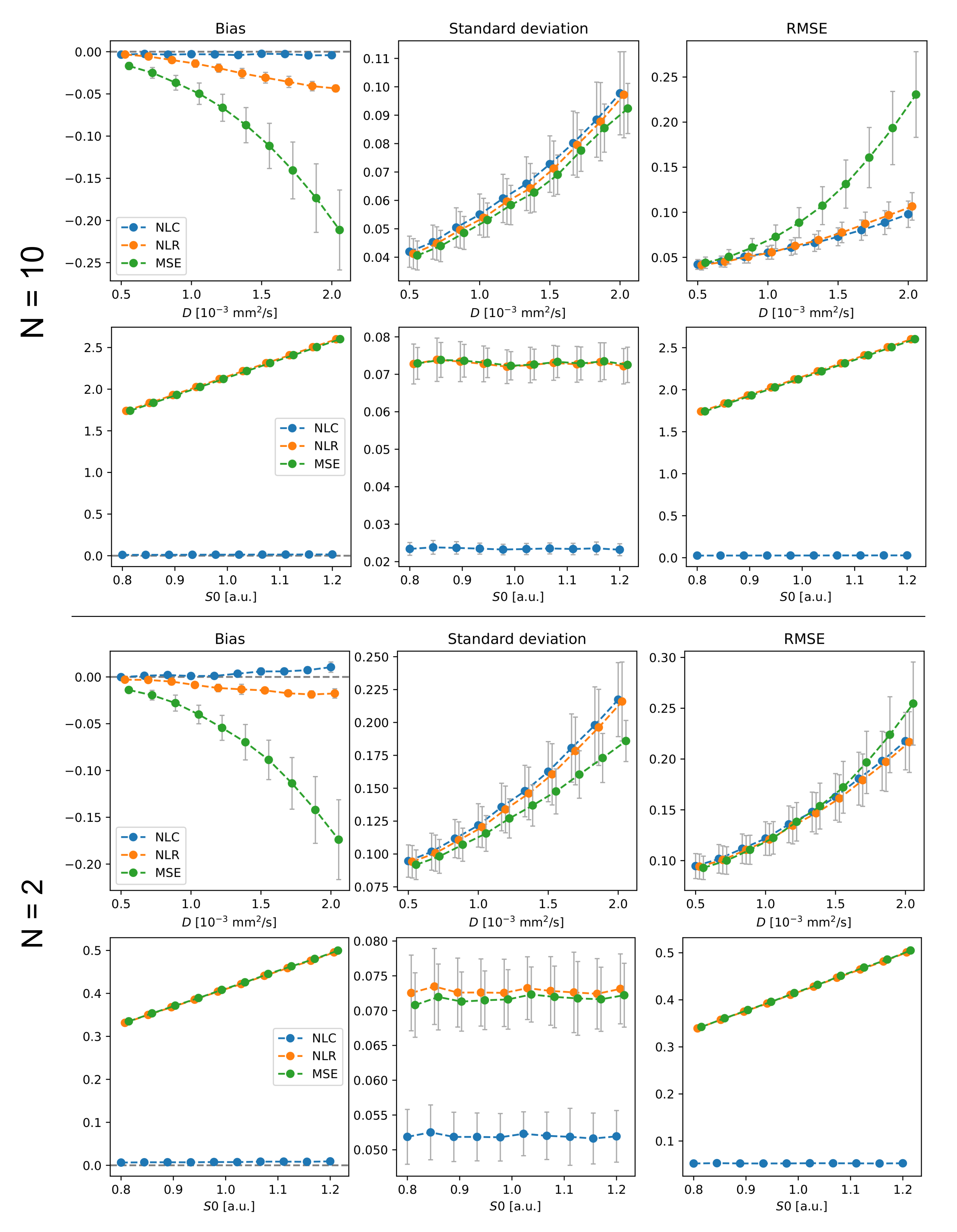
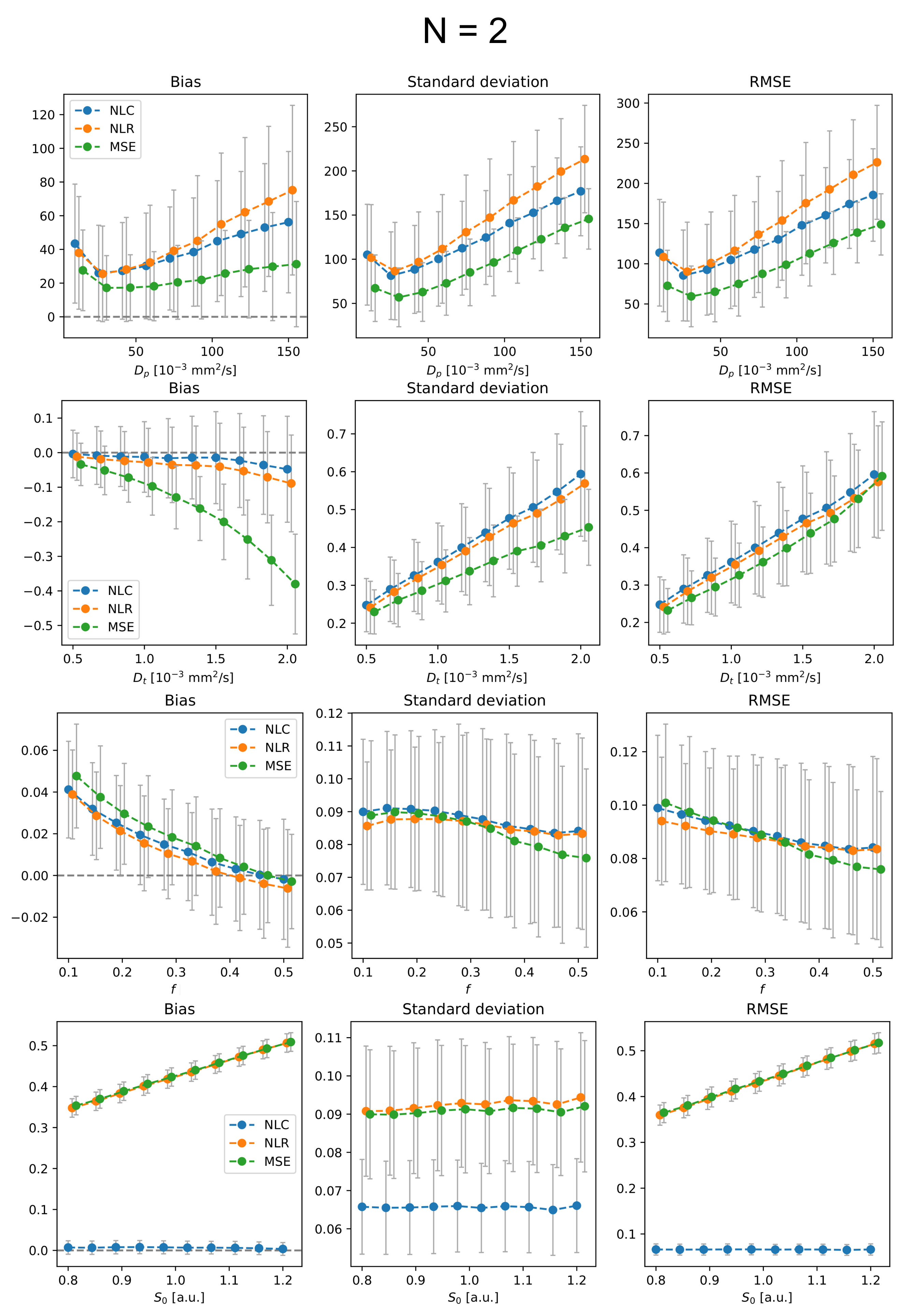
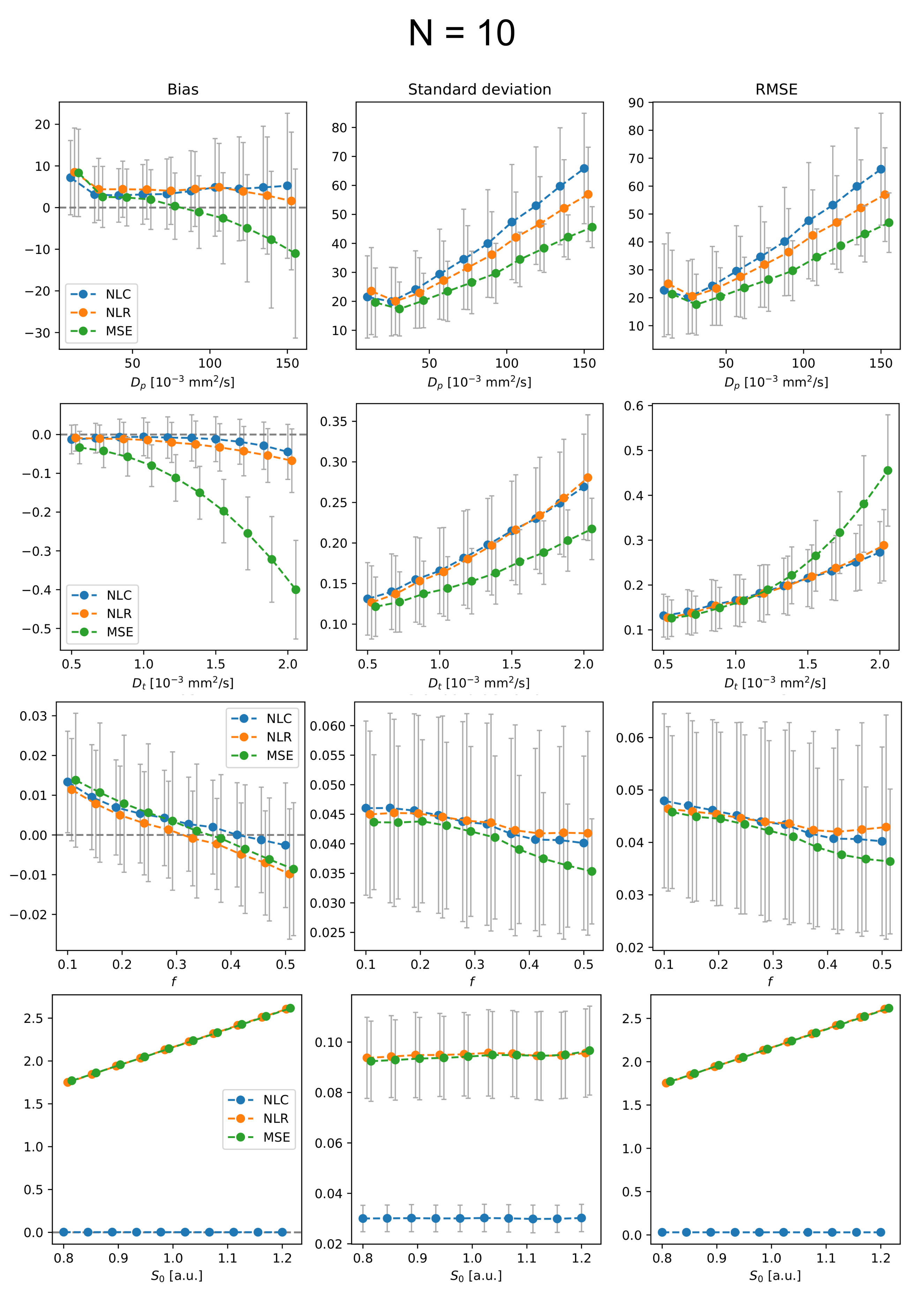
For both qMRI models, patterns of performance differences between losses were similar at high and low SNR, with all showing improved performance (higher accuracy and precision and lower total error) at high SNR in simulated data. We therefore focus on performance at low SNR.For the ADC model, the NLC loss shows higher accuracy than NLR or MSE losses for both ADC and S0 parameters on simulated data reconstructed from N=2 and N=10 receiver coils, with higher precision for S0 (the signal magnitude in each receiver coil). Higher precision for ADC was observed at N=10 for all losses compared to N=2. Lower accuracy for S0 was observed at N=10 compared to N=2 for MSE and NLR losses, whereas the NLC accurately estimated S0 consistently.
For the IVIM model, Dp shows high accuracy at N=10 and over-estimation at N=2 for all losses. For both N=2 and N=10, Dt is underestimated with MSE loss, whereas accuracy is high for the NLC and NLR losses. Fp estimation is relatively accurate and precise for all losses at both N=2 and N=10.
Discussion
For simple mono-exponential signal decay, NLC loss’ higher accuracy is explained by its more accurate modelling of the distribution of reconstructed MRI signals. As the number of coils used in the SoS reconstruction increases, the distribution of signals becomes increasingly shifted towards higher values relative to the noise-free signal (see preview picture where $$$v$$$=1). As N increases, the MSE and NLR losses will predict noise-free signals that are closer to the centre of the measured signals, causing under-estimation of ADC. Higher precision of estimates reported at high N is explained by the relatively higher number of signal averages in the reconstructed signal.Conclusion
The NLC loss is designed for training self-supervised deep networks for quantitative MRI on parallelised acquisitions. Results in simulated data show improved parameter estimation for ADC estimation and improved S0 estimation for IVIM.Acknowledgements
CSP, DCA and HZ are supported by the Medical ResearchCouncil (MR/T046473/1).References
[1] Parker, C.S., Schroder, A., Epstein, S.C., Cole, J., Alexander, D.C. and Zhang, H., 2023. Rician likelihood loss for quantitative MRI using self-supervised deep learning. arXiv preprint arXiv:2307.07072.
[2] Barbieri, S., Gurney‐Champion, O.J., Klaassen, R. and Thoeny, H.C., 2020. Deep learning how to fit an intravoxel incoherent motion model to diffusion‐weighted MRI. Magnetic resonance in medicine, 83(1), pp.312-321.
[3] Griswold, M.A., Jakob, P.M., Heidemann, R.M., Nittka, M., Jellus, V., Wang, J., Kiefer, B. and Haase, A., 2002. Generalized autocalibrating partially parallel acquisitions (GRAPPA). Magnetic Resonance in Medicine: An Official Journal of the International Society for Magnetic Resonance in Medicine, 47(6), pp.1202-1210.
[4] Pruessmann, K.P., Weiger, M., Scheidegger, M.B. and Boesiger, P., 1999. SENSE: sensitivity encoding for fast MRI. Magnetic Resonance in Medicine: An Official Journal of the International Society for Magnetic Resonance in Medicine, 42(5), pp.952-962.
[5] Constantinides, C.D., Atalar, E. and McVeigh, E.R., 1997. Signal‐to‐noise measurements in magnitude images from NMR phased arrays. Magnetic resonance in medicine, 38(5), pp.852-857.
[6] Sotiropoulos, S.N., Moeller, S., Jbabdi, S., Xu, J., Andersson, J.L., Auerbach, E.J., Yacoub, E., Feinberg, D., Setsompop, K., Wald, L.L. and Behrens, T.E.J., 2013. Effects of image reconstruction on fiber orientation mapping from multichannel diffusion MRI: reducing the noise floor using SENSE. Magnetic resonance in medicine, 70(6), pp.1682-1689.
[7] Epstein, S.C., Bray, T.J., Hall-Craggs, M. and Zhang, H., 2022. Choice of training label matters: how to best use deep learning for quantitative MRI parameter estimation. arXiv preprint arXiv:2205.05587
Figures