1759
Self-Supervised Deep-Learning Networks for Mono and Bi-exponential T1ρ Fitting in the Knee Joint1Bernard and Irene Schwartz Center for Biomedical Imaging, Department of Radiology, New York University Grossman School of Medicine, New York, NY, United States, 2Center for Advanced Imaging Innovation and Research (CAI2R), Department of Radiology, New York University Grossman School of Medicine, New york, NY, United States
Synopsis
Keywords: Analysis/Processing, Quantitative Imaging, Quantitative Mapping, T1ρ mapping, Nonlinear Least Squares, Bi-exponential models, Deep Learning
Motivation: The nonlinear least squares (NLS)-based estimation of mono- and bi-exponential T1ρ maps in the knee joint is highly time-consuming. Deep-learning (DL) methods are faster alternatives.
Goal(s): However, DL requires substantial training data, which is usually obtained using NLS on acquired data. This paper introduces self-supervised DL models that leverage synthetic target data for training, eliminating the need for scanned or NLS data to be used as reference.
Approach: We have tested five different DL models, each utilizing a distinct activation function, and compared them against NLS.
Results: The proposed models are 25-200x faster than the NLS method, with errors close to NLS.
Impact: This study compared five different self-supervised DL models for estimating mono- and bi-exponential T1ρ maps in the knee joint. These models are faster alternatives to NLS, potentially replacing it to produce reference maps.
Introduction
The spin-lattice relaxation in the rotating frame (T1ρ) provides quantitative MRI probing on protons bound to macromolecules, proving valuable for diverse musculoskeletal conditions (1,2). Bi-exponential (BE) relaxation model, represented as the sum of two exponentials (2,3), can increase specificity, since the fast-relaxing component can represent the relaxation of water bound to the macromolecules, better capturing this complex tissue behavior (1,3).To fit BE models, usually nonlinear least squares (NLS) methods are applied to T1ρ-weighted image sequences at various spin-lock times (TSLs) (2). However, NLS methods are slow, rendering the T1ρ mapping task very time-consuming. Because of this, NLS is only used in very specific regions, such as in the cartilage voxels. Recent studies highlighting the broader impact of osteoarthritis (OA) beyond cartilage have stimulated the search for faster tools to comprehensively assess the entire knee joint. Researchers are actively exploring faster approaches to obtain quantitative MRI values of the knee joint, including DL methods (4,5,6,7).
However, most supervised DL methods, such as (4,5,6), require reference values produced by NLS methods. Demanding to use of NLS on thousands of voxels in each 3D image. Not to mention that this has to be repeated for each image in a large dataset. Here, we propose a self-supervised voxel-wise DL approach that is trained with synthetic data as a fast method to be used in place of NLS methods.
Methods
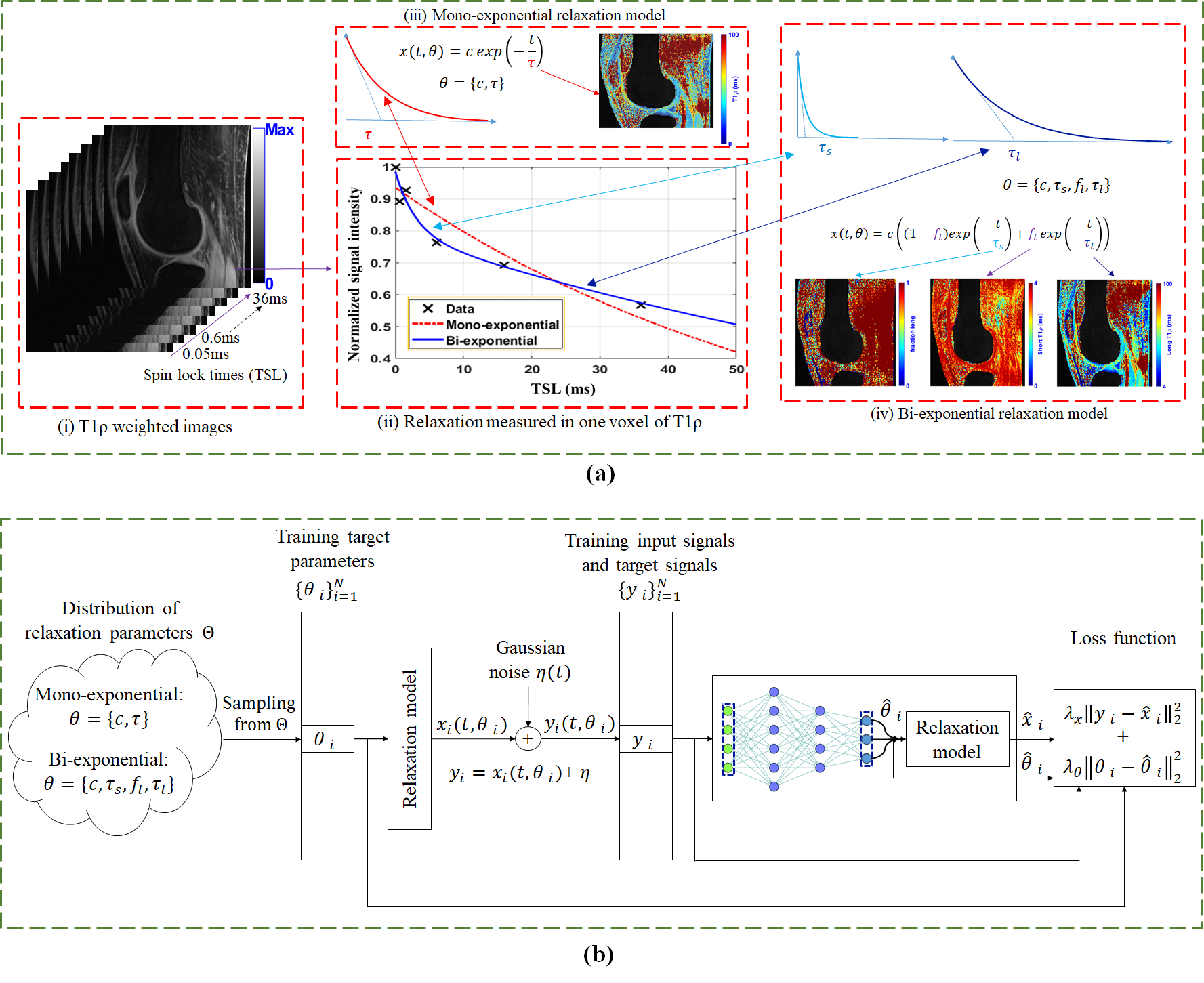
Considering the relaxation in a voxel, at TSL $$$t$$$, can be expressed as$$y(t)=x(t,\theta)+\eta(t),$$where $$$y$$$ is the voxel measurements, $$$\eta$$$ is the noise, and $$$x(t,\theta)$$$ is the relaxation model with parameters $$$\theta$$$. The diagrammatic flow of the discussed models is presented in Figure 1.The NLS approach fits the parameters minimizing the squared Euclidean norm of the residual, using $$\hat{\theta }=\arg \min_{\theta} \sum_{t=1}^{T}|y(t)-x(t,\theta)|^2,$$where $$$T$$$ is the number of TSLs. This is solved using iterative algorithms such as in (8).
The self-supervised approach studied here uses the following loss function for training$$Loss= \lambda_x ||y_i-\hat{x}_i||^2 + \lambda_{\theta} ||\theta_i-\hat{\theta}_i||^2,$$where $$$\hat{\theta}_i=R_{\omega}(y_i)$$$, being $$$R_{\omega}$$$ the fitting network, and $$$\hat{x}_i$$$ is the relaxation signal produced with the estimated parameters $$$\hat{\theta}_i$$$. Parameters $$$\theta_i$$$ are sampled from a known distribution $$$\Theta$$$.
In this study, we used $$$\lambda_x=10$$$ and $$$\lambda_{\theta}=1$$$. The first term of the loss function tries to reduce the residue, as in NLS approaches, producing a relaxation curve consistent with the synthetically generated measured values at the voxel. The second term tries to reduce the error against the ground truth values. This term also acts as a regularization.
The fitting architecture is composed of 7 repeated blocks of fully connected layers, with 512 intermediate elements each, followed by a nonlinear activation function. We tested five different activation functions such as Gaussian error linear unit (Gelu), LeakyRelu, hyperbolic tangent (Tanh), Swish, and Relu. The models are trained using the Adam optimizer with a maximum of 100 epochs, and each epoch processes mini-batches of 200 samples. The initial learning rate is set to 1.0e-3. The proposed model is tested on 3D-T1ρ MRI data from five different healthy subjects.
Results, Discussion, and Conclusion
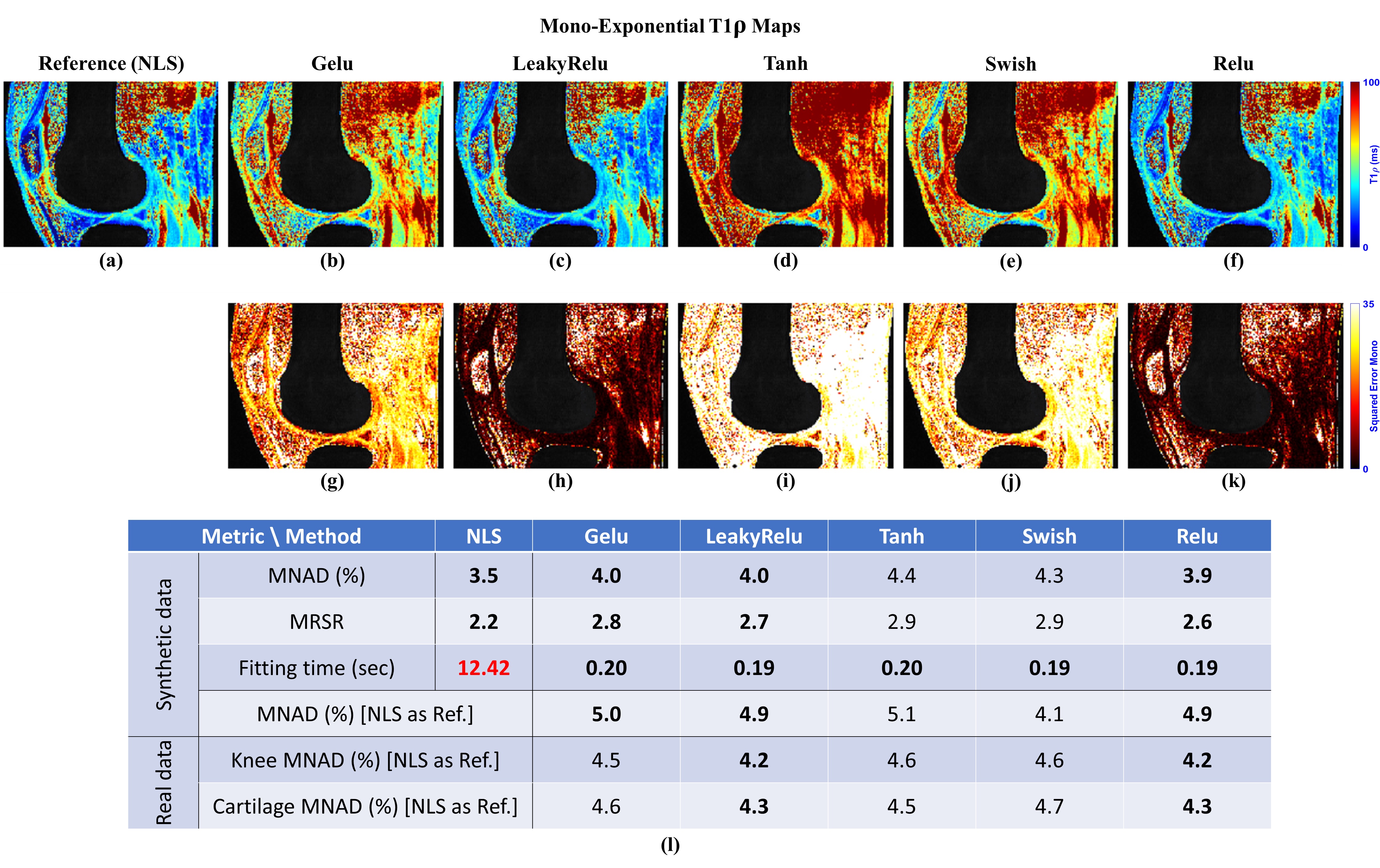
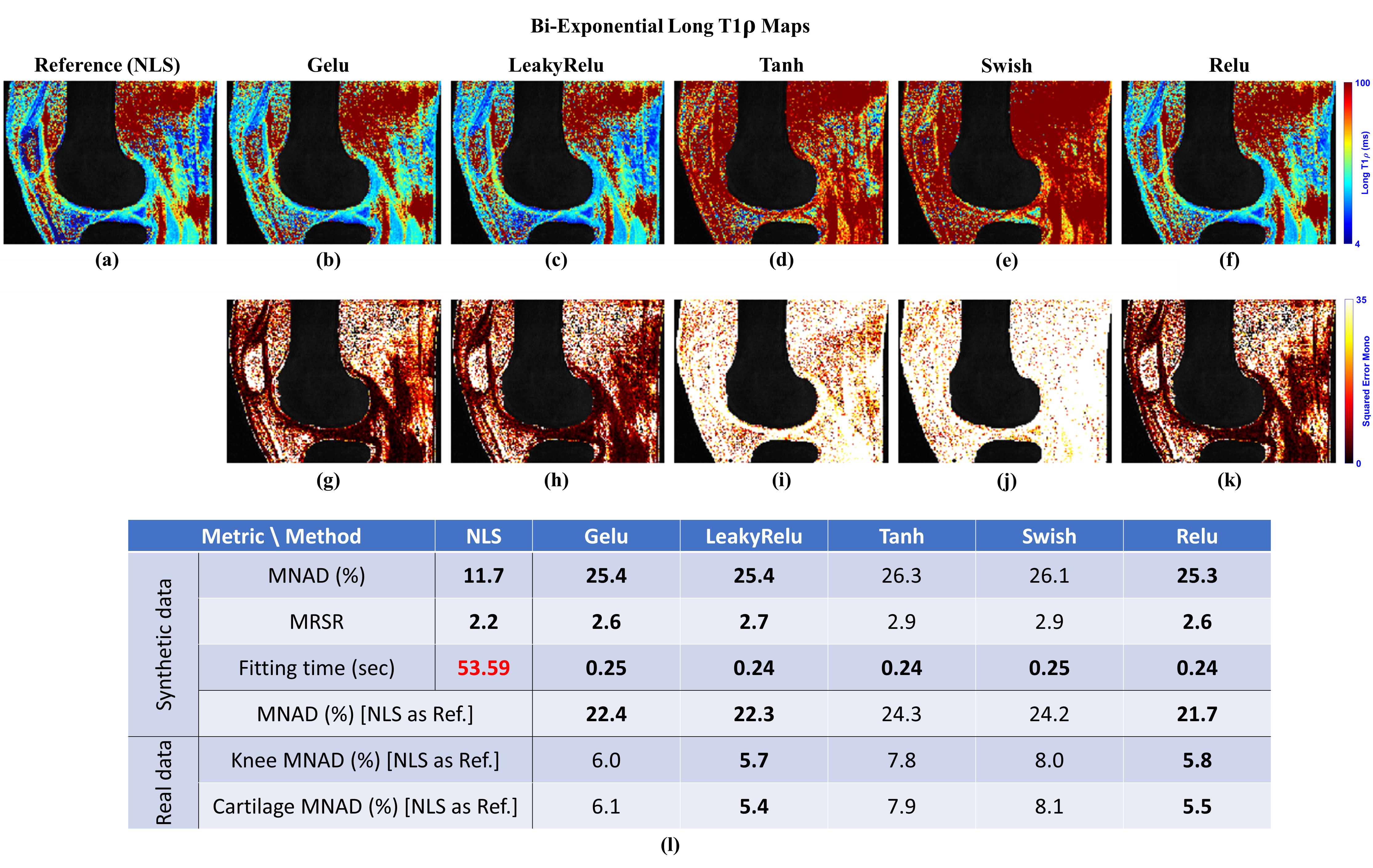
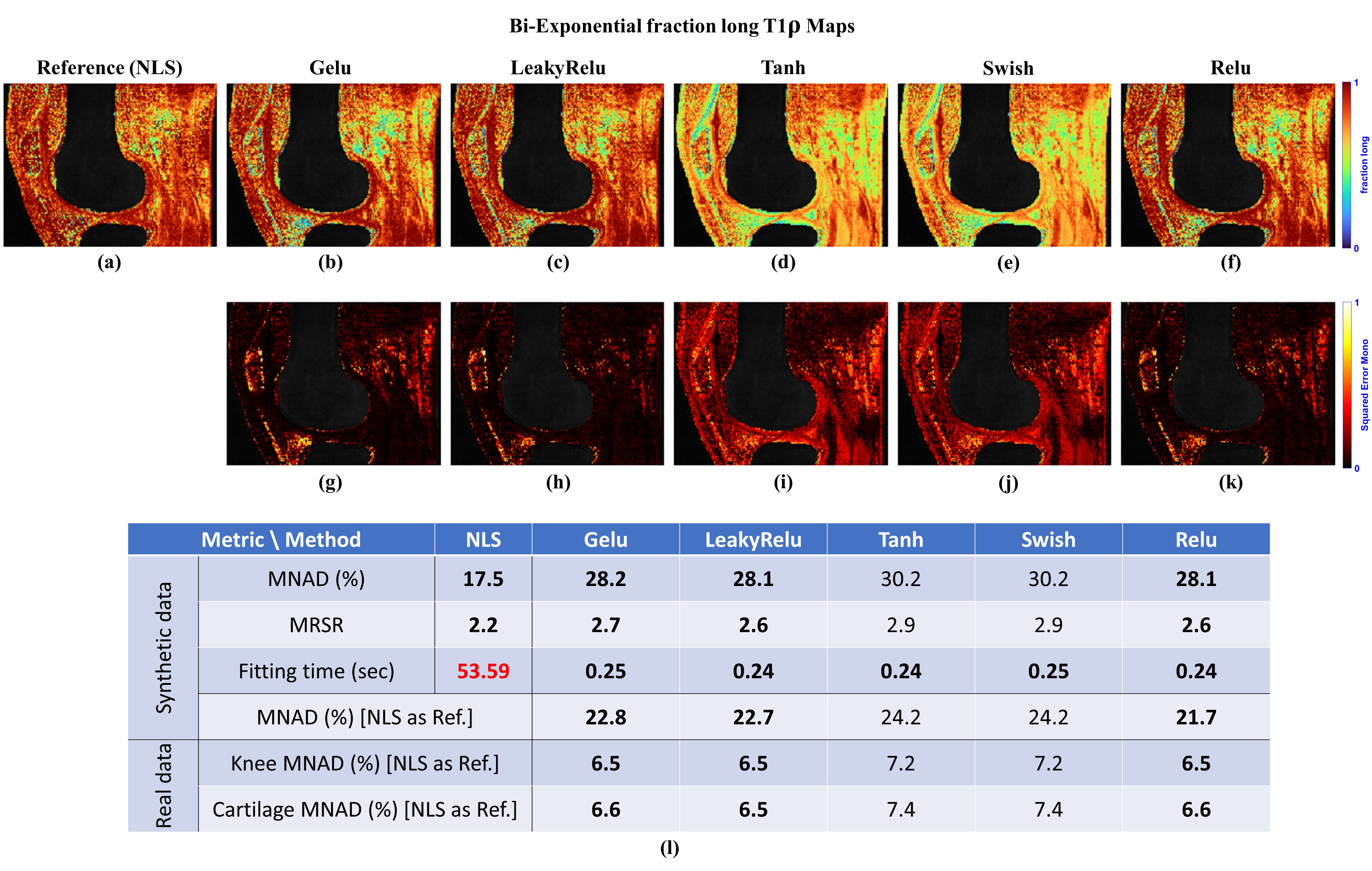
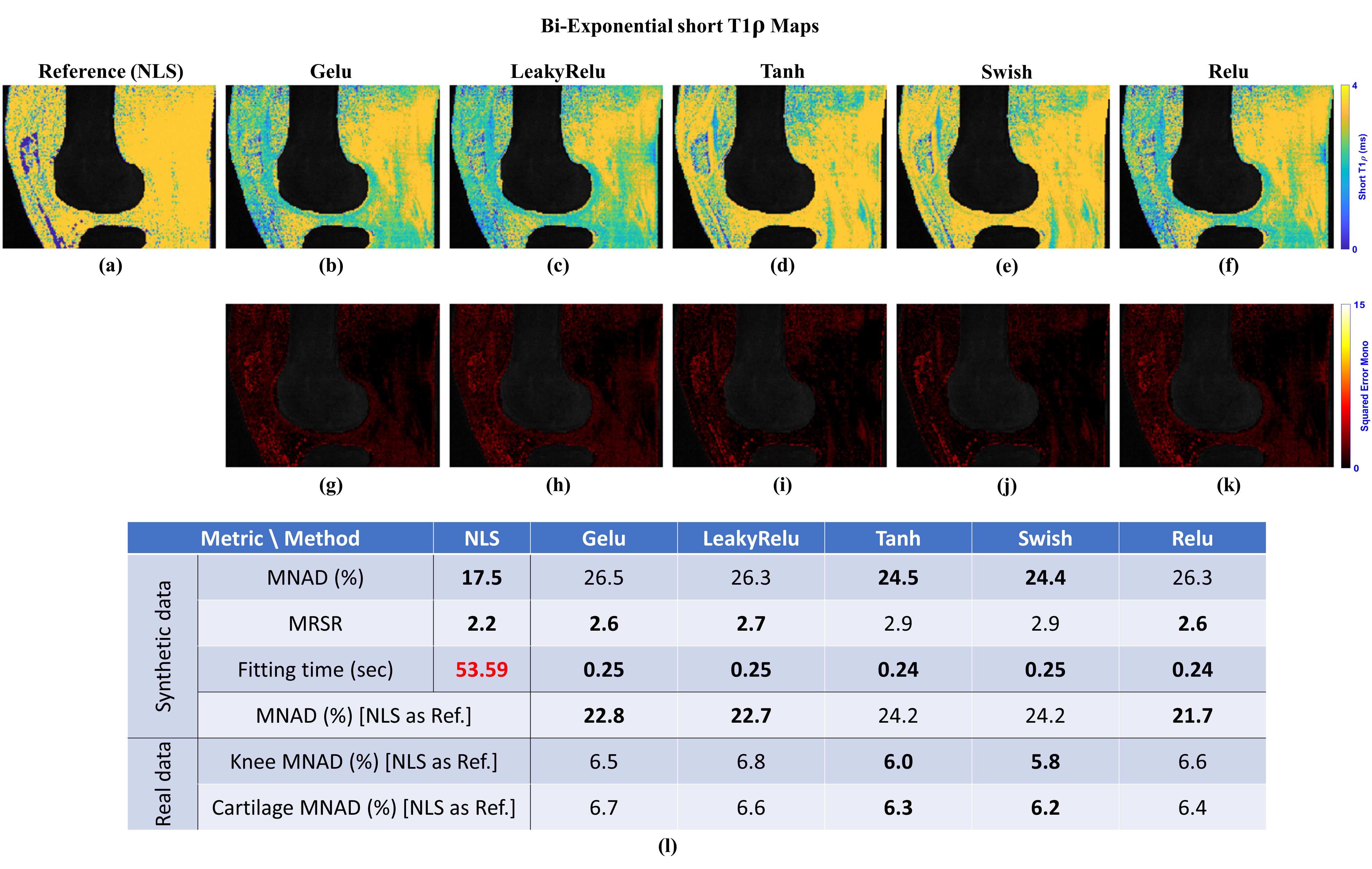
In Figs. 2, 3, 4, and 5, it is shown the results with estimated mono-exponential (ME), BE long, BE fraction long, and BE short components of the T1ρ maps, respectively. Inside the figures, tables show the fitting error of the parameters using the mean of the normalized absolute error (MNAD), and mean root squared residual (MRSR), representing the difference between the voxel-wise values and the relaxation curve produced by the estimated parameters..Note that NLS produced the best quality results in the synthetic case, with MNAD of 3.4~17.4%, and lower residual, with MRSR 2.1~2.3. However, it takes 25-100x more computational time. On the other hand, the best self-supervised approaches obtained an MNAD of 3.9~28.1%, with MRSR 2.5~2.7, with T1ρ maps visually very close to those of the NLS. The best activation functions were Relu and LeakyRelu. While there are still several aspects to investigate, these preliminary results show that voxel-wise self-supervised DL methods, trained with synthetic data, are a good fast alternative to replace NLS for T1ρ mapping of the knee joint.
Acknowledgements
This study was supported by NIH grants, R01-AR076328-01A1, R01-AR076985-01A1, and R01-AR078308-01A1 and was performed under the rubric of the Center of Advanced Imaging Innovation and Research (CAI2R), an NIBIB Biomedical Technology Resource Center (NIH P41-EB017183).References
1. Sharafi, Azadeh, Gregory Chang, and Ravinder R. Regatte. "Bi-component T1ρ and T2 relaxation mapping of skeletal muscle in-vivo." Scientific reports 7, no. 1 (2017): 14115.
2. de Moura, Hector L., Rajiv G. Menon, Marcelo VW Zibetti, and Ravinder R. Regatte. "Optimization of spin-lock times for T1ρ mapping of human knee cartilage with bi-and stretched-exponential models." Scientific Reports 12, no. 1 (2022): 16829.
3. Zibetti, Marcelo VW, Patricia M. Johnson, Azadeh Sharafi, Kerstin Hammernik, Florian Knoll, and Ravinder R. Regatte. "Rapid mono and biexponential 3D-T1ρ mapping of knee cartilage using variational networks." Scientific reports 10, no. 1 (2020): 19144.
4. Liu, Fang, Richard Kijowski, Georges El Fakhri, and Li Feng. "Magnetic resonance parameter mapping using model‐guided self‐supervised deep learning." Magnetic resonance in medicine 85, no. 6 (2021): 3211-3226.
5. Fu, Zhiyang, Sagar Mandava, Mahesh B. Keerthivasan, Zhitao Li, Kevin Johnson, Diego R. Martin, Maria I. Altbach, and Ali Bilgin. "A multi-scale residual network for accelerated radial MR parameter mapping." Magnetic resonance imaging 73 (2020): 152-162.
6. Li, Hongyu, Mingrui Yang, Jee Hun Kim, Chaoyi Zhang, Ruiying Liu, Peizhou Huang, Dong Liang, Xiaoliang Zhang, Xiaojuan Li, and Leslie Ying. "SuperMAP: Deep ultrafast MR relaxometry with joint spatiotemporal undersampling." Magnetic Resonance in Medicine 89, no. 1 (2023): 64-76.
7. Liu, Fang, Alexey Samsonov, Lihua Chen, Richard Kijowski, and Li Feng. "SANTIS: sampling‐augmented neural network with incoherent structure for MR image reconstruction." Magnetic resonance in medicine 82, no. 5 (2019): 1890-1904.
8. Madsen K, Nielsen HB, Tingleff O. Methods for Non-Linear Least Squares Problems. 2nd ed. Technical University of Denmark, DTU; 2004.
Figures