1750
Retrospective k-Space Synthesis for Cardiac MRI Deep-learning Applications from Magnitude-only Images Using Score-based Diffusion Models1Laboratory for Translational Imaging of Microcirculation, Indiana University School of Medicine (IUSM), Indianapolis, IN, United States, 2Electrical and Computer Engineering, Purdue University, West Lafayette, IN, United States, 3Krannert Cardiovascular Research Center, IUSM, Indianapolis, IN, United States, 4Biomedical Engineering, Purdue University, West Lafayette, IN, United States
Synopsis
Keywords: AI Diffusion Models, Cardiovascular, Myocardial Perfusion MRI
Motivation: Developing deep learning (DL)-based image reconstruction techniques requires raw k-space datasets. The use of magnitude-only MRI images (DICOMs) to obtain k-space can be prohibitive for training robust models.
Goal(s): To synthesize phase-maps of DCE cardiac MRI from magnitude-only images by using the recently emerging diffusion models.
Approach: A conditional score-based diffusion model (SBDM) is trained to synthesize phase-maps from the magnitude-only images. The value of the synthesized phase-maps is assessed with a DL-based image reconstruction model.
Results: SBDM-derived phase-maps outperformed random and GAN-based phase-map generation methods in terms of reconstruction performance. Qualitative assessment suggests that SBDMs can generate realistic-looking phase-maps.
Impact: We proposed to leverage the emerging generative diffusion models for retrospective phase-map synthesis of DCE cardiac MRI from the magnitude-only images which has the potential to create large k-space datasets using the magnitude-only multi-center registries to improve deep learning-based reconstruction.
Introduction
Developing deep learning (DL)-based image reconstruction techniques requires large and diverse raw k-space datasets. In most clinical applications, due to storage and patient privacy concerns, raw k-space data is routinely discarded and magnitude-only DICOM images are the only component saved and archived. This poses a major hurdle for training generalizable DL-based models to improve image reconstruction performance. Although applying a simple forward Fourier Transform to a magnitude-only image results in a “valid” k-space, discarding the phase information in the raw k-space (i.e., training the DL model using the k-space derived from the magnitude-only image) could lead to underperformance or instability of the DL-based reconstruction algorithms. In the context of cardiovascular MRI (CMRI), through recent collaborative international efforts, large multi-vendor multi-center DICOM datasets are being built, e.g., the SCMR registry has surpassed 150,000 patient studies with over 300 million images. This motivates the need to develop “generative AI” tools for synthesizing raw k-space data from such large multi-center registry datasets. Recent work has shown the feasibility of using generative adversarial networks (GANs) for synthesis of brain MRI phase-maps to create raw k-space data1. Emerging diffusion models also hold promise in generative tasks with their impressive performance and superior training stability vs. GANs2-4. Herein, we propose a novel score-based diffusion model (SBDM) approach for generating realistic dynamic contrast-enhanced (DCE)-CMRI phase-maps from magnitude-only images. We further evaluate the quality of the synthesized phase-maps by using them to train a DL-based reconstruction algorithm.Methods
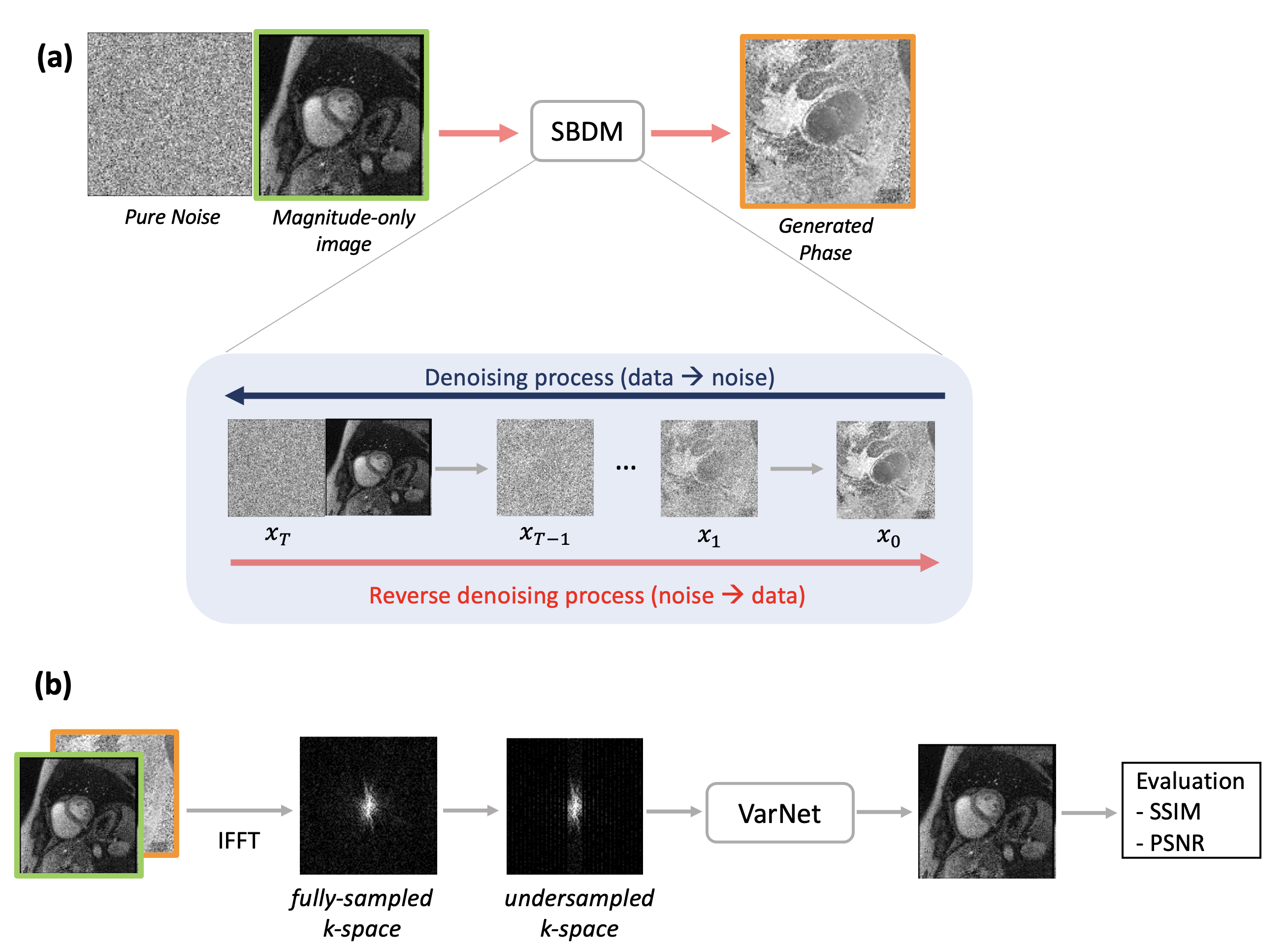
Dataset: Stress/rest DCE-CMRI raw k-space data was acquired at 3-T from patients suspected of ischemia (n=94) using time-interleaved (TGRAPPA) Cartesian acquisition which was split into training/validation (n=70/n=4) and test sets (n=20). Hyperparameter selection of the SBDM was done based on the validation set.SBDM: Score-based diffusion models add noise to the input image to gradually transform it to noise during a diffusion process and learns to reverse this process at each noise scale by computing the score function (i.e., gradient of log probability density functions) at each noise scale. We conditioned the SBDM (trained using a U-Net5 backbone by concatenating the magnitude image as a second channel to the first channel of pure noise input to enable learning of the underlying features during the synthesis process. Fig 1(a) outlines our approach for retrospective generation of realistic phase-maps.
Training and Evaluation: We evaluated the quality of the generated phase-maps using DL-based image reconstruction approach VarNet6. The input to VarNet is undersampled k-space which is obtained by combining synthesized phase-maps (output of the SBDM) with magnitude images, as shown in Fig. 1(b), followed by undersampling. During VarNet training, 5-fold cross validation was performed by splitting the test set (n=20) for a second time (n=16 training/n=4 test split for VarNet). As the state-of-the-art (SoTA) comparison method, we trained a generative adversarial network (GAN)7 to compare its capabilities vs. SBDMs.
Results
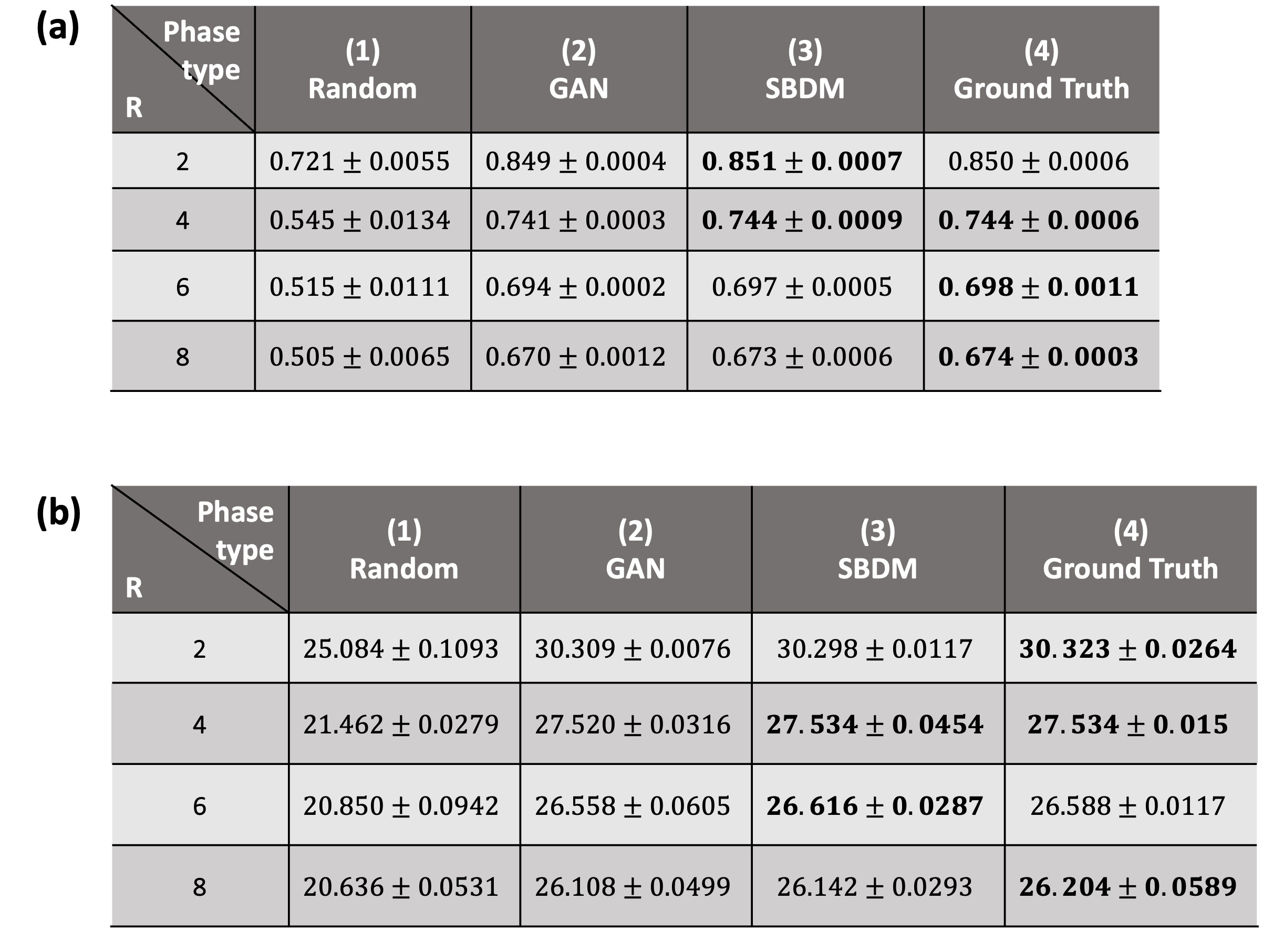
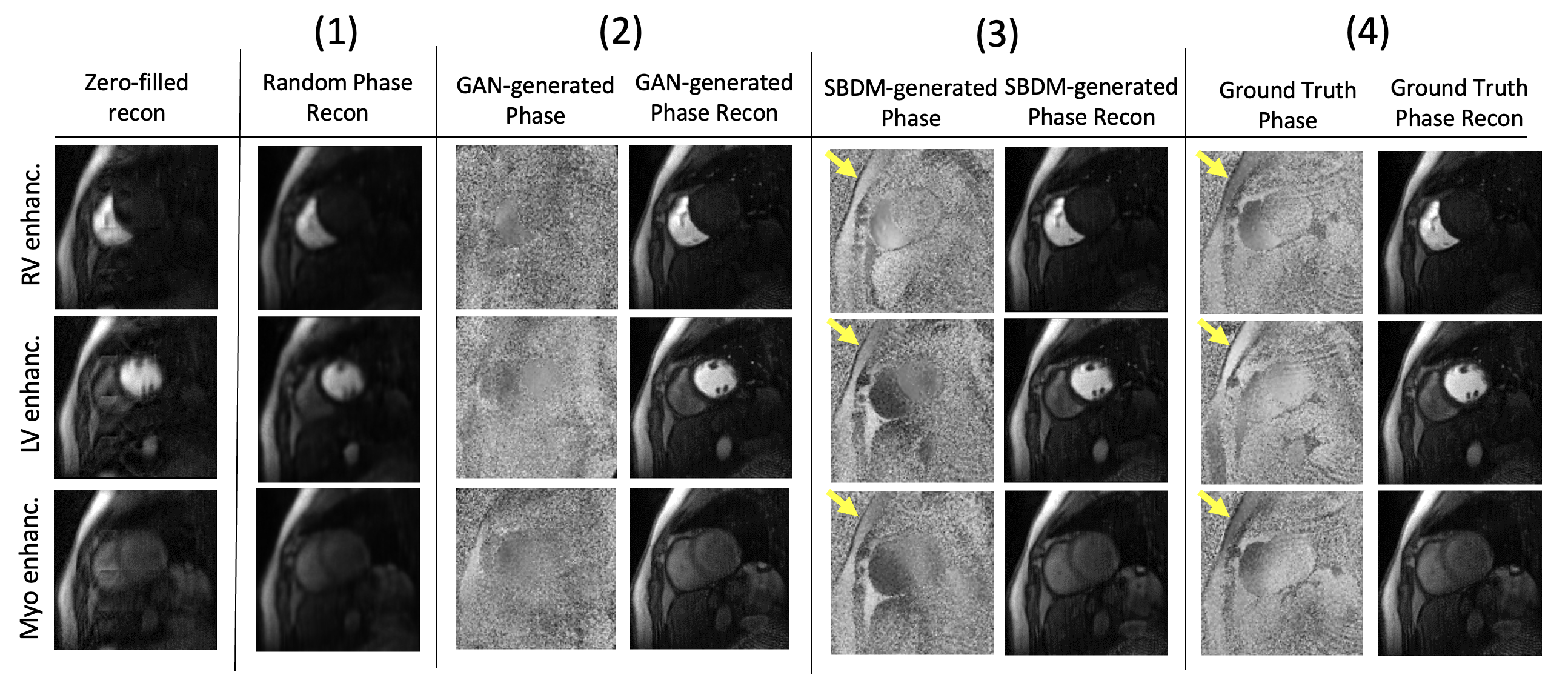
Table 1 summarizes the cumulative performance of VarNet reconstructions evaluated using structural similarity index measure (SSIM) and peak signal-to-noise ratio (PSNR) across different sources of phase-maps: (1) randomly generated (naïve approach), (2) GAN-generated as the SoTA comparison, (3) proposed SBDM-synthesized, and (4) ground truth phase-maps (as a control experiment) at various acceleration factors (R ∈ {2,4,6,8}). As can be seen, our proposed SBDM-derived phase-map outperforms the randomly generated ones across the board as expected and, in fact, achieves a similar performance as the ground truth phase. The proposed approach also surpasses SoTA GAN-generated phase-maps in terms of SSIM and PSNR, although with a small difference. Qualitative assessment, however, revealed that SBDM can generate more “realistic looking” phase-maps compared to GANs. For example, Fig. 2 shows the results for a representative case where retrospectively generated phase-maps using the SBDM approach appear realistic, i.e., similar to the ground truth phase-map (yellow arrows point to the location of similar structure in the phase-maps).Conclusion
Our proposed generative SBDM framework enables retrospective synthesis of realistic phase-maps from magnitude-only DICOMs which, in turn, creates realistic raw k-space data corresponding to the acquired CMRI dataset. Moreover, our results indicate that the generated raw k-space can improve the performance of DL-based reconstruction, which points to the possibility of leveraging large DICOM datasets to develop robust DL-based reconstruction techniques. To the best of our knowledge, this work is the first to implement conditional SBDMs to synthesize phase-maps for MRI datasets.* Dilek M. Yalcinkaya and M. Berk Sahin contributed equally to this work.
Acknowledgements
This work was supported by the NIH awards R01-HL153430 & R01-HL148788, and the Lilly Endowment INCITE award (PI: B. Sharif).References
1. Deveshwar N, et al. Synthesizing Complex-Valued Multicoil MRI Data from Magnitude-Only Images. Bioengineering. 2023;10(3):358.
2. Song J, et al. Denoising diffusion implicit models. Int Conf Learn Represent (ICLR) 2021. DOI: 10.48550/arXiv.2010.02502.
3. Song Y, et al. Score-based generative modeling through stochastic differential equations. Int Conf Learn Represent (ICLR) 2021. DOI: 10.48550/arXiv.2011.13456.
4. Miyato T, et al. Spectral normalization for generative adversarial networks. Int Conf Learn Represent (ICLR) 2018. DOI: 10.48550/arXiv.1802.05957.
5. Ronneberger O, et al. U-Net: Convolutional Networks for Biomedical Image Segmentation. Med Image Comput Comput Assist Interv (MICCAI) 2015. Part III (pp. 234-241). DOI: 10.1007/978-3-319-24574-4_28
6. Sriram A, et al. End-to-end variational networks for accelerated MRI reconstruction. Med Image Comput Comput Assist Interv (MICCAI) 2020, Part II (pp. 64-73). DOI: 10.1007/978-3-030-59713-9_7
7. Isola P, et al. Image-to-Image Translation with Conditional Adversarial Networks. Proc 2017 IEEE Comput Soc Conf Comput Vis Pattern Recognit (IEEE CVPR). DOI: 10.48550/arXiv.1611.07004.
Figures