1739
Eight weeks of bright light therapy increases myelin density in the posterior thalamic radiation in young adults with subthreshold depression1First Affiliated Hospital of Jinan University, Guangzhou, China, 2MR Research, GE Healthcare, Beijing, China, Guangzhou, China
Synopsis
Keywords: Psychiatric Disorders, White Matter
Motivation: Subthreshold depression (SD) is a significant risk indicator of major depressive episodes. The inhomogeneous magnetization transfer (ihMT) technique has not been used to probe myelin abnormalities and its response to bright light therapy (BLT) in SD.
Goal(s): In this study, we used ihMT technique to investigate myelin integrity in a relatively large sample size of university students with SD.
Approach: The qihMT and ihMTR values of 50 white matter (WM) fibers were compared between SD and HCs.
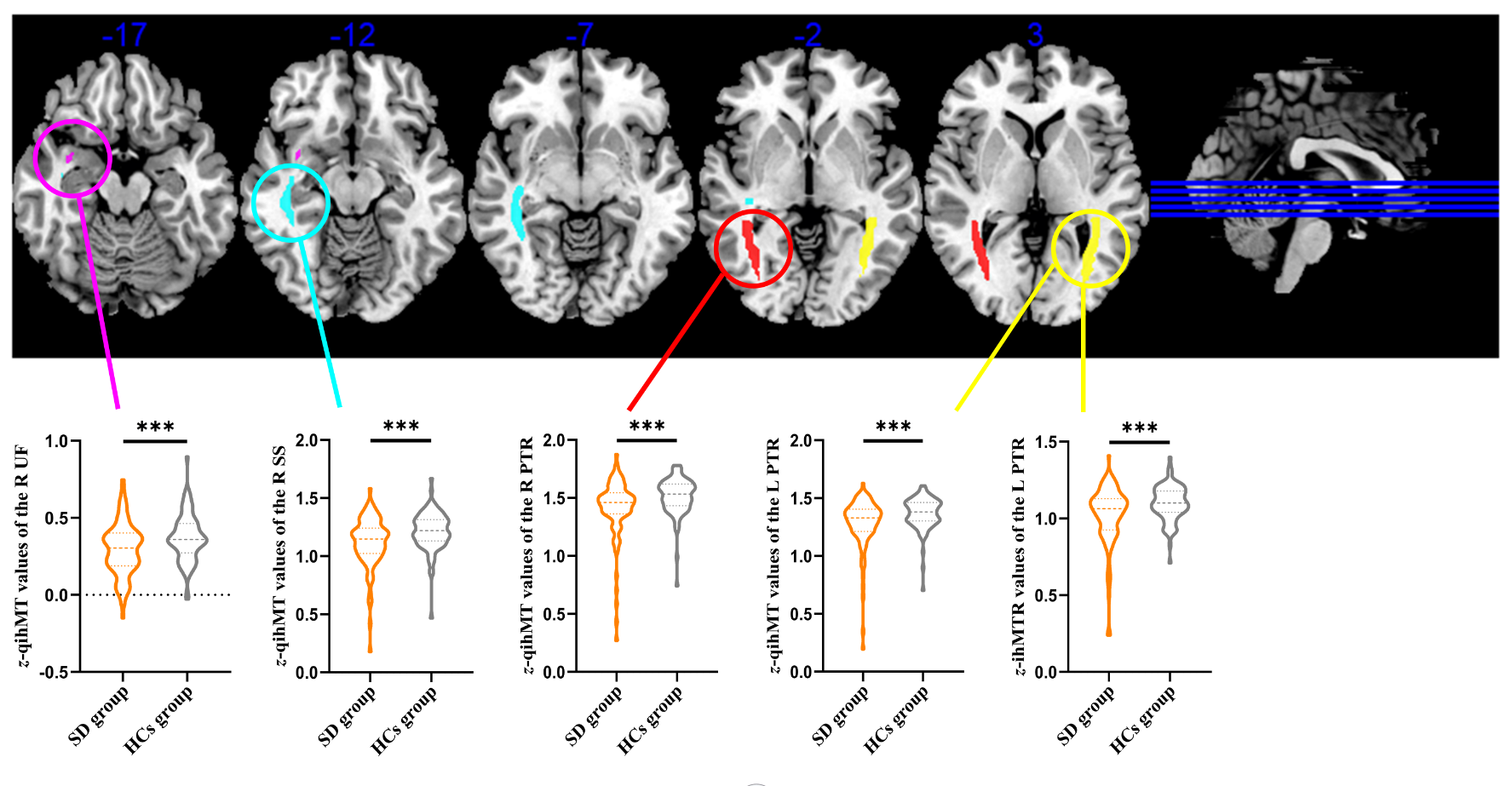
Results: Macromolecular disruption of myelin in the posterior thalamic radiation (PTR), sagittal stratum, and uncinate fasciculus might exist in the early stages of depression.
Impact: These findings suggest the myelin impairments in the posterior thalamic radiation could be reversed by bright light therapy, which might be used as the potential neural target for bright light therapy in subthreshold depression.
Introduction
Subthreshold depression (SD) is a significant risk indicator of major depressive episodes. The inhomogeneous magnetization transfer (ihMT) technique has not been used to probe myelin abnormalities and its response to bright light therapy (BLT) in SD.Methods
A total of 104 college students with SD and 91 age- and sex-matched healthy controls (HCs) were included. All participants underwent ihMT imaging, and pseudo-quantitative ihMT (qihMT), and ihMT ratio (ihMTR) were obtained. The qihMT and ihMTR values of 50 white matter (WM) fibers were compared between SD and HCs. Thirty-one SD participants underwent eight weeks of BLT, after which we observed the effect of treatment on WM fibers with abnormal qihMT and ihMTR values at baseline in SD. Also, the psychological variables were compared before and after BLT in SD.Results
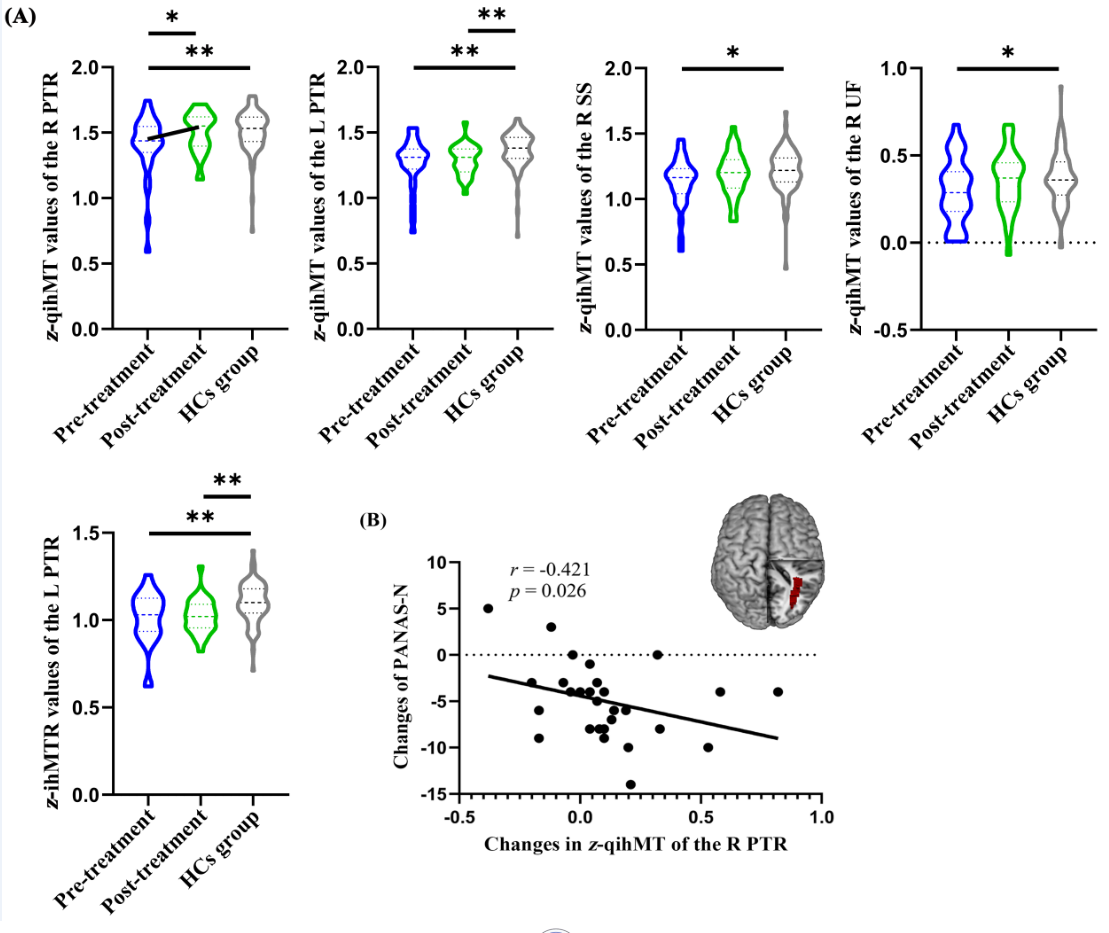
Compared to HCs, SD showed decreased qihMT values in the bilateral posterior thalamic radiation (PTR) (including optic radiation), right sagittal stratum (including inferior longitudinal fasciculus and inferior fronto-occipital fasciculus), and right uncinate fasciculus, and decreased ihMTR values in the left PTR (include optic radiation) at baseline (all, p ≤ 0.001). After eight weeks of treatment, qihMT values of all the above fiber tracts increased by BLT in SD patients, with no significant differences than HCs, and qihMT values of the right PTR increased in SD compared to baseline (p < 0.05).Conclusion
This study provides preliminary evidence of macromolecular disruption of myelin in several WM tracts, including the PTR, IFOF, ILF, and UF in SD. Decreased density of the WM myelin may have an important role in the neural pathology of SD and may occur early in the initial stages of depression. Furthermore, the myelin impairments in the PTR could be reversed by BLT, which represents the potential neural targets for BLT in SD. The ihMT technique may become a valuable and sensitive screening method for evaluating stages of depression and assessing treatment responses.Acknowledgements
The study was supported by grants from the National Natural Science Foundation of China (81671670, 81971597, and 82172530); National Key Research and Development Project (2020YFC2005700); Key-Area Research and Development Program of Guangdong Province (2020B1111100001). The funding organizations play no further role in study design, data collection, analysis and interpretation and paper writing.References
No reference found.Figures