1729
Dose Dependence of Acute Nicotine on Neurometabolic Activity in Mouse Brain1NMR Microimaging and Spectroscopy, Centre for Cellular and Molecular Biology, Hyderabad, India, 2Academy of Scientific & Innovative Research (AcSIR), Ghaziabad, India
Synopsis
Keywords: Psychiatric Disorders, Metabolism, Brain, Glutamate, GABA, Addiction
Motivation: Nicotine addiction is a neuropsychiatric disorder with worldwide deaths. Nicotine affects dopaminergic system. However, the dose dependent effect of nicotine on neurometabolic activity is not clear.
Goal(s): To evaluate the impact of dose dependence of acute nicotine on the metabolic activity of glutamatergic and GABAergic neurons in the prefrontal cortex in mice.
Approach: Different acute subcutaneous doses of nicotine were given to mice. Prefrontal cortex extracts were analysed by 1H-[13C]-NMR spectroscopy to quantify 13C labelled amino acids and rate of glucose oxidation in neurons.
Results: Nicotine at low dose has excitatory but at high doses has inhibitory effect on neuronal activity in mice.
Impact: Our data shows that nicotine at 0.025 mg/kg increases metabolic activity of glutamatergic neurons but at 1.0 and 2.0 mg/kg decreases. Additionally, nicotine at 1.0 and 2.0 mg/kg suppresses metabolic activity of GABAergic neurons.
Introduction
Addiction is a neuropsychiatric disorder characterized by a recurring desire to continue taking the drug despite its harmful consequences1. Tobacco is one of the most common addictive substances of which nicotine is the major constituent. Acute nicotine increases extracellular dopamine levels in the nucleus accumbens shell2, thereby affecting glucose utilisation in rat brain3. However, the dose dependence of nicotine on neuronal metabolic activity is not very clear. In this study, we have evaluated the impact of acute nicotine on the metabolic activity of glutamatergic and GABAergic neurons in the prefrontal cortex of mice brain.Method
All the experimental procedures with mice were approved by the Institutional Ethical Committee of Centre for Cellular and Molecular Biology, Hyderabad, India. Two months old male C57BL/6J mice were divided into different groups for nicotine (0.025, 0.25, 1.00 and 2.00 mg/kg) and sham treatment. After 15 min of nicotine injection (subcutaneous), mice were infused with [1,6-13C2]glucose using a bolus variable infusion schedule, and at 7 min brain was fixed with focused beam microwave irradiation4. The 13C labeling of brain amino acids was measured in prefrontal cortical tissue extracts. The cerebral metabolic rates of glucose oxidation (CMRGlc) were evaluated as described previously5. The statistical significance of impact of nicotine dose on CMRGlc was assessed by one way ANOVA.Results
The concentrations of neurometabolites were quantified from unedited 1H-[13C]-NMR spectrum (Fig. 1). There was no significant effect of nicotine on the levels of neurometabolites across brain. The concentrations of 13C metabolites from glucose were evaluated using 13C edited spectra (lower panels). One way ANOVA analysis indicated significant impact of nicotine on GluC4 [F(4,24)=4.84, p=0.005]. Further analysis using Bonferroni correction for multiple comparison revealed a significant (p=0.007) reduction in GluC4 labeling (2.55±0.23 µmol/g) for nicotine (2 mg/kg) when compared with sham treated controls (3.14±0.26 µmol/g) (Table 1 and Fig. 1). Additionally, there were a reduction in the GluC3 (p=0.007) and GABAC2 (p=0.0003). Moreover, GluC3 (p=0.004) and GABAC2 (p=0.006) were reduced with nicotine 1 mg/kg. There were no significant impact of nicotine on the labeling of GABAC4, GlnC4 and AspC3. The rate of glucose oxidation in glutamatergic (CMRGlc(Glu)) neurons (0.636±0.048 µmol/g/min) was significantly (p=0.0367) increased for nicotine (0.025 mg/kg) when compared with normal saline treated controls (0.561±0.047 µmol/g/min) (Fig. 2). In contrast, CMRGlc(Glu) was decreased at nicotine at 1 (p=0.008) and 2 mg/kg (p=0.0006) when compared to controls. GABAergic neurometabolic (CMRGlc(GABA)) activity was unperturbed with nicotine 0.025 mg/kg. However, there was a reduction in CMRGlc(GABA) at nicotine 1 (p=0.024) as well as 2 mg/kg (p=0.003) dose.Discussion
The neurotransmitter cycling flux is stoichiometrically coupled with neuronal glucose oxidation6. Hence, the finding of increase in CMRGlc(Glu) is suggestive of enhanced excitatory activity in the PFC with low dose of nicotine (0.025). In contrast, nicotine at higher doses (≥1.0 mg/kg) suppresses both excitatory and inhibitory neurotransmission in prefrontal cortex.Acknowledgements
This study was supported by funding from CSIR-CCMB. PB acknowledges Senior Research Fellowship from CSIR (31/039(0399)/2019-EMR-I).
References
1. Zou Z, Wang H, d'Oleire Uquillas F, Wang X, Ding J, & Chen H (2017) Definition of Substance and Non-substance Addiction. Advances in experimental medicine and biology, 1010, 21–41.
2. Pontieri FE, Tanda G, Orzi F, & Di Chiara G (1996) Effects of nicotine on the nucleus accumbens and similarity to those of addictive drugs. Nature, 382(6588), 255–257.
3. London ED, Connolly RJ, Szikszay M, Wamsley JK, & Dam M (1988). Effects of nicotine on local cerebral glucose utilization in the rat. The Journal of neuroscience : the official journal of the Society for Neuroscience, 8(10), 3920–3928.
4. Soni ND, Ramesh A, Roy D, & Patel AB (2021) Brain energy metabolism in intracerebroventricularly administered streptozotocin mouse model of Alzheimer's disease: A 1H-[13C]-NMR study. Journal of cerebral blood flow and metabolism: official journal of the International Society of Cerebral Blood Flow and Metabolism, 41(9), 2344–2355.
5. Mishra PK, Kumar A, Behar KL, & Patel AB (2018) Subanesthetic ketamine reverses neuronal and astroglial metabolic activity deficits in a social defeat model of depression. Journal of neurochemistry, 146(6), 722–734.
6. Sibson NR, Dhankhar A, Mason GF, Rothman DL, Behar KL, & Shulman RG. (1998). Stoichiometric coupling of brain glucose metabolism and glutamatergic neuronal activity. Proceedings of the National Academy of Sciences of the United States of America, 95(1), 316–321.
Figures
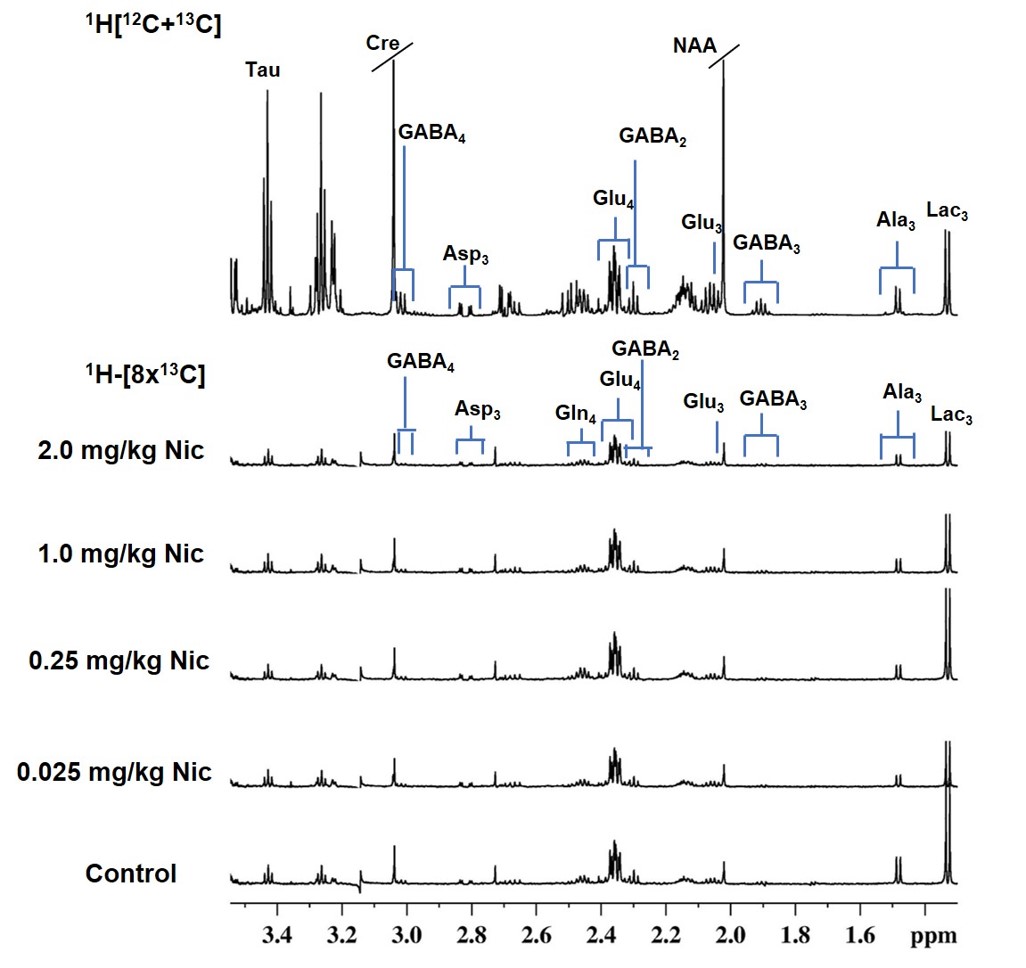
Figure 1. 1H-[13C]-NMR spectra of prefrontal cortex extract of mice treated with different concentrations of nicotine
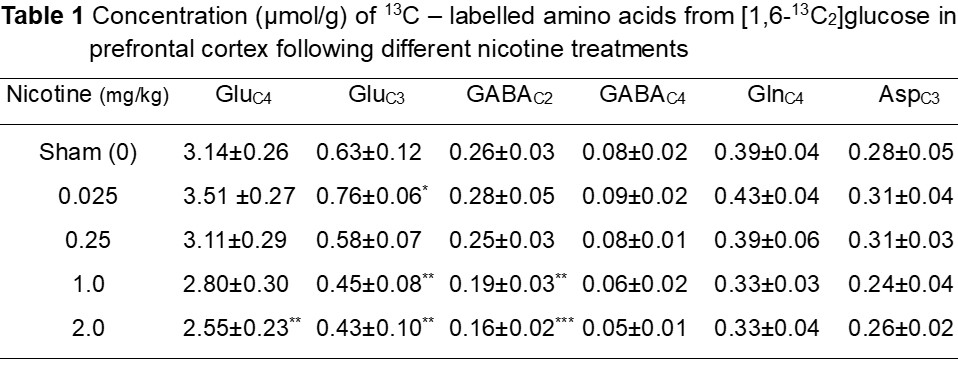
*p<0.05, **p<0.01, ***p<0.001 when nicotine treated mice are compared with sham
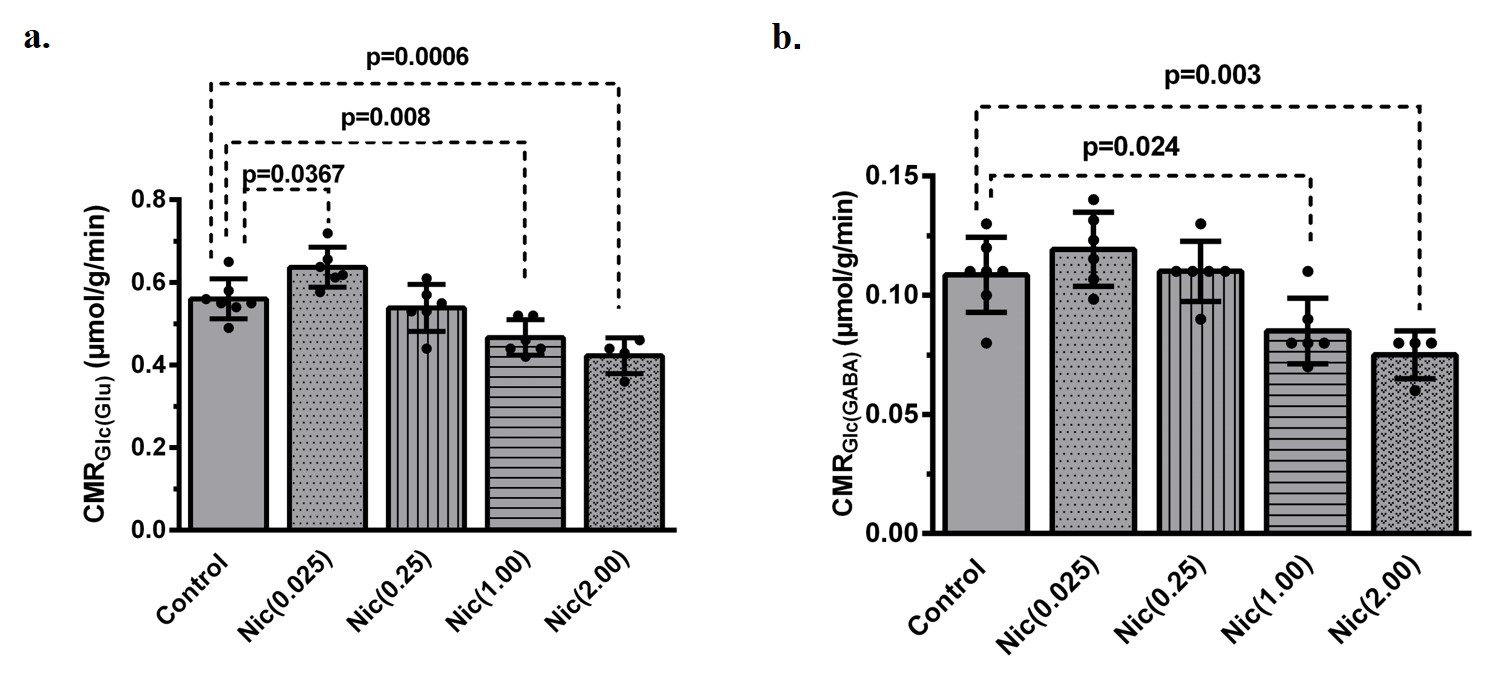
Figure 2. Dependence of metabolic rate of glucose oxidation in a) glutamatergic neurons, b) GABAergic neurons with nicotine concentration.