1664
MR feature tracking in assessment on myocardial deformation in patients on maintenance hemodialysis1Department of Radiology, Affiliated Hospital of Guizhou Medical University, Gui yang, China
Synopsis
Keywords: Myocardium, Cardiovascular
Motivation: To explore the application value of cardiac magnetic resonance (CMR) feature tracking technique in patients on maintenance hemodialysis(MHD).
Goal(s): To explore the application value of CMR feature tracking technique in patients on MHD.
Approach: CMR examination was performed in both groups, and the left ventricular myocardial strain values were obtained by FT-CMR to explore the differences in myocardial deformation between the two groups.
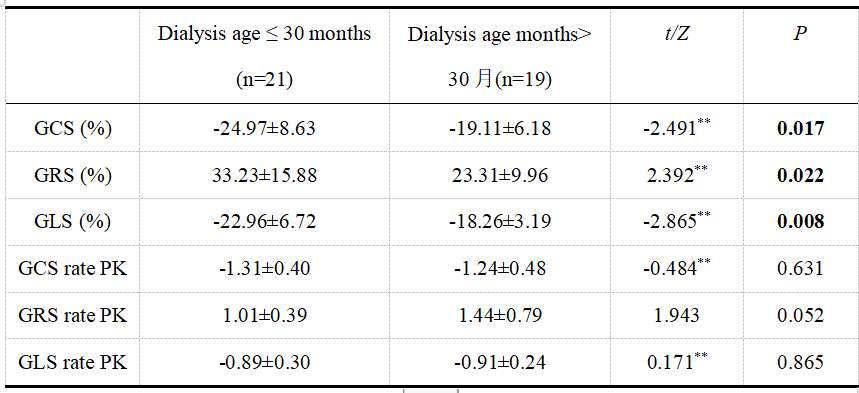
Results: With the increase of dialysis age, GCS, GRS and GLS were significantly lower than that in the low dialysis age group (-24.97±8.63 vs. -19.11±6.18, P=0.017; 23.31±9.96 vs. 33.23±15.88, P=0.022; -18.26±3.19 vs. -22.96±6.72, P=0.008).
Impact: In those with preserved ejection fraction, myocardial strain parameters are reduced, suggesting that the use of FT-CMR technique is helpful for early diagnosis of myocardial deformation injury in MHD patients.
Objective
To explore the application value of cardiac magnetic resonance (CMR) feature tracking technique in patients on maintenance hemodialysis(MHD).Methods
45 patients with MHD were prospectively collected, and 47 normal volunteers were recruited as the control group. First, to observe the differences of myocardial strain parameters between the patient group and the control group , and the changes of myocardial deformation in maintenance hemodialysis patients were evaluated as a whole. Then, the patient group was divided into low permeability age group and high permeability age group by dialysis age of 30 months, and the change trend of myocardial deformation with the increase of dialysis age in maintenance hemodialysis patients was observed. The changes of myocardial strain parameters in MHD patients with retained ejection fraction and control group were analyzed.Results
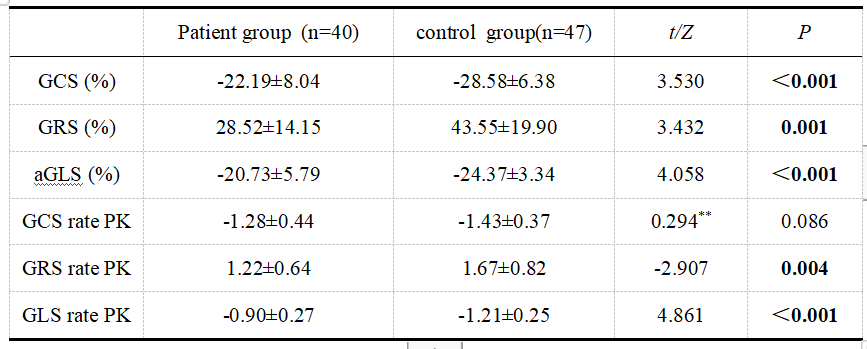
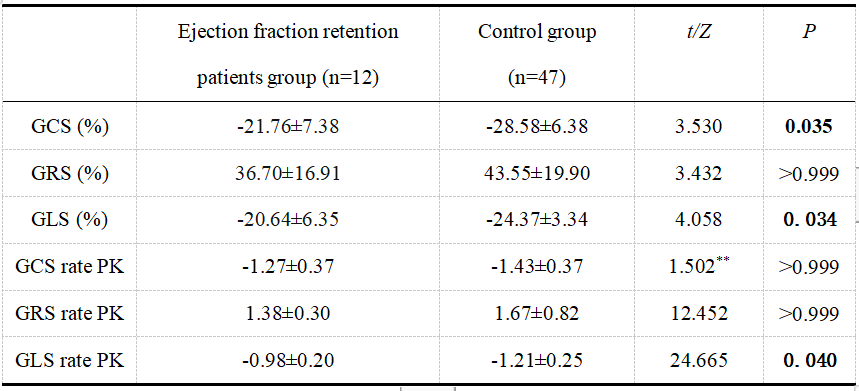
GCS, GRS and GLS in the patient group were significantly lower than those in the control group (-22.19±8.04 vs. -28.58±6.38, P<0.001; 28.52±14.15 vs. 43.55±19.90, P=0.001; -20.73±5.79 vs. -24.37±3.34, P<0.001).With the increase of dialysis age, GCS, GRS and GLS were significantly lower than that in the low dialysis age group (-24.97±8.63 vs. -19.11±6.18, P=0.017; 23.31±9.96 vs. 33.23±15.88, P=0.022; -18.26±3.19 vs. -22.96±6.72, P=0.008).GCS,GLS in the patient group with retained ejection fraction were significantly lower than those in the control group (-21.76±7.38 vs. -28.58±6.38,P=0.035; -20.64±6.35 vs. -24.37±3.34, P=0.034).Conclusion
In MHD patients, especially in those with preserved ejection fraction, myocardial strain parameters are reduced, suggesting that the use of FT-CMR technique is helpful for early diagnosis of myocardial deformation injury in MHD patients.Acknowledgements
Thank you to the experts and staff of this conferenceReferences
[1] Tonelli M, Muntner P, Lloyd A, Manns BJ, Klarenbach S, Pannu N, James MT, Hemmelgarn BR. Risk of coronary events in people with chronic kidney disease compared with those with diabetes: a population-level cohort study[J]. Lancet, 2012,380(9844):807-814.
[2] Liyanage T, Ninomiya T, Jha V, Neal B, Patrice HM, Okpechi I, Zhao MH, Lv J, Garg AX, Knight J, Rodgers A, Gallagher M, Kotwal S, Cass A, Perkovic V. Worldwide access to treatment for end-stage kidney disease: a systematic review[J]. Lancet, 2015,385(9981):1975-1982.
[3] Pecoits-Filho R, Okpechi IG, Donner JA, Harris DCH, Aljubori HM, Bello AK, Bellorin-Font E, Caskey FJ, Collins A, Cueto-Manzano AM, Feehally J, Goh BL, Jager KJ, Nangaku M, Rahman M, Sahay M, Saleh A, Sola L, Turan KR, Walker RC, Walker R, Yao Q, Yu X, Zhao MH, Johnson DW. Capturing and monitoring global differences in untreated and treated end-stage kidney disease, kidney replacement therapy modality, and outcomes[J]. Kidney Int Suppl (2011), 2020,10(1):e3-e9.
[4] Couillerot-Peyrondet AL, Sambuc C, Sainsaulieu Y, Couchoud C, Bongiovanni-Delarozière I. A comprehensive approach to assess the costs of renal replacement therapy for end-stage renal disease in France: the importance of age, diabetes status, and clinical events[J]. Eur J Health Econ, 2017,18(4):459-469.
[5] Ahmadmehrabi S, Tang W. Hemodialysis-induced cardiovascular disease[J]. Semin Dial, 2018,31(3):258-267.
[6] Ahmadmehrabi S, Tang W. Hemodialysis-induced cardiovascular disease[J]. Semin Dial, 2018,31(3):258-267.
[7] Saran R, Robinson B, Abbott KC, Agodoa LY, Albertus P, Ayanian J, Balkrishnan R, Bragg-Gresham J, Cao J, Chen JL, Cope E, Dharmarajan S, Dietrich X, Eckard A, Eggers PW, Gaber C, Gillen D, Gipson D, Gu H, Hailpern SM, Hall YN, Han Y, He K, Hebert H, Helmuth M, Herman W, Heung M, Hutton D, Jacobsen SJ, Ji N, Jin Y, Kalantar-Zadeh K, Kapke A, Katz R, Kovesdy CP, Kurtz V, Lavalee D, Li Y, Lu Y, McCullough K, Molnar MZ, Montez-Rath M, Morgenstern H, Mu Q, Mukhopadhyay P, Nallamothu B, Nguyen DV, Norris KC, O'Hare AM, Obi Y, Pearson J, Pisoni R, Plattner B, Port FK, Potukuchi P, Rao P, Ratkowiak K, Ravel V, Ray D, Rhee CM, Schaubel DE, Selewski DT, Shaw S, Shi J, Shieu M, Sim JJ, Song P, Soohoo M, Steffick D, Streja E, Tamura MK, Tentori F, Tilea A, Tong L, Turf M, Wang D, Wang M, Woodside K, Wyncott A, Xin X, Zang W, Zepel L, Zhang S, Zho H, Hirth RA, Shahinian V. Us renal data system 2016 annual data report: Epidemiology of kidney disease in the united states[J]. Am J Kidney Dis, 2017,69(3 Suppl 1):A7-A8.
Figures