1652
Preoperative Left Atrial Strain Predicts Outcome in Patients with Hypertrophic Obstructive Cardiomyopathy after Myectomy1Fuwai Hospital, Beijing, China
Synopsis
Keywords: Myocardium, Cardiovascular
Motivation: The association of preoperative LA strain assessed by cardiac magnetic resonance (CMR)-FT with the late outcome of HOCM patients after myectomy remains unknown.
Goal(s): To evaluate the prognostic value of preoperative LA strain in HOCM following myectomy.
Approach: In this retrospective, single-center study, 802 adult patients with HOCM after myectomy were included, who underwent preoperative CMR with clinical outcome follow-up.
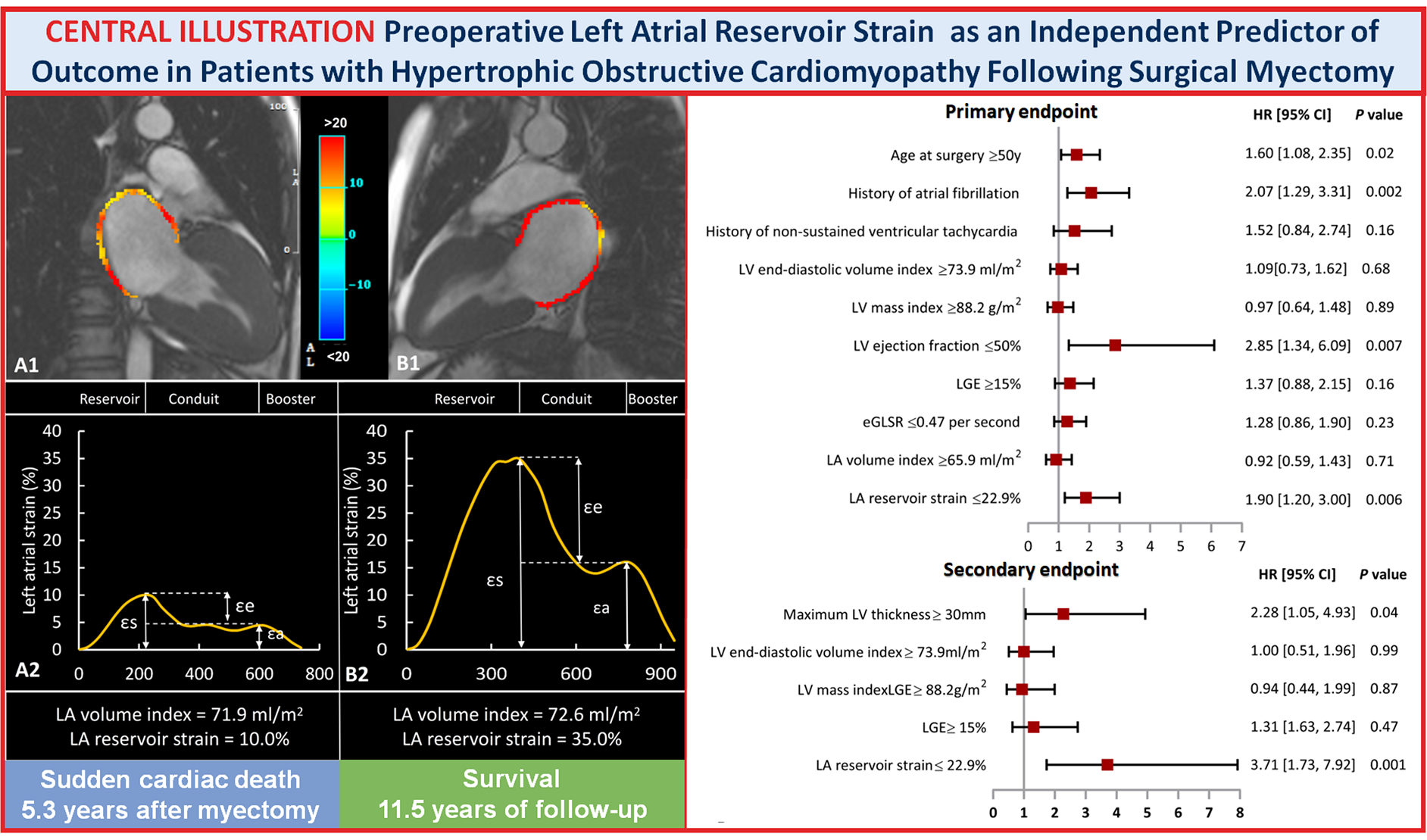
Results: LA reservoir strain ≤ 22.9% was independently associated with postoperative adverse outcomes. Incorporating LA reservoir strain, the performance of the HCM Risk-SCD score improved for SCD prediction (C-statistic: from 0.62 to 0.69; log-likelihood: from -110.31 to -108.27, P=.04).
Impact: HOCM patients with reduced preoperative LA reservoir strain tend to have poor postoperative outcomes, so reinforced follow-ups may be required in those patients.
BACKGROUND
Left atrial (LA) enlargement and dysfunction are frequently seen in patients with hypertrophic obstructive cardiomyopathy (HOCM). Feature tracking (FT) allows sensitive quantification of LA functional remodeling regardless of LA size. However, the association of preoperative LA strain assessed by cardiac magnetic resonance (CMR)-FT with the late outcome of HOCM patients after myectomy remains unknown.OBJECTIVES
To investigate the prognostic value of preoperative FT-derived LA strain among patients with HOCM following myectomyMETHODS
In this retrospective, single-center study, 802 adult patients with HOCM who underwent myectomy from January 2010 through December 2017 were included. All patients underwent preoperative CMR with complete clinical outcome follow-up. Preoperative LA phasic strains were measured using CMR-FT, and the 2014 ESC guideline-based hypertrophic cardiomyopathy (HCM) Risk-Sudden cardiac death (SCD) score was calculated. Primary endpoint included all-cause mortality, heart transplantation, unscheduled hospitalization for heart failure, and stroke. Secondary endpoint included all-cause mortality and heart transplantation.RESULTS
Of the 802 patients in this study, 116 experienced primary endpoints and 38 experienced secondary endpoints during a median follow-up of 56.7 (IQR, 40.2-78.6) months. Among all LA volumetric and functional parameters, LA reservoir strain demonstrated the strongest predictive power for the occurrence of adverse outcomes. Compared with the group with LA reservoir strain > 22.9% (median), the annual event rate of primary endpoint (4.2% vs. 1.7%, p<0.0001), secondary endpoint (1.5% vs. 0.4%, p=0.0005), and SCD (0.7% vs. 0.2%, p=0.047) was significantly higher in the group with LA reservoir strain ≤ 22.9%. In multivariable Cox proportional hazards regression analysis, LA reservoir strain ≤ 22.9% was independently associated with primary endpoint (HR 1.98, 95%CI 1.26-3.11, p=0.003) and secondary endpoint (HR 3.71, 95%CI 1.73-7.92, p=0.001). Incorporating LA reservoir strain, the performance of the HCM Risk-SCD score improved for SCD prediction (C-statistic: from 0.62 to 0.69; log-likelihood: from -110.31 to -108.27, p=0.04).CONCLUSIONS
In patients with HOCM undergoing myectomy, reduced preoperative LA reservoir strain assessed by CMR-FT is independently associated with postoperative adverse outcomes. LA reservoir strain shows the potential to optimize the risk stratification of SCD incidents in patients with HOCM after myectomy.Acknowledgements
This study is supported by grants from the National Key Research and Development Program of China (No. 2021YFF0501404, No. 2021YFF0501400), the key projects of the National Natural Science Foundation of China (No. 81930044), National High Level Hospital Clinical Research Funding (No. 2022-GSP-GG-29), and CAMS Innovation Fund for Medical Sciences (No. 2022-I2M-1-005).References
1. Yang S, Chen X, Zhao K, Yu S, Dong W, Wang], et al. Reverse remodeling of left atrium assessedby cardiovascular magnetic resonance feature tracking in hypertrophic obstructivecardiomyopathy after septal myectomy.J Cardiovasc Magn Reson. 2023;25:13.
2, Alis D, Asmakutlu 0, Topel C, Karaarslan E. Diagnostic value of left atrial strain in pediatricypertrophic cardiomyopathy with normal maximum left atrial volume index: preliminary cardiacmagnetic resonance study. Pediatr Radiol. 2021;51:594-604.
3. Yang Y, Yin G, Jiang Y, Song L, Zhao S, Lu M. Quantification of left atrial function in patients withnon-obstructive hypertrophic cardiomyopathy by cardiovascular magnetic resonance featuretracking imaging: a feasibility and reproducibility study. J Cardiovasc Magn Reson. 2020:22:1.
Figures