1620
Network-based statistic and connectome-based predictive modeling for structural alterations in military service members with mild TBI1National Intrepid Center of Excellence, Bethesda, MD, United States
Synopsis
Keywords: Traumatic Brain Injury, Traumatic brain injury, network-based statistic, Connectome-based Predictive Modeling, post-concussion syndrome, post-traumatic stress disorder
Motivation: Mild traumatic brain injury (mTBI) presents with a wide array of clinical features due to the great heterogeneity of underlying pathological features.
Goal(s): To identify aberrant structural connectivity in mTBI service members (SMs) and to evaluate the usefulness of predictive models of brain-behavior relationships from structural connectivity data.
Approach: Employ Network-Based Statistic (NBS) and Connectome-based Predictive Modeling (CPM) to evaluate the structural connectome of SMs who had a remote mTBI, as mapped by advanced diffusion MRI.
Results: NBS identified sub-networks involving the default mode networks with decreased connectivity density; CPM revealed an association between the predicted post-concussive symptom scores and the self-report scores.
Impact: Structure connectome-based analysis using advanced diffusion MRI techniques has the potential for the objective evaluation of white matter properties, which can become biomarkers in monitoring clinical symptoms in SMs after a remote brain injury
Introduction
Mild traumatic brain injury (mTBI) is difficult to diagnose and characterize. Brain white matter (WM) structural changes have been shown to be associated with persistent post-concussive symptom, which can potentially be used for differentiating mTBI from purely psychological disorders. The network-based statistic (NBS)1 is a well-known tool for performing statistical inference on brain graphs, which controls the family-wise error rate in a mass univariate analysis by combining the cluster-based permutation technique and the graph-theoretical concept of connected components. Connectome-based Predictive Modeling (CPM)2,3 is a machine learning method uses connectome data to predict individual differences in behavior and clinical symptoms. The goal of this study is to identify aberrant structural connectivity after a remote brain injury in mTBI service members (SMs) and to evaluate the usefulness of predictive models of brain-behavior relationships from structural connectivity data.Methods
Two hundred and eleven (211) male SMs (age: 40.18 ± 5.88 years old) were selected from a larger sample of TBI cohort at the National Intrepid Center of Excellence, WRNMMC. Diagnosis of TBI during enrollment occurred via a multi-layered structured interview process screening for every potential concussive event (PCE) during military deployments and across the entire lifetime using a modification of the Ohio State University TBI Identification (OSU TBI-ID) instrument4. Forty-three (43) male non-TBI controls were recruited for comparison (age: 35.50 ± 8.64 years old). Simultaneous multi-slice (SMS, factor=3) multi-shell dMRI was acquired using a 3T scanner equipped with a 32-channel head coil with three shells (b=1000, 2000, 3000, 1.7 mm3). dMRI was preprocessed using the TORTOISE package. Neurite orientation dispersion and density imaging (NODDI)-Watson model5 was fitted to reconstruct maps of neurite density index (NDI), the intracellular volume fraction which primarily represents axonal density within WM; the volume fraction of the isotropic diffusion compartment representing the free water content within the tissue; and orientation dispersion index (ODI) of neurites. To perform NBS, structural connectome was constructed by converting the tractogram, using anatomically-constrained tractography and spherical-deconvolution Informed Filtering of Tractograms method, into a streamline count normalized by the sizes of nodes on a parcellation image, created by Freesurfer (cortical regions) and FSL (subcortical nuclei). Non-parametric permutation assessed connectome group-wise statistics at the edge level using general linear model, age as a covariate, followed by threshold free network based statistics (TFNBS)6 method. CPM consisted of the following steps: (i) feature selection, (ii) feature summarization, (iii) model building, and (iv) assessment of prediction significance. Pearson correlation between the Self-report symptomatic scores, i.e. the total scores of the Neurobehavioral Symptom Inventory (NSI), and each edge of the connectivity matrices were computed. The most relevant edges (p < 0.01) were used to predict symptom based on a linear regression model.Results
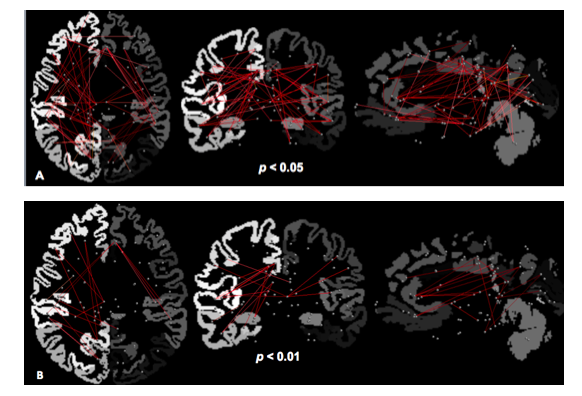
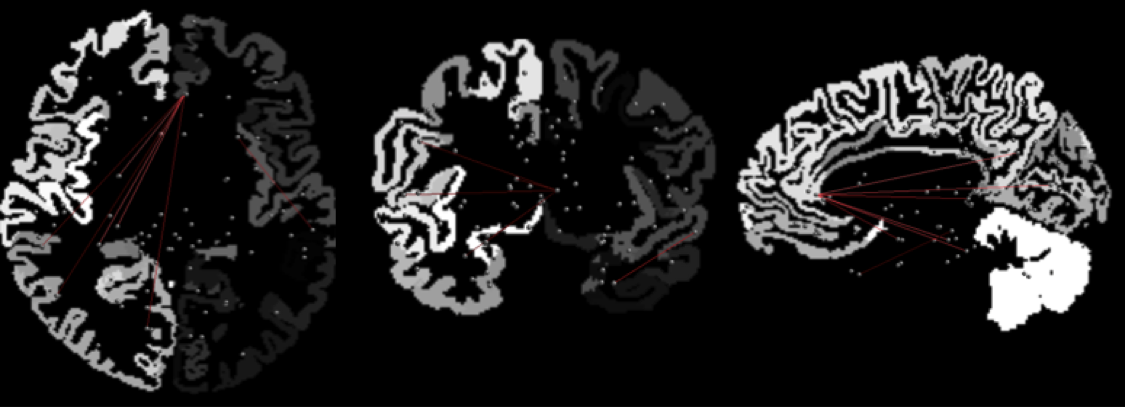
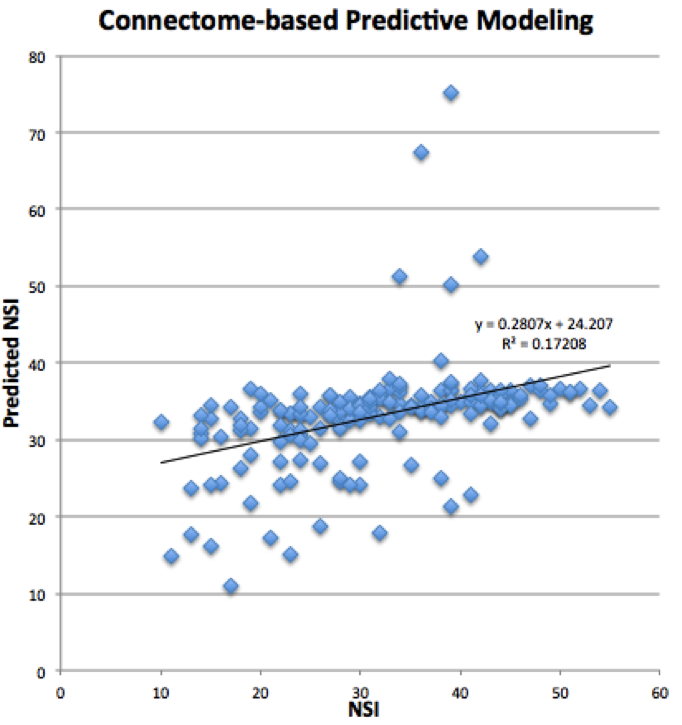
TFNBS analysis detected changes in sub-network connectivity that appeared to be specific to mTBI in SMs (corrected p < 0.05). Specifically, compared with controls, TFNBS identified mTBI had significantly decreased streamline counts in the sub-network connectivity of comprising edges interconnecting the left rostral anterior cingulate to the left supramarginal gyrus and the right posterior central gyrus; between the right precuneus and right pars triangularis gyrus, and between the right posterior cingulate and right middle frontal gyri (Fig.1). In addition, mTBI had decreased free water fraction (FWF) of NODDI in sub-network connectivity of comprising edges interconnecting left middle temporal gyri and the left supramarginal gyrus, and edges between left rostral anterior cingulate and the regions of the right amygdala-hippocampal complex, right entorhinal cortex and right parahippocamal gyrus (Fig. 2) relative to the controls. The results of linear regression of CPM showed the predictive NSI score, using the structural connectivity assessed by streamline counts, correlated significantly with self-report NSI score (r=0.28, p< 0.05) (Fig. 3). However, the inter-regional structural connectivity using NODDI metrics did not predict self-report NSI score.Discussion / Conclusions
The results of TFNBS showed that the null hypothesis of equality in the mean streamline count and free water fraction (FWF) between mTBI and controls was rejected for networks involving the default mode network, e.g. posterior cingulate cortex, (pre)cuneus, medial prefrontal cortex, supramarginal and angular gyri (Fig. 1), suggesting disrupted DMN sub-networks in mTBI SMs. A more appropriate CPM approach, e.g. using a non-parametric method to calculate the "true" r-value to this distribution of null r-values, would be needed for improving accuracy of prediction. Limitation of this study is that CPM is solely linear and only designed for regression problems. We are working to modify and refine the predictive modeling by using advanced statistical methods, e.g. support vector machine and Random Forest Classifier for feature selection algorithms.Acknowledgements
Disclaimer: The views expressed in this abstract are those of the authors and do not necessarily reflect the official policy of the Department of Defense or the U.S. Government.References
1. Zalesky A, Fornito A, Bullmore ET. Network-based statistic: Identifying differences in brain networks. Neuroimage. 2010;53(4):1197-1207. doi:10.1016/j.neuroimage.2010.06.041
2. Shen X, Finn ES, Scheinost D, et al. Using connectome-based predictive modeling to predict individual behavior from brain connectivity. Nat Protoc. 2017;12(3):506-518. doi:10.1038/nprot.2016.178
3. Finn ES, Shen X, Scheinost D, et al. Functional connectome fingerprinting: Identifying individuals using patterns of brain connectivity. Nat Neurosci. 2015;18(11). doi:10.1038/nn.4135
4. Walker WC, Carne W, Franke LM, et al. The Chronic Effects of Neurotrauma Consortium (CENC) multi-centre observational study: Description of study and characteristics of early participants. Brain Inj. 2016;30(12):1469-1480. doi:10.1080/02699052.2016.1219061
5. Zhang H, Schneider T, Wheeler-Kingshott CA, Alexander DC. NODDI: Practical in vivo neurite orientation dispersion and density imaging of the human brain. Neuroimage. Published online 2012. doi:10.1016/j.neuroimage.2012.03.072
6. Vinokur L, Zalesky A, Raffelt D, Smith RE, Connelly A. A Novel Threshold-Free Network-Based Statistical Method: Demonstration and Parameter Optimisation Using in Vivo Simulated Pathology. In: Proc ISMRM. Vol 2874. ; 2015.
Figures