1618
Cognitive Performance and Brain Connectivity in High-Contact and Low-Contact Sport Athletes1Radiology, Stanford University, Stanford, CA, United States, 2Bioengineering, Stanford University, Stanford, CA, United States, 3Medical Biophysics, University of Toronto, Toronto, ON, Canada, 4Neurosurgery, Stanford University, Stanford, CA, United States
Synopsis
Keywords: Traumatic Brain Injury, Traumatic brain injury, Brain Connectivity, high-contact sports, resting state functional connectivity
Motivation: Repetitive head impact in contact sports is linked to long-term cognitive sequelae, but the complexities of these changes remain unclear.
Goal(s): Determine potential relationships between resting-state functional connectivity (rsFC) and cognitive performance differential between high- and low-contact sports.
Approach: We assessed baseline rsFC and cognitive performance in PAC-12 athletes using rsfMRI and the ImPACT test.
Results: Enhanced ImPACT visual-motor-speed performance was present in low-contact sports and associated with increased connectivity between attentional networks and sensorimotor/visual/auditory regions. High-contact sports showed less connectivity between these motor and auditory regions, but more connectivity between these motor and visual regions.
Impact: This research sheds light on how repetitive head impacts in contact sports affect cognitive function and brain connectivity.
Introduction
Repetitive head trauma is common in high-contact sports such as football, and raises concerns about cognitive decline1,2 and higher risk for neurodegenerative diseases.3 Resting state functional MRI (rsfMRI) is sensitive to neurological impairments and functional changes. This study aimed to determine the relationship between cognitive performance, assessed via the Immediate Post-Concussive Assessment and Cognitive Testing (ImPACT) test, and resting state functional MRI (rsfMRI) connectivity at baseline in high- and low-contact sport athletes.Methods
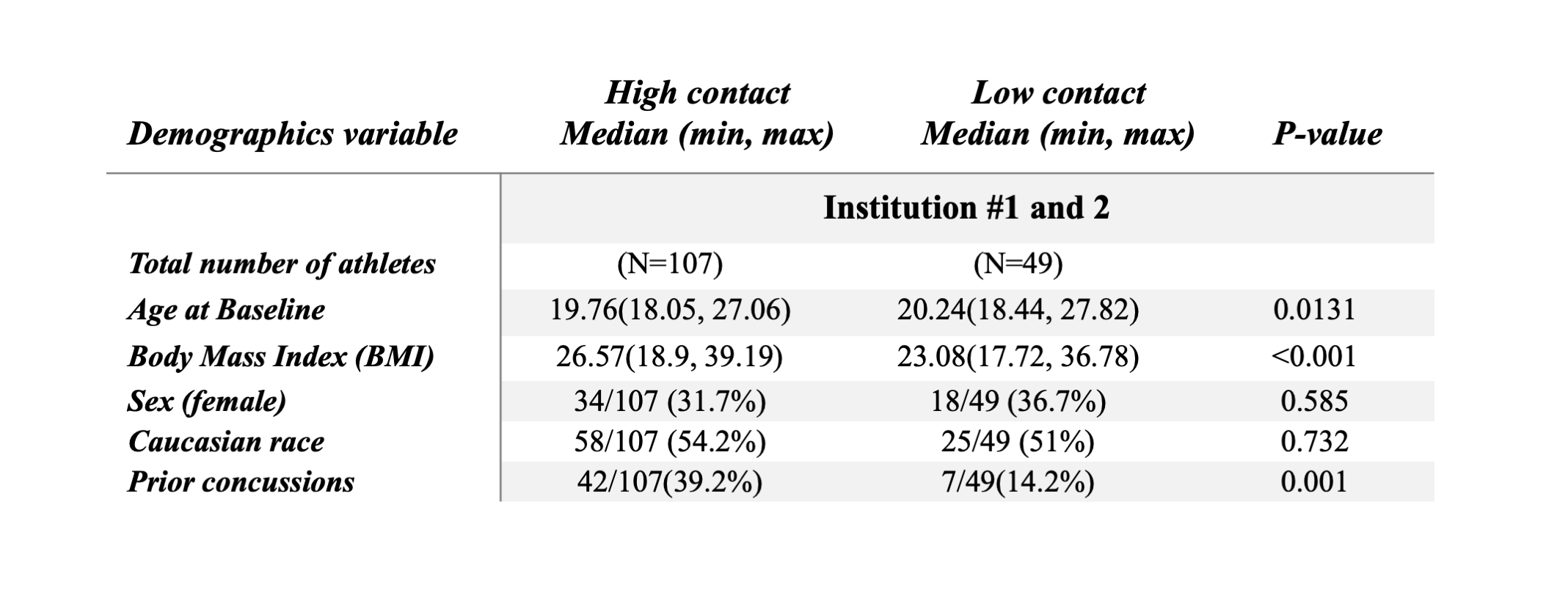
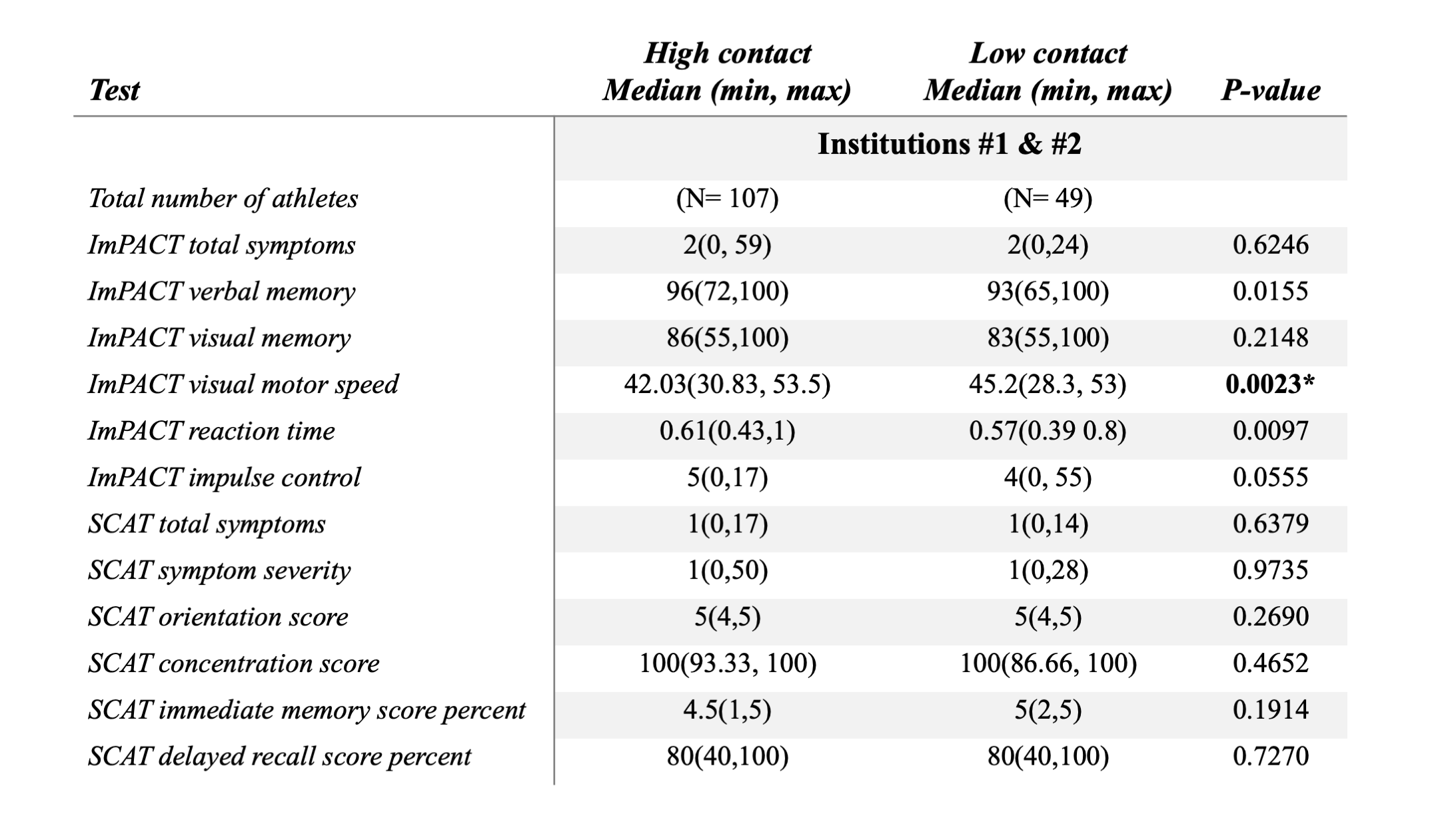
Subjects. 107 high-contact (34 female, 73 male) and 49 low-contact athletes (18 female, 31 male) from PAC-12 athletic teams from 2 different institutions (Institution #1, n=127; Institution #2, n=29) were MR scanned before the start of their sport season. High-contact sports included: football (n=56), lacrosse (n=20), rugby (n=21), and wrestling (n=10). Low-contact sports included: archery (n=10), badminton (n=6), golf (n=4), rowing (n=18), tennis (n=10), and swimming (n=1). All athletes underwent pre-first-season Standardized Concussion Assessment Tool (SCAT) testing (version 5) and ImPACT assessment. ImPACT assesses total symptoms, verbal memory, visual memory, visual motor speed, reaction time, and impulse control. Demographics, ImPACT and SCAT test components were compared between groups using nonparametric tests (Table 1 and Table 2).Imaging data acquisition and analysis. Imaging at institution #1 was performed on a 3T GE-MR750 scanner with a 32-channel head coil. T1-weighted MPRAGE anatomical images were acquired (sagittal ME-MPRAGE, TR=7.9ms, six TEs from 1.6 to 9.6ms, 1mm isotropic, 5.1min). rsfMRI was performed using a whole-brain rsfMRI sequence of 1000 volumes, with 20 reverse field polarity images for distortion correction, TR=490ms, TE=30ms, multi-band acceleration 6, 3x3x3.5mm isotropic, 8min).
At institution #2 imaging was conducted in a 3T Siemens Magnetom Prisma. T1-weighted multi-echo anatomical scan (sagittal TFL-MGH-multiecho, TR=2840ms, six TEs from 2.31ms to 13.51ms, 1mm isotropic, 5.05 min). rsfMRI was performed using similar whole-brain rsfMRI sequence as the institution #1. All subjects were instructed to close their eyes but remain awake during rsfMRI.
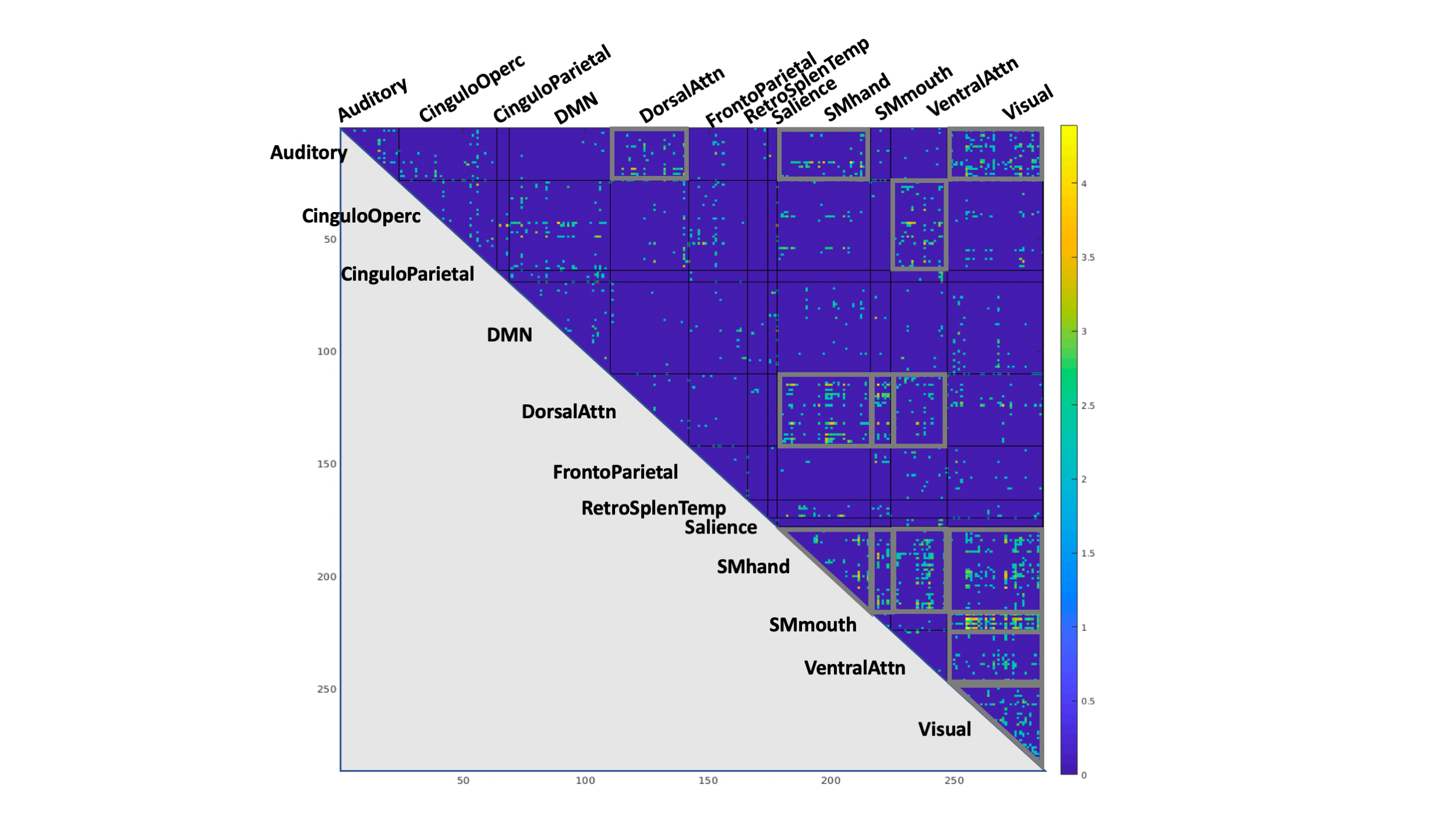
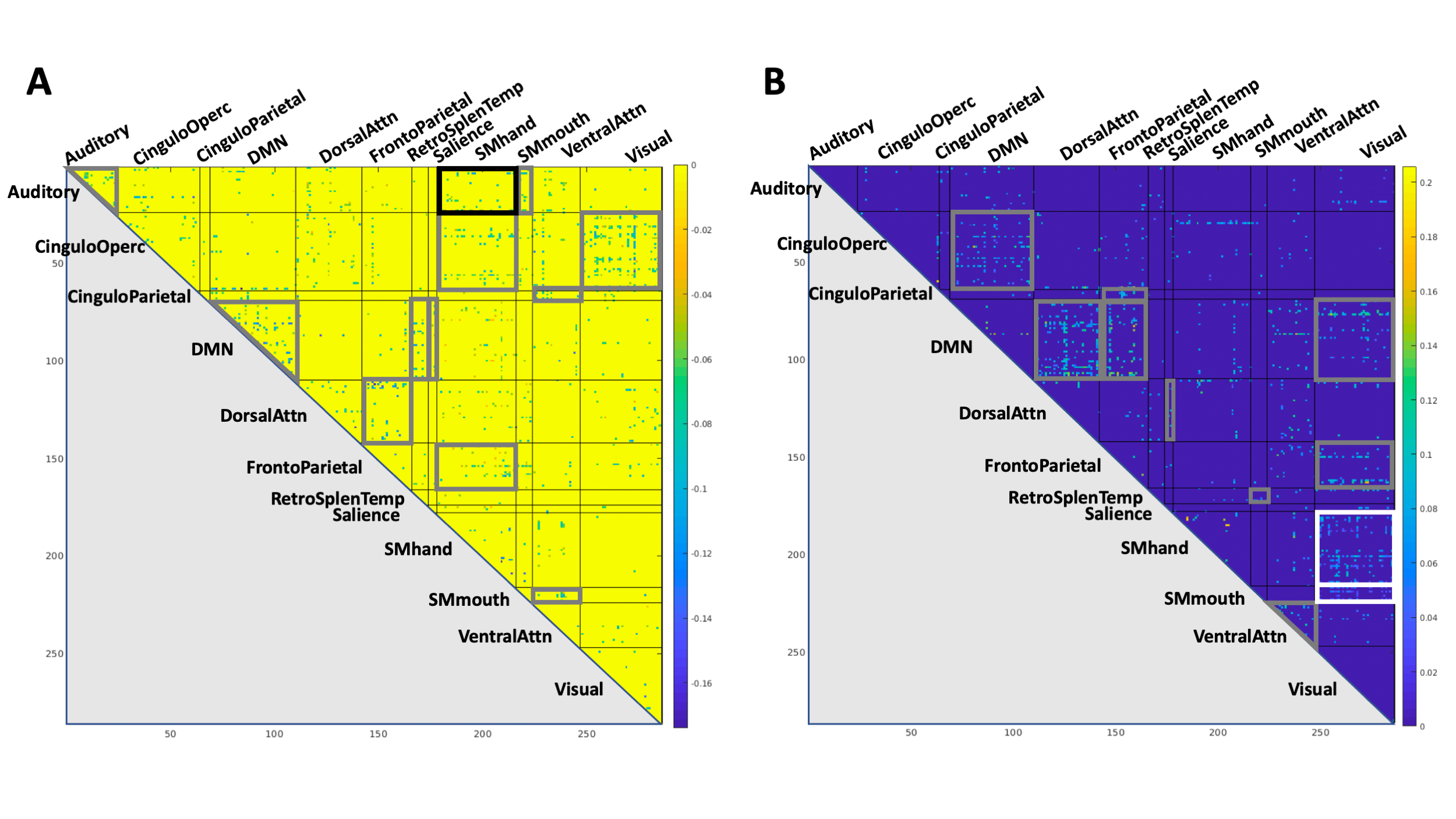
Resting state data were preprocessed using the DCAN-Labs / abcd-hcp-pipeline.4 This pipeline is a modification of the HCP minimal processing pipelines, and performs FreeSurfer segmentations of T1 images, followed by standard preprocessing of rsfMRI data. rsfMRI frames with high frame displacement (FD>0.2) were discarded. Linear Pearson correlations between the motion-corrected, parcellated time series5 for each cortical region were used to generate functional connectivity matrices for each subject. A linear model was applied to assess rsFC with ImPACT test scores, including the covariates of age and gender. A separate linear model was used to investigate rsFC differences between sports. All nodes were arranged by their associated twelve functional networks.5 A community chi-squared analysis (CCA) was used to identify significant within/between network effects from a set of mass univariate tests.6 We used 10,000 permutations, and the false-discovery rate threshold was 0.05 divided by 12, to correct for multiple comparisons across the 12 networks. The output of CCA shows a higher proportion of significant connections within/between each of these network pairs.
Results
Correlations with Cognitive Performance. SCAT tests were identical between groups. Among the six ImPACT components, we observed that low-contact athletes performed significantly better in visual-motor-speed compared to high-contact athletes. Better visual-motor-speed scores were associated with increased rsFC between the dorsal and ventral attention networks and between/within sensorimotor/visual/auditory regions (Fig.1, DorsalAttn, VentralAttn, SMhand, SMmouth, visual, and auditory). No other ImPACT tests showed significant rsFC differences after correcting for multiple comparisons.High-contact vs. low-contact sports. In high-contact sports, 11/12 network pairs exhibited increased/decreased connectivity (Fig.2). Cross-referencing correlations with networks positively correlated with ImPACT visual motor-speed, decreased connectivity in high-contact sports was observed between hand sensorimotor with the auditory cortex regions. Conversely, increased connectivity was observed between hand/mouth sensorimotor and visual cortex.
Discussion and Conclusion
Multiple regions in athletes shows increased connectivity with improved visual motor speed, which was different between groups. When comparing this against overall group differences between high- and low-contact sports, overlapping regions had less connectivity between motor and auditory regions in high-contact sports, but more connectivity between motor and visual regions. This dissociation maybe is due to redirection of connectivity from motor-auditory to motor-visual connectivity in athletes who undergo high impacts.Acknowledgements
This research was conducted with funding from General Electric Healthcare and the Pac-12 Conference’s Student Athlete Health and Well-Being Initiative.References
1. Bazarian, Jeffrey J., et al. "Persistent, long-term cerebral white matter changes after sports-related repetitive head impacts." PloS one 9.4 (2014): e94734.
2. Strain, Jeremy F., et al. "Imaging correlates of memory and concussion history in retired National Football League athletes." JAMA neurology 72.7 (2015): 773-780.
3. McKee, Ann C., et al. "Chronic traumatic encephalopathy in athletes: progressive tauopathy after repetitive head injury." Journal of Neuropathology & Experimental Neurology 68.7 (2009): 709-735.
4. https://github.com/DCAN-Labs/abcd-hcp-pipeline
5. Gordon, Evan M., et al. "Generation and evaluation of a cortical area parcellation from resting-state correlations." Cerebral cortex 26.1 (2016): 288-303.
6. https://github.com/DCAN-Labs/CommunityChiSquaredAnalysis
Figures