1601
Simulating the Magnetic Field of a Nonlinear and Time-Varying Arbitrary-Nucleus Coil1University of California, Berkeley, Berkeley, CA, United States
Synopsis
Keywords: In Silico, Simulations, X-Nuclei, RF, Coil, FDTD
Motivation: An untuned, non-resonant coil called the ADAPT Coil has recently been developed to excite any nucleus in high field, human-scale MRI. However, the coil’s nonlinear and time-varying characteristics render conventional simulation methods insufficient.
Goal(s): To develop an accurate simulation method for nonlinear and time-varying coils.
Approach: A finite-difference time-domain solver and a harmonic balance simulator were combined to simulate the linear components and the nonlinear and time-varying components, respectively.
Results: Nonlinear and time-varying coil operation was simulated and the resulting magnetic fields for five harmonics were visualized. The fundamental frequency magnetic field resembles that of an ideal current loop.
Impact: If validated for use with humans, the ADAPT Coil would significantly reduce barriers to clinical translation of X-nuclei research. The simulation method presented here represents a major step towards validation of the ADAPT Coil or any other nonlinear coil.
Introduction
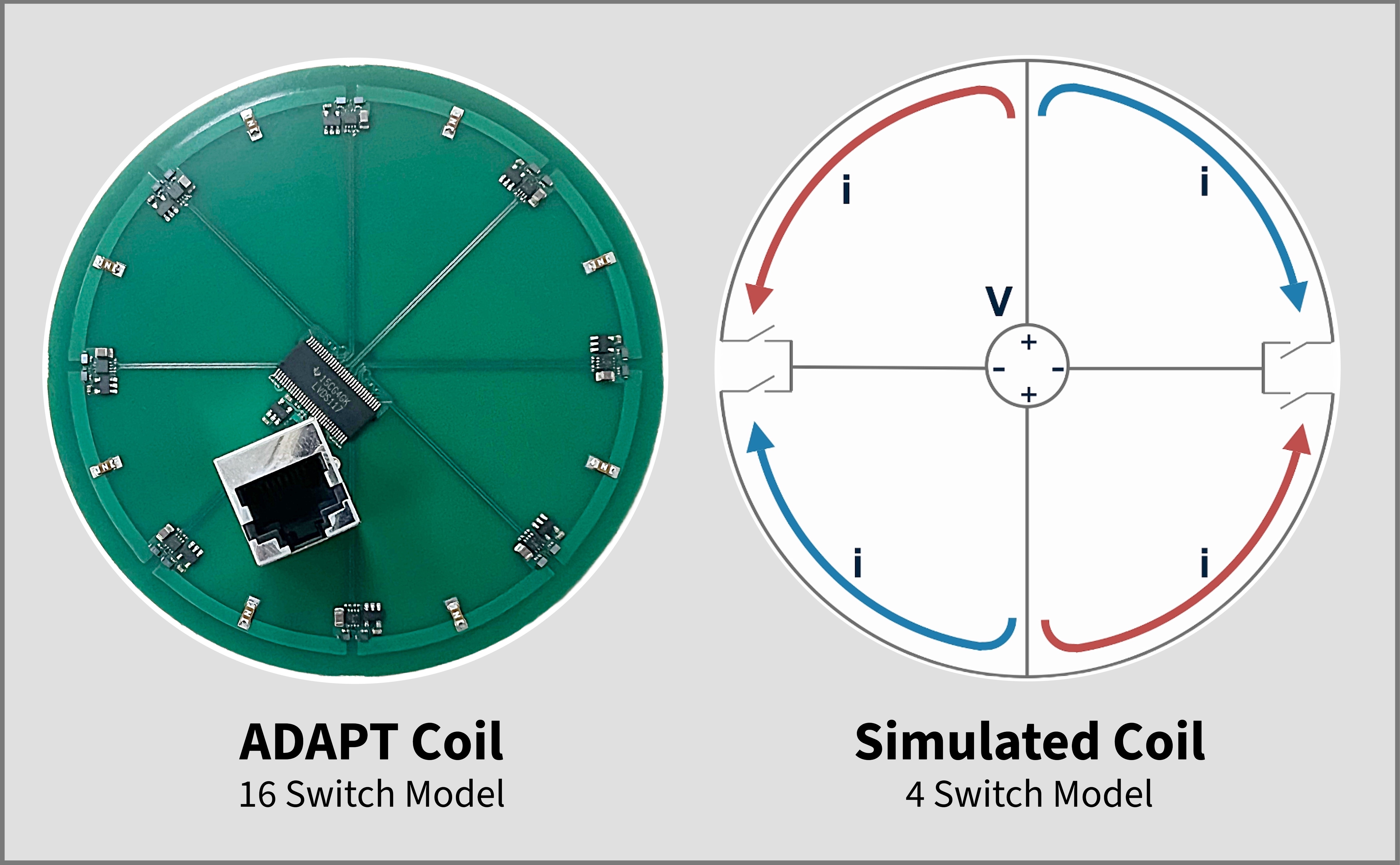
Most MRI transmit coils behave like resonant circuits. Although there are at least 39 clinically relevant NMR isotopes,1 most coils are tuned to the Larmor frequency of 1H. In a paper under review, Han et al. present the Any-nucleus Distributed Active Programmable Transmit (ADAPT) Coil as an inexpensive alternative capable of efficiently transmitting RF signals at arbitrary, digitally-controlled frequencies. With high frequency semiconductor power switches integrated in the coil structure, this unique architecture breaks a traditional coil up into 16 sub-loops (Figure 1). The series inductance and electrical length of each resultant arc segment are lower than that of a traditional coil of the same radius, which allows the ADAPT coil to transmit along the broad band of 3T Larmor frequencies, circumnavigating the need to tune and match an inductive coil at multiple frequencies.Because of the ADAPT Coil’s nonstandard topology, it is critical to characterize the transmitted B1 field at the fundamental frequency and the higher order harmonics. To that end, we develop a Finite-Difference Time-Domain (FDTD) Circuit Co-Simulation pipeline for the RF field generated by the ADAPT coil, which will exhibit nonlinear and time varying behavior introduced by the switches. Without losing generality, we demonstrate our approach with a four arc segment model (Figure 1).
Methods
The ADAPT coil's complex architecture poses significant challenges for simulating its transmitted field with standard linear methods. High-frequency electromagnetic solvers, including FDTD solvers, are often favored for their ability to account for distributed parasitics, including the inductance of coil loops, as well as any loading conditions from phantoms or human subjects. These solvers, however, are primarily tailored for linear systems with high-frequency sources, prompting our implementation of an FDTD Circuit Co-Simulation approach, amalgamating the strengths of two software tools, Sim4Life’s FDTD solver (Zürich MedTech, Zurich, Switzerland) and ADS’s (Advanced Design System) harmonic balance simulator (Keysight, Santa Rosa, USA).A multiport simulation in Sim4Life's FDTD solver models the electromagnetic behavior of the coil. All four switches and the DC source are substituted by edge ports. A 5-port S-parameter matrix is generated, characterizing incident and reflected waves at each port across the simulated RF spectrum.
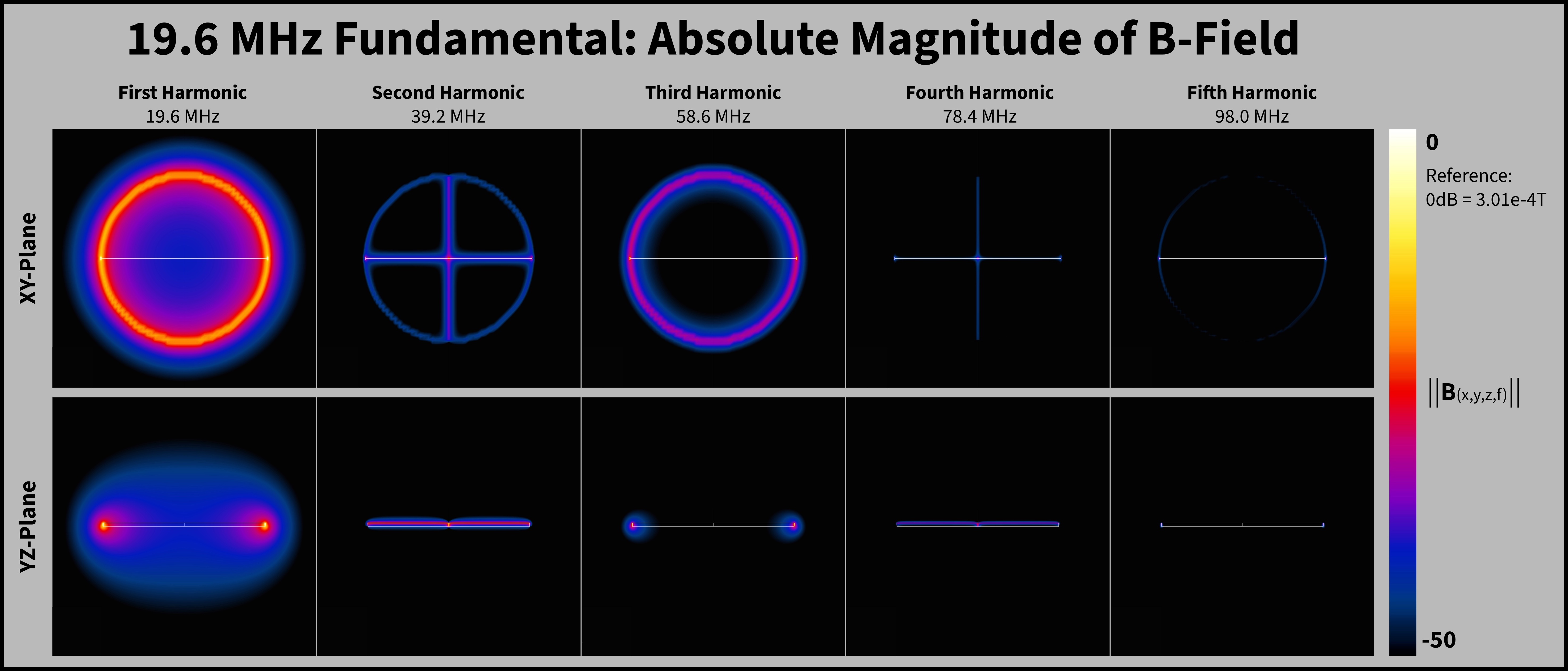
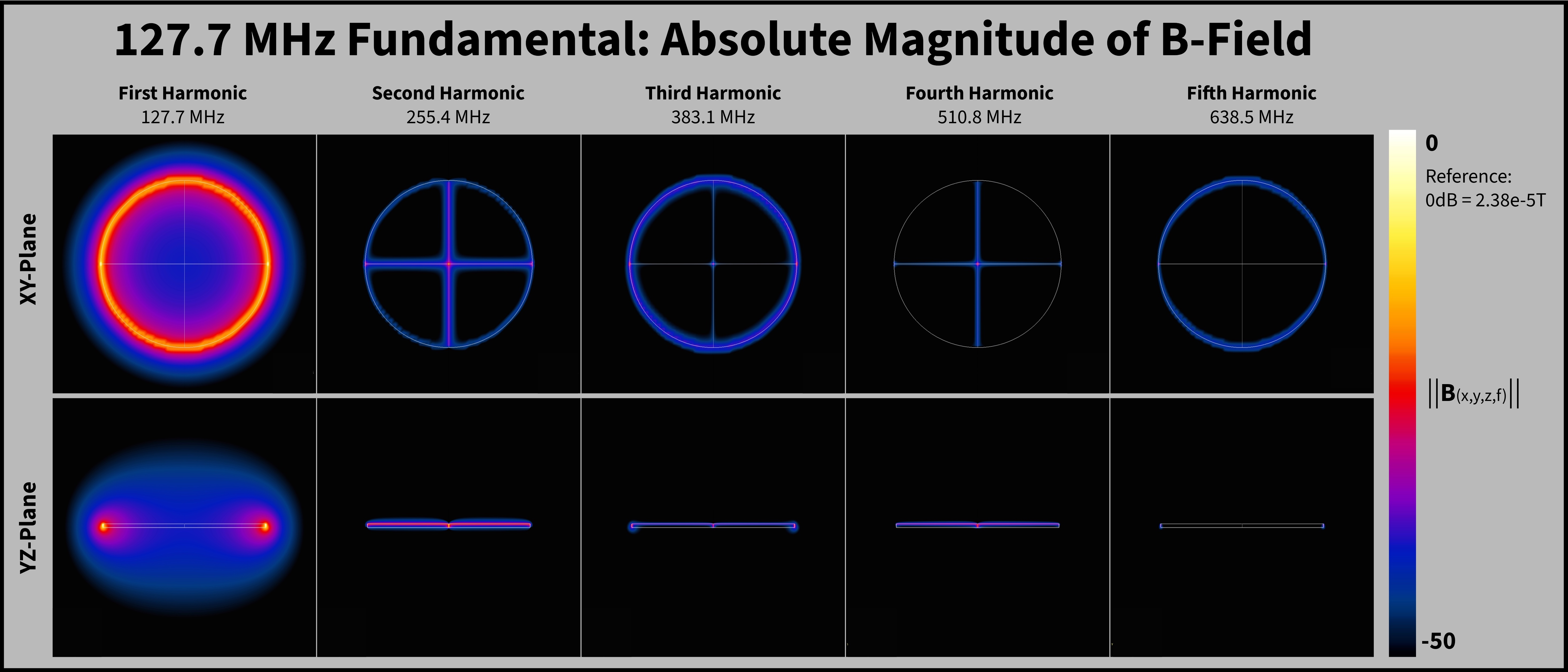
In ADS, an equivalent DC schematic is constructed, with the arc segment impedances represented by lumped series resistors. The S-parameter matrix from Sim4Life is imported into the schematic and treated as a black box in parallel with the equivalent DC model. DC blocks in series with the 5-port network prevent the use of the S-parameter matrix at DC, and DC feeds are placed in series with the DC model prevent the DC model from affecting higher frequencies. Subsequently, the harmonic balance simulator is used to generate an accurate calculation of the power and phase at each port. This data is then exported from ADS and used to update the phase and magnitude of the voltage at each port in Sim4Life. The resulting RF magnetic fields at the first five harmonics of two 3T Larmor frequencies, 19.6 MHz for 2H and 127.7 MHz for 1H, are presented.
Results
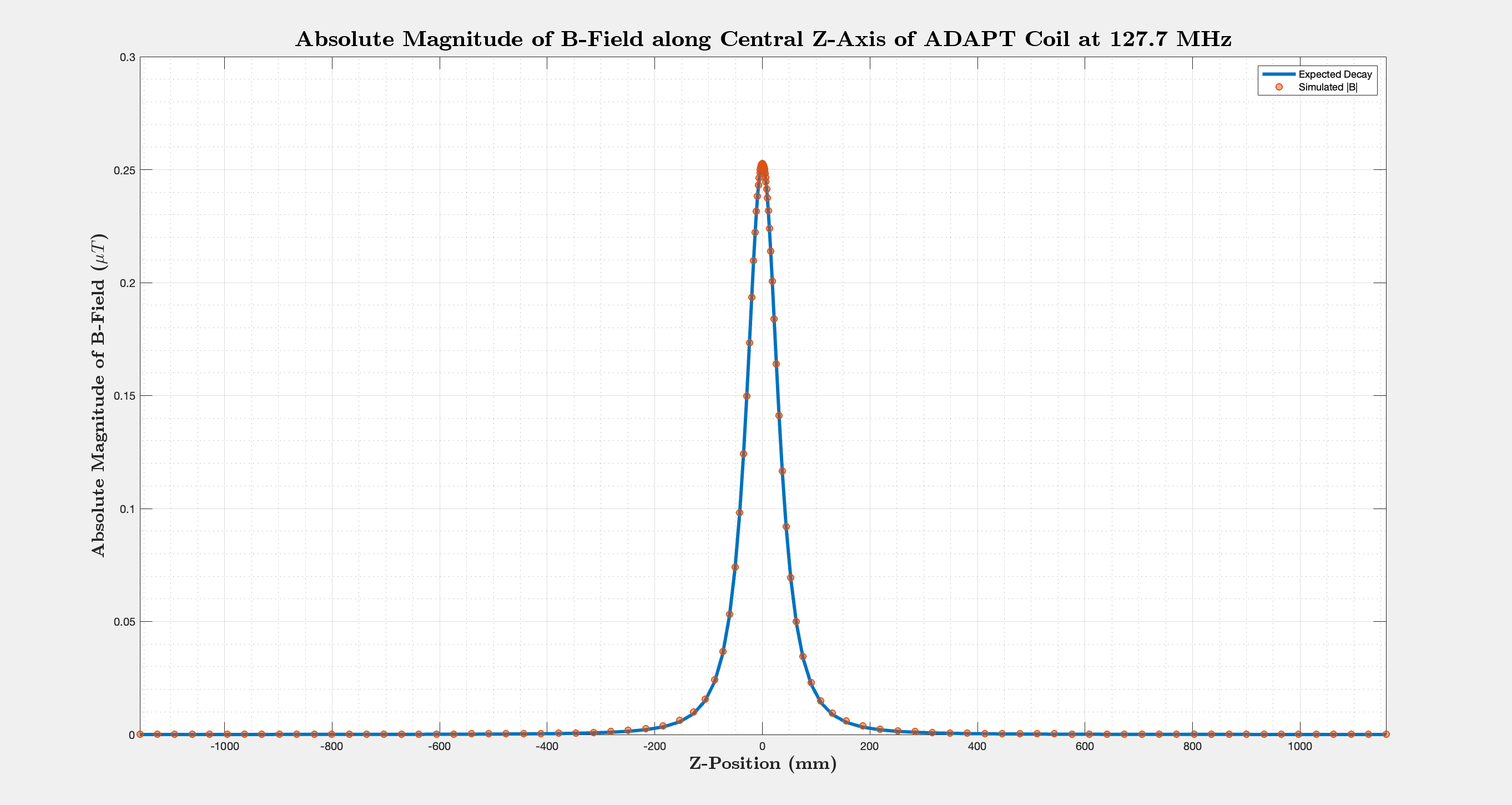
Figures 2 and 3 present the final simulated B1 fields for the first five harmonics of the 3T Larmor frequencies for 2H and 1H, respectively, allowing us to observe the superimposed field produced by the four arc segments as well as the diminishing amplitudes of the higher order harmonics.Figure 4 presents the Biot-Savart magnetic field distribution of a simple current loop along the central z-axis overlaid with the simulated ADAPT field, allowing us to compare how each field decays with distance normal to the coil.
Discussion and Conclusion
Figures 2 and 3 reveal that the magnetic fields produced by each arc segment superimpose to resemble the field of one continuous current loop at each fundamental frequency. Along the YZ plane, we observe that the amplitudes of the higher order harmonic fields diminish rapidly with distance from the coil. Although this finding has implications for SAR deposition, which is approximately proportional to frequency squared,3 we must validate the simulation prior to drawing conclusions about safety.Figure 4 reveals that the magnitude of the simulated field exhibits a decay pattern along the z-axis equivalent to that of a Biot-Savart current loop, which is a function of $$$R^2/(z^2+R^2)^{3/2}$$$. This observation informs us that despite the nontraditional topology and nonlinear elements, the magnetic field of the ADAPT Coil at the fundamental frequency is similar to that of a simple inductive coil loop along the z-axis, which is helpful for predicting the flip angle as a function of distance normal to the coil.
Acknowledgements
The authors thank Tanya Ipek, Suma Anand, and Sang Min Han for assisting with the installation of FDTD software as well as Julian Maravilla and Professor Miki Lustig for providing resource support and general simulation advice.References
1. Patching SG. NMR-active nuclei for biological and biomedical applications. Journal of Diagnostic Imaging in Therapy. 2016;3(1):7-48.
2. Han V, Reeder CP, Liu C. ADAPT Coil: One Coil to Excite Any Nucleus. Manuscript under review. 2023
3. Hoult DI, Lauterbur PC. The sensitivity of the zeugmatographic experiment involving human samples. Journal of Magnetic Resonance (1969). 1979;34(2):425-433. doi:10.1016/0022-2364(79)90019-2
Figures