1600
FPGA Microwave Link Testbed for Wireless MRI1Electrical Engineering, Stanford University, Stanford, CA, United States, 2GE Healthcare, Aurora, OH, United States, 3Radiology, Stanford University, Stanford, CA, United States
Synopsis
Keywords: Hybrid & Novel Systems Technology, Hybrid & Novel Systems Technology, Wireless
Motivation: MRI coil arrays are now burdened by cable and connector limitations that inhibit conformability.
Goal(s): We seek a low cost approach to wireless MRI coil data links that is easy to scale with multiple array subsections. We demonstrate feasibility of a FPGA-based short-range microwave wireless serial link.
Approach: A complete end to end link was constructed for link distances of 20cm. A low power FPGA sent scrambled serial data with embedded start/stop bits to a receiver with FPGA recovery of the data.
Results: This complete demo could achieve over 200Mbps with a simple FPGA, mixer and oscillator.
Impact: Cutting the cord of MRI arrays has been a long-term goal of MRI engineering. It would eliminate the mechanical and RF pitfalls of the cable, and enable more conformable and wearable receive arrays.
Introduction
Modern MRI receive arrays have reached a point where the cable and balun distribution has become a limiting factor, and remains a sore point for patient workflow. Wireless receive arrays have been proposed since the mid 1990's but their full implementation in MRI remains elusive. Wireless standards such as WiFi 5 and WiFi 6e can now support rates into Gbps, though a recent proof of concept attained 256 Mbps with WiFi 5 2x2 MIMO and needs embedded Linux CPU control1. WiFi supports multiple users to over 100m link distances. In contrast, wireless MRI only needs link distances from coil to bore wall. Short range microwave serial links in the mm-wave2 or UWB bands3 may be a viable and low complexity alternative. Here we create a complete FPGA-based microwave serial link to assess its feasibility.Methods
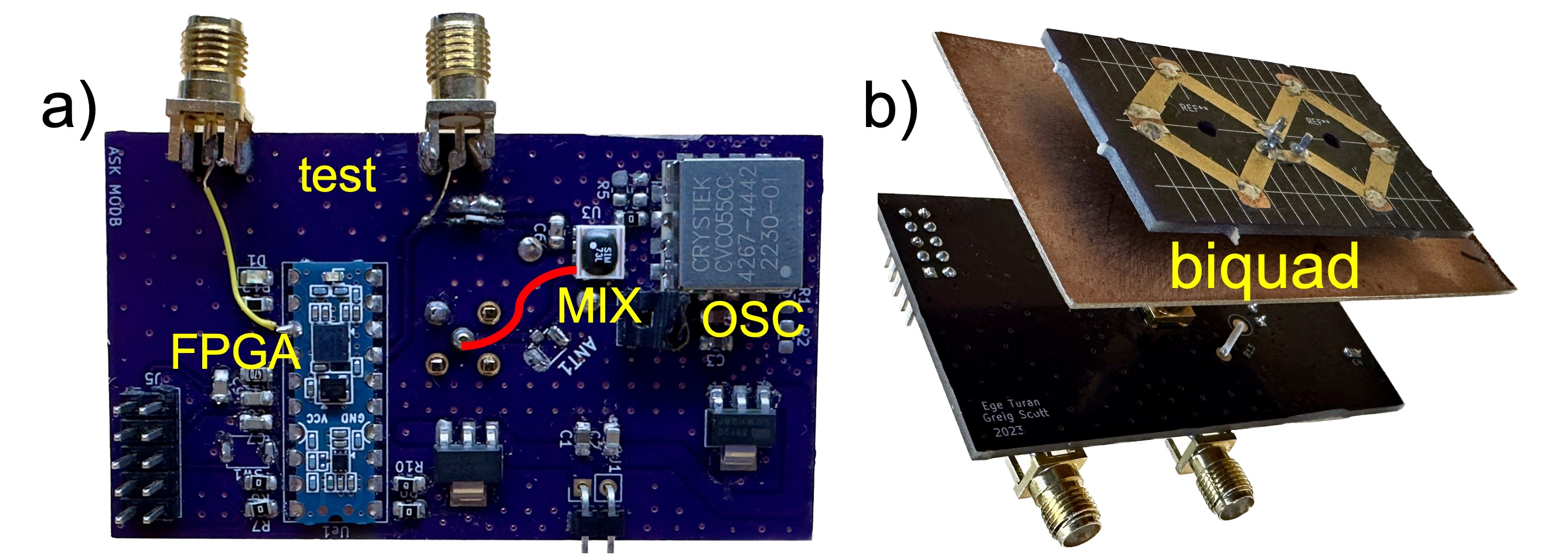
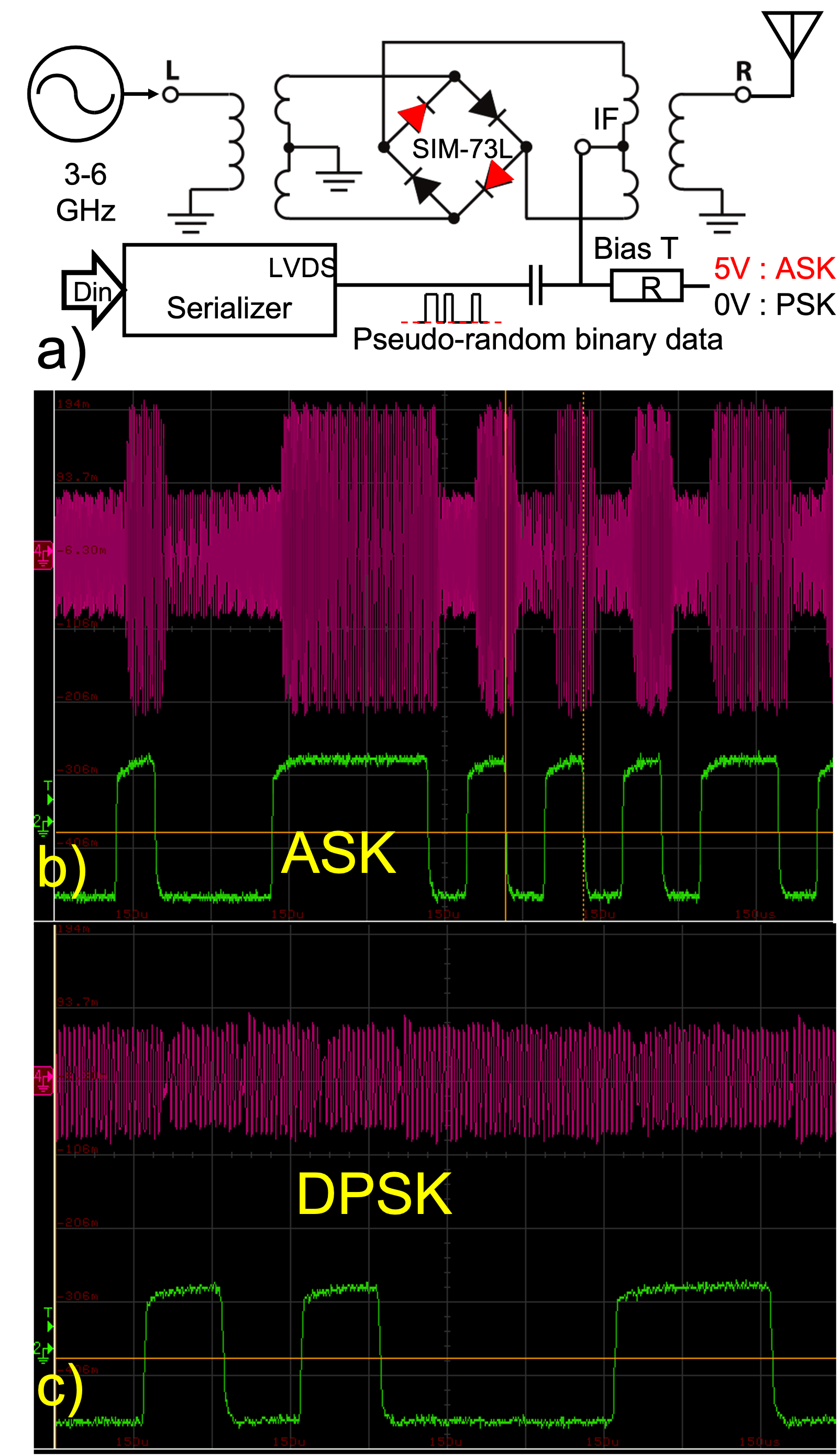
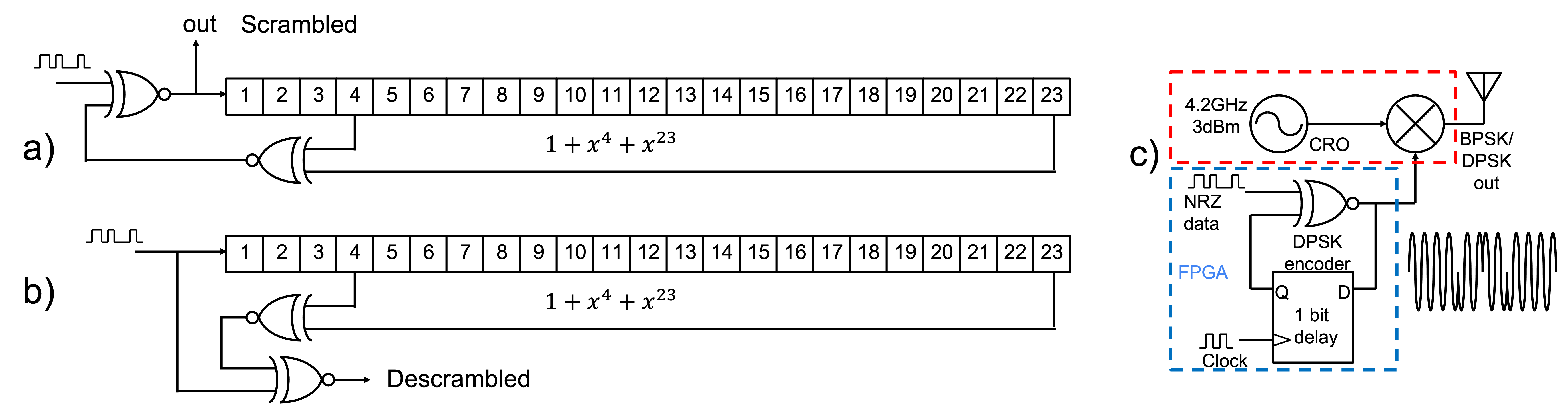
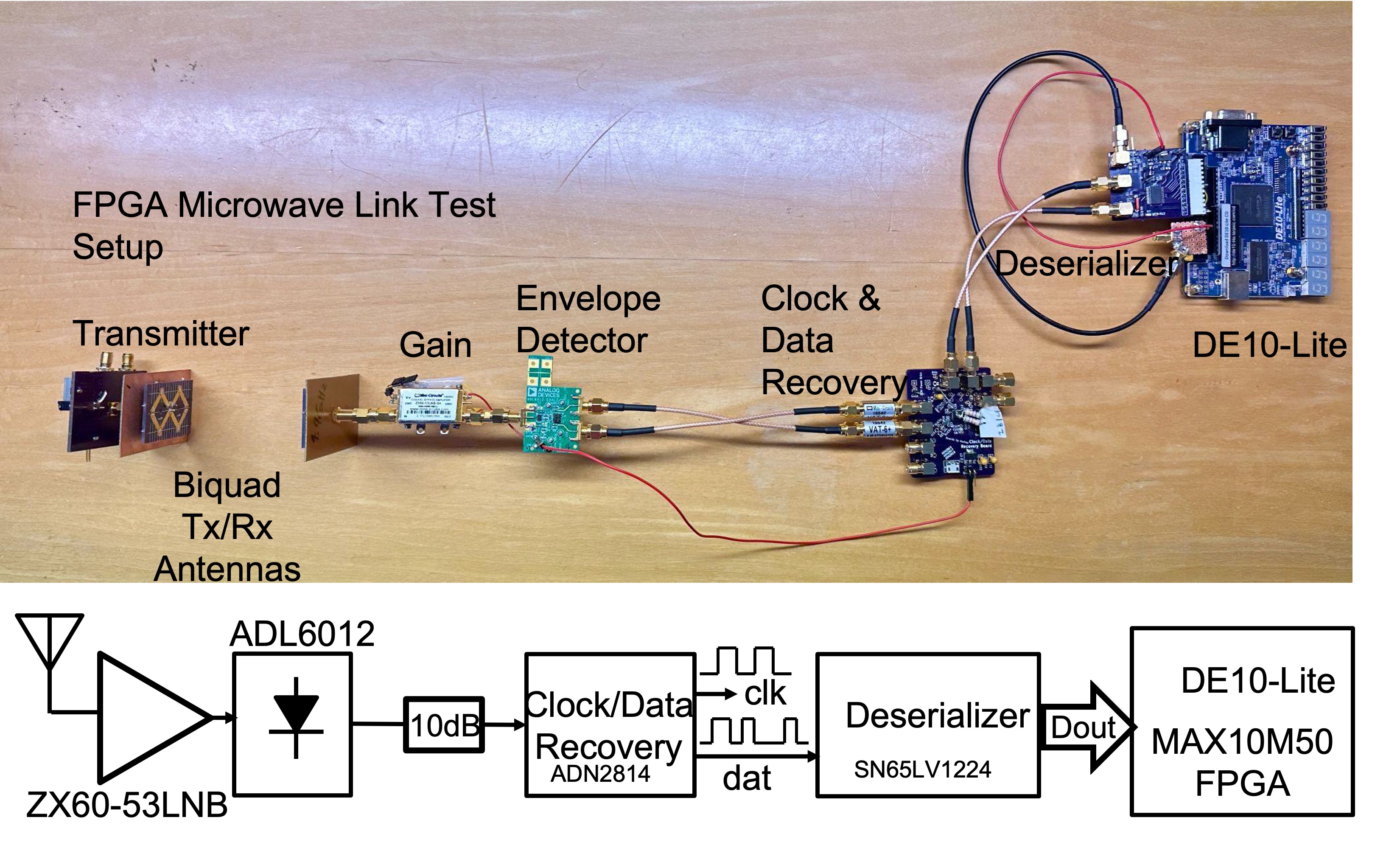
The microwave transmitter link was implemented on a custom printed circuit board with a Cerasite MAX10M02 FPGA module (Fig 1), SIM-73 mixer and Crystek 4.4GHz oscillator. The mixer included the option to inject about 4mA bias current at the IF port to generate amplitude shift keyed (ASK) signals. With bias absent, the output is binary/differential phase shift keyed (DPSK) (Fig 2). For testing, the FPGA was configured to generate 10-bit test words at 20MHz update rates. To avoid short term code repetition, each word was then randomized by a multiplicative scrambler (Fig. 3a). Subsequently, a start (1) and stop (0) bit were inserted to bound each word. The FPGA phase-locked loop generated a 240MHz bit clock for serializing the resulting 12-bit words. For ASK modulation, no further coding was needed. For DPSK, each output bit could be exclusive OR'd with the prior bit before mixing (Fig. 3c).The data receiver commands the bulk of the circuitry (Fig. 4) and is shown for ASK demodulation. Following a biquad Rx antenna and amplifier, the signal is envelope detected by an ADL8012 and clock/data are recovered by an ADN2814 module. The cleaned up data is streamed to an SN65LV1224 deserializer which strips the start/stop bits, and presents the data output as a 10-bit parallel word. This is latched by a DE10-LITE FPGA board (MAX10M50). Internally, the descrambler of Fig. 3b is applied to the data, and the output is displayed on the LED segment displays.
Results
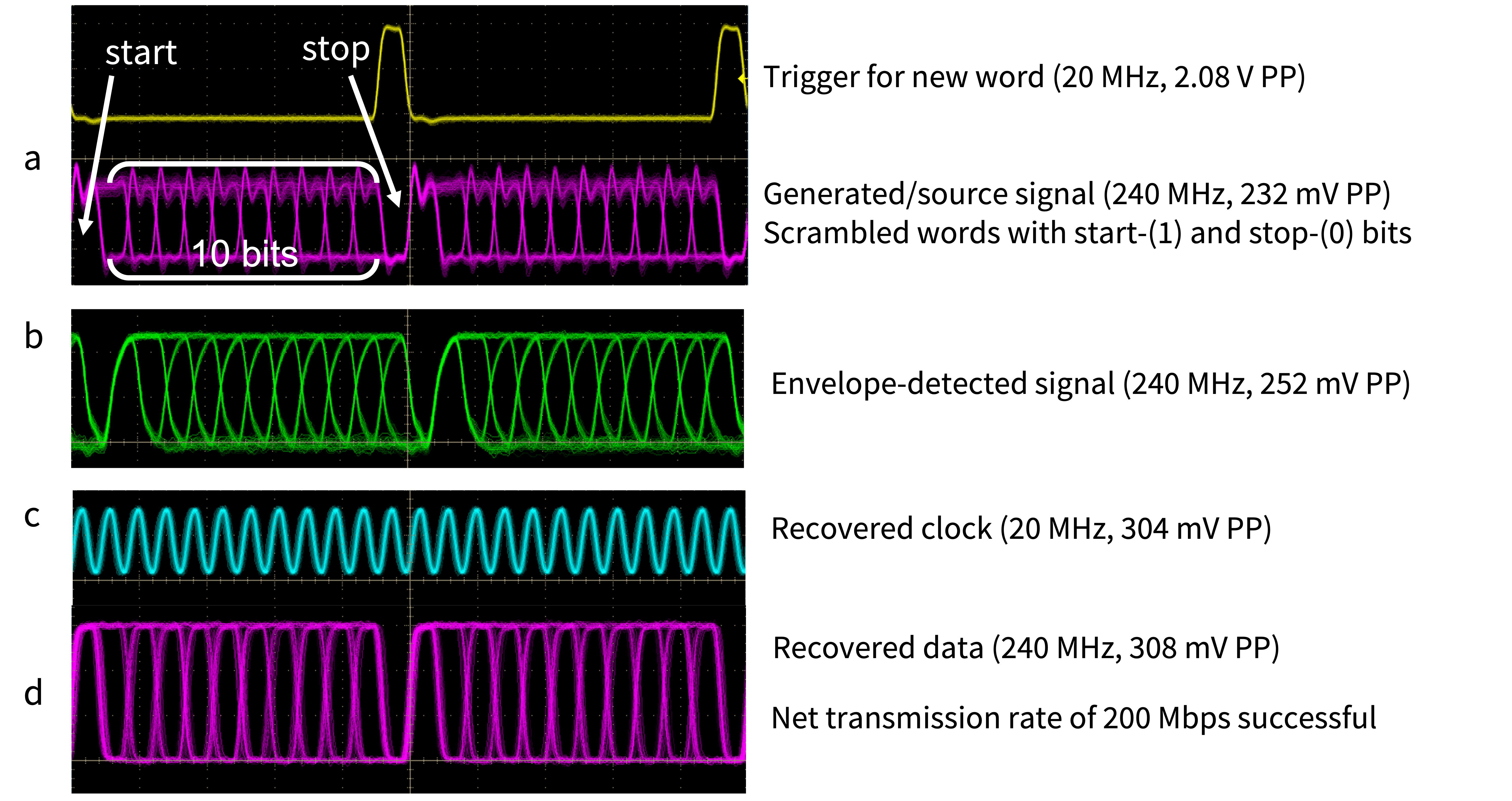
Waveforms at various points in the transmit/receive link are shown in Fig. 5. Here, the start (1) and stop (0) bits bound the 10 bit data payload from the FPGA output. Over a 20cm link distance, the envelope-detected signal shows the net effect of propagation and antenna bandwidth on a degradation of the bit shape. The clock/data recovery block is essential for retiming and signal conditioning before final deserialization. In our initial demonstrations, we had simply transmitted a 10-bit integer, incremented once per second, but repeated at 20 Mword/s. Without the scrambler, there would be too many repeating codes which would have prevented the deserializer to properly synchronize to the start/stop bit patterns. Since this setup does not yet have a gain control, the link "breaks" by about 30cm. The transmitter block required about 65mA at 5V.Discussion
This complete proof of concept streamed a raw 240 Mbps or net 200 Mbps data throughput (start/stop excluded). However, unlike WiFi which uses concatenated channels in 20MHz multiples, the spectral bandwidth of one binary modulated microwave link will exceed 500MHz. The approach depends on the microwave bit retaining coherence within the MRI bore subject to patient and bore reflections. The analysis of these impairments is best pursued through the system fidelity function (SFF)4. To form a fully robust link, several development steps are still needed. First, the receive chain needs automatic gain control (AGC) to ensure the signal amplitude is optimal for the envelope detector, and for range extension. Second, several digital transmit blocks are needed including data compression5, error correction codes, and finally 8b/10b data framing, all of which can be implemented in the FPGA. Unlike WiFi, each link acts as a pure serial data streamer without operating system or CPU intervention. Multiple Tx links could be distributed around an array, each at its own carrier, and dedicated to a local bank of coil digitizers. From the FPGA programming perspective, it appears logically identical to an optical link.Conclusion
Short range microwave serial links operating in the 3-10GHz band could provide a viable alternative to WiFi data transmission for use in wireless MRI receive arrays. Each data link transmitter has low complexity, and notably, is achievable with readily available components - dedicated IC development is not needed.Acknowledgements
The authors would like to thank GE Healthcare for research support, and acknowledge research funding from NIH grants R01EB019241, U01EB029427, R01EB012031, U01EB026412.References
[1] K Okamoto, S Kato, M Spring, Y Hamamura, D Horio, Y Tanaka, S Sugimoto, and K Watanabe. Feasibility Study for Wireless RF Coil: Wireless transfer of 8ch MR received data using body array coil and system clock. In Proc. Intl. Soc. Mag. Reson. Med. 28, page 1066, Toronto, 2023.
[2] Kamal Aggarwal, Kiran Joshi, Yashar Rajavi, Mazhareddin Taghivand, John Pauly, Ada Poon, and Greig Scott. A Millimeter-Wave Digital Link for Wireless MRI. IEEE Trans Med Imaging, 36(2):574–583, Feb 2017.
[3] Greig Scott, Audrey Chan, Fraser Robb, John Pauly, and Shreyas Vasanawala. High Speed Serial ASK Signal Integrity for Wireless MRI. In Proceedings of the 29th Annual Meeting of ISMRM, page 4280, Web Mtg, 2021.
[4] Wonje Lee, Fraser Robb, John Pauly, Shreyas Vasanawala, and Greig Scott. UWB antenna system fidelity investigation for wireless MRI. In Proceedings of the 29th Annual Meeting of ISMRM, page 1409, Web Mtg, 2021.
[5] Greig Scott, Fraser Robb, John Pauly, and Shreyas Vasanawala. Assessing Universal Code Compression to Lower Wireless MRI Data Rates. In Proceedings of the 30th Annual Meeting of ISMRM, page 2005, London, 2022.
Figures