1597
Reed Relay-Switched Tuning Circuit for Stretchable RF Coils in Low Field, Portable MRI1Department of Electrical Engineering and Computer Science, Massachusetts Institute of Technology, Cambridge, MA, United States, 2Department of Radiology, Athinoula A. Martinos Center for Biomedical Imaging, Charlestown, MA, United States, 3Independent Consultant, Charlestown, MA, United States, 4Harvard Medical School, Boston, MA, United States, 5Harvard-MIT Division of Health Sciences and Technology, Cambridge, MA, United States
Synopsis
Keywords: Non-Array RF Coils, Antennas & Waveguides, Non-Array RF Coils, Antennas & Waveguides, flexible coil
Motivation: Portable low-field MRI opens doors for low-cost and point-of-care imaging, but comes at the expense of decreased SNR, resulting in inferior image quality.
Goal(s): We aim to increase SNR with stretchable, subject-adaptable, helmet coils for low-field, portable MRI brain imaging. Specifically, a single-channel Tx/Rx volume coil for brain imaging at 72 mT.
Approach: We use a flexible 3D printed former and elastic bands for stretchable coil former. To account for the coil’s variable inductance, we develop an MATLAB-controlled autotuning circuit, composed of 8 capacitor values that can be switched in/out via Reed relays.
Results: We present a preliminary coil and autotuning system design.
Impact: To unlock portable MRI's full potential, we must boost SNR without sacrificing portability or safety. Our solution involves stretchable RF coil caps that mold to the subject's head in conjunction with an auto-tuning system for optimal performance.
Introduction
Low-field, portable MRI is gaining traction due to its low-cost, improved safety, lower power requirements, and ability to perform point-of-care brain imaging. Despite many advantages, the open problem of improving SNR and therefore image resolutions and portable MRI sensitivity still remains.Tighter fitting receiver coils made with a low-loss conductor should yield higher SNR due to higher filling factor of the coil, and therefore higher tissue to coil coupling 1,2. However, it is impossible to optimize the fit of rigid coil formers for all subjects. Despite the impressive research that's been done on flexible and stretchable RF coils at higher field MRI 3-8, there have been no flexible, geometrically adaptable or stretchable coils reported for brain imaging at the relevant field range for portable MRI (50-100 mT). To address this, we are developing stretchable single channel receiver caps for our 73 mT portable MRI brain scanner. The stretchable coils will adapt to each subject to provide the highest possible filling factor for the coil and aim to approach body-noise dominance. We also focus on a complementary relay-based autotuning system to account for the variable inductance of the stretchable coil. The autotuning is similar to methods previously demonstrated to account for things like variable loading at high-field and dual tuned coil switching 9,10.
Methods
The presented coil is designed for a 73 mT permanent magnet Halbach dome with the B0 pointed in the transverse direction, allowing for solenoid-based RF coils 11,12. Previously, we used rigid RF coils based on a single channel spiral cap geometry 13-15. Here we present a stretchable spiral coil whose geometry adapts to the wearer's head. The basic concept for the stretchable coils is shown in Figure 1A. The base is a washable elastic cap with a chin strap made from neoprene. The coil former consists of “wings” with wire grooves (green in figure) which is 3D printed with flexible material. We plan to wind the coil with flexible Litz wire and epoxy segments into the grooves. Distributed capacitors will be mounted to a semi-rigid section for coarsely tuning the coil. This adaptable RF coil works in conjunction with our proposed autotuning circuit, constructed with capacitors, to ensure resonance at a desired frequency regardless of changing impedance in the coil as it stretches.This autotuning circuit is designed to stabilize the coil tuning/matching with varying coil impedances (from stretching) and Larmor frequencies (from temperature drift). We considered two different ways of varying capacitance: a fixed capacitor array with switches (pin diodes, reed relays, MOSFETs) and varactors. While varactors promise high Q, they have a limited capacitance range and their power limits prevent T/R coil mode. Therefore, we opted for fixed capacitors with switches and decided to focus on reed relays due to the demonstrated success of reed-relays for low-field TR switches 16.
The switched capacitor options consist of 4 matching capacitors and 4 tuning capacitors in a binary ladder scheme (each capacitor is ~0.5 of the previous capacitor). The inductance of our preliminary coil varied from 11.4uH to 13.7uH with stretching. Therefore, we chose a capacitor range of 120-135 pF for tuning and 80-100pF for matching. To control the autotuning system, we use a MATLAB program that measures the coil S11 with a Copper Mountain VNA and outputs control signal to the reed relay via a NI USB 6001 board.
Results
A preliminary prototype of the flexible coil former is shown in Fig 2. The winding former consists of six 3D printed flexible (Flexible 80A Resin V1 (FLFL8001), FormLabs) ‘wings’ joined on the top to ensure perfect fit to a head with evenly distributed wire grooves. The populated winding locations can be later optimized for B1 homogeneity. The wire is tacked in position to the wings using velcro strips, and an elastic band is fixed to the bottom of the wings to ensure a tight fit.The current circuit schematic and PCB for autotuning circuit board is displayed in Figure 3. With this board, we were able to provide 256 different capacitor combinations. The resulting 256 S11 curves are shown in Fig 4.
Next Steps
We plan to use Litz wire for the coil winding to minimize copper loss, but are currently working on mechanical methods to better mold the wire the head, including pull-down strip and an elastic-bound wire method. The clear next step is to perform more imaging experiments with the flexible coil, and do SNR comparisons with rigid coils.We also plan to build a similar receive-only system using varactors to achieve finer adjustment.
Acknowledgements
This work was supported by grant R21-EB034865-01.References
1. Hoult DI, Richards RE. The signal-to-noise ratio of the nuclear magnetic resonance experiment. J. Magn. Reson. 1976;24:71–85 doi: 10.1016/0022-2364(76)90233-X.
2. Darrasse L, Ginefri JC. Perspectives with cryogenic RF probes in biomedical MRI. Biochimie 2003;85:915–937 doi: 10.1016/J.BIOCHI.2003.09.016.
3. Port A, Luechinger R, Brunner DO, Pruessmann KP. Elastomer coils for wearable MR detection. Magn Reson Med. 2021 May;85(5):2882-2891. doi: 10.1002/mrm.28662. Epub 2021 Jan 12. PMID: 33433044.
4. Nordmeyer-Massner JA, Pruessmann KP, Wyss M, Manoliu A, Hodler J, Andreisek G, Mamisch-Saupe N. MR imaging of healthy knees in varying degrees of flexion using a stretchable coil array provides comparable image quality compared to a standard knee coil array. Eur J Radiol. 2016 Mar;85(3):518-23. doi: 10.1016/j.ejrad.2015.12.004. Epub 2015 Dec 18. PMID: 26860662.
5. Motovilova E, Ching T, Vincent J, Shin J, Tan ET, Taracila V, Robb F, Hashimoto M, Sneag DB, Winkler SA. Dual-Channel Stretchable, Self-Tuning, Liquid Metal Coils and Their Fabrication Techniques. Sensors (Basel). 2023 Sep 1;23(17):7588. doi: 10.3390/s23177588. PMID: 37688046; PMCID: PMC10490642.
6. Zhang B, Brown R, Cloos M, Lattanzi R, Sodickson D, Wiggins G. Size-adaptable "Trellis" structure for tailored MRI coil arrays. Magn Reson Med. 2019 May;81(5):3406-3415. doi: 10.1002/mrm.27637. Epub 2018 Dec 21. PMID: 30575119; PMCID: PMC6484426.
7. Wang B, Siddiq SS, Walczyk J, Bruno M, Khodarahmi I, Brinkmann IM, Rehner R, Lakshmanan K, Fritz J, Brown R. A flexible MRI coil based on a cable conductor and applied to knee imaging. Sci Rep. 2022 Sep 2;12(1):15010. doi: 10.1038/s41598-022-19282-6. PMID: 36056131; PMCID: PMC9440226.
8. Cogswell PM, Trzasko JD, Gray EM, Campeau NG, Rossman PJ, Kang D, Robb F, Stormont RS, Lindsay SA, Bernstein MA, McGee KP, Huston J 3rd. Application of Adaptive Image Receive Coil Technology for Whole-Brain Imaging. AJR Am J Roentgenol. 2021 Feb;216(2):552-559. doi: 10.2214/AJR.20.22812. Epub 2020 Nov 25. PMID: 33236945; PMCID: PMC7968701.
9. Sohn SM, DelaBarre L, Gopinath A, Vaughan JT. Design of an Electrically Automated RF Transceiver Head Coil in MRI. IEEE Trans Biomed Circuits Syst. 2015 Oct;9(5):725-32. doi: 10.1109/TBCAS.2014.2360383. Epub 2014 Oct 28. PMID: 25361512; PMCID: PMC4412778.
10. Maunder A, Rao M, Robb F, Wild JM. Comparison of MEMS switches and PIN diodes for switched dual tuned RF coils. Magn Reson Med. 2018 Oct;80(4):1746-1753. doi: 10.1002/mrm.27156. Epub 2018 Mar 9. PMID: 29524235; PMCID: PMC6120476
11. McDaniel P, Cooley CZ, Stockmann JP, Wald LL. Numerically optimized design for a low-cost, lightweight 86mT whole-brain magnet. Proc 27th Annu Meet ISMRM, Montr 2019. 2019;1466.
12. Cooley, CZ, Stockmann JP, Wald LL, A portable brain MRI scanner based on a 72 mT, 35 kg "Halbach-bulb" magnet and external gradient coil. Proceedings of the 29th Annual Meeting of the International Society of Magnetic Resonance in Medicine; 2021; Virtual.
13. LaPierre C, Sarracanie M, Waddington DEJ, Rosen MS, Wald LL, 2015. A single channel spiral volume coil for in vivo imaging of the whole human brain at 6.5 mT. Proc 23rd Annu Meet ISMRM, Toronto, 2015.:1793.
14. Sarracanie M, LaPierre CD, Salameh N, Waddington DEJ, Witzel T, Rosen MS, 2015. Low-Cost High-Performance MRI. Sci Rep. 5:15177.
15. Cooley CZ, McDaniel PC, Stockmann JP, Srinivas SA, Cauley SF, Śliwiak M, Sappo CR, Vaughn CF, Guerin B, Rosen MS, Lev MH, Wald LL. A portable scanner for magnetic resonance imaging of the brain. Nat Biomed Eng. 2021 Mar;5(3):229-239.
16. Straney, D., Cooley, C.Z., Rosen, M.S. An Improved Power Handling Active Transmit/Receive Switch for Low Field MRI using Reed Relays. ISMRM 2021.
Figures
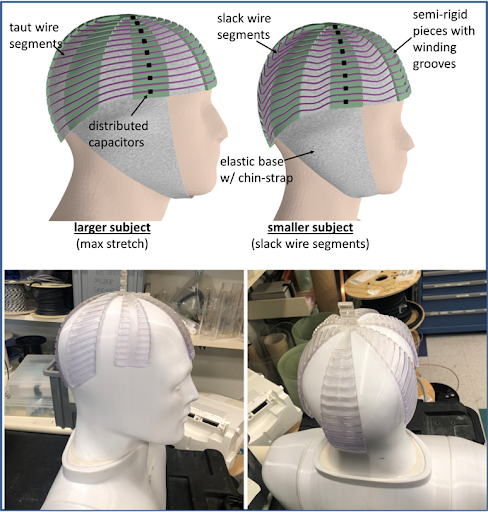
Figure 1
A-B) Concept stretchable single-channel Rx coil, based on a spiral design. The base is an elastic cap with a chin-strap (similar to EEG). Semi-rigid pieces (green) with winding grooves will be mounted with Litz wire epoxied. The wire segments between the semi-rigid formers will be slack when the coil is not stretched (A) and taut at its maximum size (B) The same coil is shown here on 2 sized subjects. (C-D) flexible 3D print of the coil former.
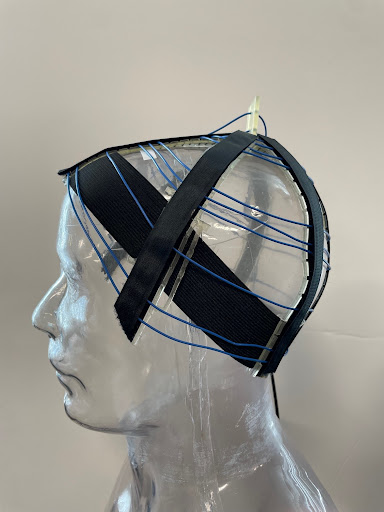
Figure 2
A) Photo of preliminary stretchable coil wound with stranded AWG 20 wire. Future iteration will use flexible litz wire. The former is attached to an elastic band to conform the variable size subjects. Velcro strips are use to hold wire into the grooves of the flexible former.
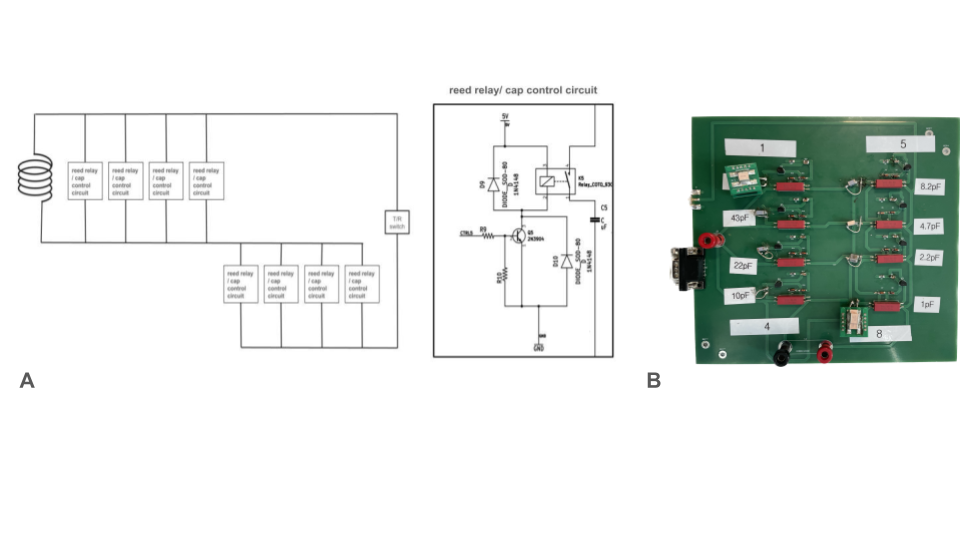
Figure 3
A) Schematic of basic auto-tuning concept. Different reed relays can be switched on/off to add/remove capacitance from the tuning and matching circuit. The control circuit closes the reed-relay when control line is pulled high and thus introduces capacitance to the circuit. B) Prototype PCB.
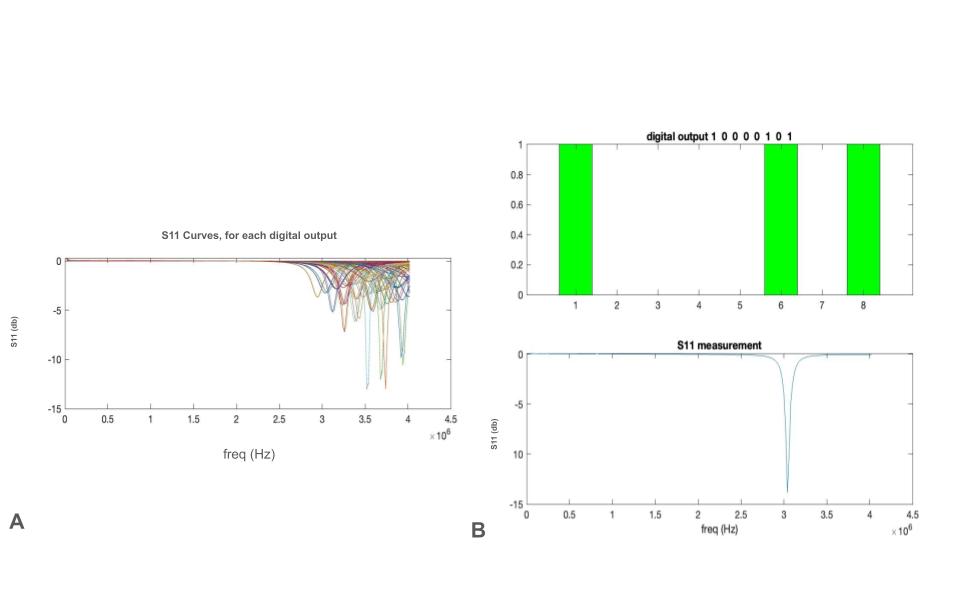
Figure 4
A) Resulting S11 curves from all possible combinations of the 8 capacitors on the autotuning board. These curves could be rapidly acquired after the subject is positioned in the scanner, then the best combination can be selected for the scan. Alternatively, the impedance can be measured and the optimal capacitance can be calculated and chosen. The capacitance selection will also depend on the current B0 center frequency, which drifts with temperature. B) The MATLAB interface displays the digital control output to the autotuning circuit and the corresponding S11 measurement.