1596
Multimodal surface coils for small animal MR imaging at ultrahigh fields1Department of Biomedical Engineering, State University of New York at Buffalo, Buffalo, NY, United States, 2Department of Electrical Engineering, State University of New York at Buffalo, Buffalo, NY, United States
Synopsis
Keywords: Non-Array RF Coils, Antennas & Waveguides, Non-Array RF Coils, Antennas & Waveguides
Motivation: High performance RF coils are needed for better SNR so that higher resolution and spectral dispersion can be obtained in small animal MR imaging.
Goal(s): To develop a surface coil with improved SNR over the conventional surface coil for small animal imaging at 7T.
Approach: A small animal surface coil is designed based on multimodal surface coil technique. The coil is investigated and compared with conventional surface coil using full-wave electromagnetic simulations.
Results: The multimodal surface coil shows superior B1 field efficiency and lower E field over standard coils, indicating a potential to gain SNR and resolution.
Impact: The proposed multimodal surface coil can operate at high frequency and provides improved SNR over conventional surface coils at 7T, opening avenues for highly efficient coil design in small animal imaging, ultimately enabling the detection of previously indiscernible physiological details.
Introduction
In this work, we present a novel multimodal surface coil design, meticulously crafted for ultrahigh-field MRI at 7 Tesla, suitable for small animal imaging. This design is centered around the enhancement of B1 field efficiency and B1/E field efficiency ratio, which are key factors in improving the SNR which is essential for high-resolution imaging. This design consists of an arrangement of stacked resonators that are electromagnetically coupled and form a multimodal surface coil. One of the resonant modes offers efficient B1 field and is suitable for MR imaging. This singular focus on B1 field efficiency is the cornerstone of our design, setting it apart by providing significantly improved SNR over the conventional surface coil at 7T. The effectiveness of the multimodal surface coil has been verified through electromagnetic simulations.Methods
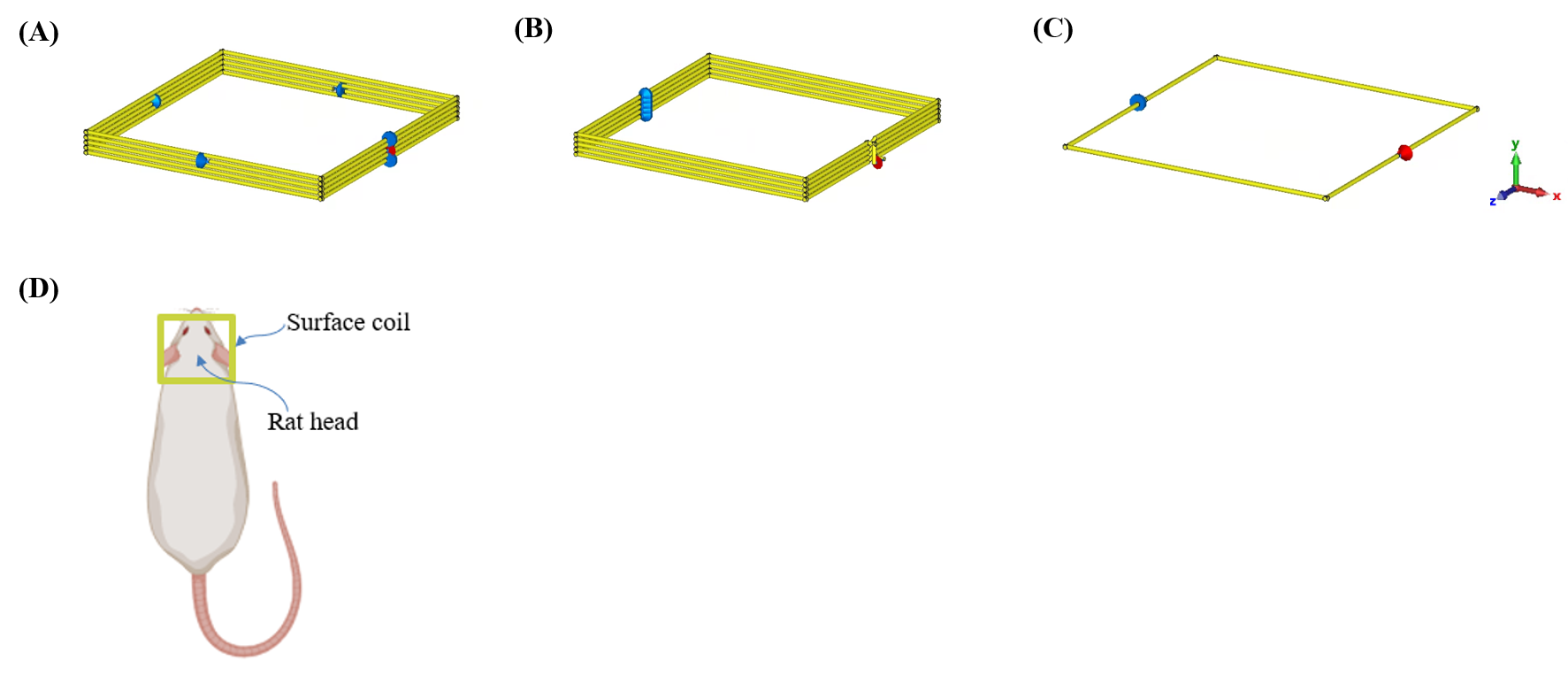
Figure 1A illustrates the constructed model for a novel multimodal surface coil for our simulations. This coil configuration includes five resonating loops—four square-shaped resonators each with a dimension of 2 cm per side, integrated with a tuning capacitor to achieve resonance at 298 MHz. Central among these is a coil imbued with an impedance matching network to effectively drive the multimodal assembly. The design ensures a 0.4 mm gap between adjacent coils to promote increased inductive coupling, culminating in a total stack height of 1.6 cm. Comparative analysis in Figures 1B and 1C consider alternative designs: a five-loop solenoid and a conventional surface coil, both with a side length of 2 cm. The solenoid mirrors the multimodal coil in height and turn spacing. Constructed from 28 AWG copper, each design is resonated to 298 MHz and matched for a 50-ohm impedance. A square-shaped oil phantom, measuring 2 cm by 2 cm and with a depth of 1 cm, was placed 1 mm from the coil for field strength evaluations. The multimodal coil's efficiency was evaluated through S-parameters, B1 and E field efficiency assessments, and the computation of the B1/E field efficiency ratio, with field distribution plots standardized to a 1 W accepted power. All simulation results generated by EM simulation software CST Studio Suite.Results
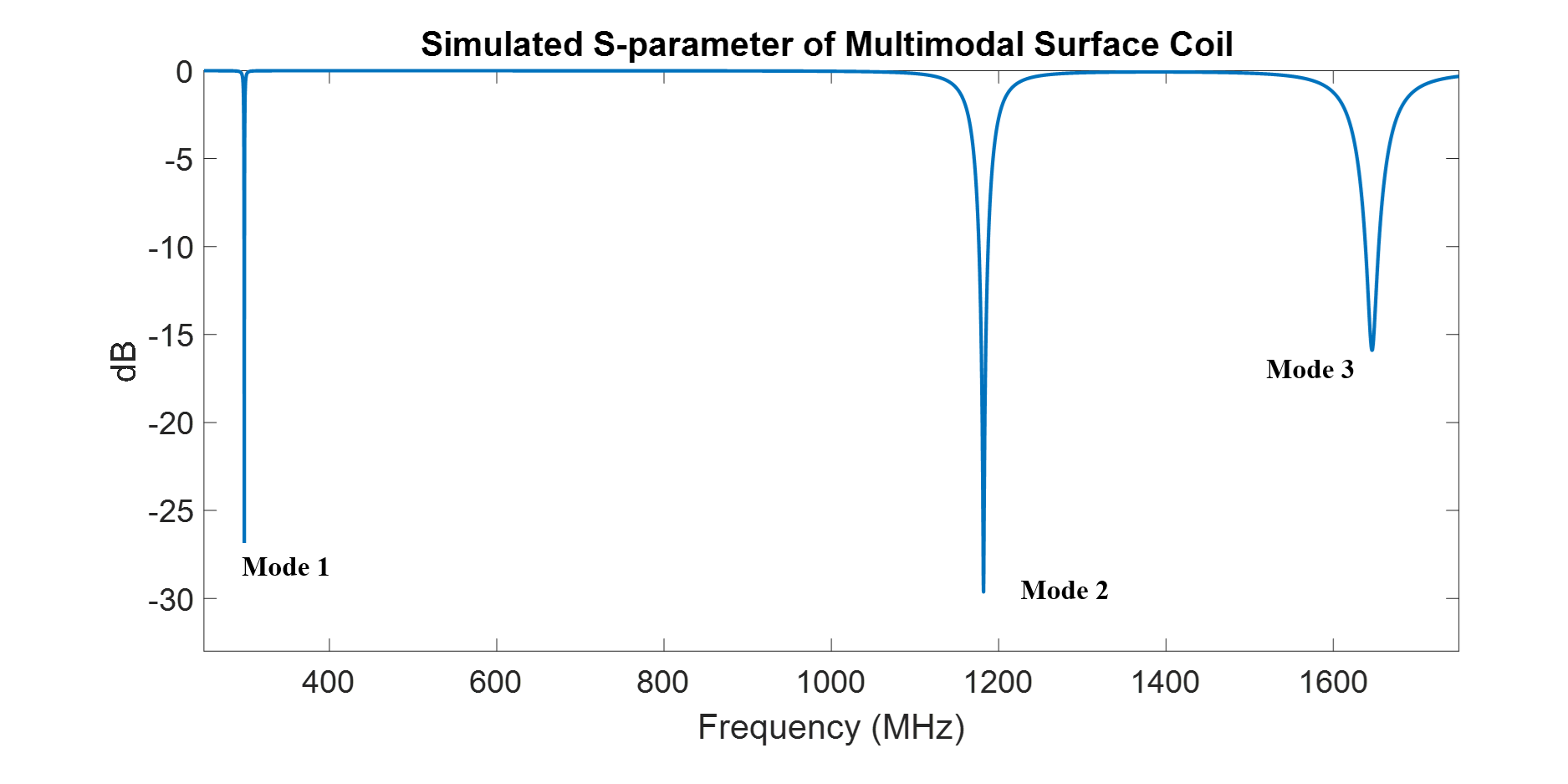
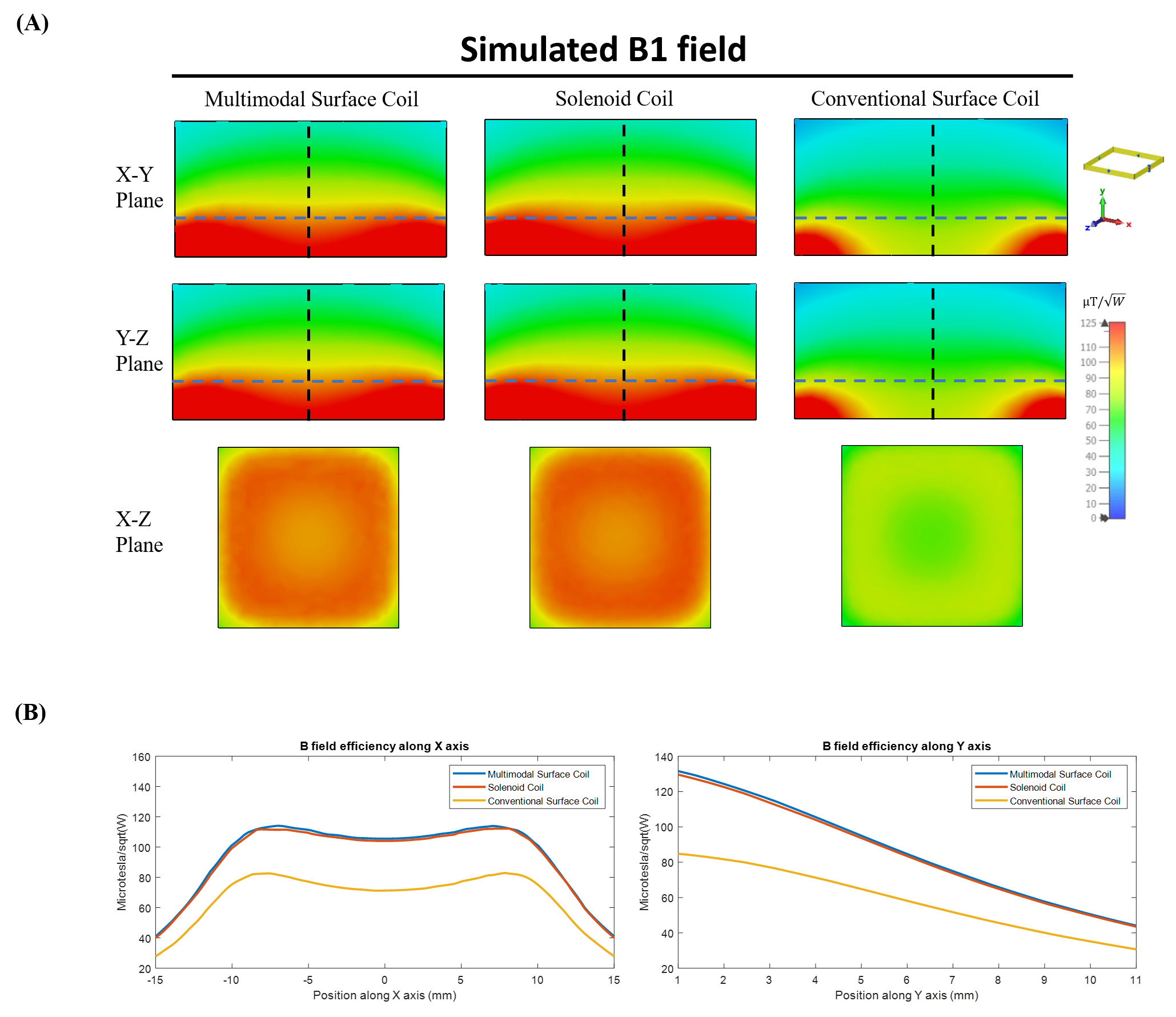
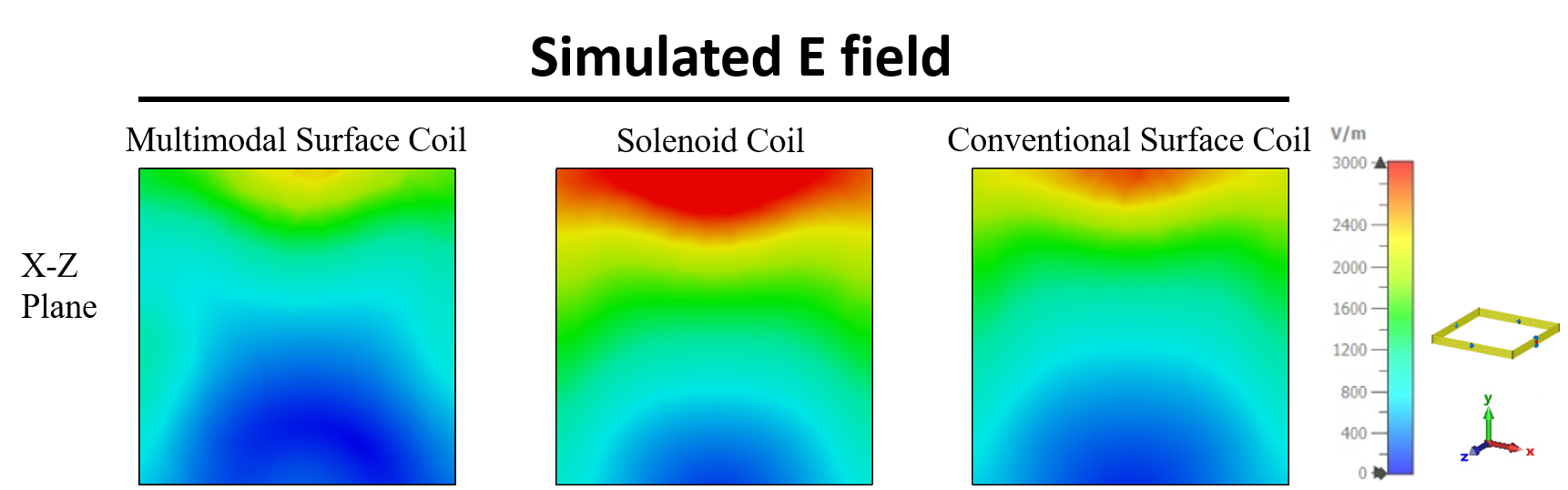
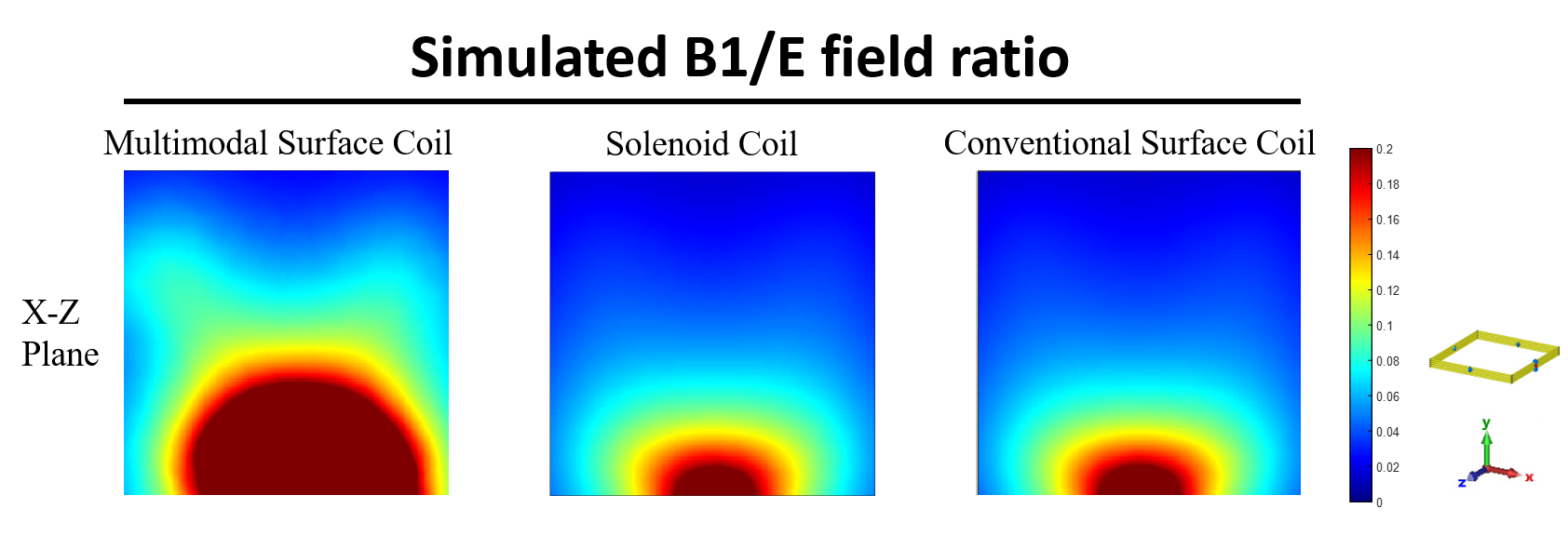
Figure 2 depicts the resonance characteristics of the multimodal surface coil via its scattering parameter profile across a frequency range. The graph highlights the occurrence of strong inter-coil coupling, which manifests as three resonant frequencies, with mode 1, the principal resonant frequency for imaging purposes, identified at 298 MHz. In Figure 3A, the B1 field efficiency is visually represented through efficiency maps in the X-Y, Y-Z, and X-Z planes within the imaging phantom, courtesy of the multimodal surface coils and the comparative coils. Figure 3B further distills this comparison into a one-dimensional plot of field strength along the phantom's dashed line as seen in Figure 3A. The data exhibit that the multimodal surface coil provides a superior B field efficiency relative to the conventional surface coil, while maintaining comparable efficiency to that of the solenoid coil. Figure 4 delineates the simulated efficiency of the E field for each coil setup in X-Z plane. The results indicate that the multimodal surface coil generates the least E field, in contrast to the solenoid coil, which produces the highest. Figure 5 compares the B1/E field efficiency ratios in the X-Z plane. When normalized for the same accepted power input, the B1/E field efficiency ratio highlights the multimodal surface coil's lower E field generation compared to the solenoid coil. This reduction in E field contributes to a decrease in noise, which consequently leads to an improvement in the SNR for the multimodal surface coil setup.Conclusion
The proposed multimodal surface coil, optimized for small animal 7 Tesla MRI, exhibits superior B1 field efficiency, which translates into enhanced signal-to-noise ratio (SNR) and resolution. Our results confirm strong resonant coupling and distinct resonant modes, with a primary resonance at 298 MHz suitable for MR imaging at 7T. Compared to conventional coils, the proposed design demonstrates a more efficient B field and a significantly reduced E field, yielding lower noise levels.Acknowledgements
This work is supported in part by the NIH under a BRP grant U01 EB023829 and by the State University of New York (SUNY) under SUNY Empire Innovation Professorship Award.References
1) Hoult, D.I. The signal-to-noise ratio of the nuclear magnetic resonance experiment. J.Magn Reson. 24, 71-85 (1976)
2) Pang, Y, et al. Parallel traveling wave MRI: A feasibility study. Magn Reson Med. 67, 965-978 (2012)
3) Wang, C, et al. A practical multinuclear transceiver volume coil for in vivo MRI/MRS at 7 T. Magn Reson Imag. 30, 78-84 (2012)
4) Zhao, Y, et al. A coupled planar RF array for ultrahigh field MR imaging. ISMRM 2023, 3910
Figures