1577
Compact and Frequency-independent Dual-Tuned Cable Traps for Multi-Nuclear MRI and MRS1College of Nuclear Equipment and Nuclear Engineering, Yantai University, Yantai, China, 2Department of Electrical and Computer Engineering, Vanderbilt University, Nashville, TN, United States, 3Vanderbilt University Institute of Imaging Science, Vanderbilt University Medical Center, Nashville, TN, United States, 4Department of Radiology and Radiological Sciences, Vanderbilt University Medical Center, Nashville, TN, United States
Synopsis
Keywords: RF Arrays & Systems, Parallel Imaging
Motivation: Dual-tuned cable traps, instead of two separate single-tuned ones in series, are preferred in multi-nuclear MRI and MRS.
Goal(s): We introduce a frequency-independent dual-tuned cable trap. For proton nuclear, standard solenoid cable trap was employed. For X-nuclear, an additional solenoid resonator was employed to block the common-mode signal.
Approach: The dual-tuned cable trap was analyzed in electromagnetic simulation, fabricated and its performance is evaluated by bench test.
Results: The dual-tuned trap exhibits exceptional common-mode current suppression abilities at both frequencies. And two frequencies of dual-tuned trap can be adjusted independently without mutual interference.
Impact: This novel dual-tuned cable trap fills an important gap in dual-tuned MRI hardware for multi-nuclear magnetic resonance studies, potentially enable next-generation dual-tuned coils.
INTRODUCTION
Cable trap or balun circuits are crucial for suppressing common-mode currents on the outer conductors of coaxial cables in RF coil systems for MRI and MRS. In multi-nuclear MRI, where two sets of RF coil systems are in use, it is essential to suppress common-mode currents at the Larmor frequencies of both 1H and X-nuclei. Additionally, cable traps or baluns should be compact to conserve valuable space. Consequently, dual-tuned cable traps or baluns, instead of two separate single-tuned ones in series, are preferred in practice, such as dual-tuned traps with an add-on tank circuit [1] and dual-tuned lattice baluns [2]. However, in such designs, the two operating frequencies may affect each other, leading to a complex fabrication process. Furthermore, it is challenging for dual-tuned traps/baluns to maintain high performance at both frequencies when designed in a compact structure. In this work, we introduce a frequency-independent dual-tuned cable trap. The mechanism for blocking common-mode current at high frequencies mirrors that of a standard solenoid cable trap [3]. However, at the low frequency, the common-mode current is blocked using an indirect inductive coupling method. These two different mechanisms allow for independent adjustment of the high and low frequencies, eliminating the need to compromise performance between the two frequencies.METHODS
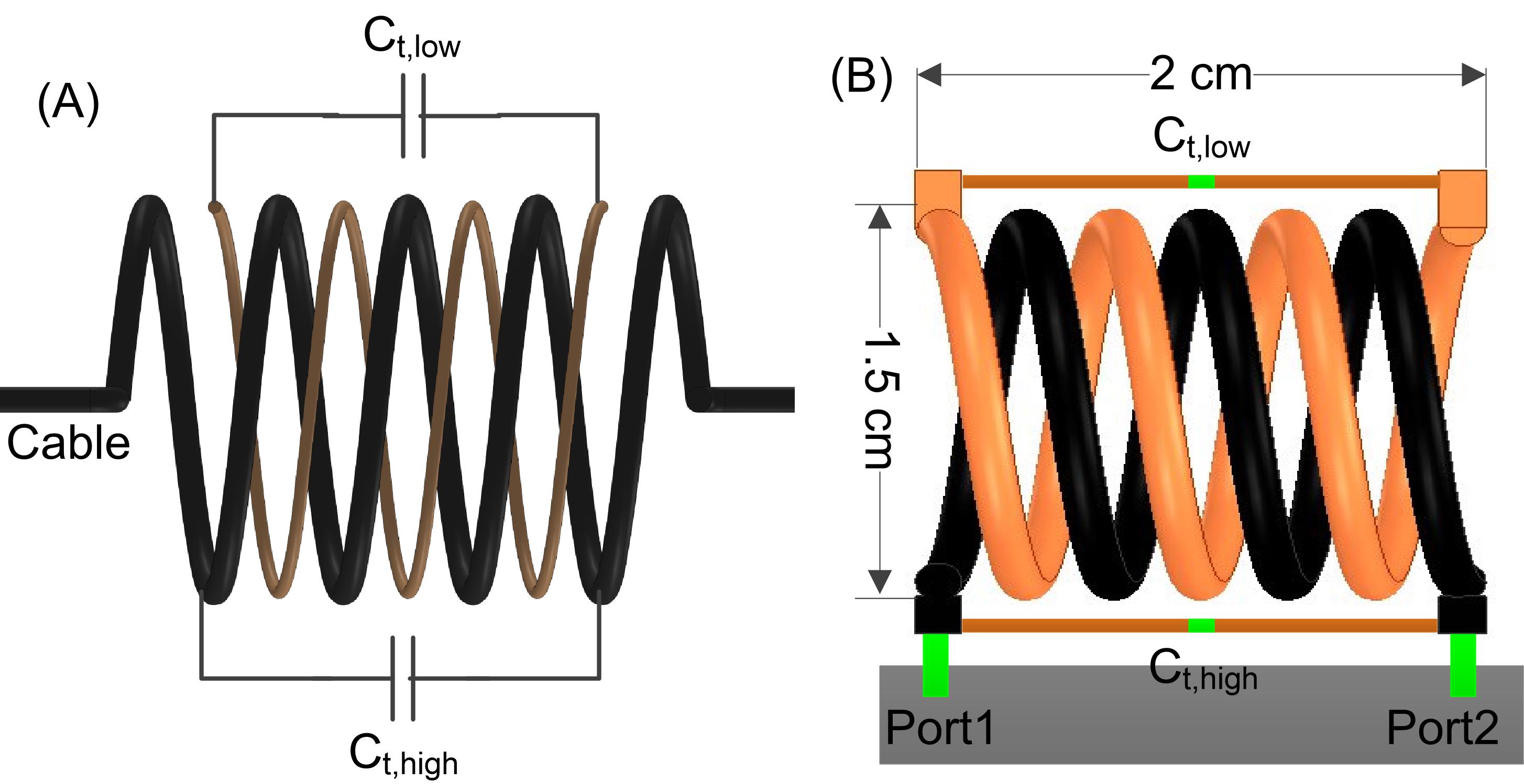
Figure 1A presents the circuit diagram of the proposed frequency-independent dual-tuned cable trap. In this diagram, the coaxial cable, highlighted in bold black in Figure 1A, is wound into a solenoid shape. The cable's two ends are connected to a lumped capacitor, denoted as Ct,high. This configuration creates a standard solenoid cable trap that blocks common-mode current at high frequencies, specifically the Larmor frequency of protons in a multi-nuclear system. To address common-mode current at low frequencies, particularly the typical Larmor frequency of X-nuclear systems, an additional solenoid resonator, shown in brown in Figure 1A, is introduced. Unlike the standard solenoid cable trap, this add-on solenoid resonator is not connected to the coaxial cable. Instead, it employs inductive coupling to trap common-mode signals at low frequencies.A series of electromagnetic (EM) simulations were performed (Ansys HFSS) to verify the concept and investigate the performance. The coaxial cable shield has an outer diameter of xx mm to mimic the dimension of a non-magnetic flexible cable (Huber+Suhner G_02232_D). The common-mode suppression ability was evaluated by the transmission coefficient (S21) between two 50-ohm ports with their grounds connected through a large copper foil, as shown in Figure 1B.
RESULTS
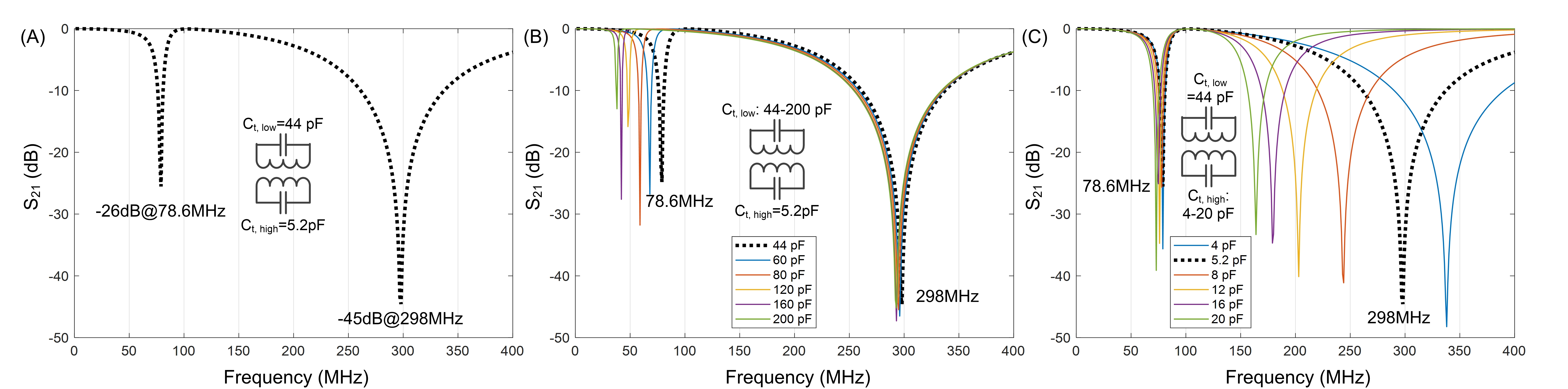
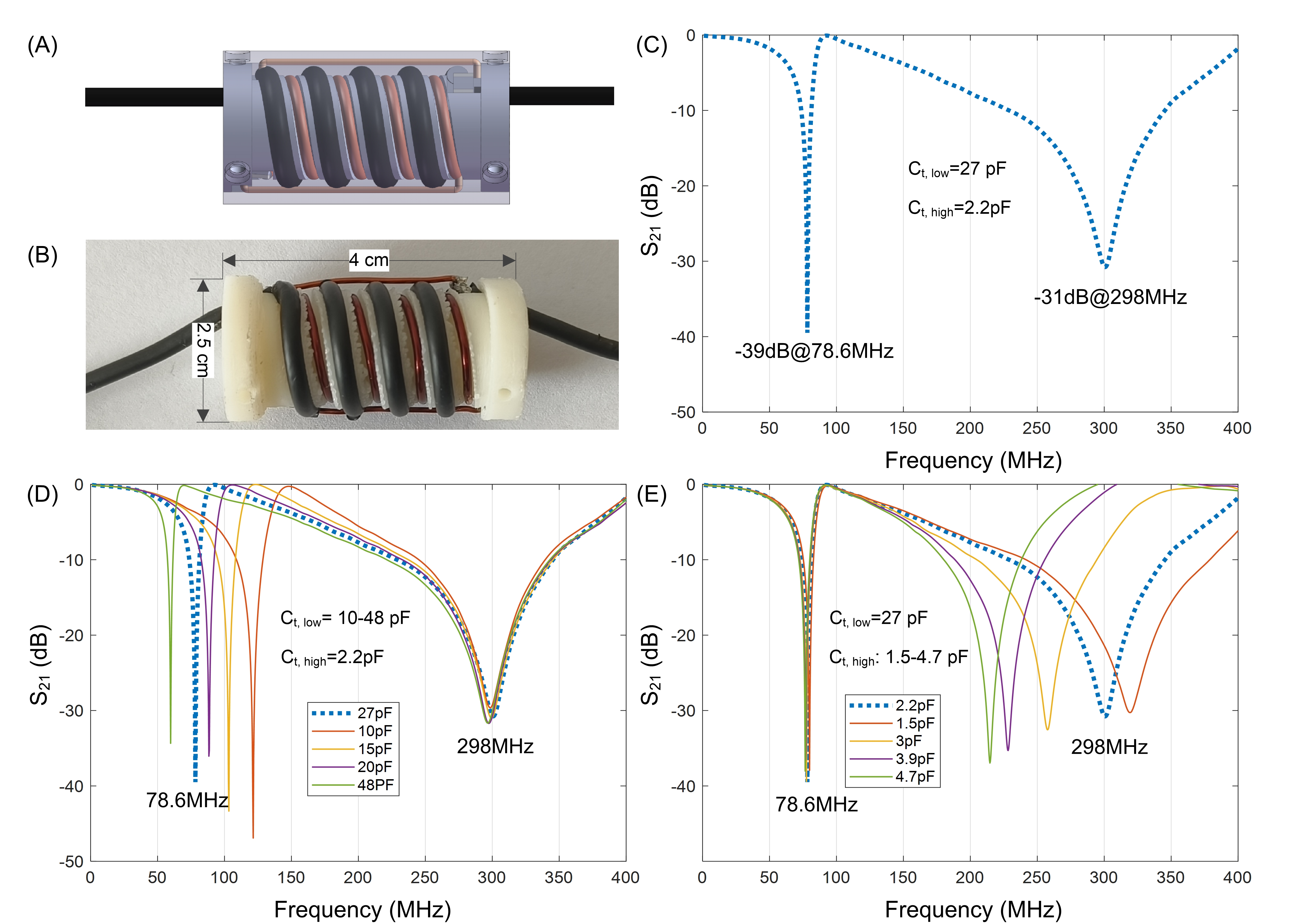
Figure 2 displays the simulation results for the proposed dual-tuned balun designed for the 7T 1H/23Na applications (Larmor frequencies of 298 MHz and 78.6 MHz). Optimal values for Ct,high, and Ct,low, ensuring exceptional common-mode suppression at both frequencies, were found to be 44 pF and 5.2 pF, respectively. When we varied Ct,low from 44 pF to 200 pF while maintaining Ct,high at a constant 5.2 pF, we observed no shift in the operating high frequency, which remained at 298 MHz. Similarly, when adjusting Ct,high within the range of 4 pF to 20 pF, we observed minimal frequency variation in the operating low frequency of the balun. Furthermore, it is important to highlight that this dual-tuned balun, despite its compact dimensions with a diameter of 1.5 cm and a length of 2 cm, exhibits exceptional common-mode suppression capabilities at both frequencies, with an S21 value of -26 dB and -45 dB at 78.6 MHz and 298 MHz.Figure 3A and 3B display the CAD models and photographs of the fabricated dual-tuned cable trap. Consistent with the simulation results, this compact device demonstrates remarkable common-mode suppression capabilities, achieving -39 dB at 78.6 MHz and -31 dB at 298 MHz. Throughout the fabrication process, we observed that the two operating frequencies are independent and can be readily tuned to desired values with minimal effort.
CONCLUSION
This study proposes a frequency-independent dual-tuned balun in which the two operating frequencies can be adjusted independently without mutual interference. This design exhibits exceptional common-mode current suppression abilities at both frequencies, even within a compact structure.Acknowledgements
This work was in part supported by NIH grants R03 EB034366 and R01 EB031078. The content is solely the responsibility of the authors and does not necessarily represent the official views of the National Institutes of Health. This work was performed during the period of Dr. Ming Lu’s visit to Vanderbilt University Institute of Imaging Science.References
- M. Wilcox, S. M. Wright, and M. P. McDougall, “Multi-Tuned Cable Traps for Multinuclear MRI and MRS,” IEEE Transactions on Biomedical Engineering, vol. 67, no. 4, pp. 1221–1228, Apr. 2020, doi: 10.1109/TBME.2019.2933733.
- Y. Zhu, C. R. Sappo, W. A. Grissom, J. C. Gore, and X. Yan, “Dual-tuned Lattice Balun for Multi-nuclear MRI and MRS,” IEEE Transactions on Medical Imaging, pp. 1–1, 2022, doi: 10.1109/TMI.2022.3140717.
- W. H. Harrison, M. Arakawa, and B. M. McCarten, “RF coil coupling for MRI with tuned RF rejection circuit using coax shield choke,” US4682125A, Jul. 21, 1987 Accessed: May 31, 2022. [Online]. Available: https://patents.google.com/patent/US4682125A/en
Figures