1569
Open BirdcageBuilder1Bernard and Irene Schwartz Center for Biomedical Imaging, Department of Radiology, New York University Grossman School of Medicine, New York, NY, United States, 2Center for Advanced Imaging Innovation and Research (CAI2R), Department of Radiology, New York University Grossman School of Medicine, New York, NY, United States
Synopsis
Keywords: Non-Array RF Coils, Antennas & Waveguides, Software Tools, Birdcage Coil Design
Motivation: Currently the well-known BirdcageBuilder software tool for providing a first prediction of capacitor values for Birdcage Coil design is available only as an app for Android devices.
Goal(s): We introduce an Open-source version of BirdcageBuilder available for the MR community to use and improve on GitHub.
Approach: From Java code for BirdcageBuilder Mobile, we developed a version in JavaScript. The GUI is an HTML web page, so the webapp runs in any modern web browser on any device. Outputs were validated against the original publication and the Mobile version.
Results: The software and code are available to all for use and improvement.
Impact: A freely-available open-source version of the BirdcageBuilder software facilitates rapid design of birdcage coils and allows improvement by the MR community. Additional functionalities could include prediction of all resonances of a coil, noncylindrical coils, and output of a CAD model.
INTRODUCTION
Since its introduction in 2002 (1), BirdcageBuilder has become a well-known software tool for providing a first prediction of what capacitor values to use for specific Birdcage Coil designs. The first iterations of the software, distributed on CD-ROM for Windows95 and hosted online in Java, are no longer available to the public. Since 2013 BirdcageBuilder has been downloadable for use on Android phones (2) and integrated into widely-used simulation software (Sim4Life, Zurich MedTech, AG) (3), but otherwise not available for general use. The original paper has been cited more than 100 times, and BirdcageBuilder Mobile has been downloaded more than 500 times in the past 5 years alone.Here we introduce Open BirdcageBuilder, rewritten in JavaScript and HTML for use on any web browser with source code available on Github (4). We invite the MRI research community to suggest and implement further advances.
METHODS
Starting with the Java code from the BirdcageBuilder Mobile Android version, we developed a version in JavaScript, largely transcribed from the same codebase, with some minor modifications. The GUI is a standard HTML web page, using basic CSS for styling. Therefore, the webapp should run in any modern web browser on any device (mobile phone, laptop computer, tablet, etc.). Use of external libraries was avoided to keep the code self-contained, with one exception: Unit testing was implemented using the QUnit JavaScript testing framework (8) which runs in the browser as well. This is independent from the functionality of the code, and not required for regular use.The calculator webapp is hosted on Github Pages (4) which requires an internet connection. However, thanks to this new open source release, the full code repository can now be downloaded in advance and run locally, without an internet connection.
The new implementation was validated by comparing predicted capacitor values for all designs presented in the original paper (1), as well as against the previous Android app results.
RESULTS AND DISCUSSION
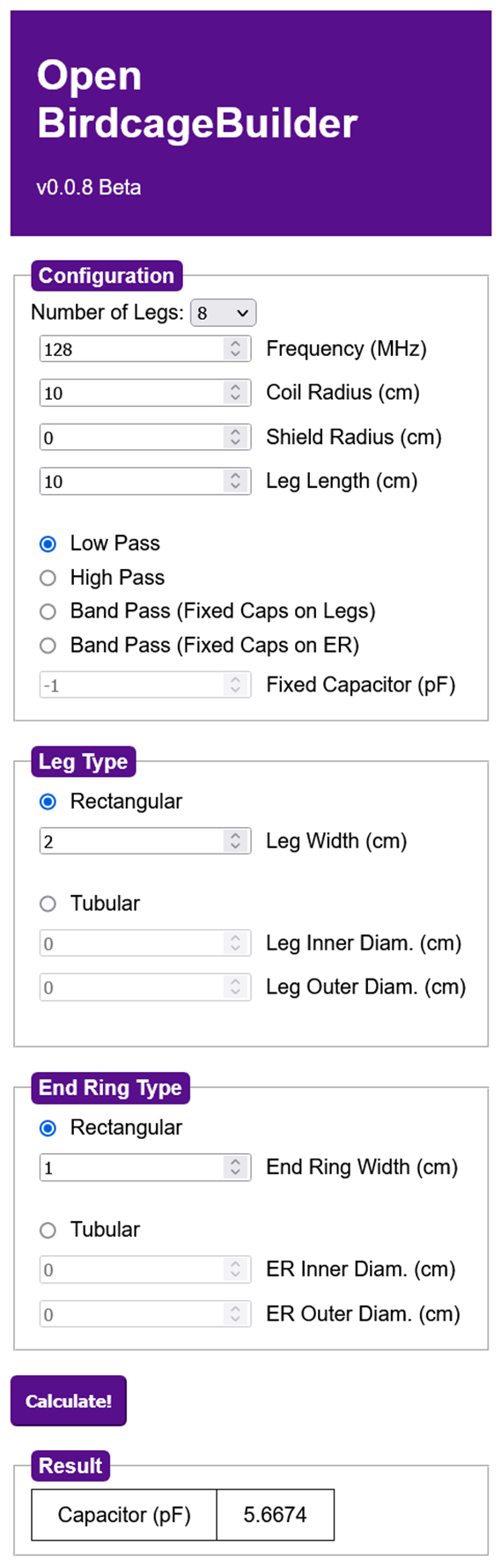
Figure 1 shows a screenshot of the new implementation as it would appear through a web browser on a mobile device. The design is “responsive” in order to adapt to various screen sizes and devices. All inputs are grouped and presented in an intuitive manner, and the predicted capacitor value, shown towards the bottom of the page, is updated whenever the “Calculate” button is pressed. User inputs are automatically evaluated and obvious input errors are highlighted with dashed red outline. A specific error message is also displayed (not currently supported on all browsers).The webapp, open source code, and documentation are publicly available on Github (4). The project has been submitted for listing on opensourceimaging.org (9) alongside many other open source MRI- and imaging-related projects. We also expect hosting through the NYU/CAI2R resources page (10) soon. The open source code is available to the community, with an invitation for improvement, extension, and reuse within the terms of the license. We hope the simple, highly flexible web browser-based open source design inspires further advances to this tool, and development of other tools for the MR research community. Possible additional functionalities for Open BirdcageBuilder could include prediction of all resonances of a given coil design, design of noncylindrical birdcage coils (1, 5-7), and output of a CAD model of a given design to aid in construction or simulation.
Acknowledgements
This work was performed under the rubric of the Center for Advanced Imaging Innovation and Research (CAI2R, www.cai2r.net), an NIBIB National Center for Biomedical Imaging and Bioengineering (NIH P41 EB017183).
We acknowledge Dr. Chih-Liang Chin as the programmer for the first distributed version of BirdcageBuilder, and both Dr. Tobias Bloch and Roy Wiggins for assistance and suggestions regarding online implementation of Open BirdcageBuilder.
References
1. Chin CL, Collins CM, Li S, Dardzinski BJ, Smith MB. BirdcageBuilder: design of specified‐geometry birdcage coils with desired current pattern and resonant frequency. Concepts in Magnetic Resonance: An Educational Journal. 2002 Jun;15(2):156-63.
2. https://cai2r.net/resources/birdcagebuilder-mobile/
3. Yan X, Allen S, Lu M, Moore D, Meyer CH, Grissom WA. Dark band artifact in transcranial MR-guided focused ultrasound: Mechanism and mitigation with passive crossed wire antennas. Magnetic Resonance Imaging. 2023 Nov 1;103:169-78.
4. https://github.com/dbnyu/OpenBirdcageBuilder
5. Li S, Collins CM, Dardzinski BJ, Chin CL, Smith MB. A method to create an optimum current distribution and homogeneous B1 field for elliptical birdcage coils. Magnetic resonance in medicine. 1997 Apr;37(4):600-8.
6. Leifer MC. Theory of the quadrature elliptic birdcage coil. Magnetic resonance in medicine. 1997 Nov;38(5):726-32.
7. De Zanche N, Pruessmann KP. Algebraic method to synthesize specified modal currents in ladder resonators: Application to noncircular birdcage coils. Magnetic resonance in medicine. 2015 Nov;74(5):1470-81.
8. https://qunitjs.com/
9. https://www.opensourceimaging.org/
10. https://cai2r.net/resources/#radiofrequency-and-dielectric-tools
Figures