1568
Rapid fabrication of integrated liquid metal stretchable receiver coils using 3D printing.1Weill Cornell Medicine, New York, NY, United States, 2GE Healthcare, Aurora, OH, United States
Synopsis
Keywords: Non-Array RF Coils, Antennas & Waveguides, RF Arrays & Systems, stretchable
Motivation: Most commercial MRI coil designs are rigid, prohibiting optimal SNR and patient comfort. Flexible coils conform to anatomies varying in size/shape and significantly improve image quality in applications such as breast imaging.
Goal(s): We optimize manufacturing of our previously developed stretchable coils by direct integration of liquid metal within the polymeric coil substrate to allow for rapid one-step fabrication of multi-element arrays in the future.
Approach: Liquid metal is directly 3D printed on the substrate to expedite/integrate fabrication.
Results: A stretchable single element is fabricated and resonance at the 3T Larmor frequency is demonstrated.
Impact: Our novel 3D printing technique simplifies the production of stretchable liquid metal MRI coils, ensuring consistent quality and efficiency. With reduced fabrication time and elimination of manual injection steps, this technology facilitates seamless construction of multi-channel stretchable coil arrays.
Background and Purpose
Conventional flexible receiver RF coils are rigid and tend to undergo resonance detuning when deformed/stretched1-4. We have previously laid the foundation of stretchable liquid metal technology that self-tunes to the required resonance frequency5-9. Direct ink writing methods have been found to be the most useful due to their repeatability, printability, and manufacturing speed. Previously, Liquid metal (EGain) was separately injected into microchannels within the silicone-based substrate of the stretchable coil array. However, injection of EgaIn can result in a potentially uneven liquid metal distribution as the coil shape changes. Moreover, the injection is an additional fabrication step that has to be done manually. The injection method also leads to complexities when implementing overlapping coil elements in a multi-channel array5,6.This work expands on this technology optimizing and integrating the fabrication process into a one-step method that allows for even liquid metal distribution and efficient manufacturing of MRI coils, especially as larger multi-channel arrays are assembled from overlapping single elements. We explore a one-step 3D printing strategy that allows for direct deposition of the liquid metal conductor on/within the polymer substrate. This method allows for improved manufacturing of arrays and speeding the manufacturing process. The resulting self-tuning coil elements/arrays can accommodate and conform to nonconventional anatomical shapes without the need for frequency retuning.
Methods
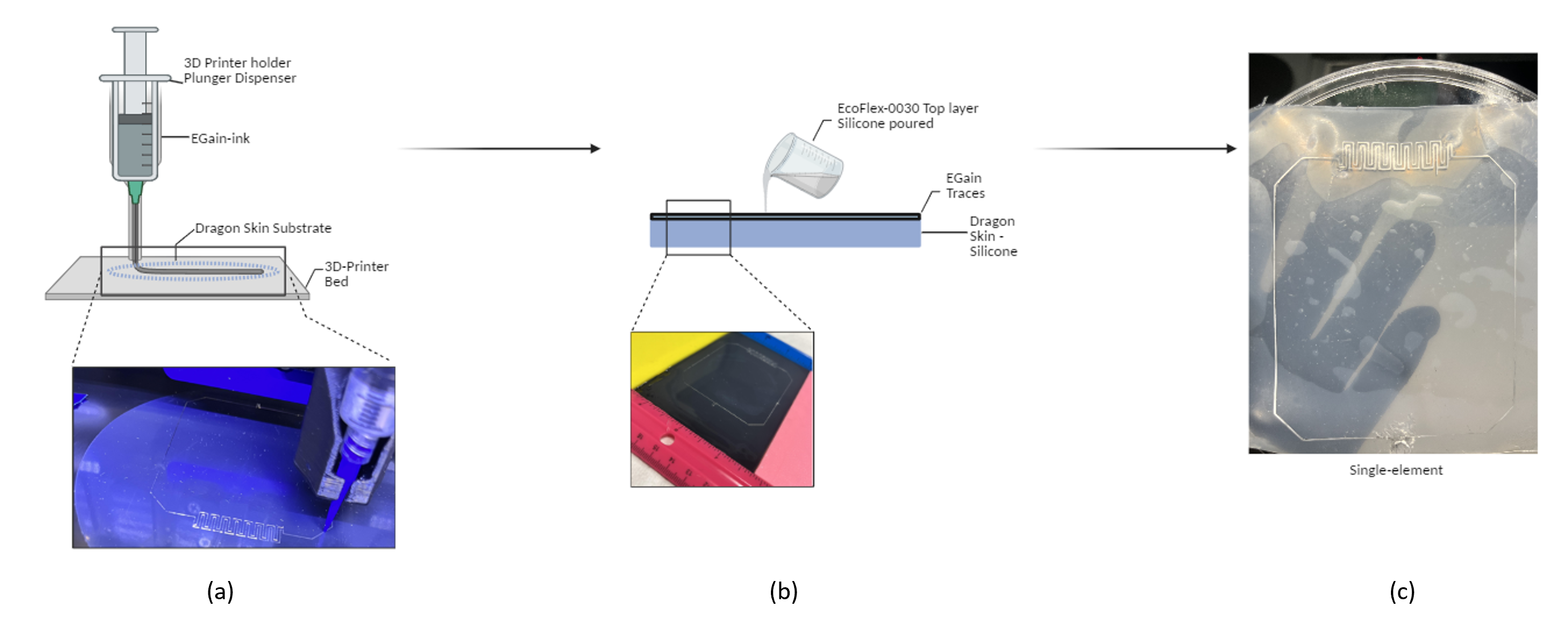
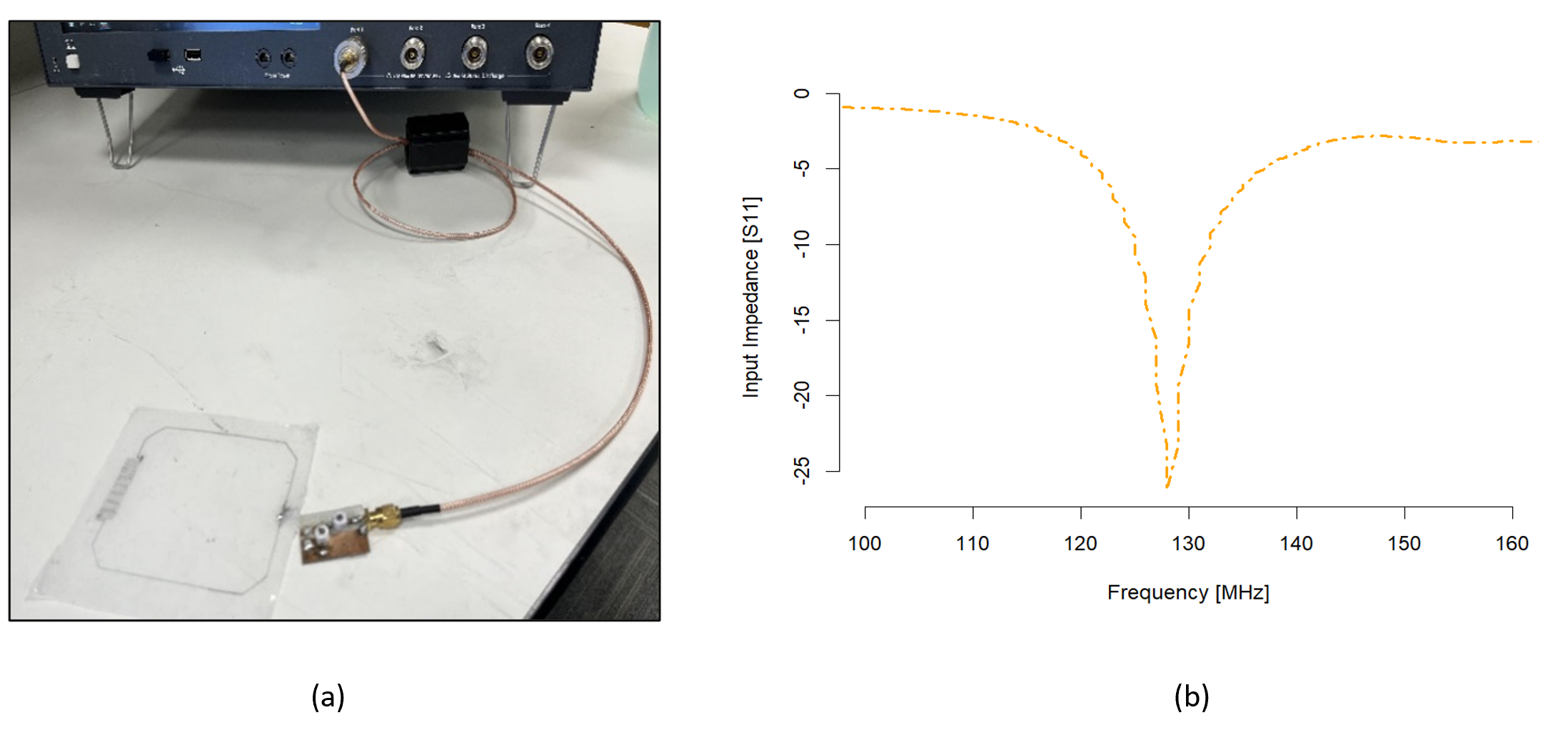
Coil Fabrication: Dragon Skin® Silicone substrate was prepared using two polylactic acid (PLA) material sheets. Prior to curing, a liquid-base silicone sample was poured on a PLA sheet and covered by a second PLA sheet to make a strong and stable even substrate surface. Post substrate curing, the silicone sheet was removed from the PLA formers and placed on the bed of a 3D printer (Hyrel Hydra H21). Liquid metal (Eutectic GaIn alloy) was then printed (~10 minutes) to form the conducting traces of the stretchable coil on the fully cured Dragon Skin silicone substrate. A nonmetallic 0.4 inner-diameter Gauge 22 syringe tip was used together with an extruder speed of 0.5 mm/sec and no dispensing pressure (0 kPa) 10,11. Rigorous optimzation of the machine G-code was performed to optimize process variables for seamless and uniform deposition of the liquid metal conductor traces. After the liquid metal printing, each trace was tested for conductivity with a digital multimeter. Copper wires were placed at the terminals and secured with SilPoxy silicone sealant. Lastly, an Ecoflex® elastomer top layer was added to fully embed the intact interdigital capacitor traces. The coil copper wires were then connected to a PCB feed board containing tuning and matching circuitry. The coil was tuned to 128 MHz and matched to 50 ohms.Bench tests: The 3D printed liquid metal coil prototype was tested on the bench, and S-parameters were evaluated using a vector network analyzer (VNA) (Keysight E5071C).
Results
Fabrication: Figure 1 shows the single-element coil prototype fabrication process: (a) 3D printed traces with an extrusion width of 0.4 mm and a 0.5 mm height. (b) Intact liquid metal traces were embedded within a single element. (c) Fully cured prototype of stretchable self-tuning coil with inserted copper wires.Process improvements: While our previous fabrication methodology required approximately 4-5 hrs. to yield a fully cured device, here we reduce the fabrication time by a factor of 2 while removing the need for separate manual injection steps. This bears promise for direct fabrication of a multi-channel array without coil overlap complexity.
Impedance test: Figure 2(a) shows the hardware set-up of the self-tuning coil with the VNA. Figure 2(b) shows the measured S11-parameter, demonstrating a properly matched coil resonating at a frequency of 128 MHz.
Conclusion
Based on the previously patented stretchable liquid metal technology, known as LiquiTune, we address fabrication challenges that limit liquid metal uniformity and overlapping coil array construction. Our preliminary results successfully demonstrate direct 3D printing of EGaIn on a silicone substrate without the need for microfluidic channel fabrication. Future work includes coil stretching tests and array fabrication as well as in vivo imaging in healthy volunteers.Acknowledgements
This work was supported by NIH R01 EB031820 and GE Healthcare.References
1. A. Mehmann et al., “On the Bending and Stretching of Liquid Metal Receive Coils for Magnetic Resonance Imaging,” IEEE Trans. Biomed. Eng., vol. 66, no. 6, pp. 1542–1548, Jun. 2019.
2. A. Mehmann et al., “Automatic Resonance Frequency Retuning of Stretchable Liquid Metal Receive Coil for Magnetic Resonance Imaging,” IEEE Trans. Med. Imaging, vol. 38, no. 6, pp. 1420–1426, Jun. 2019.
3. J. A. Nordmeyer-Massner, N. De Zanche, and K. P. Pruessmann, “Mechanically adjustable coil array for wrist MRI,” Magn. Reson. Med., vol. 61, no. 2, pp. 429–438, Feb. 2009.
4. N. R. Zwart, “Liquid metal in stretchable tubes: A wearable 4-channel knee array.” https://archive.ismrm.org/2019/1114.html (accessed Nov. 03, 2023).
5. E. Motovilova et al., “Multi-channel, Stretchable, Self-Tuning Coil Array Based on Liquid Metal Technology,” in ISMRM 2023 Proceedings, Accessed: Nov. 03, 2023. [Online]. Available: https://cds.ismrm.org/protected/23MPresentations/abstracts/3906.html
6. E. Motovilova et al., “Dual-Channel Stretchable, Self-Tuning, Liquid Metal Coils and Their Fabrication Techniques,” Sensors , vol. 23, no. 17, Sep. 2023, doi: 10.3390/s23177588.
7. E. Motovilova, J. Vincent, V. Taracila, and S. A. Winkler, “Bi-Directional Stretchable Capacitors for Self-Tuning MRI Receive Coils,” in 2023 IEEE International Symposium on Antennas and Propagation and USNC-URSI Radio Science Meeting (USNC-URSI), Jul. 2023, pp. 775–776. DOI: 10.1109/USNC-URSI52151.2023.10238115
8. E. Motovilova et al., “Silicone-based materials with tailored MR relaxation characteristics for use in reduced coil visibility and in tissue-mimicking phantom design,” Med. Phys., vol. 50, no. 6, pp. 3498–3510, Jun. 2023.
9. E. Motovilova et al., “Stretchable self-tuning MRI receive coils based on liquid metal technology (LiquiTune),” Sci. Rep., vol. 11, no. 1, p. 16228, Aug. 2021.
10. Y.-G. Park, H. S. An, J.-Y. Kim, and J.-U. Park, “High-resolution, reconfigurable printing of liquid metals with three-dimensional structures,” Sci Adv, vol. 5, no. 6, p. eaaw2844, Jun. 2019.
11. S. Kim, J. Oh, D. Jeong, and J. Bae, “Direct Wiring of Eutectic Gallium-Indium to a Metal Electrode for Soft Sensor Systems,” ACS Appl. Mater. Interfaces, vol. 11, no. 22, pp. 20557–20565, Jun. 2019.
Figures