1565
Wave-impedance-match materials for Travelling Wave MRI1Hangzhou Institute of Technology, Xidian University, Hangzhou, China, 2National Key Laboratory of Antennas and Microwave Technology, School of Electronic Engineering, Xidian University, Xian, China
Synopsis
Keywords: Non-Array RF Coils, Antennas & Waveguides, Non-Array RF Coils, Antennas & Waveguides
Motivation: Wave-impedance-match is key to ensure maximized power transmission in travelling-wave (TW) MRI. Currently, only coaxial waveguide method has been proposed. It requires adding metallic cylinder inside magnet and gradient coils, which introduces risks of mechanical instability and patient safety due to eddy current.
Goal(s): Propose a novel wave-impedance-match method for TW excitation with non-metallic materials.
Approach: Dielectric cubes made up of easy-accessible distilled water were modelled and placed between feed and the load. Power-flow-density and power-loss results were used to evaluate wave-impedance-match.
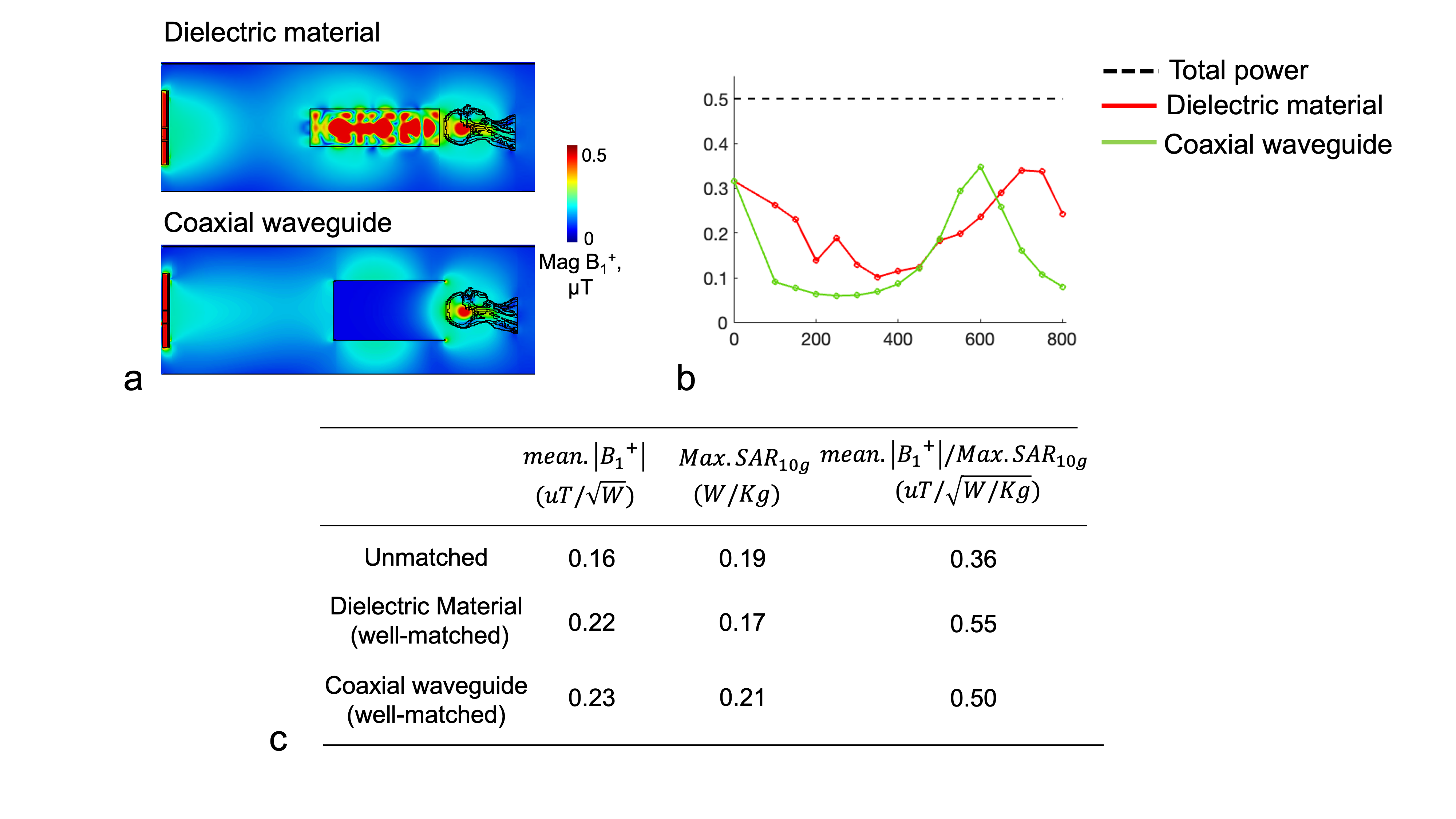
Results: Wave-impedance-match varies with length and width of dielectric cube. The well-matched conditions with dielectric cube and coaxial waveguide are similar.
Impact: Non-metallic wave-impedance-match method was proposed for TW excitation. This has the potential to accelerate maturity of traveling-wave excitation method in UHF MRI.
INTRODUCTION
Travelling-wave excitation is a promising method in UHF MRI [1-3]. As a radiative method, it has intrinsically low SAR compared to the classic reactive method. It also has shown benefit in large coverage, which makes it promising as a potential whole-body excitation solution. However, TW MRI surfers from apparent weakness in transmission efficiency. Unmatched wave-impedance is one of the major reasons leading to low efficiency. The coaxial waveguide method has been proposed to achieve wave-impedance-match [4]. However, it requires inserting large metallic tubes inside the MRI magnet and gradient coils and placing them in close vicinity to the imaging subject. The complex setup introduces safety concerns regarding eddy-current-induced mechanical instability and heating damage. To address this problem, this study explores the capability of dielectric materials in wave-impedance-match. It provides a novel wave-impedance-match solution with high MRI compatibility.METHODS
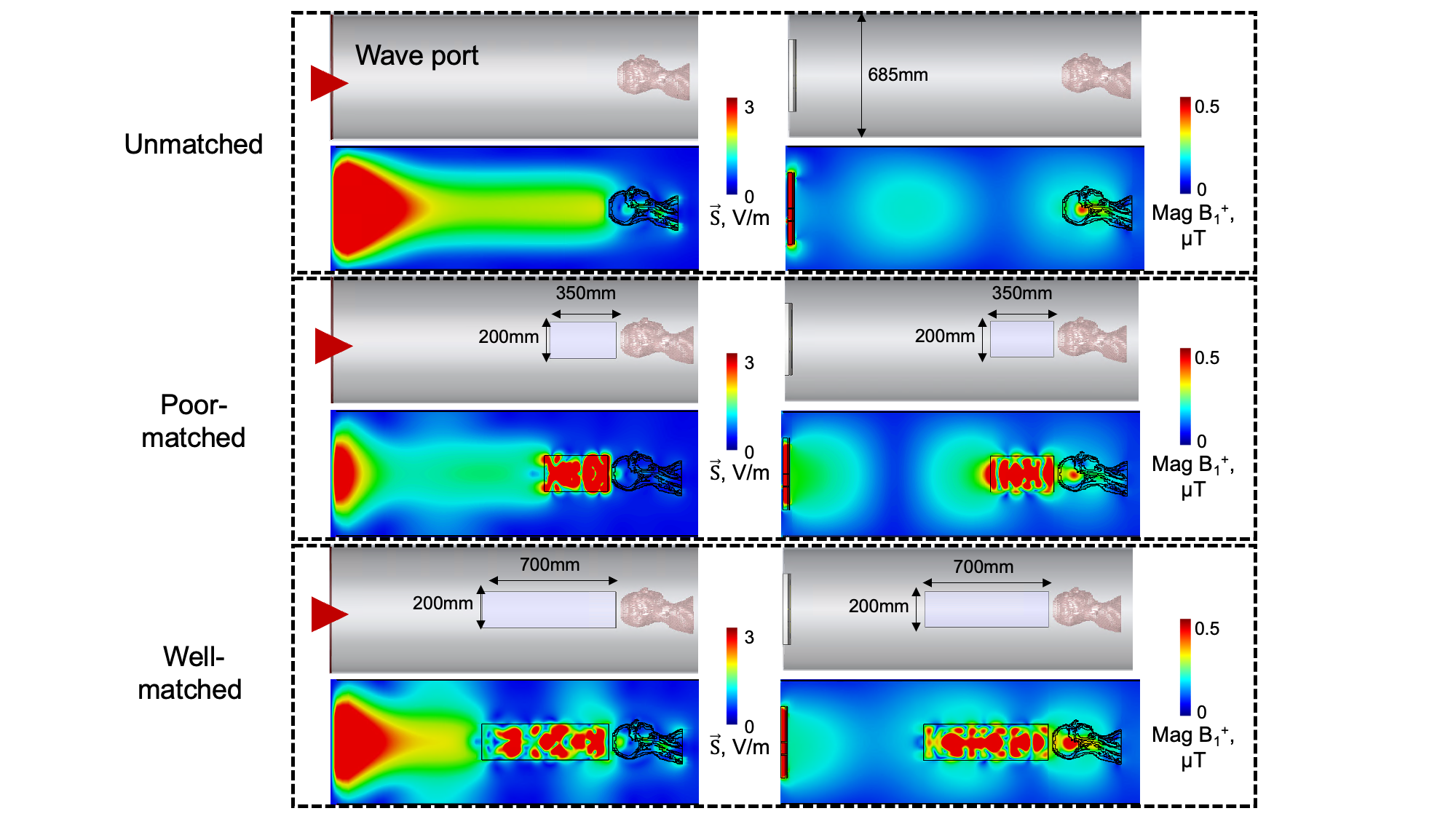
Numerical electromagnetic simulations were conducted in CST (Dassault Systèmes, France). The characteristics of dielectric materials (length, width, z-position) in wave-impedance-match were investigated through simulations. Dielectric cubes were modeled with easily accessible materials, the distilled water (dielectric constant 78, non-conductive). The MRI-embedded waveguide was modelled as a PEC cylindrical surface (diameter of 650mm, length of 3360mm). The head of the human model was positioned 150cm away from the waveguide feed, as shown in. The dielectric cube was placed near the head of the human body, as illustrated in Figure 1. Wave-impedance-match conditions were evaluated through wave port feed. Poynting vector (power flow density), as well as power-losses (in dielectrics, accepted, reflected), were calculated to monitor wave-impedance match conditions. B1+ results were calculated through patch antenna feed (driven by two quad-hybrid discrete ports).RESULTS
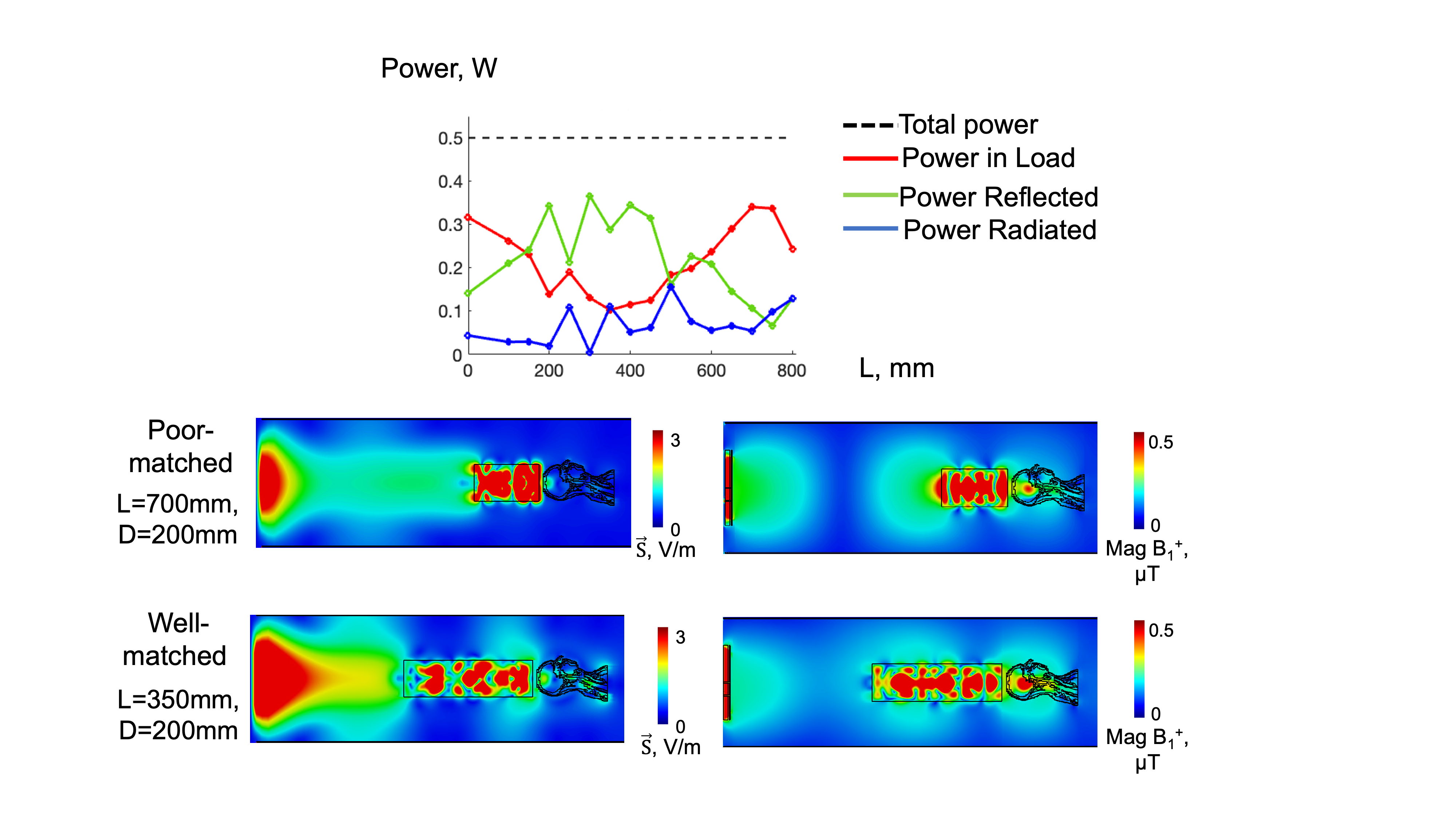
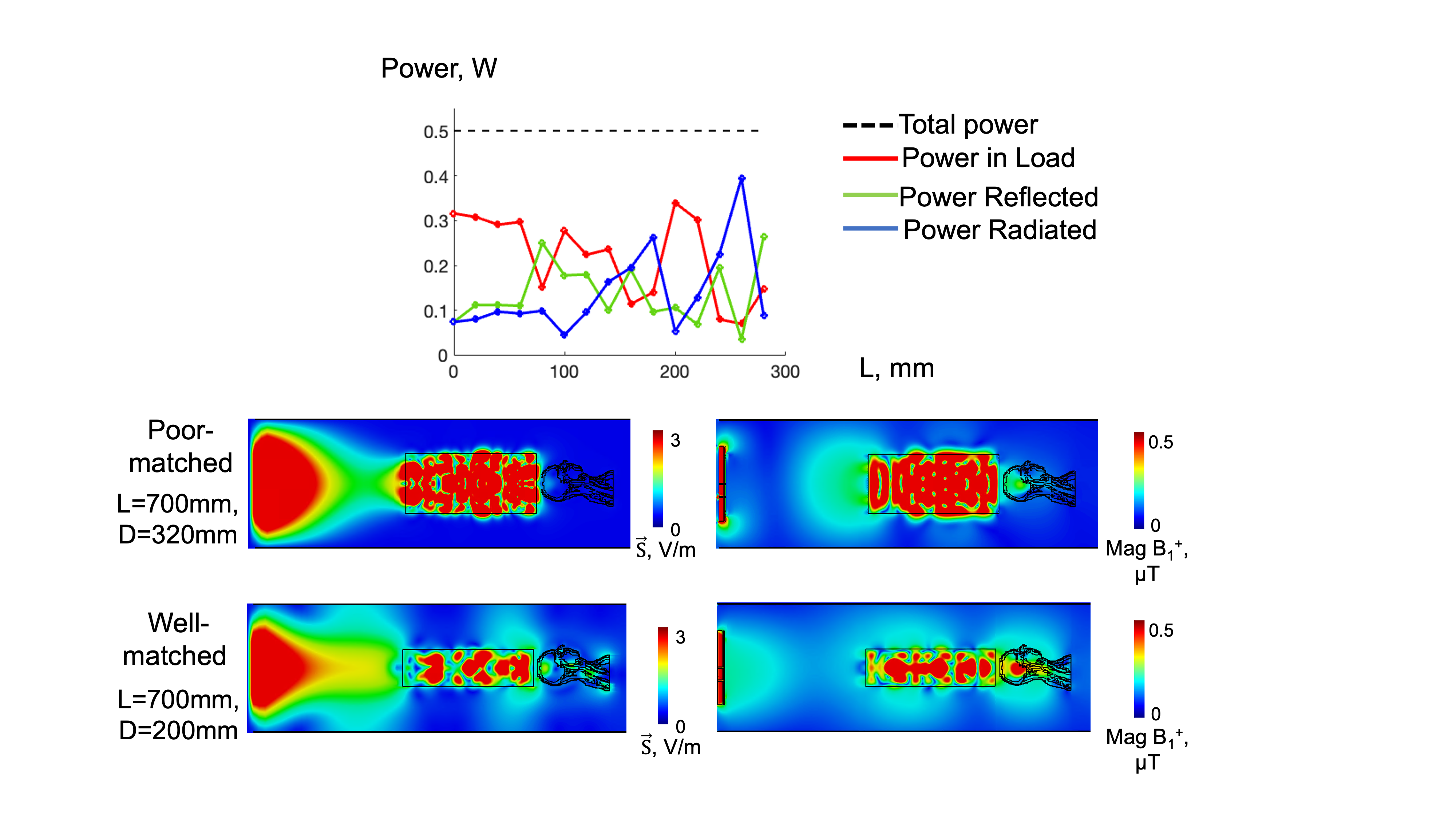
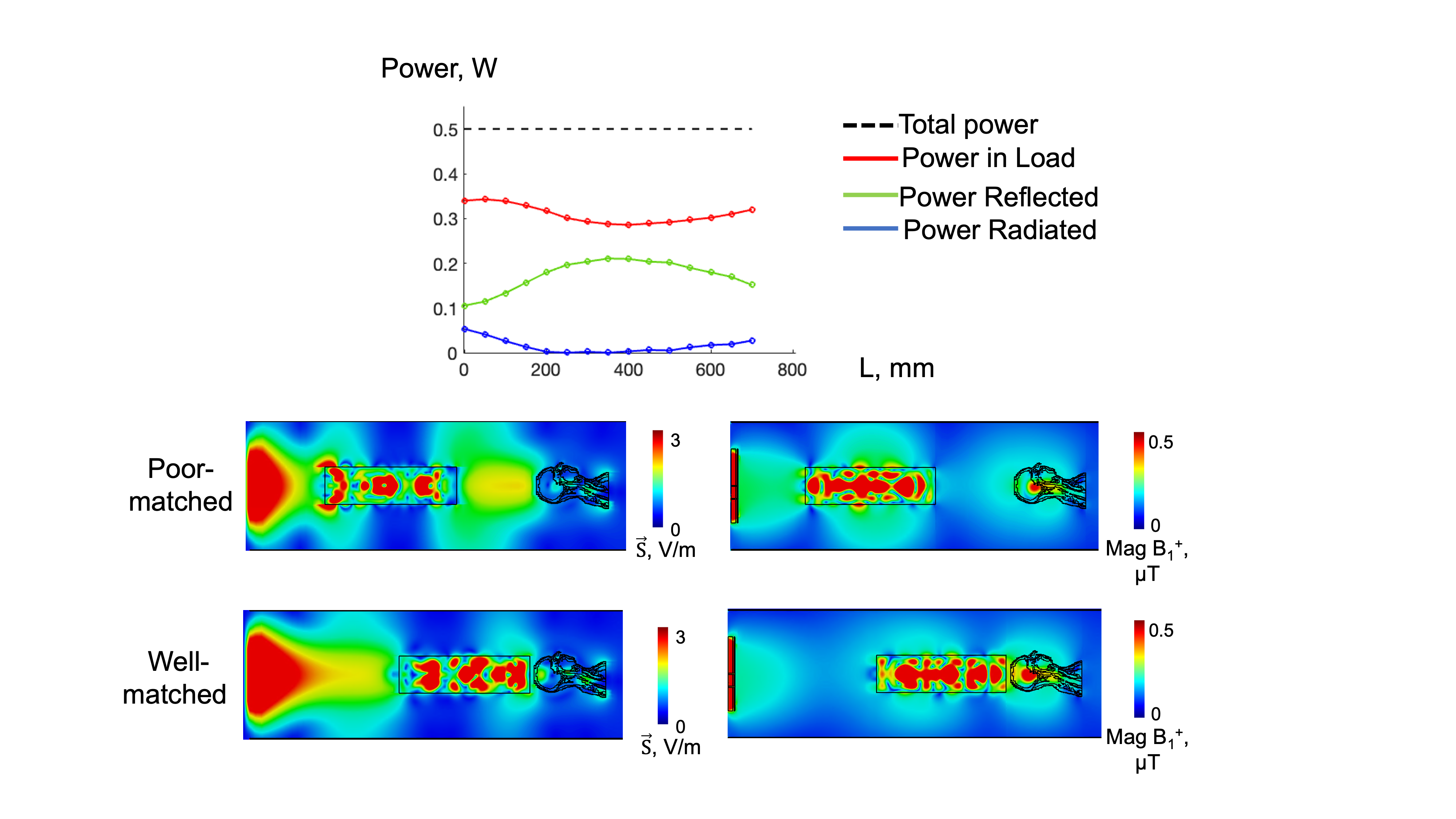
As shown in Fig. 1, it can be observed that through placing dielectric cubes modelled with distilled water material in the waveguide, the energy flow can be significantly altered. Under the well-matched condition, more energy was delivered to the human head. As a result, higher B1+ can be observed at human head region, compared to the unmatched condition. The wave-impedance-match condition indicated by the “Power in Load” varies with the length (Fig. 2), the width (Fig. 3) as well as the position in z-direction between feed and human subject (Fig. 4). The wave-impedance-match performance of optimized dielectric cube structure was compared with the coaxial waveguide method, as shown in Fig. 5. Dielectric materials have shown similar and slightly better performance in SAR efficiency.CONCLUSIONS
In ultra-high field magnetic resonance imaging, TW magnetic resonance imaging is a highly promising alternative due to its wide coverage and simple setup. However, its limited transmission efficiency has hindered its widespread application. This paper proposes the use of dielectric materials for wave-impedance-match in TW MRI to maximize transmission efficiency. Compared to the coaxial waveguide method which requires a metallic cylinder insert, our method with a dielectric material insert can greatly reduce safety concerns regarding mechanical instability and patient safety arising from eddy current. According to the results, similar wave-impedance-match conditions can be achieved using both methods.Acknowledgements
No acknowledgement found.References
[1] Smith NB, Haines K, Versluis M, Webb AG. Human Imaging Using Traveling Waves at 7 Tesla. In: Proceedings of the ISMRM Workshop on High Field Systems and Applications, Rome, Italy, 2008.
[2] Brunner DO, Zanche ND, Frohlich J, Paska J, Pruessmann KP . Travelling-wave nuclear magnetic resonance. Nature.2009;457:994–999.
[3] Andreychenko, Anna, et al. "Coaxial waveguide for travelling wave MRI at ultrahigh fields." Magnetic Resonance in Medicine 70.3 (2013): 875-884.
[4] Andreychenko, A., et al. "Improved steering of the RF field of traveling wave MR with a multimode, coaxial waveguide." Magnetic Resonance in Medicine 71.4 (2014): 1641-1649.
Figures