1520
Initial clinical experience of mineral bone imaging using a ZTE sequence reconstructed with Deep-Learning and Chemical Shift Correction (DLCSC)1GE HealthCare, Clinical Research, Buc, France, 2Medical Imaging, Cliniques Universitaires Saint Luc, UCLouvain, Brussels, Belgium, 3GE HealthCare, MR Clinical Solutions, Atlanta, GA, United States, 4GE HealthCare, MR Clinical Solutions, New York, NY, United States
Synopsis
Keywords: Bone, Bone, Deep Learning reconstruction
Motivation: Bone MRI using ZTE has the potential to provide clinically relevant information on mineral bone but its routine use remains limited by its low SNR and chemical shift artifacts especially at 3.0T
Goal(s): We evaluated the impact of a deep learning reconstructions for ZTE which performs denoising, improves resolution and minimizes chemical shift artifacts (DLCSC).
Approach: ZTE sequences prospectively obtained in 10 patients were reconstructed with the DLCSC algorithm. Native and processed images were compared for their performance to detect bone lesions, taking CT as gold standard.
Results: DLCSC increased image quality and significantly improved bone lesion detection compared to native ZTE images.
Impact: DLCSC reconstruction overcomes the pitfalls of the ZTE sequence (low SNR and chemical shift artifacts) and improves its diagnostic performance. A complete study of the skeleton, including mineral bone assessment, becomes possible within a single MRI examination.
INTRODUCTION
Conventional MRI sequences cannot depict structures such as bone cortices, trabeculae and other calcified tissues. Recent development of Zero Echo Time (ZTE) sequence has made possible the complete exploration of the musculoskeletal system including mineral bone assessment without the need of an additional ionizing exam. ZTE sequence with their low flip angle and ultra-short TE provides high contrast between bone and soft tissues.Several clinical indications have emerged, such as the assessment of traumatic bone lesions, of degenerative or inflammatory joint conditions, the detection of calcified depositions, or the characterization of bone destruction or sclerosis in tumoral conditions. However, ZTE sequence presents two major pitfalls: presence of chemical shift artifacts and low SNR, which limits its diagnostic performance compared to CT, the reference technique [1].
The aim of our study was to evaluate a new deep learning-based reconstruction algorithm [2] specifically designed to address those pitfalls and to assess the possibility of obtaining true CT-like images on MRI.
MATERIALS AND METHODS
10 patients referred for various clinical indications underwent MR examinations of the lumbar spine, bony pelvis and proximal femurs on a 3T MR system (Signa PREMIER, GE HealthCare). In addition to the standard MR sequences performed routinely for bone marrow study, a coronal ZTE sequence was added with the following parameters: 1.6 mm isotropic acquisition (0.8mm reconstructed slices) with FOV= 44cm and matrix = 278, FA=1°, Number of average=2 and bandwidth=62.5 kHz to increase SNR. Sequence duration was 2min54sec with 360 slices to cover anatomy in A/P direction. A concurrent CT exam was acquired within the same week as part of the standard of care pathway and used as the gold standard for the study. A new deep learning-based reconstruction designed for ZTE sequence with advanced Chemical Shift Correction was used to obtain an optimized additional ZTE sequence reconstruction.All image analyses were read by two radiologists. Readings were performed blindly to patient history, clinical indication and other relevant imaging information.
Ten bone regions (5 lumbar vertebrae, sacrum, right and left coxal bones, right and left femurs) were considered to assess the respective performance of the native ZTE sequence and the optimized ZTE sequence reconstructed with the new Deep-Learning model (ZTE + DLCSC) to detect bone lesions.
CT reading was used as reference standard to define the presence of bone lesions and classify them as degenerative or tumoral. The presence of these lesions was determined separately on native ZTE and ZTE + DLCSC. For all images, bone regions and lesion types, two scores were recorded: a categorical score (presence of lesion = yes/no corresponding to a score = 1/0) and a quantitative score corresponding to the count of lesions.
In addition, ZTE and ZTE + DLCSC sequences were scored for their quality on a 3-point Likert scale for each of the following categories: image quality, global lesion conspicuity (1: poor, 2: good, 3: excellent) and chemical shift artifacts (1: no artifact, 2: few artifacts without diagnostic impact, 3: artifacts with diagnostic impact).
RESULTS
ZTE image quality was improved with the application of DLCSC reconstructions that significantly decreased Chemical Shift artifacts and led to improved lesion conspicuity (Fig 1). ZTE + DLCSC images, alike reference CT, really highlighted the bone structure (Fig 2 and Fig 3).A total of 82 lesions (32 degenerative and 50 tumoral lesions) were detected by CT. Regular ZTE detected 52 lesions (27 degenerative and 25 tumoral lesions). ZTE + DLCSC detected 75 lesions (30 degenerative and 45 tumoral lesions).
Fig. 4 illustrates lesion detection in different skeletal areas using CT as reference. Lesion detection was significantly increased with ZTE + DLCSC compared to regular ZTE, especially in lumbar vertebrae and pelvic areas where SNR was lower and Chemical Shift Artifacts more pronounced (Fig 5).
DISCUSSION
Compared to conventional reconstructions, correction of the ZTE sequences using the deep learning-based reconstruction with Chemical Shift Correction significantly improves the image quality and diagnostic performance of ZTE sequences. The corrected images become very similar to CT in terms of visual assessment but also of diagnostic performance. The realistic depiction of bone structures that cannot be visualized on regular ZTE sequence due to limited signal to noise and chemical shift artifacts, largely improves assessment of trabecular and cortical bone lesions.CONCLUSION
This study demonstrates the added value of a new Deep Learning reconstruction algorithm integrating Chemical Shift Correction for ZTE sequence, which improves image quality and diagnostic performance. The use of DLCSC reconstruction for ZTE sequence allows an important step forward for the study of mineral bone and detection of bone lesions within an MRI examination.Acknowledgements
No acknowledgement found.References
[1] Ü. Aydıngöz, A. E. Yıldız, and F. B. Ergen, “Zero Echo Time Musculoskeletal MRI: Technique, Optimization, Applications, and Pitfalls,” Radiographics, vol. 42, no. 5, pp. 1398–1414, 2022, doi: 10.1148/rg.220029.
[2] R. M. Lebel, “Performance characterization of a novel deep learning-based MR image reconstruction pipeline,” arXiv.org. Accessed: Oct. 26, 2023. [Online]. Available: https://arxiv.org/abs/2008.06559v1
Figures
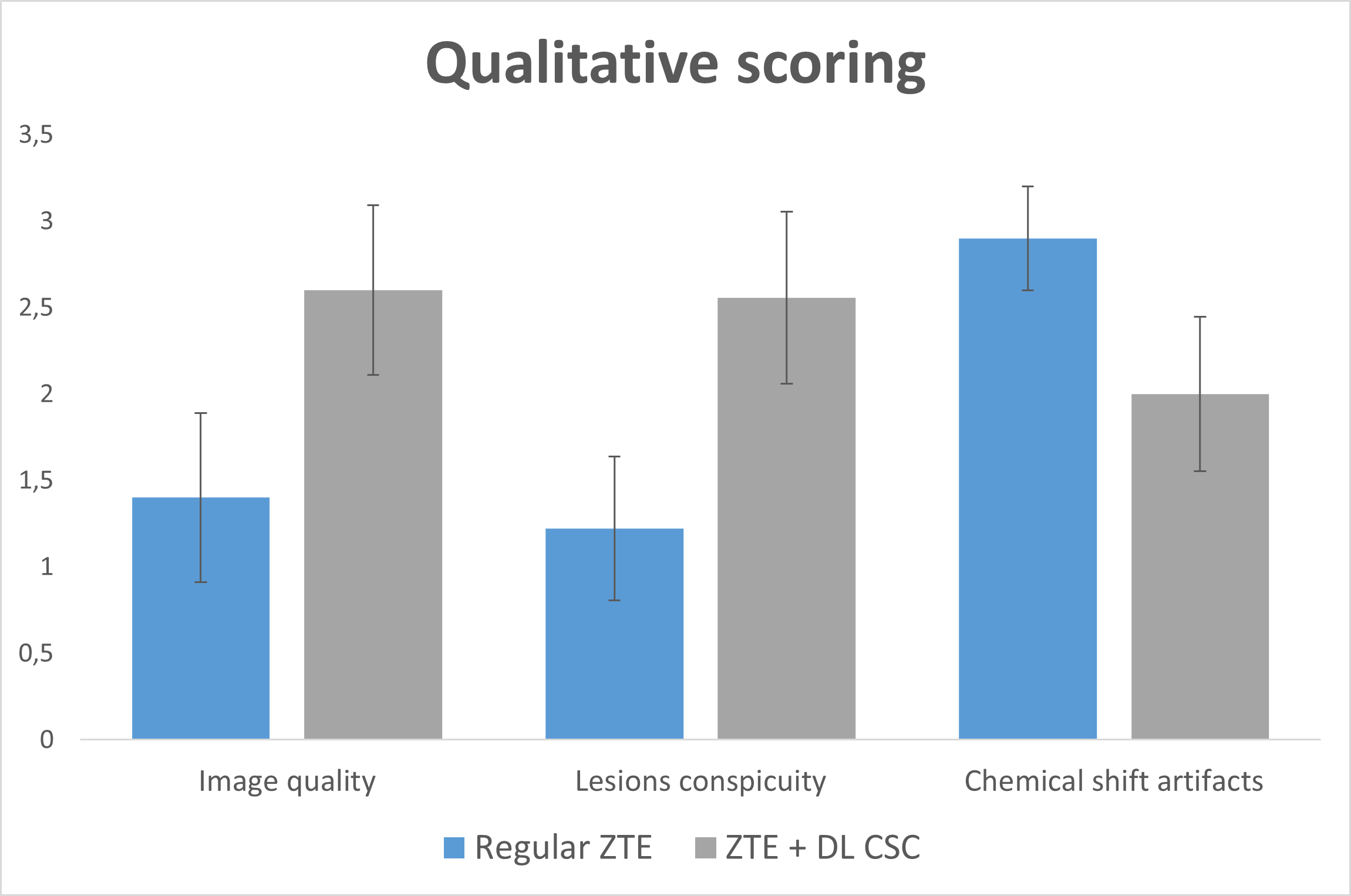
Figure 1: Results of qualitative scoring by readers show the DL-based Chemical Shift Correction reconstruction significantly increases overall image quality and lesions conspicuity and minimizes Chemical Shift artifacts.
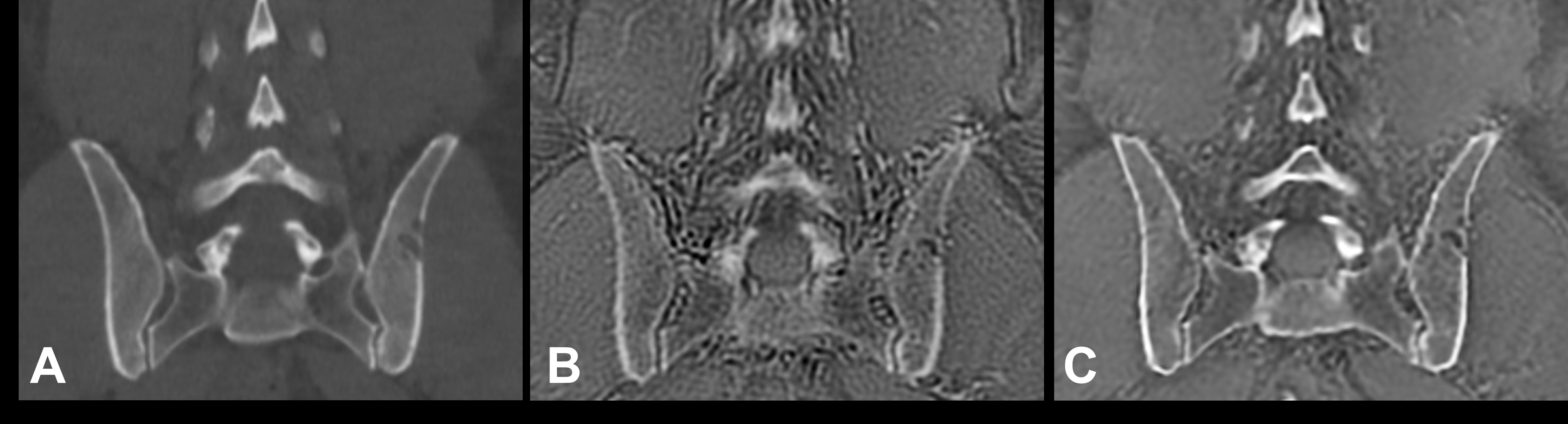
Figure 2: DL-based Chemical Shift Correction reconstruction (Image C) appears highly similar to Gold Standard CT image (Image A), clearly improving image quality compared to native ZTE image (Image B)
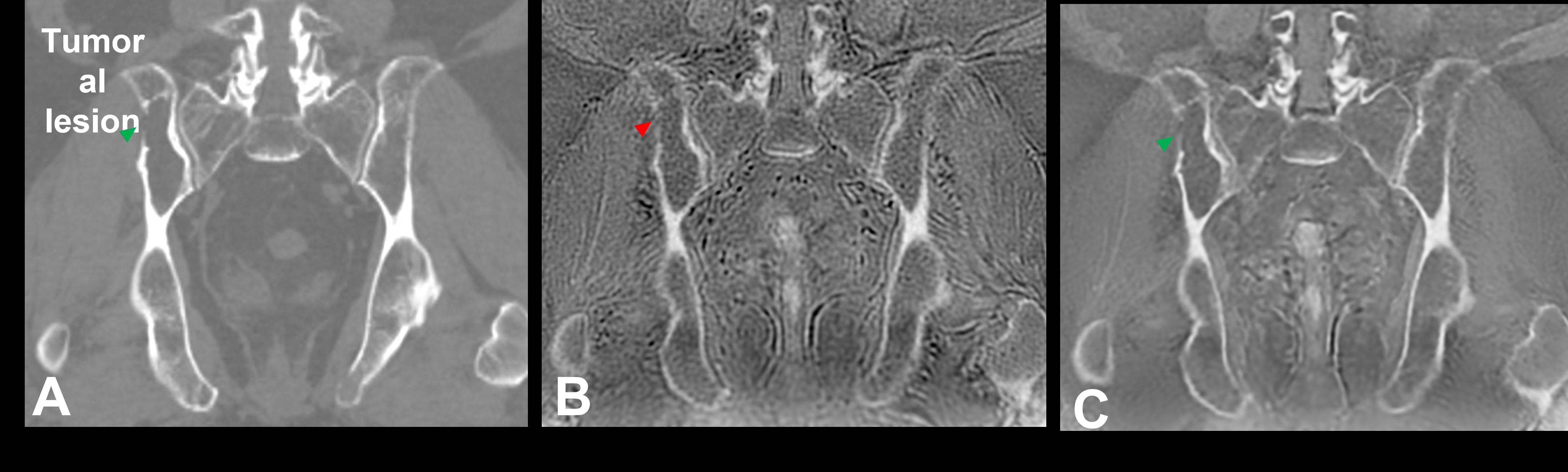
Figure 3: DL-based Chemical Shift Correction reconstruction of ZTE (Image C) improves conspicuity of right illiac bone structure and allows detection of lytic bone lesion and cortical interruption confirmed on CT (Image A) but barely visible on the native ZTE sequence (Image B)
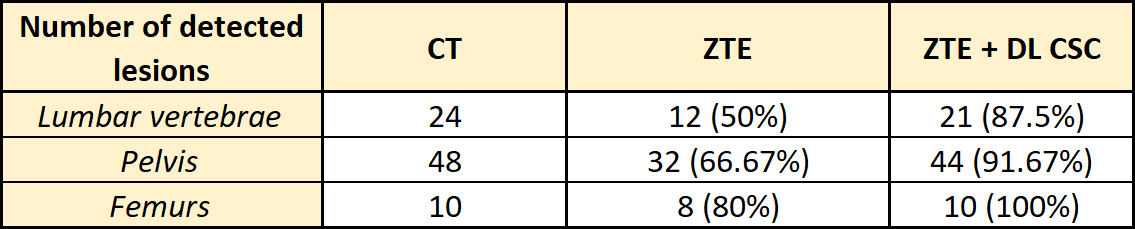
Figure 4: DL-based Chemical Shift Correction reconstruction increases ZTE diagnostic performance in all regions. Numbers are lesions detected by each method with percentages in parentheses.
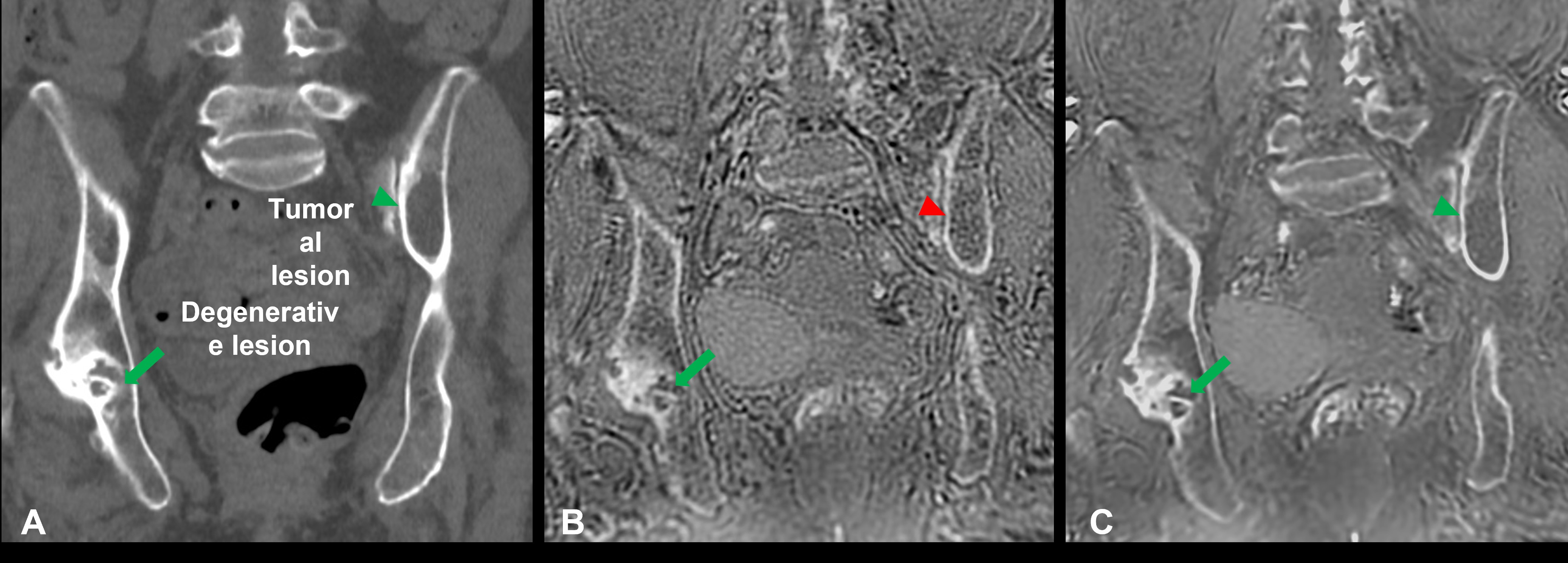
Figure 5: DL-based Chemical Shift Correction reconstruction of ZTE (Image C) improves analysis of bone structures and allows detection of degenerative right iliac degenerative cysts (green arrows) compared to the regular ZTE sequence (Image B). Osteolytic focus confirmed on CT (green arrowhead in Image A and C) was detected on DL-based Chemical Shift Correction reconstruction of ZTE (Image C) but not seen on regular ZTE sequence (Red arrowhead in B)