1443
Design of Multichannel Two-row Quadrature Transceive Array for Ultrahigh field MR Imaging1Department of Biomedical Engineering, State University of New York at Buffalo, Buffalo, NY, United States
Synopsis
Keywords: RF Arrays & Systems, High-Field MRI, Hybrid & Novel Systems Technology, RF Array, Parallel Imaging
Motivation: Increased sensitivity and sufficient image coverage is demanded for more efficient and comprehensive extremity imaging.
Goal(s): Our goal is to exploit multiple-row quadrature RF coil array configuration to increase detection/transmission sensitivity and image coverage for human knee imaging at 7T.
Approach: Due to the increase of the channel count in a multiple-row configuration, it is technically challenging to attain adequate decoupling between quadrature elements of the array. We address this issue by using a double cross magnetic wall decoupling.
Results: The use of double cross magnetic wall decoupling have proven to be an efficient decoupling method.
Impact: The feasibility of this work is a substantial achievement in the multichannel RF hardware engineering, poised to enhance MR imaging technology, especially in high-field applications, where multiple-row quadrature RF coil array configuration can significantly impact image quality and overall efficiency.
Introduction
It is crucial to achieve comprehensive imaging with improved sensitivity and coverage, especially in cases where detailed examination of extremities is required. Multiple rows configuration 1-2 of quadrature coil elements can offer several advantages, including more efficient and comprehensive imaging reducing the need for multiple acquisitions or repositioning of the patient. Furthermore, a close-fitting multichannel coil array can significantly enhance the spatial resolution and image quality 3-4. However, achieving sufficient electromagnetic decoupling among the resonant elements in multiple row RF arrays with closely placed resonant elements can be very challenging, especially when the resonant elements are quadrature resonators. The design of decoupling networks for multiple-rows can be technically intriguing due to the 3D geometry of the coil array. While inductor/capacitor decoupling networks are effective in reducing coupling between elements in the same row, they may not be as effective in addressing coupling between elements from adjacent rows, in particular for quadrature transceive array 5-6. In this work, a double cross magnetic wall decoupling network 7-8 is employed to prevent interference between adjacent coil elements from a two-rows 16-channels quadrature transceiver array targeted for human knee imaging at 7T. The decoupling performance along with the combined transmit/receive ($$$B_1^+/B_1^-$$$), SNR map, and local SAR10g field distribution are evaluated on the voxel using full-wave electromagnetic field solver.Method
The single row quadrature CMDM resonators 7-8 introduced in our previous work has been expanded to a two-row multichannel array operating at 7T. The CMDM resonator is designed using split microstrip transmission line configuration. The copper strip (4 mm width) is a 3 cm x 4 cm rectangular loop placed on top of a grounded dielectric substrate. This low-profile resonator supports both common mode (CM) and differential mode (DM) current distributions 9. The design process starts with 2 x 2 elements of the array placed 1 cm on top of a cylindrical water phantom (conductivity σResults
The simulated scattering parameters of the 2 x 2 quadrature CMDM resonators without the decoupling network is shown in Fig. 2. The results indicate that there is strong coupling between the common mode ports as well as the differential mode ports. By adding the double cross magnetic wall decoupling, the design configuration in Fig. l(c) demonstrates acceptable decoupling between elements of the 2 x 2 quadrature array with at least 16 dB isolation between all the ports at the Larmor frequency (see fig. 3). The two-rows 16-channels quadrature transceiver array is arranged around a built-in human right foot voxel model from ANSYS HFSS, and the design is optimized to attain sufficient decoupling performance. The scattering parameter matrix of the multichannel two-row array illustrated in Fig. 4 shows good matching performance and strong decoupling performance between all the channels at 300 MHz. The total RF transmit/receive field ($$$B_1^+/B_1^-$$$) indicated that the RF coil is efficient in producing and receiving signals in the ROI (around the knee) of the foot voxel, as can be seen in Fig. 5. The simulated 3D local SAR10g distributions also show some hot spots around the knee due to tissue heating where the peak SAR10g value is about 7.66 W/Kg and within acceptable limits for MRI safety assessment.Conclusion
We proposed a multichannel two-row (16 channels) quadrature transceive coil array for human knee imaging at 7T. These compact and low-profile quadrature coil arrays are the result of a split microstrip transmission line topology. A systematic double cross magnetic wall decoupling network consisting of two orthogonal tuning capacitive loops is employed to reduce unwanted coupling between quadrature elements of the multichannel array. The feasibility of this work represents a significant step toward advancing MR imaging technology for high-field applications and provides a valuable contribution to more efficient and comprehensive imaging.Acknowledgements
This work is supported in part by the NIH under a BRP grant U01 EB023829 and by the State University of New York (SUNY) under SUNY Empire Innovation Professorship Award.References
1. K. Ugurbil et al., "Brain imaging with improved acceleration and SNR at 7 Tesla obtained with 64-channel receive array," Magn Reson Med, vol. 82, no. 1, pp. 495-509, Jul 2019, doi: 10.1002/mrm.27695.
2. X. Yan, et al, "Multichannel Double-Row Transmission Line Array for Human MR Imaging at Ultrahigh Fields," IEEE Trans Biomed Eng, vol. 62, no. 6, pp. 1652-9, Jun 2015, doi: 10.1109/TBME.2015.2401976.
3. N. I. Avdievich, "Transceiver-Phased Arrays for Human Brain Studies at 7 T," Appl Magn Reson, vol. 41, no. 2-4, pp. 483-506, Dec 2011, doi: 10.1007/s00723-011-0280-y.
4. G. Shajan, M. Kozlov, J. Hoffmann, R. Turner, K. Scheffler, and R. Pohmann, "A 16-channel dual-row transmit array in combination with a 31-element receive array for human brain imaging at 9.4 T," Magn Reson Med, vol. 71, no. 2, pp. 870-9, Feb 2014, doi: 10.1002/mrm.24726.
5. B. Wu, et al, "Capacitively decoupled tunable loop microstrip (TLM) array at 7 T," Magn Reson Imaging, vol. 25, no. 3, pp. 418-24, Apr 2007, doi: 10.1016/j.mri.2006.09.031.
6. B. Wu, et al, "Design of an inductively decoupled microstrip array at 9.4 T," J Magn Reson, vol. 182, no. 1, pp. 126-32, Sep 2006, doi: 10.1016/j.jmr.2006.04.013.
7. K. Payne, et al, "Quadrature Transceiver RF Arrays Using Double Cross Magnetic Wall Decoupling for Ultrahigh field MR Imaging," Proc Int Soc Magn Reson Med Sci Meet Exhib Int Soc Magn Reson Med Sci Meet Exhib, vol. 31, Jun 2023.
8. K. Payne, et al, "Double cross magnetic wall decoupling for quadrature transceiver RF array coils using common-mode differential-mode resonators," Journal of Magnetic Resonance, vol. 353, p. 107498, 2023/08/01/ 2023.
9. Y. Li, et al, Planar quadrature RF transceiver design using common-mode differential-mode (CMDM) transmission line method for 7T MR imaging, PLoS One 8 (11) (2013) e80428.
Figures
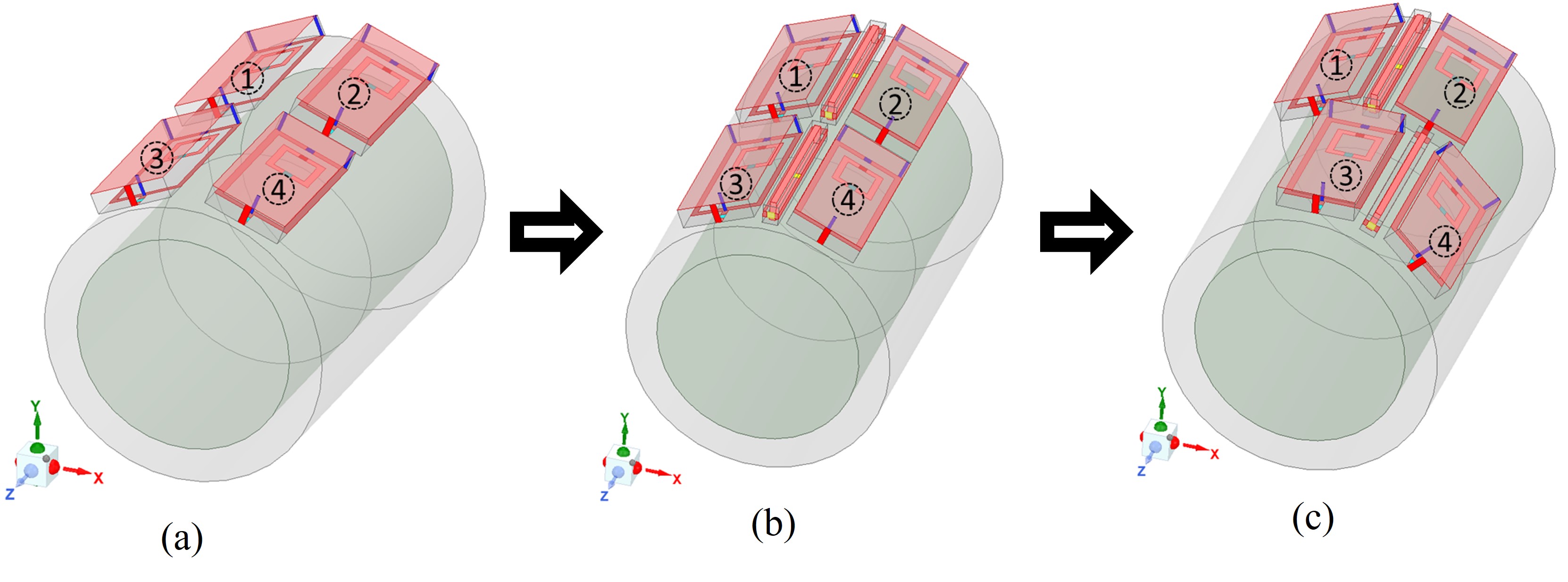
Fig. 1. (a) Topology of the 2 x 2 quadrature CMDM resonators loaded with a cylindrical (13 cm diameter and 20 cm length) water phantom (conductivity σ = 0.6 S/m and permittivity εr = 81). (b) The double cross magnetic wall decoupling networks composed of two orthogonal tuning capacitive loops is integrated in the design. (c) Second row is rotated 22.5-degree with respect to the first row around the z-axis.
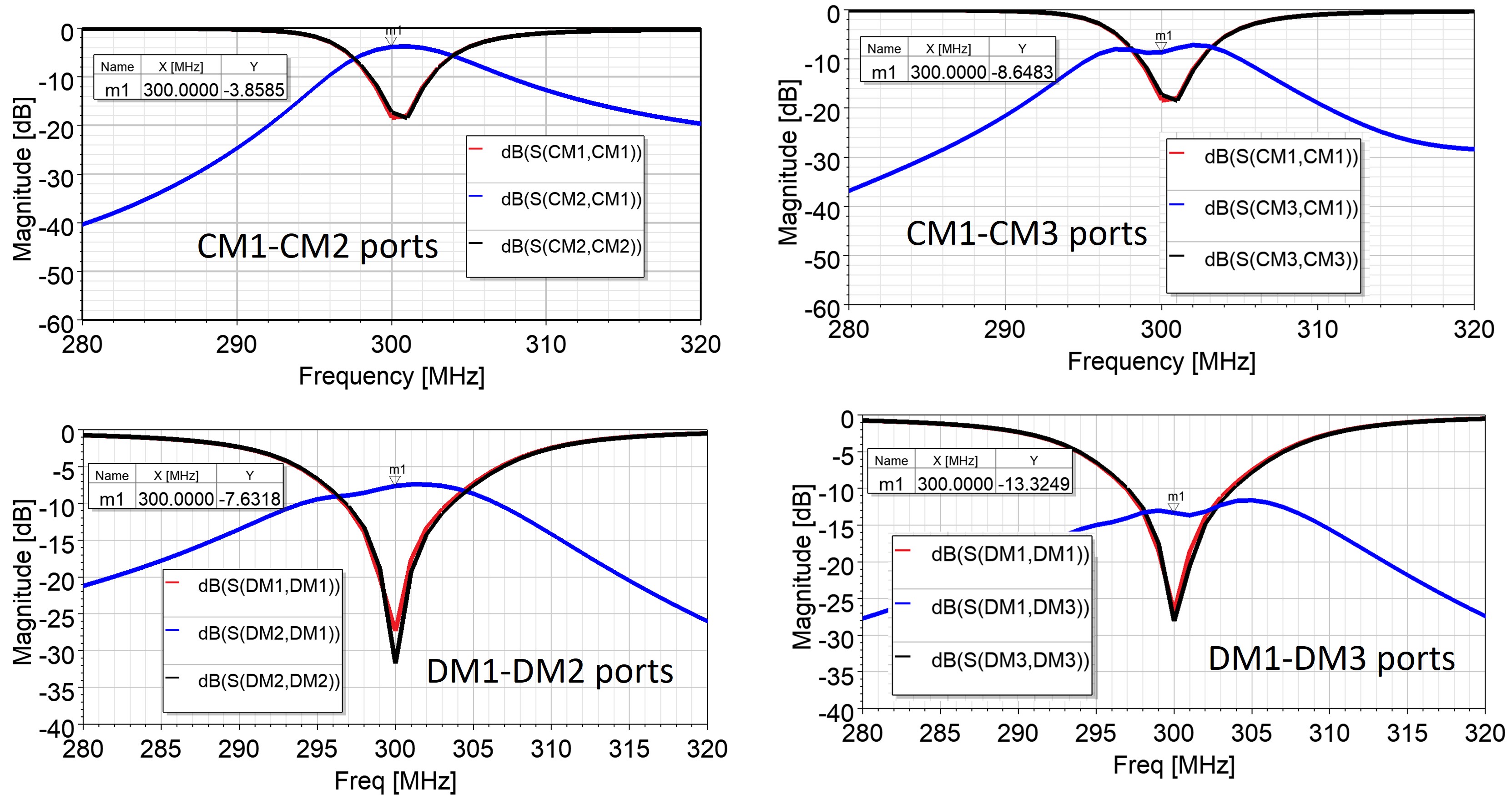
Fig. 2. Simulated scattering parameters of the 2 x 2 quadrature CMDM resonators without the decoupling network showing strong electromagnetic coupling between both neighboring CMDM resonators within the same row and within different rows.
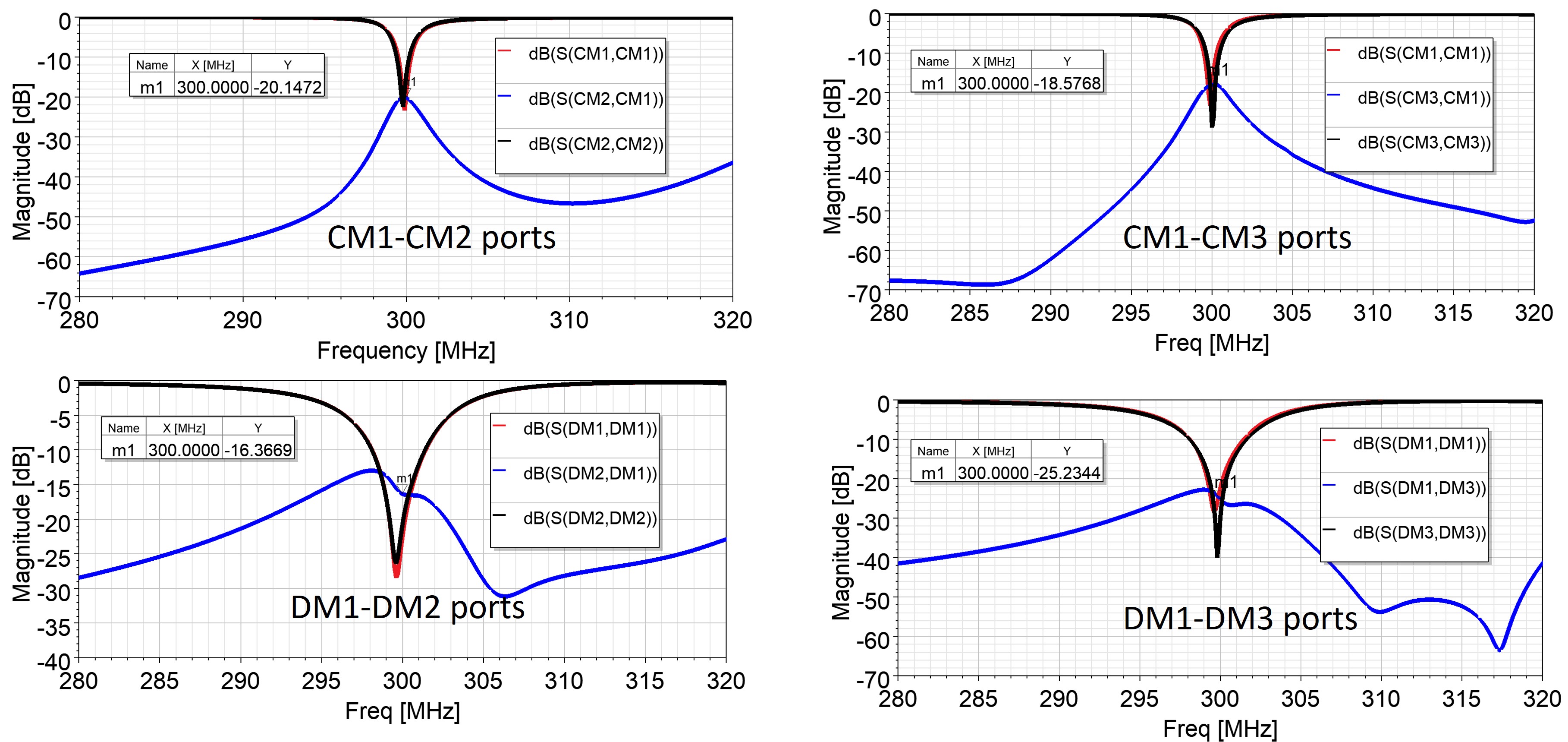
Fig. 3. Simulated scattering parameter of the 2 x 2 quadrature CMDM resonators with the double cross magnetic wall decoupling network. Results show satisfactory decoupling performance among all the ports.
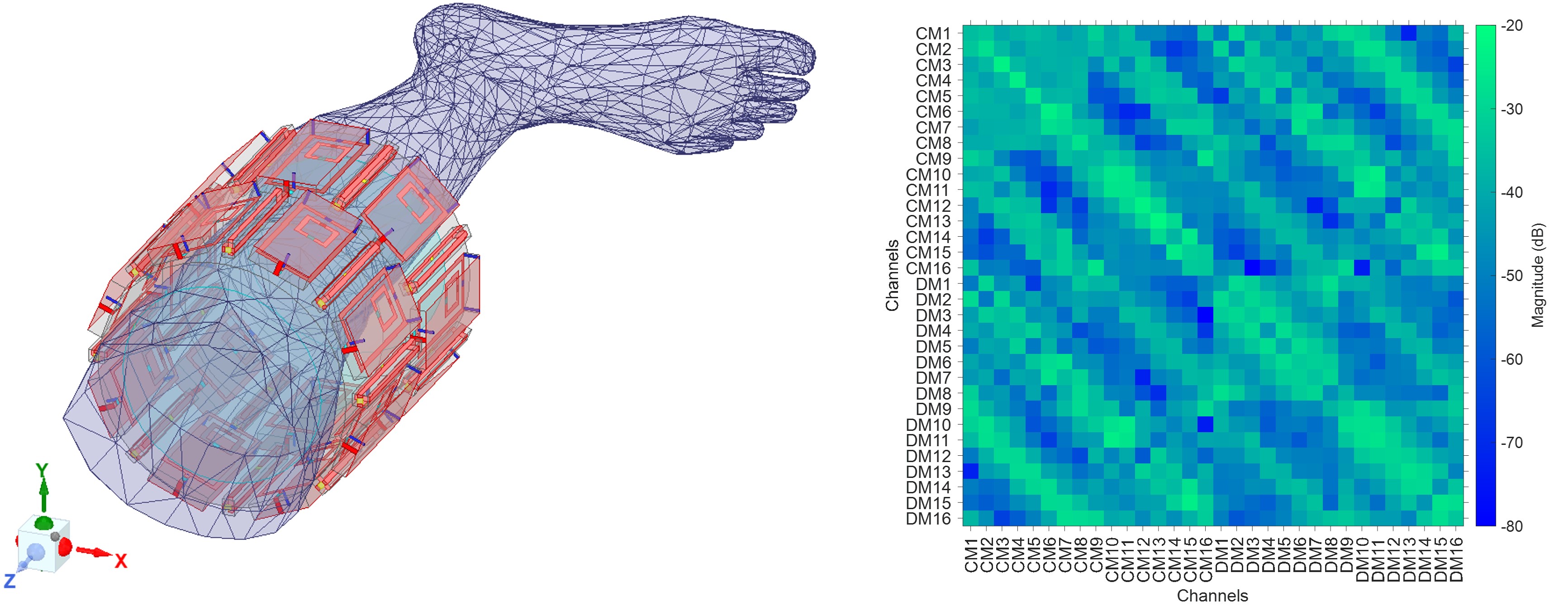
Fig. 4. Configuration of the multichannel two-row quadrature transceive array used for human knee imaging along with the simulated scattering matrix of the array showing good input impedance matching and excellent decoupling among all the ports at 300 MHz.
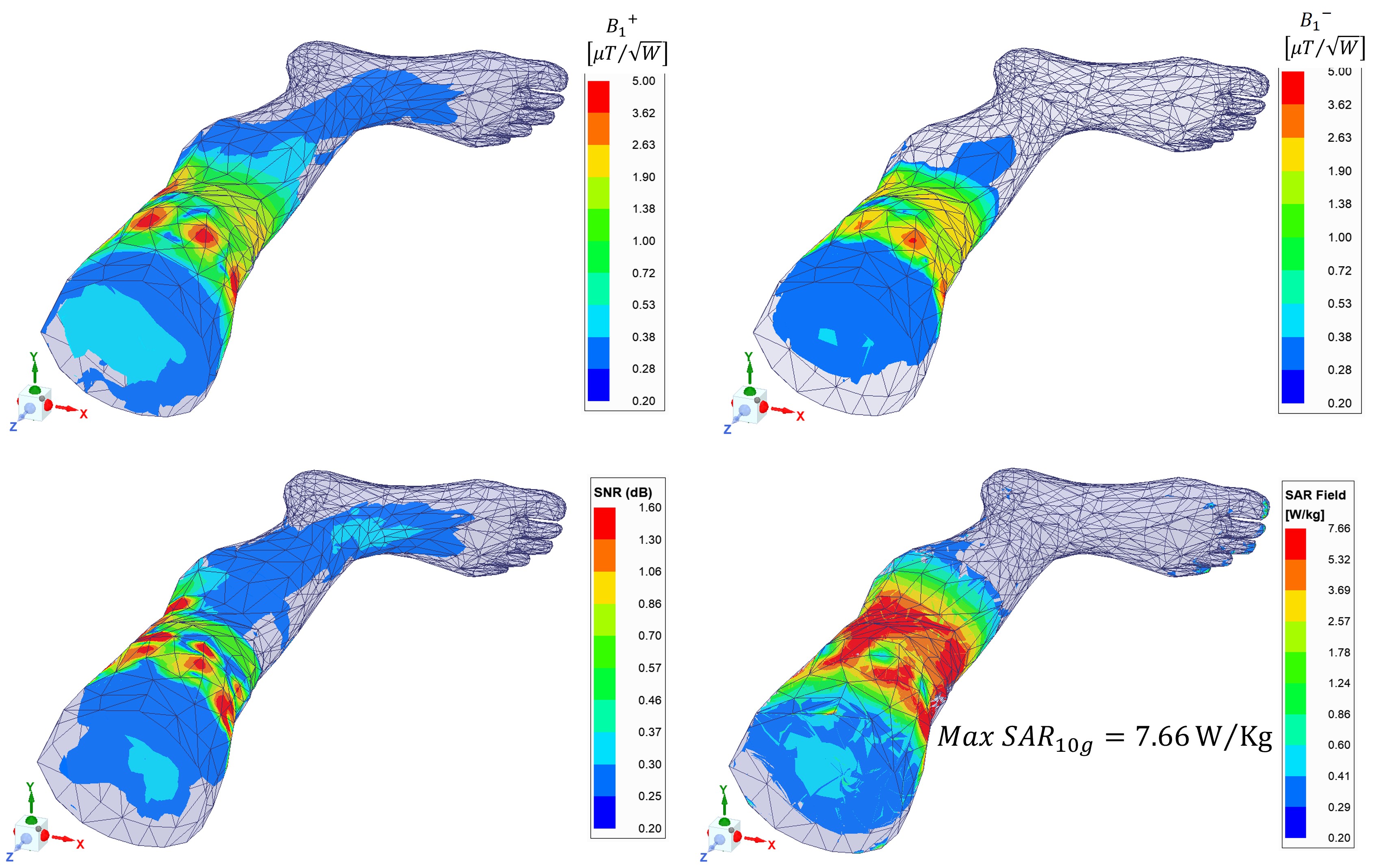
Fig. 5. Simulated 3D map of the combined transmit/receive (B1+/B1-), SNR map and local on the foot voxel model obtained from the two-rows 16-channels quadrature transceiver array excited with 1 W input quadrature power source and 45° linear phase progression of the elements within the same row.