1434
FARADAY PASSIVE SHIELDING & EFFECTIVENESS TESTING, EMI DETECTION & CANCELLATION USING A SINGLE RF COIL IN 48mT, 2 MHz POINT-OF-CARE LOW FIELD MRI.1BIOMEDICAL ENGINEERING, MRI-UGANDA, MBARARA UNIVERSITY OF SCIENCE AND TECHNOLOGY, Mbarara, Uganda
Synopsis
Keywords: Signal Representations, Signal Representations
Motivation: Point-of-Care Low Field MRI scanners are predominantly stifled by generic time-varying EMI, engendered by adjoined scanner electronics, environmental interference & radiation close to the lamor frequency and extraneous , creating decreased signal-to-noise ratio and artifacts on images.
Goal(s): Passive Faraday Shielding & Effectiveness Testing, EMI Detection, Cancellation using a single RF coil.
Approach: Passive Faraday Shielding using Aluminium and Copper sheets, Shielding Effectiveness testing using calibrated transmitters and receivers, EMI detection & cancellation using a single RF coil.
Results: Faraday Passive Shielding done and upto 74dB EMI attenuation effective. Active EMI detection & cancellation showed EMI reduction up to approximately 53% in signal strength and 46% image quality.
Impact: Broadband and Structured EMI elimination using passive faraday shielding with additional suppression techniques like system grounding, detection and elimination using a single coil will significantly improve signal strength by curbing signal loss and consequently better image quality.
BACKGROUND
Conventional MRI Scanners typically operate by culling incredibly small Free Induction Decay signals emitted by the phantom during scanning, which is further processed into images. However, any external electromagnetic and electrical interference picked up by the scanner deliberately downturn the signal strength which adversely depreciates image quality through artifacts. Therefore, passive shielding, active detection and cancellation of EMI is undeniably imperative for point-of-care low field MRI scanners which are designed for operations outside the standard Faraday-shielded rooms 1,6.KEY WORDS
Point-of-Care Low Field MRI, Electromagnetic Interference (EMI), RF Coil, Active RF Shielding, Halbach Array MagnetPROBLEM
Point-of-Care Low Field Halbach Array MRI scanners (48 mT, 2.16 MHz) are predominantly stifled by distressing electromagnetic interference, engendered by equipment adjoining the scanner, radiation close to the lamor frequency and generic time-varying extraneous environmental interference sources, creating decreased signal-to-noise ratio and artifacts on images through EM induction in the primary imaging coils. This has substantially degraded image quality, rendering them non-diagnostic, postulated notable wear down of the scanner with time, and proven unnecessary patient discomfort during scanning 1,2,6.METHODOLOGY
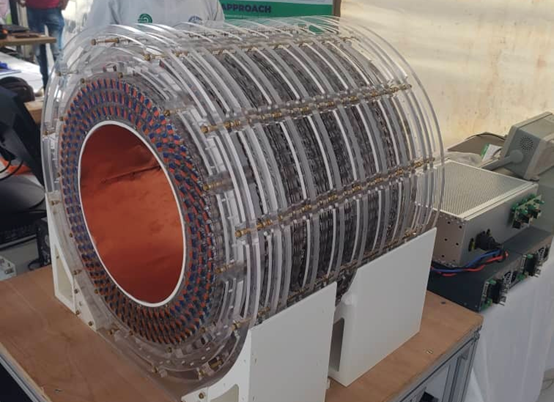
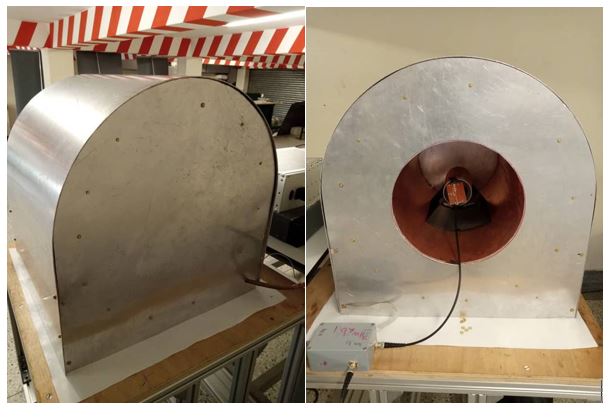
RF and EMI Faraday Passive ShieldingThe 50.6 cm long main magnetic Field B0 is placed inside a Faraday cage constructed from a 2 mm thick Aluminium Sheet (Aluminium is light-weight and offers a lower price point).
The inside of the 27cm diameter bore is covered with a 1mm thick copper sheeting (since copper is naturally an effective conductor, absorber and attenuator of RF signals) 2,3 and to ensure an impenetrable RF seal, all copper joints were soldered.
The Shielding combines the durability of Aluminium, the versatility of copper material that can be formed into the main magnet shape and bore for a complete custom fit.
SHIELDING EFFECTIVENESS TEST
Although passive shielding is a stand-alone solution, its more cost-effective when used with more EMI suppression techniques like primary grounding. Therefore, for complete EMI attenuation, the entire system was grounded and a shielding effectiveness test was performed 3,4.
Shielding Effectiveness Testing using calibrated transmitters and receivers to accurately define the signal reduced at specific frequencies, is performed on the constructed Faraday Cage with consideration of Scanner frequency range of operation. It specifies how much any external signals must be reduced 2,4.
The performance of the Faraday Shield cage is determined by taking the ratio of the RF energy on one side of the shield to the RF energy on the other side of the shield and the ratio expressed in decibels (dB) as a function of the logarithm of the ratio of incident and exit power densities as shown below:
lCnZ7hCT88PIAmTOqTna1l+B+S8WRqpF3VYAAAAAElFTkSuQmCC" alt="" style="top: 2773.34px; width: 165.455px; height: 34.1818px;">$$
Pi is the incident power, Pe is the exit power and SE is the Shielding Effectiveness.
EMI DETECTION AND CANCELLATION USING A SINGLE RF COIL.
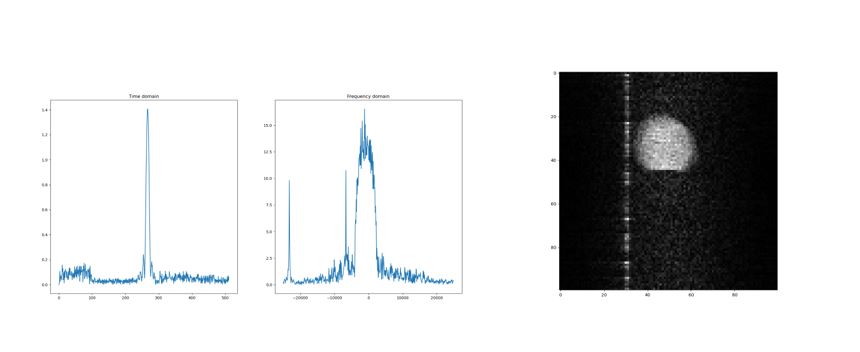
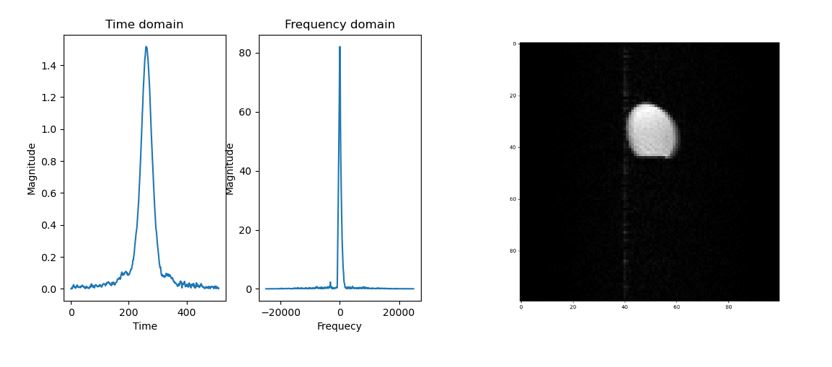
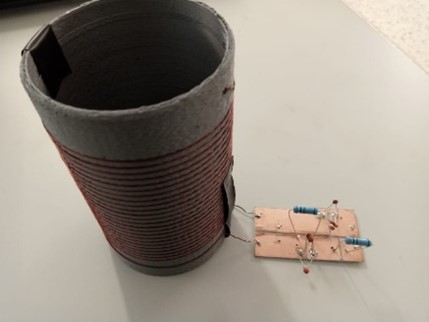
This was achieved by the implementation of the ‘‘MR-Silent” and “MR-Active” mode of EMI detection and cancellation by Thomas O’Reilly et. al 5. In the MR-Silent mode, we detect the EMI while in the MR-Active mode, we detect the EMI and MR signal. Two receive detection channel systems were used. Then we apply a simple subtraction algorithm to the signal and images in the MR-Silent mode from the MR-Active mode. Phantom signals and images with and without EMI were acquired to evaluate the efficacy of the approach.
RESULTS
- Faraday Passive Shielding was constructed using Aluminium and Copper sheets.
- Shielding effectiveness test showed Passive Faraday Cage shielding was effective with EMI attenuation upto 74dB.
- Active EMI detection and cancellation using the RF coil showed a reduction in the EMI upto approximately 53% in signal strength and 46% in the overall image quality.
Acknowledgements
I would like to thank my supervisor Dr. Johnes Obungoloch for the consistent guidance and support including Dr. Thomas O'Reilly for the sacrifice and guidance during the implementation of the EMI detection and cancellation process.References
1. Rathebe, Phoka C. “Shielding as an Effective Engineering Control for Occupational Exposure to MRI-related Electromagnetic Fields: a Brief Review.” (2015): 1-5.
2. ETS.LINDGREN. MRI SHIELDING. Minneapolis: ETS.LINDGREN, 2009.
3. TEAM, MODUS ENGINEERING. RF SHIELDING: EVERYTHING YOU NEED TO KNOW. Carlifornia: MODUS ENGINEERING TEAM, 2020.
4. IMS-AMCO Engineered Products, LLC. Shielding Effectiveness Test Report. Illinois: Radiometrics Midwest Corporation, 2006.
5. Javad Parsa, Thomas O’Reilly, Andrew Webb. “A single-coil-based method for electromagnetic interference reduction in point-of-care low field MRI systems.” (2023): 1-7.
6. Sai Abitha Srinivas, Stephen F Cauley, Jason P Stockmann, Charlotte R Sappo1,2, Christopher E Vaughn, Lawrence L Wald, William A Grissom and Clarissa Z Cooley. “External Dynamic InTerference Estimation and Removal (EDITER) for low field MRI.” (2022): 1-36.
Figures