1429
Optimized design of stop-flow polarizer for hyperpolarized 129Xe MRI1Faculty of Science and Engineering, University of Nottingham Ningbo China, Ningbo, China, 2Faculty of Medicine & Health Sciences, University of Nottingham UK, Nottingham, United Kingdom
Synopsis
Keywords: New Devices, Hyperpolarized MR (Gas)
Motivation: In the Spin Exchange Optical Pump (SEOP) technique, the spare space between pump cell and gas manifold, called dead space, might impact polarization through dilution and dark rubidium depolarization.
Goal(s): This study aims to improve the design of the stop-flow polarizer to minimize dead gas and thus increase the polarization efficiency.
Approach: A magnetic-compatible actuator was designed for automatic control of cell stem valves opening/closing in our homemade polarizer, with good adaptability of main pumping field, Class I laser regulation and mechanical deviation.
Results: Results show that under the same temperature, the polarization levels with actuator were always better than the control group.
Impact: The application of actuator in stop-flow polarizer shows the feasibility of improving polarization through minimizing dead space. It can be quite useful when acquiring small amount of HP gas but with higher requirement on polarization.
Introduction
Hyperpolarization of noble gas enhances polarization intensively that can be applied in various physical, chemical, and biological fields, for example, applied in porous media to analyse complex porosity 1,2. MRI is a powerful modality in medical and research area by forming the images with anatomy and physiological function information of human body. Combining with polarized noble gas, HP MRI technique has been explored as a novel improvement in overcoming the limitations of conventional proton MRI in the visualization of void spaces, such as the lung. It appears as a viable alternative to current clinical lung disease diagnosis tools, for example, Computed Tomography (CT), with the advantages of non-radiative and sensitive properties and the potential ability to acquire functional information through ventilation and diffusion3.Stop-flow polarizer refers to comtermitent gas charging and pumping, whose yield is limited by cell capacity and, thus, focus more on polarization efficiency. The dead space is somewhere between pump cell inlet/outlet valves to the next nearest valves, which is out of pumping range. Although the residual gas in dead space might be as little as a few millilitres, it will dilute polarized gas and suspect a drastic decrease of polarization when implementing small gas sample experiments. In addition, unpolarized Rb vapor at dead space may continuously collide with polarized Rb, leading to depolarization that also impacts the ultimate efficiency of SEOP4. This study aims to describe the design of a homemade stop-flow 129Xe polarizer with an additional actuator to minimize dead space.
Methods
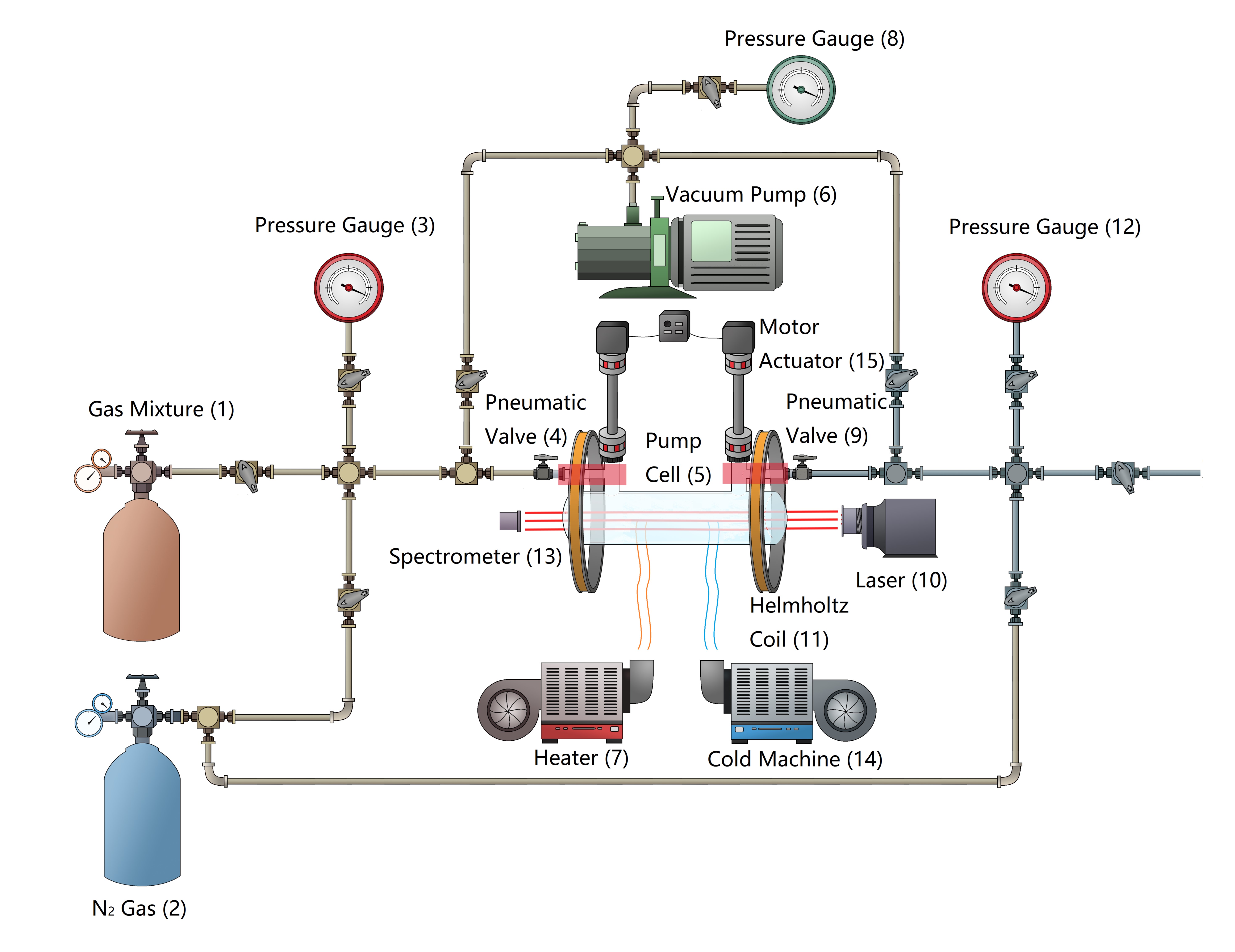
The homemade stop-flow polarizer schematic diagram is shown in Figure 1. It applied a BrightLock U-500 795nm, 135W diode laser module (10) with a 2-inch diameter optical train from QPC laser. Double Helmholtz coils (11) provide 35 Gauss field on pump cell (5) with a current of 5A and a voltage of 24V. Dual Heating system includes a heater (7) and a cold machine (14) for double cycle temperature control during pumping. And the laser output intensity change can be recorded by an Ocean Optics HR200+ optical spectrometer (13). The entire covered Class IV laser can be classified as Class I. So, manual operation of pump cell while laser on is limited. An actuator (15) was designed instead for automatic control. It is basically a motor coupling structure, shown in Figure 2, to fit with stem valves a) for rotating open/close. To avoid slipping, an extra convex coupling b) component was customized, which can be seen as a slider inside the plum coupling. Due to field homogeneity requirements, an aluminum shaft d) combined with aluminum plum couplings c,e) was used to transfer motor f) rotation from outside range of Helmholtz coils to valves. In this way, dead space can be effectively minimized. Polarization was measured through Adiabatic Fast Passage (AFP) by comparing the hyperpolarized signal intensity with a reference signal from thermal sample of xenon gas5,$$P_{HP}=P_{TH}\times\frac{S_{HP}p_{TH}V_{TH}sin(\alpha_{TH})}{S_{TH}p_{HP}V_{HP}sin(\alpha_{HP})}$$
where p is gas pressure, V is gas volume and $$$\alpha$$$ is flip angle. PTH represents thermal polarization of 129Xe which is under 1.5T and room temperature. Thermal sample signal was acquired through 500 times of average using an identical gas phantom. Both samples use nature isotopic abundance of 129Xe. A simple FID sequence was used to obtain phantom signal strength.
Results
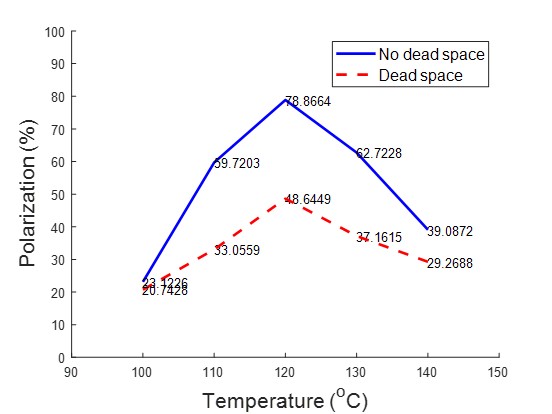
The polarizations were measured under 794.777nm laser wavelength, 1.2bar pressure and 10mins pumping time. Results of polarization versus pumping temperature were shown in Figure 3. Two groups of experiments were implemented, one with actuator (blue), and the other without (red). 5ml finger-shaped gas phantom was used, with ~0.25ml HP gas inside (5%Xe,95%N2). From the figure, the maximum polarization occurs around 120 degree, and the sample without dead gas has polarization level of 78.8%, which is much higher than 48.6% with dead gas. At the same time, under the same temperature, the polarization levels with actuator were always better than the control group.Discussions
The results show distinct improvement on polarization with the help of actuator. It can possibly be explained by the small capacity of gas phantom during collection. With estimated 1ml of the dead space in practical, it has much larger impact on colliding depolarization and dilution in a 5ml gas phantom. And with the increase or decrease of temperature, the effect on depolarization were smaller due to the reduction of polarization efficiency.Conclusions
We designed an actuator in a homemade stop-flow polarizer to minimize dead space between pump cell and gas manifold. And it has been demonstrated that it can improve polarization effectively when acquiring small amounts of HP gas volume.Acknowledgements
No acknowledgement found.References
1. Weiland E, Springuel-Huel MA, Nossov A, et al. 129Xenon NMR: review of recent insights into porous materials. Microporous Mesoporous Mater. 2016; 225: 41-65.
2. Comotti A, Bracco S, Valsesia P, et al. 2D multinuclear NMR, hyperpolarized xenon and gas storage in organosilica nanochannels with crystalline order in the walls. J. Am. Chem. Soc. 2007; 129 (27): 8566-8576.
3. Justus E, Holman P, Sivaram S, and Driehuys B, Hyperpolarized Gas MRI: Technique and Applications. Magn Reson Imaging Clin N Am. 2015; 23(2): 217–229.
4. Antonacci MA, Burant A, Wagner W, Branca RT. Depolarization of nuclear spin polarized 129Xe gas by dark rubidium during spin-exchange optical pumping. J Magn Reson. 2017; 279: 60-67.
5. Romalis MV, et al. Toward precision polarimetry of dense polarized 3He targets. Nucl. Instrum. Methods, A. 1998; 402(2-3): 260-267.
Figures