1418
An open-source automatic impedance tuning and matching module for low-field systems in clinical settings.1i3M, CSIC, Valencia, Spain, 2Universitat Politècnica de València, Valencia, Spain, 3Physio MRI SL, Valencia, Spain
Synopsis
Keywords: Data Acquisition, Software Tools, Radiofrequency, MaRCoS, open-source
Motivation: MaRCoS is an open-source tool integrating hardware, firmware, and software for low-field MRI system control. But releases lacked user-friendly features, requiring technicians to handle automatable operations manually.
Goal(s): To simplify clinical workflows, we developed a device for RF coil impedance tuning and matching in systems controlled by MaRCoS.
Approach: Our approach involved designing a TM device using switchable capacitors and testing it in a real clinical environment on a portable 72 mT system.
Results: The auto-TM system, tested on 20 volunteers (40 protocols), significantly accelerated and improved workflow compared to manual methods, marking a substantial advancement in MRI system efficiency and usability.
Impact: The introduction of our automatic tuning and matching device eases low-field MRI systems controlled by MaRCoS. By simplifying clinical workflows and improving efficiency, this innovation enhances the user experience, simplifing the workflow under clinical environments.
Introduction
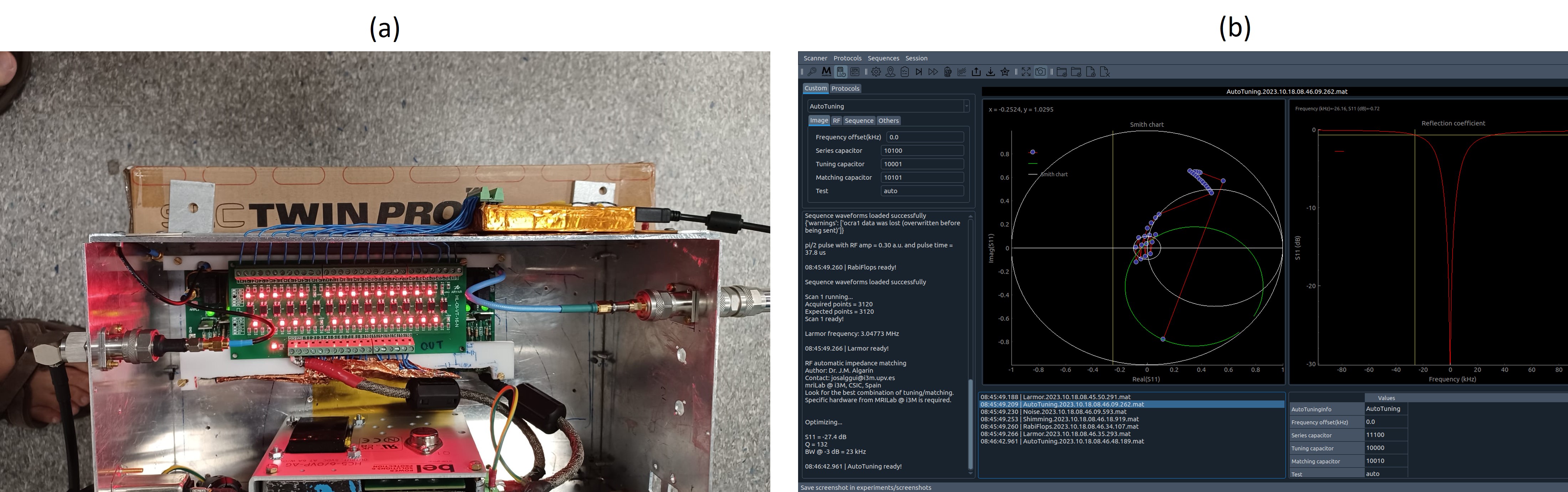
MaRCoS is constituted by an interplay of open-source hardware, firmware, and software components for MRI control, featuring high-performance at a low-cost. While previous efforts have predominantly concentrated on enhancing system reliability, the user experience in operating MaRCoS has often been disregarded.One example is the required manual impedance tuning and matching (TM) calibration of the RF coil to the Larmor frequency. Manual TM is time-consuming and hardly reproducible, and thus an obstacle to smooth clinical practice. To address this challenge, we introduce an automatic 50 Ohm TM device (Figure 1) for low frequencies, aiming to streamline the user experience and ensure straightforward operation in diverse clinical environments.
Methods
We designed an auto-TM system (Figure 1.a) based on relays that add or remove capacitors from the RF circuitry, with a total of 8192 potential combinations for impedance optimization [1]. The device is commanded by an Arduino microcontroller that switches the relays based on impedance measurements with an open-source NanoVNA [2]. The system has been conceived for frequencies around 3 MHz but can be trivially extrapolated to other frequencies.A critical aspect is to prevent noise from reaching the RF chain due to the auto-TM system. We have done this by boxing the system inside a Faraday shield (Fig. 1a) and placing all wires in grounded shields.
In parallel with the hardware development, we upgraded the MaRCoS graphical user interface [3] to incorporate the automatic tuning process into the scanner autocalibration procedure (Figure 1.b). This integration ensured a user-friendly experience, allowing operators to initiate the auto-TM seamlessly within the interface of the MaRCoS system.
To assess the effect of our auto-TM device and its influence on user experience, we conducted extensive in vivo tests. This evaluation took place within a portable and cost-effective 72 mT MRI scanner [4], installed in a major hospital. The same protocol, involving full system autocalibration and four RARE sequences with different parameters, was conducted on both knees of a total of 50 volunteers (20 of them with the auto-TM), and we compared automatic against manual TM in terms of usability and image quality.
Results
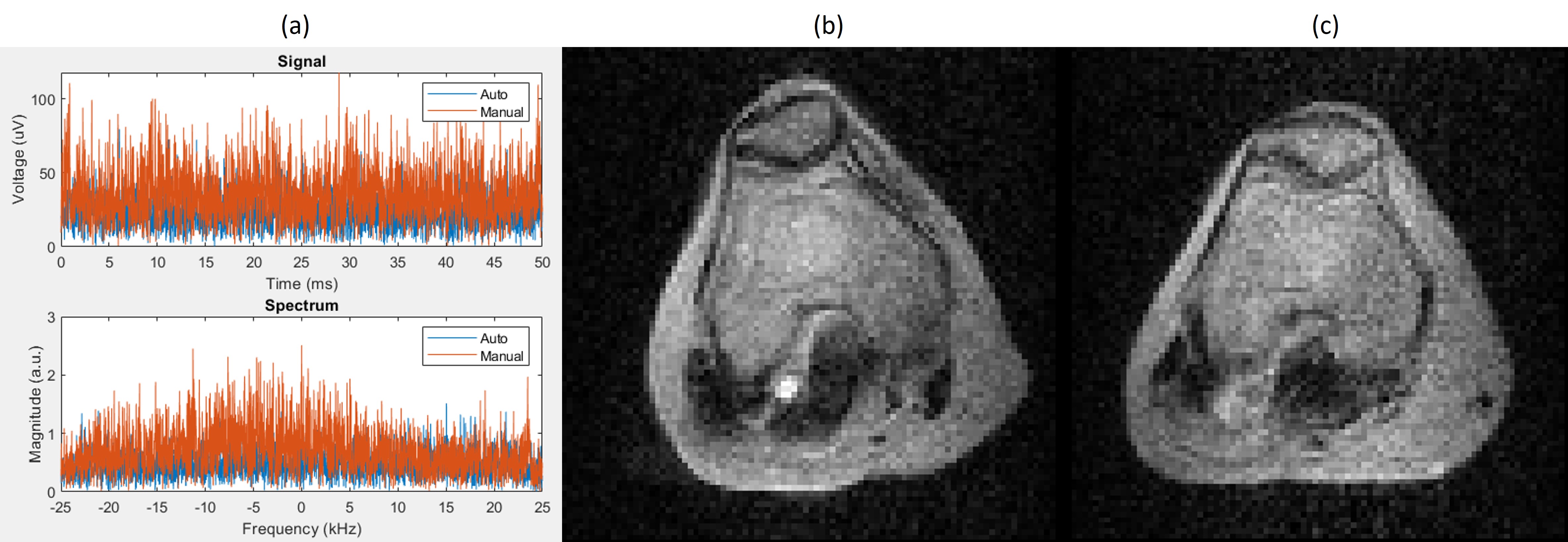
Executing the full protocol with our automatic tuning device was straightforward, requiring only a few clicks within the MaRCoS interface. This simplified process streamlined the workflow for all participants, eliminating the complexities associated with manual TM and ensuring efficient protocol execution.Figure 2.a shows noise measurements (top) and its corresponding spectrum (bottom) obtained from automatic and manual TM in two distinct volunteers. Both measurements show clean profiles without any relevant electromagnetic interferences, with a similar value for root mean square noise voltage. This indicates the level of additional noise introduced by our automated system can be made negligible under real conditions.
Figures 2.b and 2.c present images acquired using manual (b) and automatic (c) tuning matching from the same volunteers featured in Figure 2.a. The quality of both images is comparable.
Discussion
Automatic TM eases adjustments to the RF coil impedance and eliminates the need for time-intensive manual calibrations. In this way, we have significantly enhanced the efficiency of the TM process, improving the way RF coil impedance is managed in our MRI system and enabling non-experts to carry out the procedure with minimal training.These findings reinforce the efficacy and reliability of our automatic tuning device, demonstrating its ability to produce images of comparable quality to those generated through tedious manual tuning processes. These consistent results further validate the seamless integration of our technology into the MRI workflow, improving user experience in clinical environments.
Conclusion
In conclusion, our study introduces a new tool for MRI system operation through the integration of an automatic tuning and matching device within the open MaRCoS ecosystem. By addressing the limitations of manual RF coil tuning and matching, our solution streamlines the workflow, enhancing operational efficiency and user experience. The execution of protocols requires only a few clicks. After imaging 50 volunteers (100 limbs) under real clinical conditions, we conclude the auto-TM is a valuable upgrade, easy to install, seamlessly integrated, simple to use, and with direct impact on clinical practice, thereby establishing new standards inside MaRCoS.Acknowledgements
Project funded by: the EU (EIC Transition, 101136407), EURAMET (22HLT02), Spanish MICINN (PID2022-142719OB-C22), the Valencian Government (CIPROM/2021/003) and the Valencian Innovation Agency (INNVA1/2022/4, INNVA1/2023/30).References
[1] Sohn, S. M., DelaBarre, L., Gopinath, A., & Vaughan, J. T. (2015). Design of an Electrically Automated RF Transceiver Head Coil in MRI. IEEE Transactions on Biomedical Circuits and Systems, 9(5), 725–732. https://doi.org/10.1109/TBCAS.2014.2360383
[2] https://nanovna.com/
[3] https://github.com/yvives/PhysioMRI_GUI
[4] Guallart-Naval, T., Algarín, J. M., Pellicer-Guridi, R., Galve, F., Vives-Gilabert, Y., Bosch, R., Pallás, E., González, J. M., Rigla, J. P., Martínez, P., Lloris, F. J., Borreguero, J., Marcos-Perucho, A., Negnevitsky, V., Martí-Bonmatí, L., Ríos, A., Benlloch, J. M., & Alonso, J. (2022). Portable magnetic resonance imaging of patients indoors, outdoors and at home. Scientific Reports, 12. https://doi.org/10.1038/s41598-022-17472-w
Figures