1409
Coupled stack-up volume RF coils for low-field MR imaging1Department of Biomedical Engineering, State University of New York at Buffalo, Buffalo, NY, United States, 2Department of Electrical Engineering, State University of New York at Buffalo, Buffalo, NY, United States
Synopsis
Keywords: Non-Array RF Coils, Antennas & Waveguides, Non-Array RF Coils, Antennas & Waveguides
Motivation: Low-field MRI has garnered significant attention in recent years due to its unique advantages in safety, cost-effectiveness and accessibility. However, lower field strength comes with an inherently lower SNR as its primary limitation.
Goal(s): In this work, we introduce a novel volume RF coil design using coupled stack-up resonators to mitigate this challenge.
Approach: To demonstrate the proposed design, we take 0.5T as an example field strength and designed a prototype coupled stack-up volume coil operating in the 20MHz range.
Results: Compared to the birdcage coil, the proposed design significantly improves RF field efficiency and homogeneity, ultimately enhancing the performance of low-field MRI.
Impact: The proposed stack-up volume coil outperforms the standard birdcage coil in B1 efficiency and field homogeneity at low fields, ultimately improving the performance of low-field MRI and advancing its applications.
Introduction
Low-field open magnetic resonance imaging (MRI) has greatly expanded the accessibility of MRI. However, the inherent challenges of low-field MRI, such as limited signal-to-noise ratios, have prompted the need for innovative coil designs that can improve image quality (1,2). In response to these challenges, we introduce the coupled stack-up volume coil, a novel RF coil design that uses coupled multiple resonators (3) and addresses the shortcomings of conventional birdcage in the context of low-field open MRI. The proposed coupled stack-up volume coil design utilizes a unique architecture that optimizes both transmit/receive efficiency and RF field homogeneity and offers the advantage of a simple design and construction, making it a practical and feasible solution for low field MRI applications.Methods
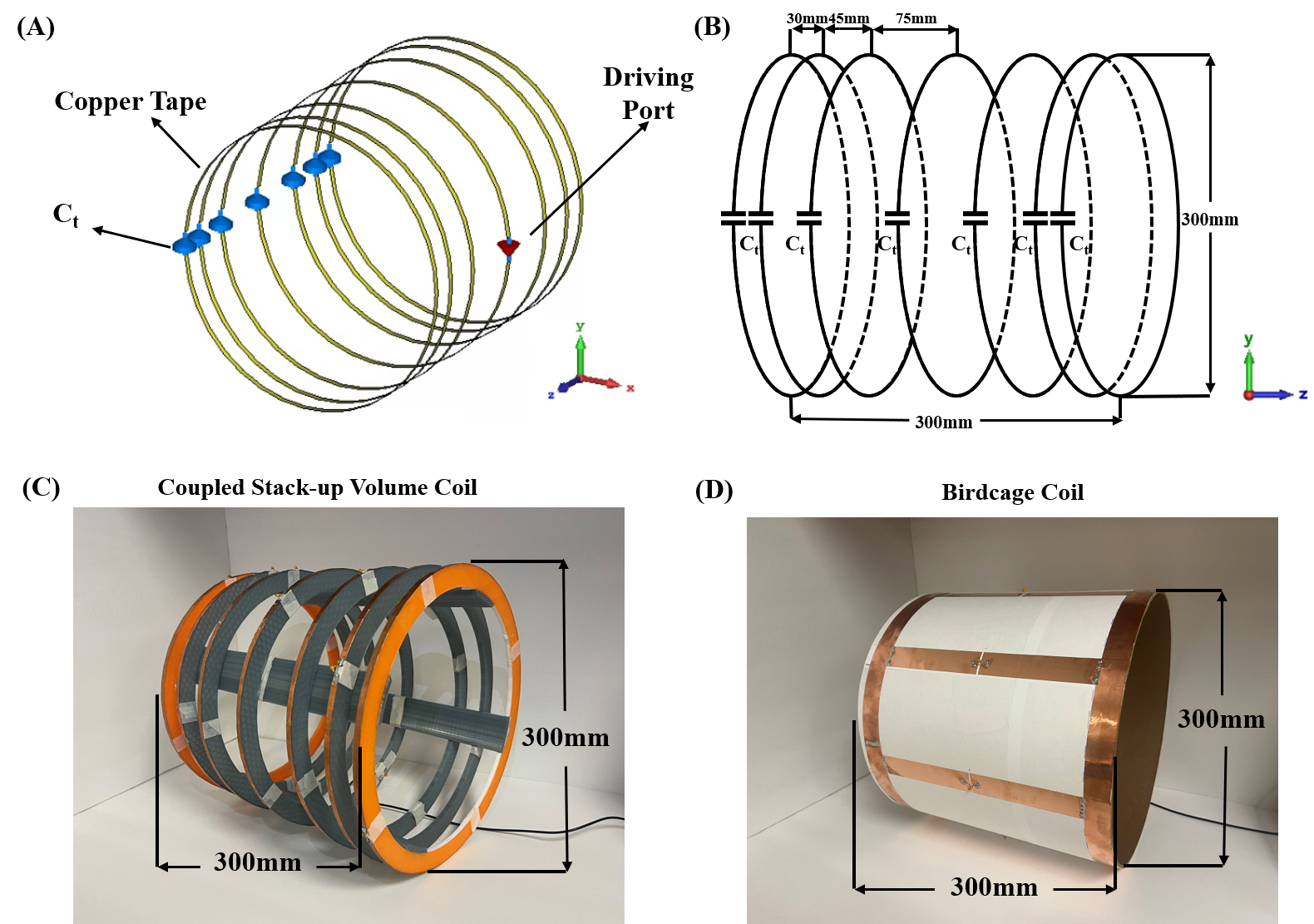
Figure 1A shows the layout of the coupled stack-up volume coil. The coupled stack-up volume coil design consists of a stack of seven identical coils each with one tuning capacitor mounted, arranged to create a cylindrical imaging area with dimensions of 300mm in diameter and 300mm in length. The central coil in this stack configuration serves as the driving coil with a driving port mounted. The spacing between these individual coils has been carefully orchestrated as shown in Figure 1B. The lowest resonant mode of the coil is used for imaging. A conventional birdcage coil with the same size of a coupled stack-up coil has also been built for comparison. In comparison study, a cylindrical air phantom of 200mm in diameter and 300mm in length and a dielectric constant of 1 was been placed in the center of the coils as an imaging area for field strength and distribution evaluation. Numerical results of the proposed designs were obtained using the electromagnetic simulation software CST Studio Suite. Figure 1C and 1D shows photographs and dimensions of bench test models of the coupled stack-up volume coil and birdcage coil. The bench test models have the same dimensions and resonant frequencies as the simulation model. Results of bench test models were obtained using a vector network analyzer based 3-D magnetic and electric field mapping system.Results
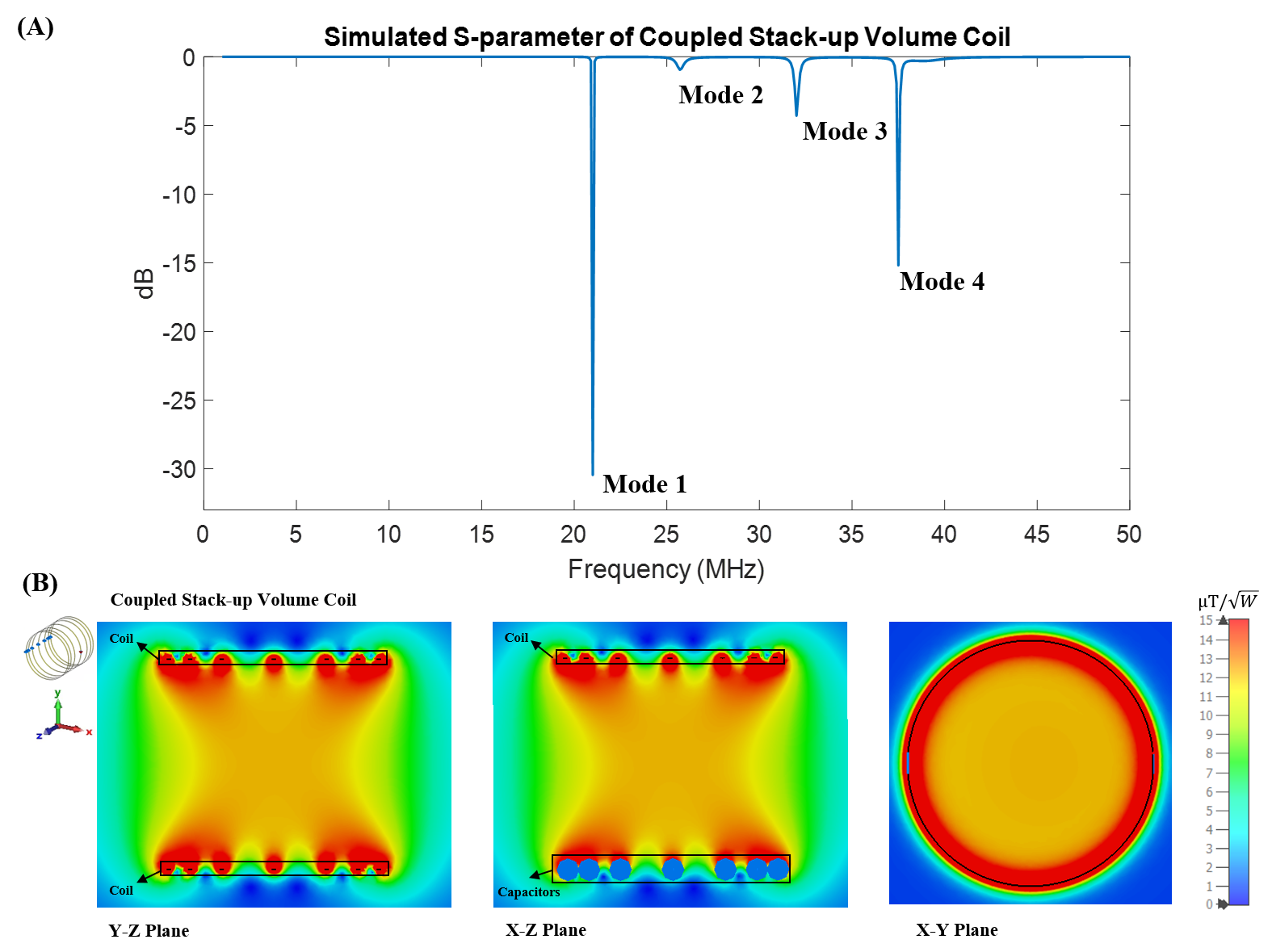
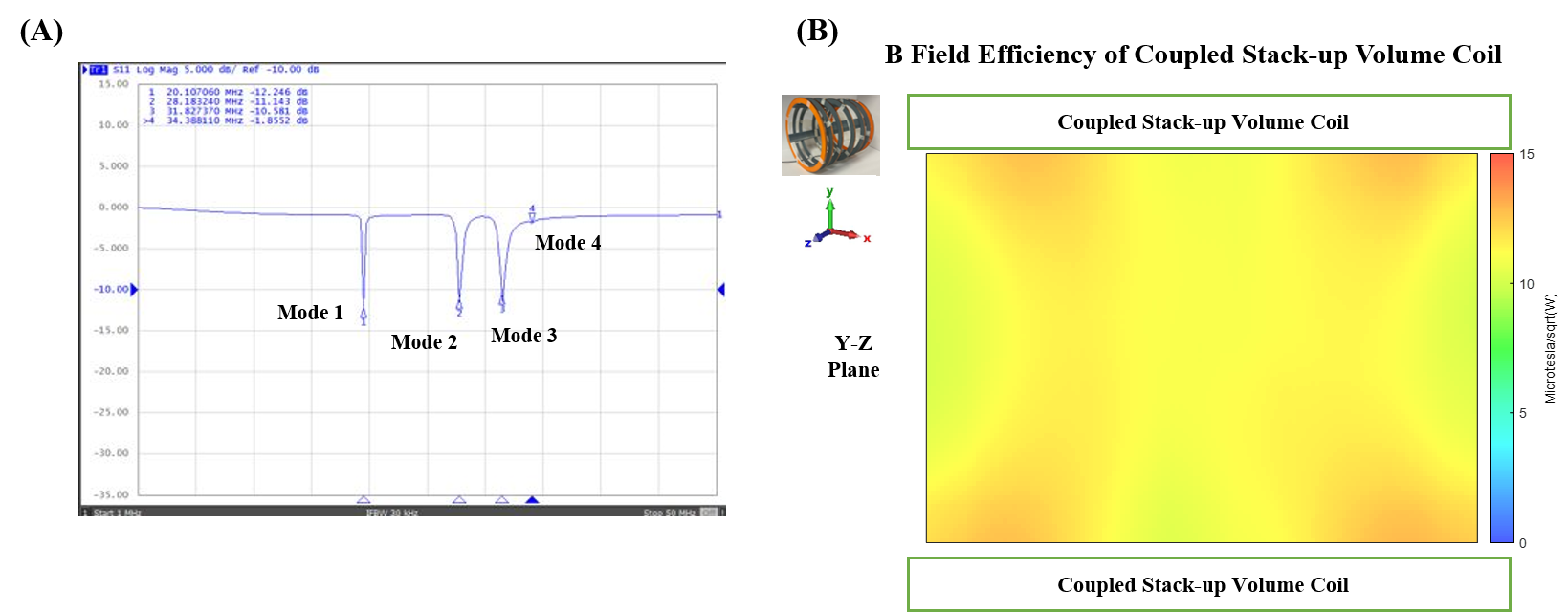
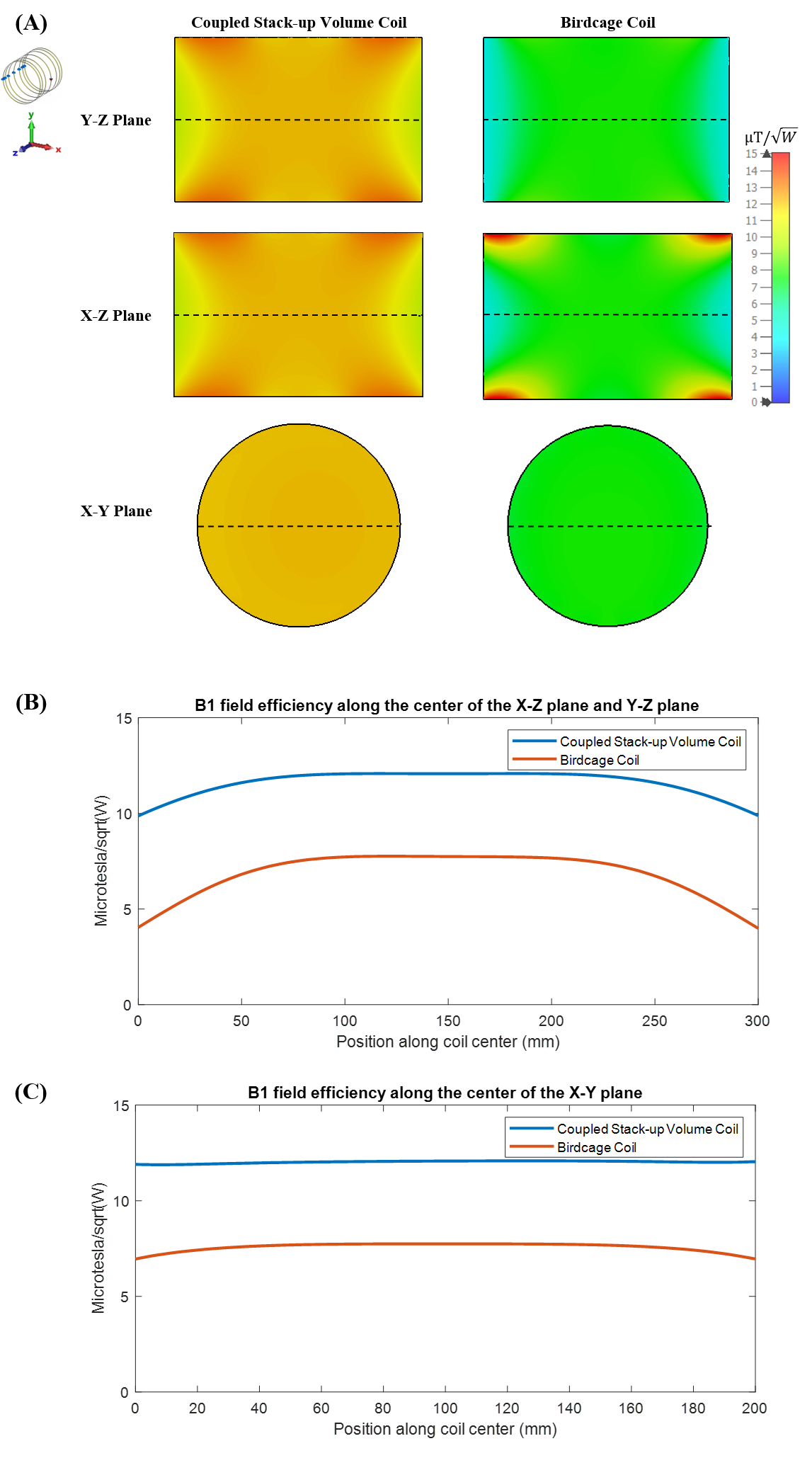
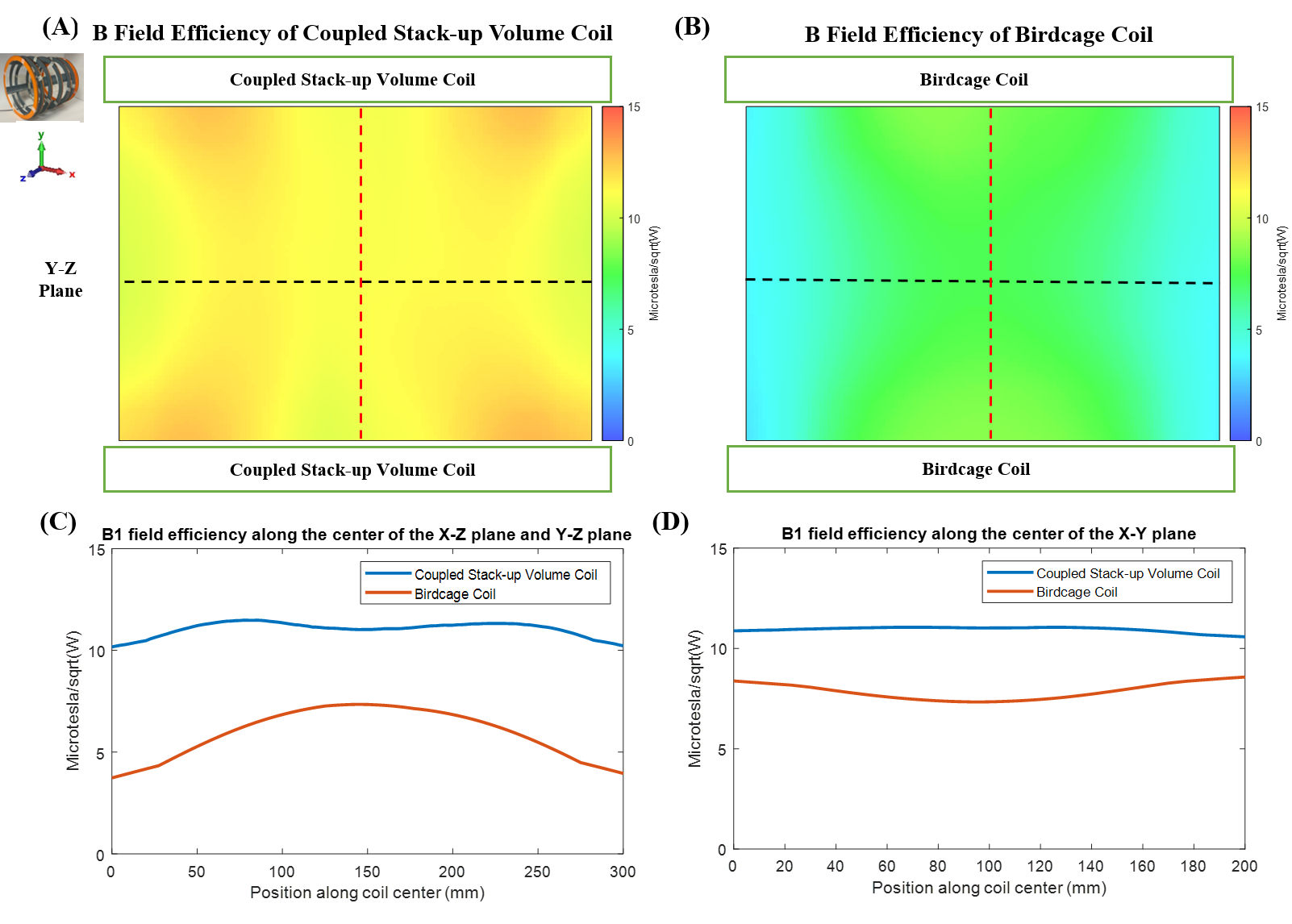
Simulated scattering parameters versus frequency of the stacked coils are shown in Figure 2A. As shown in the figure, strong coupling is created between the coils, resulting in four split resonant peaks. Figure 2B shows simulated Y-Z, X-Z, and X-Y plane B field efficiency maps at lowest frequency inside phantom generated by coupled stack-up volume coils, in which both planes are at the center of the axis. The simulation result shows the coupled stack-up volume coil has a homogenous field which can be used for MR imaging. Figure 3A shows that the S-parameter vs. frequency plots of the bench test model of coupled stack-up coil is in good agreement with the simulation results with four resonant modes formed. Figure 3B shows the B field efficiency distribution map on Y-Z plane measured with 3-D magnetic field mapping system. Coupled stack-up volume coil shows significant homogeneity and strong B field efficiency on the Y-Z plane and is in accordance with the simulation result. Figure 4 compares the simulated B1 field efficiency between the coupled stack-up coil and birdcage coil on three different planes with the B1 field efficiency distribution map. The result shows that the coupled stack-up coil has higher B field efficiency and B field homogeneity compared with the birdcage coil. With an average of 9.6058 uT/sqrt(W) inside the phantom, the B field efficiency of the coupled stack-up volume coil is 47.7% higher than the average B field efficiency of birdcage coil and the standard deviation of B field generated by coupled stack-up volume coil is also 68% lower than birdcage coil. Figure 5 compares the between B field efficiency of bench test model of coupled stack-up volume coil and birdcage coil. The measured result is in accordance with simulation result again and validates that the coupled stacked coil has a strong and homogeneous field within the imaging area compared with the birdcage coil.Conclusion
This study has introduced the coupled stack-up volume coil, a novel radio frequency (RF) volume coil design developed to mitigate the challenges inherent in low-field MRI by providing improved transmit/receive efficiency and field homogeneity over the standard birdcage coil. Through a research framework encompassing electromagnetic simulations and benchtop characterizations, we have illuminated the significant advantages offered by this innovative coil design.Acknowledgements
This work is supported in part by the NIH under a BRP grant U01 EB023829 and by the State University of New York (SUNY) under SUNY Empire Innovation Professorship Award.References
1) Hoult, D.I. The signal-to-noise ratio of the nuclear magnetic resonance experiment. J.Magn Reson. 24, 71-85 (1976)
2) X Zhang, et al. Microstrip RF surface coil design for extremely high-field MRI and spectroscopy. Magn Reson Med, 46, 443-50. (2001)
3) Y Zhao, et al. A coupled planar RF array for ultrahigh field MR imaging. ISMRM 2023, 3910
Figures