1393
Improved ex-vivo cerebral microbleed detection using self-supervised learning with fuzzy segmentation1Computer Science, Illinois Institute of Technology, Chicago, IL, United States, 2Rush Alzheimer's Disease Center, Rush University Medical Center, Chicago, IL, United States, 3Biomedical Engineering, Illinois Institute of Technology, Chicago, IL, United States
Synopsis
Keywords: Diagnosis/Prediction, Aging, Ex-Vivo Applications, Brain, Microbleeds
Motivation: Accurate and efficient detection of cerebral microbleeds (CMBs) on postmortem MRI is necessary for MR-pathology studies on the relationship between CMBs and cerebral small vessel disease (SVD).
Goal(s): The development and improvement of an automated detection framework for identifying cerebral microbleeds (CMBs) on MRI scans of community-based older adults.
Approach: Fuzzy segmentation, a novel self-supervised auxiliary task based on CMB data synthesis, is proposed for pre-training a CMB detection model alongside other state-of-the-art SSL methods.
Results: Self-supervised pre-training with fuzzy segmentation and rotation prediction led to an 11% increase in average precision for automated CMB detection on postmortem MRI.
Impact: This study demonstrates a new state-of-the-art for postmortem CMB detection performance using self-supervised learning. Automated CMB detection on postmortem MRI will enable future MR-pathology studies into the links between CMBs and neuropathology observed at autopsy such as cerebral amyloid angiopathy.
Introduction
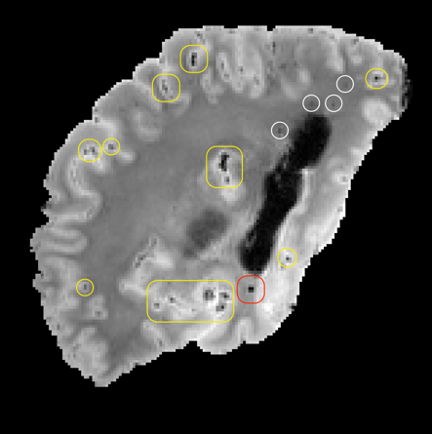
Cerebral microbleed (CMB) annotation on postmortem MRI scans of autopsied brains of community-based older adults is necessary for MR-pathology studies of cerebral small vessel disease (SVD)1-4. However, automation of CMB detection is challenging due to the low incidence of CMBs in community-based older adult brains, combined with the high prevalence of CMB mimics on ex-vivo MRI (Fig. 1). While data synthesis can improve model performance by increasing the amount of available training data5, biases in the synthesis model can lead to poor generalization performance. Self-supervised learning (SSL) has been shown to be a powerful tool for improving representation learning in data-scarce environments such as medical imaging6-7. In this work, we propose a novel pretext task called fuzzy segmentation (FuzzSeg) that leverages the data synthesis process as a form of self-supervision. Ex-vivo CMB detection models pre-trained with FuzzSeg are shown to outperform models trained from scratch.Methods
Data background and preparation286 participants from the Rush Memory and Aging Project8 and Religious Orders Study9, two longitudinal cohort studies of aging, were included in this work. T2*-weighted gradient echo scans of autopsied brain hemispheres with a voxel size of 1 x 1 x 1 mm3 were used after N4 bias correction. CMBs in these images were manually annotated by an experienced rater blinded to all clinical and pathological information.
Fuzzy segmentation and self-supervised learning
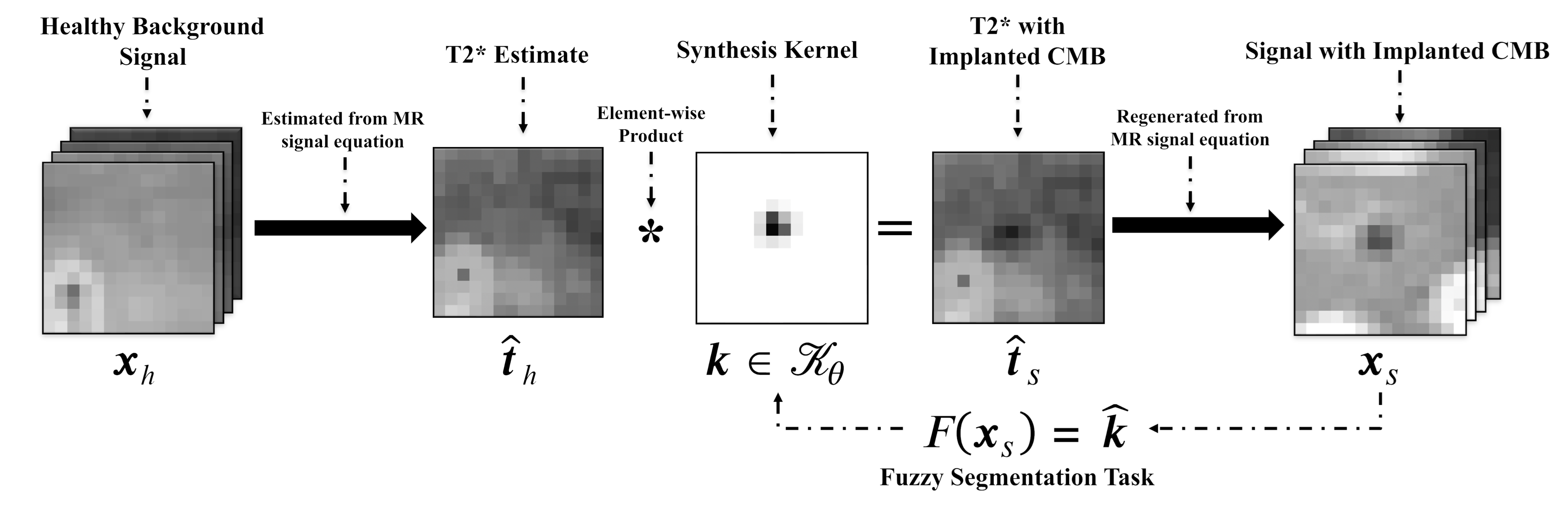
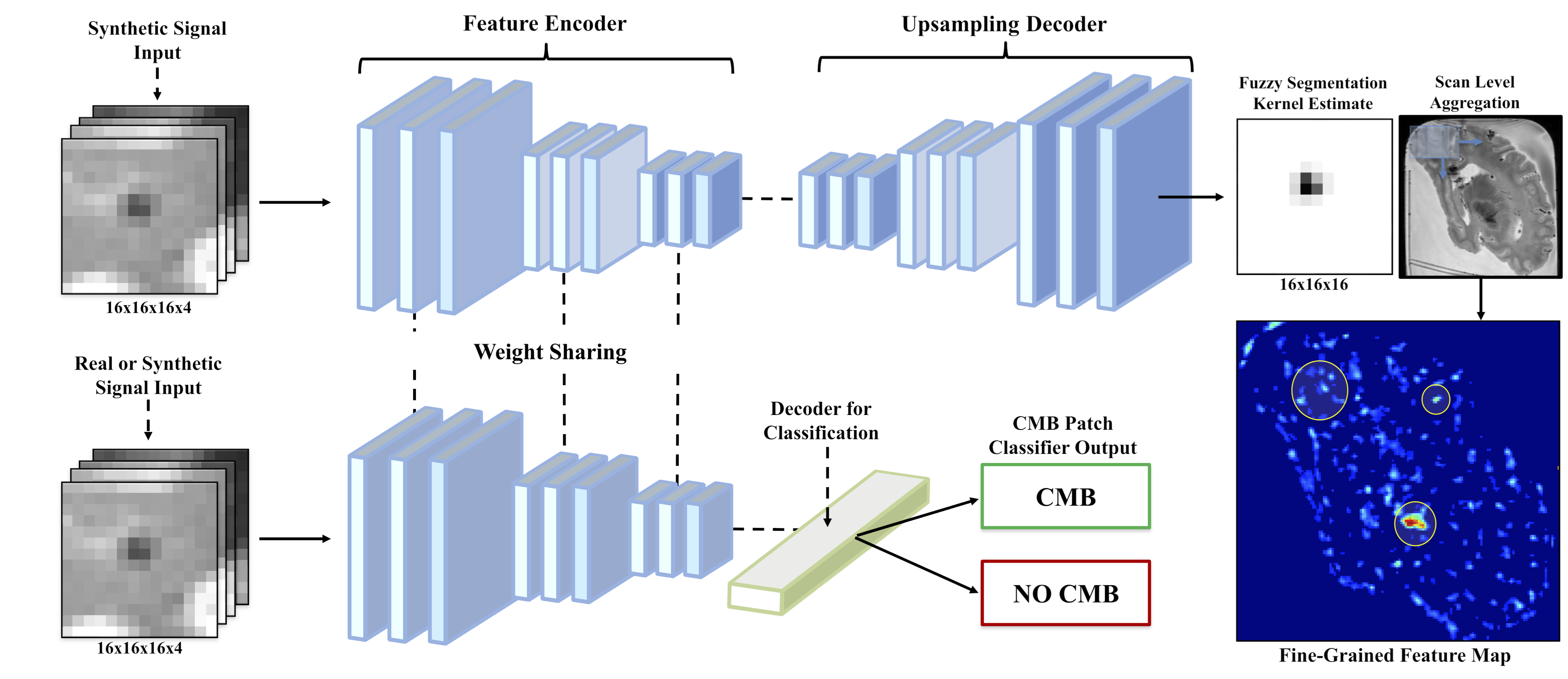
Given a synthetic example, the goal of fuzzy segmentation is to predict the hidden kernel used to generate it (Fig. 2). The term fuzzy segmentation refers to the fact that each kernel is interpreted as the relative scalar intensity drop in T2* at a particular voxel compared to healthy background, rather than as a simple probability. Fuzzy segmentation is well-suited for pre-training because it requires the model to learn to separate hypointense foreground from background and estimate key features of potential CMBs such as hypointensity shape and relative intensity. Two additional general-purpose self-supervised pretext tasks, rotation prediction and image inpainting, were also evaluated. A modified 3D ResNet2010 backbone is used as the encoder component of the network. Task-specific decoder heads were attached for pre-training. Encoder weights are learned by pre-training on the self-supervised pretext tasks and then transferred to the CMB detection task by replacing the decoder component with a classification head (Fig. 3).
Detector training and evaluation
An end-to-end CMB detection framework that combines data synthesis, candidate selection, false positive reduction, and full scan evaluation was used as the backbone for this work11. Input patches of size 16 x 16 x 16 x 4 were used with four signal echoes in the channel dimension. The training dataset comprised synthetic CMBs, synthetic non-CMBs, real CMB mimics, and real CMBs. A high-sensitivity, low-precision SVM-based model was used to identify CMB candidates based on pre-generated image features. Both training and evaluation were done using a repeated randomized 5-fold cross-validation technique to avoid training or evaluation biases caused by the small dataset size.The final evaluation probability maps were generated by averaging the probability maps from each individual holdout run for each participant.
Results
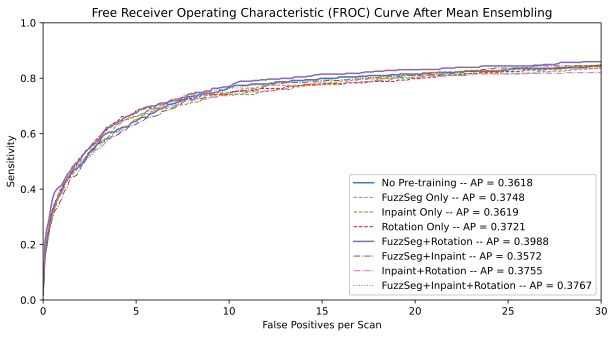
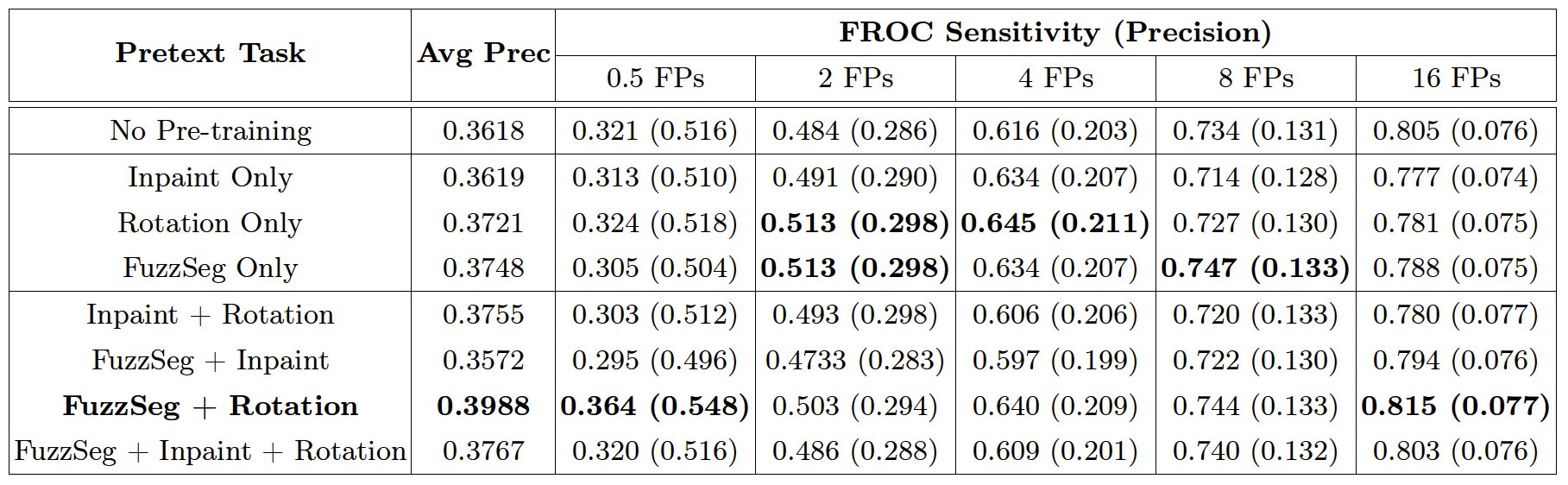
The CMB detection model jointly pre-trained on fuzzy segmentation and rotation prediction tasks (Average Precision=0.3988) achieved the highest sensitivity at both 0.5 false positives per subject (36.4%) and at 16 false positives per subject (81.5%) of all models evaluated (Fig. 4). Pre-training with fuzzy segmentation alone (AP=0.3748) also led to improvements over a baseline model trained without pre-training (AP=0.3618), pre-training with rotation prediction (AP=0.3721), and pre-training with image inpainting (AP=0.3619). Full results are shown in Table 1.Discussion
Self-supervised pre-training with FuzzSeg led to improved CMB detection compared to training from scratch or pre-training with alternative self-supervised auxiliary tasks. Joint task pre-training utilizing a combination of a domain-specific task (FuzzSeg) and a general-purpose task (rotation prediction) was shown to maximize performance on the downstream detection task. This suggests that SSL frameworks, which leverage a priori knowledge embedded in domain-specific data processing steps like data synthesis, can be powerful tools for enhancing ex-vivo CMB detection. This study establishes a new state-of-the-art for ex-vivo CMB detection in community-based cohorts and introduces a new auxiliary task, FuzzSeg, that can be adapted to other CMB detection pipelines.Conclusion
This work demonstrates that self-supervised pre-training with FuzzSeg is a data-efficient technique for improving the performance of ex-vivo CMB detection algorithms in community-based cohorts where CMB prevalence is low and mimics are abundant. This has led to reduced labeling time and increased sensitivity for partially automated CMB annotation, a critical step in future MR-pathology studies examining the link between CMBs and neuropathology in community-based older adults.Acknowledgements
National Institute of Neurological Disorders and Stroke (NINDS) UH2-UH3NS100599, UF1NS100599
National Institute on Aging (NIA) R01AG064233, R01AG067482, R01AG017917, R01AG015819, P30AG010161, P30AG072975
References
1. Nikseresht G, Evia AM, Nag S et al. Neuropathologic correlates of cerebral microbleeds in community-based older adults. Neurobiol Aging. 2023 Sep;129:89-98.
2. Charidimou A, Shams S, Romero JR, et al. Clinical significance of cerebral microbleeds on MRI: A comprehensive meta-analysis of risk of intracerebral hemorrhage, ischemic stroke, mortality, and dementia in cohort studies (v1). Int J Stroke. 2018 Jul;13(5):454-468.
3. Martinez-Ramirez S, Romero JR, Shoamanesh A, et al. Diagnostic value of lobar microbleeds in individuals without intracerebral hemorrhage. Alzheimers Dement. 2015;11(12):1480-1488.
4. Pasi M, Pongpitakmetha T, Charidimou A, et al. Cerebellar Microbleed Distribution Patterns and Cerebral Amyloid Angiopathy [published correction appears in Stroke. 2019 Aug;50(8):e240]. Stroke. 2019;50(7):1727-1733.
5. Nikseresht G, Agam G, Arfanakis K. End-to-End Task-Guided Refinement of Synthetic Images for Data Efficient Cerebral Microbleed Detection. Proceedings of the 26th International Conference on Pattern Recognition (ICPR). 2022:2756-2763.
6. Tang Y, Yang D, Li W, et al. Self-Supervised Pre-Training of Swin Transformers for 3D Medical Image Analysis. Proceedings of the 2022 IEEE/CVF Conference on Computer Vision and Pattern Recognition (CVPR). 2022:20698-20708.
7. Azizi S, Mustafa B, Ryan F, et al. Big Self-Supervised Models Advance Medical Image Classification. Proceedings of the 2021 IEEE/CVF International Conference on Computer Vision (ICCV). 2021:3458-3468.
8. A. Bennett D, A. Schneider J, S. Buchman A, et al. Overview and Findings from the Rush Memory and Aging Project. Curr Alzheimer Res. 2012;9(6):646-663.
9. A. Bennett D, A. Schneider J, Arvanitakis Z, et al. Overview and Findings from the Religious Orders Study. Curr Alzheimer Res. 2012;9(6):628-645.
10. Szegedy C, Liu W, Jia Y, Sermanet P, Reed S, Anguelov D. Going deeper with convolutions. Proceedings of the 2015 IEEE/CVF Conference on Computer Vision and Pattern Recognition (CVPR). 2015 Jun:1–9.
11. Nikseresht G, A. Tamhane A, Javierre-Petit C, et al. Microbleed detection in autopsied brains from community-based older adults using microbleed synthesis and deep learning. Poster presented at: International Society for Magnetic Resonance in Medicine; May 7-12, 2022; London, England.
Figures