1325
Multimodal surface coils for low-field MR imaging1Department of Biomedical Engineering, State University of New York at Buffalo, Buffalo, NY, United States, 2Department of Electrical Engineering, State University of New York at Buffalo, Buffalo, NY, United States
Synopsis
Keywords: Multimodal, Non-Array RF Coils, Antennas & Waveguides
Motivation: By the need to address the limitations of low-field MRI, such as low SNR and insensitive frequency tuning.
Goal(s): We proposed a design of multimodal surface coil that can enhance the B1 efficiency while reducing the associated electric field.
Approach: Through both electromagnetic simulation and bench testing, the performance of this novel coil design technique was evaluated and compared with the conventional surface coil and solenoid coil.
Results: The results affirmed the superior performance of the proposed multimodal surface coil design in terms of B1 efficiency and frequency tuning over the surface coil and solenoid coil at the low field of 0.5T.
Impact: The proposed multimodal surface coil design improves B1 efficiency compared with the conventional surface coil and solenoid coil at 0.5T. It also mitigates frequency tuning challenges and has the potential to enhance the quality of low-field MRI in clinical diagnosis.
Introduction
Low-field MRI offers several advantages, including lower operating costs, reduced power requirements, and increased safety for patients with certain medical conditions or implants. However, low-field MR suffers from an intrinsically low signal-to-noise ratio (SNR) and thus low image resolution. It is known that MR SNR is linearly proportional to the B1 efficiency of RF coils (1-3). In this work, we introduce the multimodal surface coil, an innovative design that provides significantly improved B1 fields over the conventional surface coil and has the potential to enhance MR SNR. The design is based on a set of stacked resonators (4) that are electromagnetically coupled and form a multimodal resonator. The proposed multimodal surface coil design also provides a low frequency tuning capability and alleviates the low frequency tuning challenges encountered in low field MR imaging. The design has been validated through full-wave electromagnetic simulations and standard RF bench tests and measurements.Methods
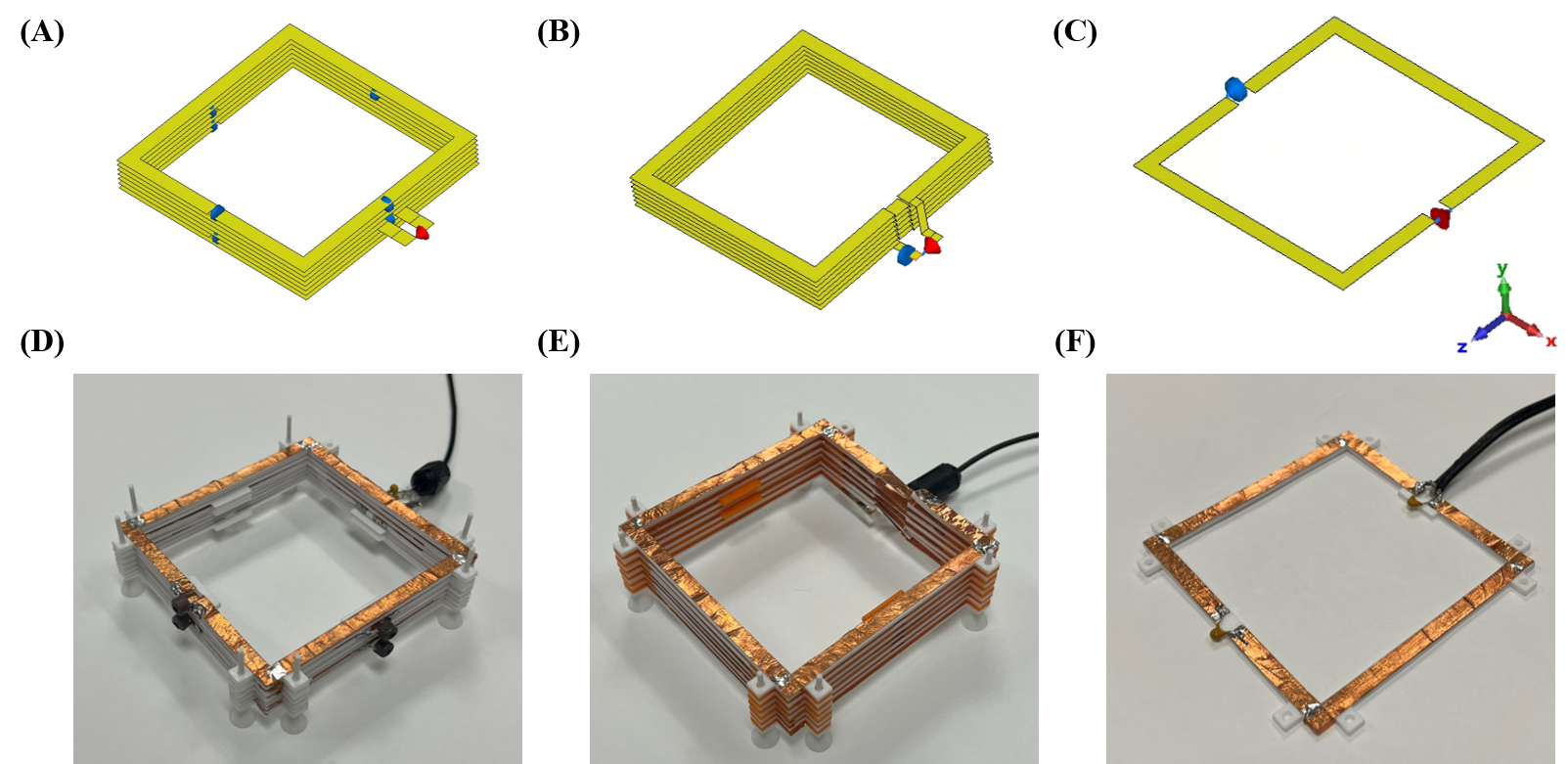
Figure 1A displays the simulation model of a multimodal surface coil. The multimodal surface coil comprised of seven coil loops or resonators, with six identical squared coils with 10 cm side length each equipped with a tuning capacitor to tune the coil to 42 MHz, and the middle coil contains an impedance matching circuit for driving the multimodal surface coil. A 5 mm spacing between coils enhances mutual inductive coupling, with the entire stack reaching a 3 cm height. Figure 1B and 1C show two comparative setups - a seven-turn solenoid and a conventional surface coil, each defined by a 10 cm length. The solenoid has a 3 cm height and a 5 mm spacing between each turn. All designs were built using a 6.35 mm wide copper sheet conductor and are tuned to 21.3 MHz and impedance matched to 50 ohms. Performance assessments of the multimodal surface coil involved analyzing scattering parameters, B1 efficiency, E field efficiency, and B1/E field efficiency ratio field distribution plots, with all electromagnetic field plots normalized to 1 W accepted power. All simulation results generated by EM simulation software CST Studio Suite. Figures 2A, 2B, and 2C show the bench test model of multimodal surface coil, solenoid, and conventional surface coils. The bench test models have the same dimensions and resonant frequencies as the simulation model. The coils were built with 6.35 mm wide copper tape and on a 3D printed polylactide structure. Results of bench test models were obtained using a vector network analyzer based 3-D positioning magnetic and electric field mapping system.Results
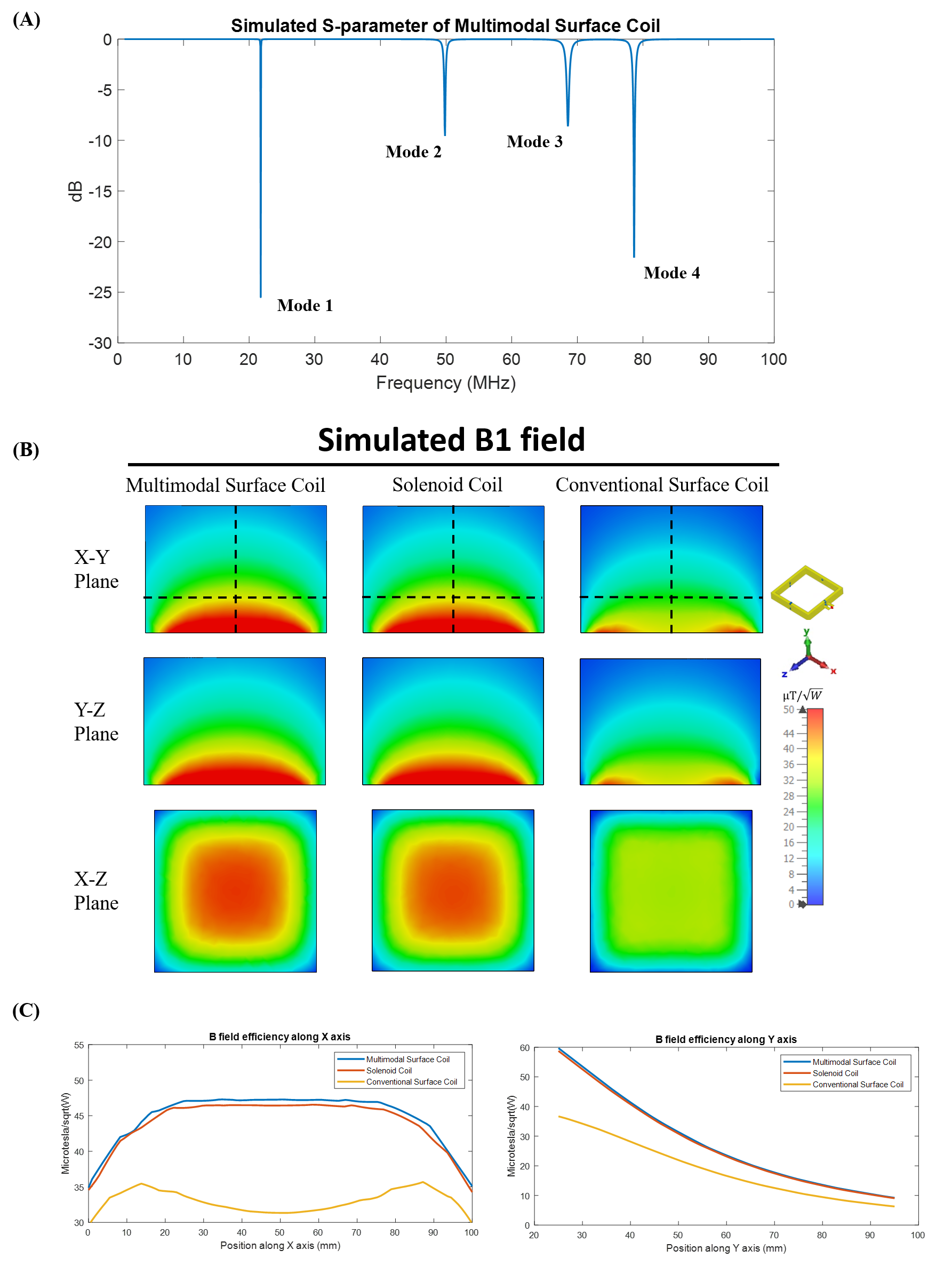
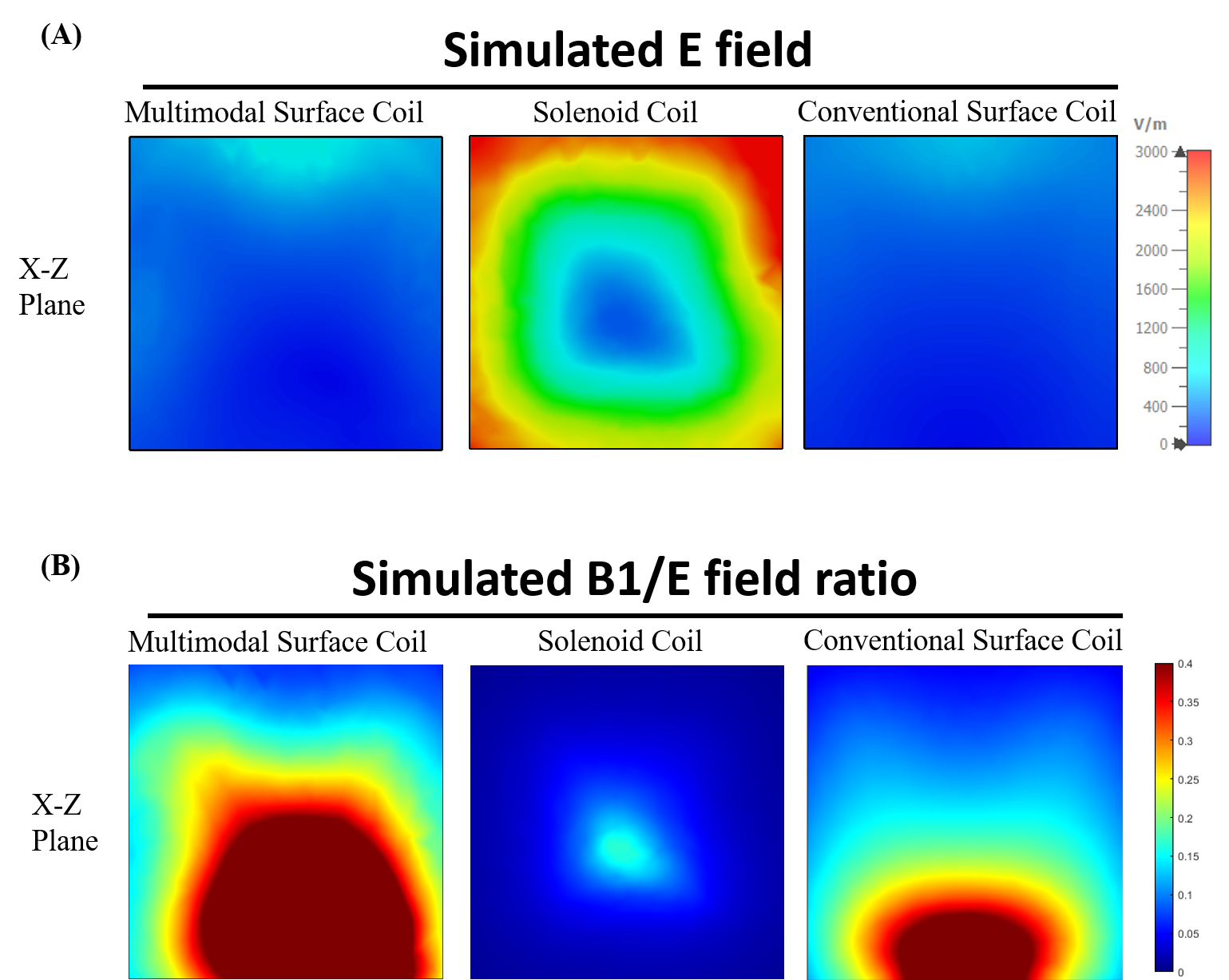
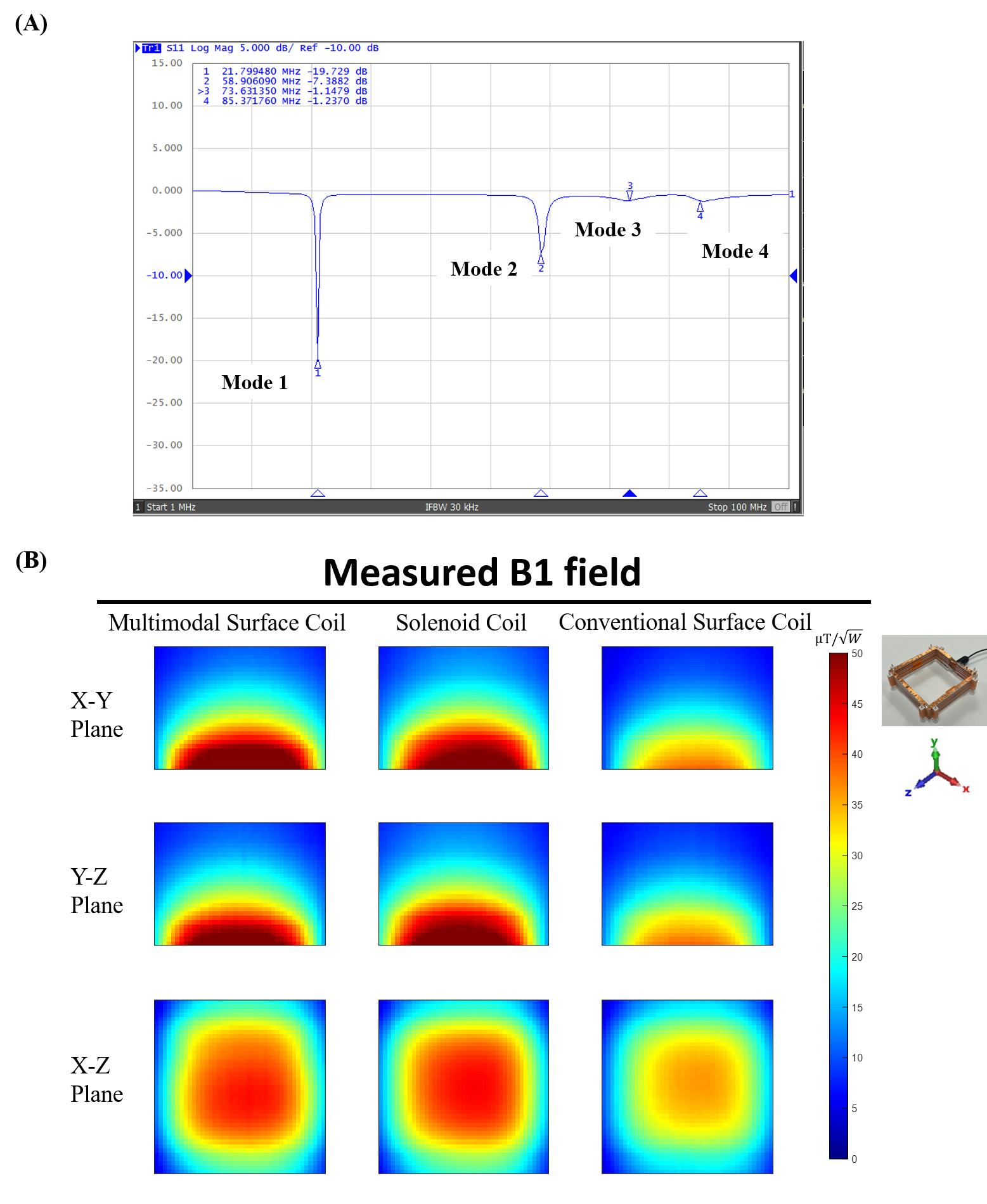
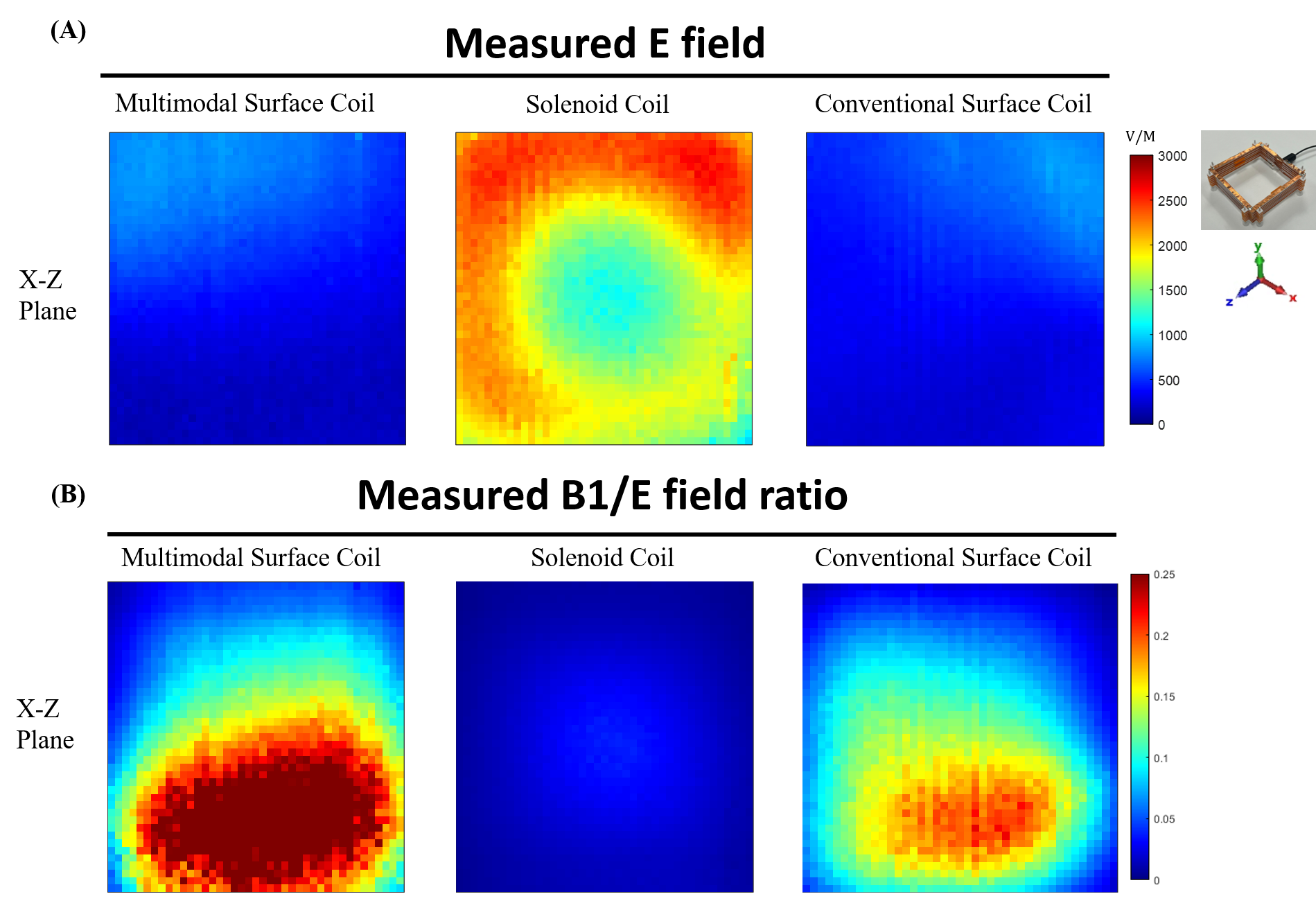
Figure 2A illustrates the simulated scattering parameters against the frequency of the multimodal surface coil. The figure reveals that strong coupling occurs between the coils, leading to the emergence of four distinct split resonant peaks with lowest peak at 21 MHz for imaging, while each individual coil resonates at 42 MHz. Figure 2B displays the B field efficiency maps in the Y-Z, X-Z, and X-Y planes at the lowest frequency within the phantom, produced by the multimodal surface coils. Figure 2C shows the 1-D field strength plot along the dashed line in Figure 2B. The simulation result shows the multimodal surface coil has stronger B field efficiency comparing with the conventional surface coil and similar B1 field efficiency comparing with the solenoid coil. Figure 3 shows that the simulated E field efficiency and B1/E field efficiency ratio in X-Z planes for all three setups. With same amount of accepted power, multimodal surface coils show significantly lower E field comparing with the solenoid coil, which leads to a much lower noise in SNR calculation.Figure 4A shows the bench test scattering parameters for the multimodal surface coil and Figure 4B shows the measured B field efficiency map for all three setups in different planes. Figure 5 shows the measured E field efficiency and B1/E field efficiency ratio map for all three setups in X-Z plane. In the bench test, the measured results are in accordance with the simulated results, indicating that the multimodal surface coil has advantages in B and E field efficiency when comparing with conventional surface coil and solenoid coil. This would lead to an improved overall SNR for low field MR imaging.
Conclusion
In conclusion, the proposed multimodal surface RF coil has demonstrated significant improvements in B1 efficiency over conventional surface coils, ultimately leading to an improved SNR for low-field MRI. The proposed multimodal surface coil design also helps to achieve low frequency tuning which is technically challenging at low magnetic fields. This multimodal surface coil technique can be possibly used to design high frequency small animal RF coils.Acknowledgements
This work is supported in part by the NIH under a BRP grant U01 EB023829 and by the State University of New York (SUNY) under SUNY Empire Innovation Professorship Award.References
1) Hoult, D.I. The signal-to-noise ratio of the nuclear magnetic resonance experiment. J.Magn Reson. 24, 71-85 (1976)
2) Pang, Y, et al. Parallel traveling wave MRI: A feasibility study. Magn Reson Med. 67, 965-978 (2012)
3) Wang, C, et al. A practical multinuclear transceiver volume coil for in vivo MRI/MRS at 7 T. Magn Reson Imag. 30, 78-84 (2012)
4) Zhao, Y, et al. A coupled planar RF array for ultrahigh field MR imaging. ISMRM 2023, 3910
Figures