1238
Rapid Reconstruction of Infant Cortical Surfaces with Spherical Topology1University of North Carolina at Chapel Hill, Chapel Hill, NC, United States, 2Dalian Maritime Time University, Dalian, China
Synopsis
Keywords: Analysis/Processing, Segmentation, Cortical Surface Reconstruction
Motivation: Cortical surface reconstruction (CSR) is important for surface-based analysis of the structure and function of the cerebral cortex.
Goal(s): We present an efficient method for simultaneous CSR and spherical mapping, all within a matter of seconds. Inherent correspondence allows easy and direct mapping of geometric features from cortical surfaces to the sphere.
Approach: Our flow-based method learns velocity fields to deform a spherical template mesh to the cortical surfaces with one-to-one vertex correspondence for direct spherical mapping.
Results: Using data from the Baby Connectome Project (BCP), we demonstrate that our method predicts more accurate and uniform surface meshes compared with several state-of-the-art methods.
Impact: Our method provides a way for fast and accurate infant cortical surface reconstruction. The one-to-one vertex correspondence between template sphere and the cortical surfaces enables easy and direct downstream analyses.
Introduction
Cortical surface reconstruction (CSR) is important for surface-based analysis of the structure and function of the cerebral cortex. While recent deep learning approaches have improved the speed of CSR, a substantial amount of runtime is still needed to map the cortex to a topologically-correct spherical manifold to facilitate downstream geometric analyses. In addition, existing methods typically cannot accurately reconstruct cortical surfaces from infant brain MRI due to tissue contrast changes associated with rapid brain development during the first postnatal year.We present an efficient flow-based method for simultaneous CSR and spherical mapping. Velocity fields are learned to gradually warp a sphere template to the white and pial surfaces, preserving mesh topology. The diffeomorphism between the template sphere and the cortical surfaces allows easy and direct mapping of geometric features like convexity and curvature to the sphere for visualization and downstream processing. We evaluated our method on the Baby Connectome Project (BCP)1 dataset in comparison with several state-of-the-art methods including DeepCSR2, CorticalFlow++3, SurfFlow4, Vox2Cortex5, and CortexODE6.
Method
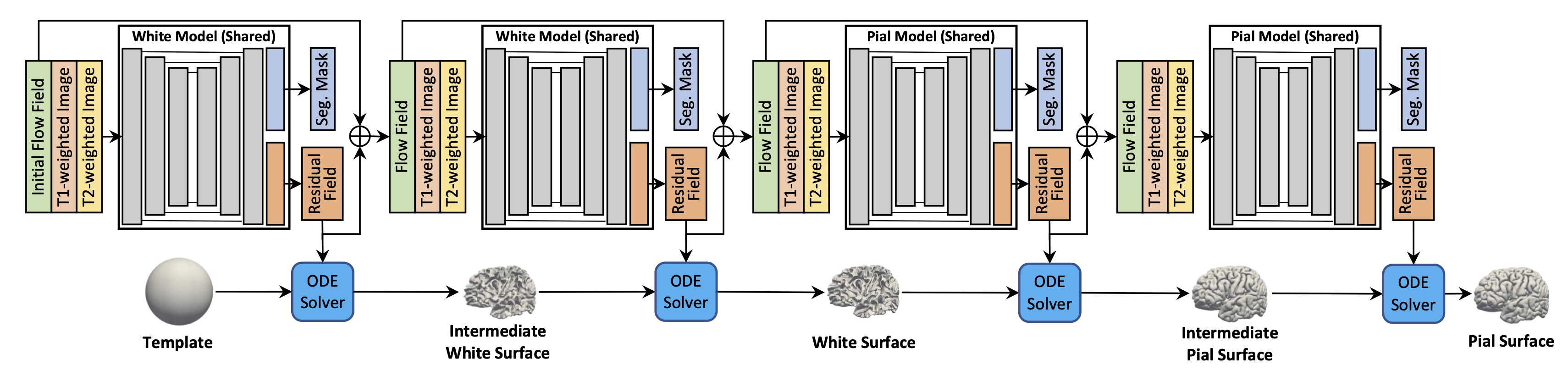
Flow-based approaches3,4,6 commonly solve an ODE that characterizes the trajectory of each vertex of a surface:$$\frac{\partial \phi (t; \textbf{x})}{\partial t} = \textbf{V}(\phi (t; \textbf{x})),$$
assuming a stationary velocity field (SVF) $$$V$$$. $$$\phi$$$ is the deformation to be determined and $$$\textbf{x}$$$ is the location of a vertex.
Our model (Fig. 1) comprises two sub-networks, one for the white surface and another for the pial surface. Both have a common U-shaped architecture. To overcome the limited capacity of a SVF in handling large deformations, we introduce a recurrent deformation learning strategy that allows large deformations to be learned incrementally with multiple smaller deformations. Both networks operate recurrently, predicting a SVF each time to estimate per-vertex displacement vectors based on the current state of deformation and a pair of T1- and T2-weighted images.
The loss function used in our approach is a weighted combination of Chamfer distance (CD) $$$L_{cd}$$$, an adaptive edge length loss $$$L_{edge}$$$, and a segmentation loss $$$L_{seg}$$$. The segmentation loss is a combination of cross-entropy and the dice loss.
To accommodate dynamic changes in brain volume during the first postnatal year and to ensure satisfactory mesh regularity, we adaptively constrain the sizes of the triangles in the predicted meshes for each subject based on the brain volume. The target edge length $$$\mu_{\text{adaptive}}$$$ is adaptively set to $$$2\sqrt{\frac{S}{\sqrt{3}N}}$$$ where $$$S$$$ is the total surface area and $$$N$$$ is the number of faces in the spherical template mesh. We propose using the adaptive edge length loss below to drive the edge length to $$$\mu_{\text{adaptive}}$$$:
$$L_{\text{edge}}= \frac{1}{|P|}\sum_{p\in P} \frac{1}{|\mathcal{N}(p)|}\sum_{k\in \mathcal{N}(p)} (\mu_{\text{adaptive}} - \Vert p-k \Vert_2)^2$$
where $$$P$$$ denotes the predicted mesh, $$$p$$$ is a vertex on $$$P$$$, and $$$\mathcal{N}(p)$$$ contains the neighbors of $$$p$$$.
Results & Analysis
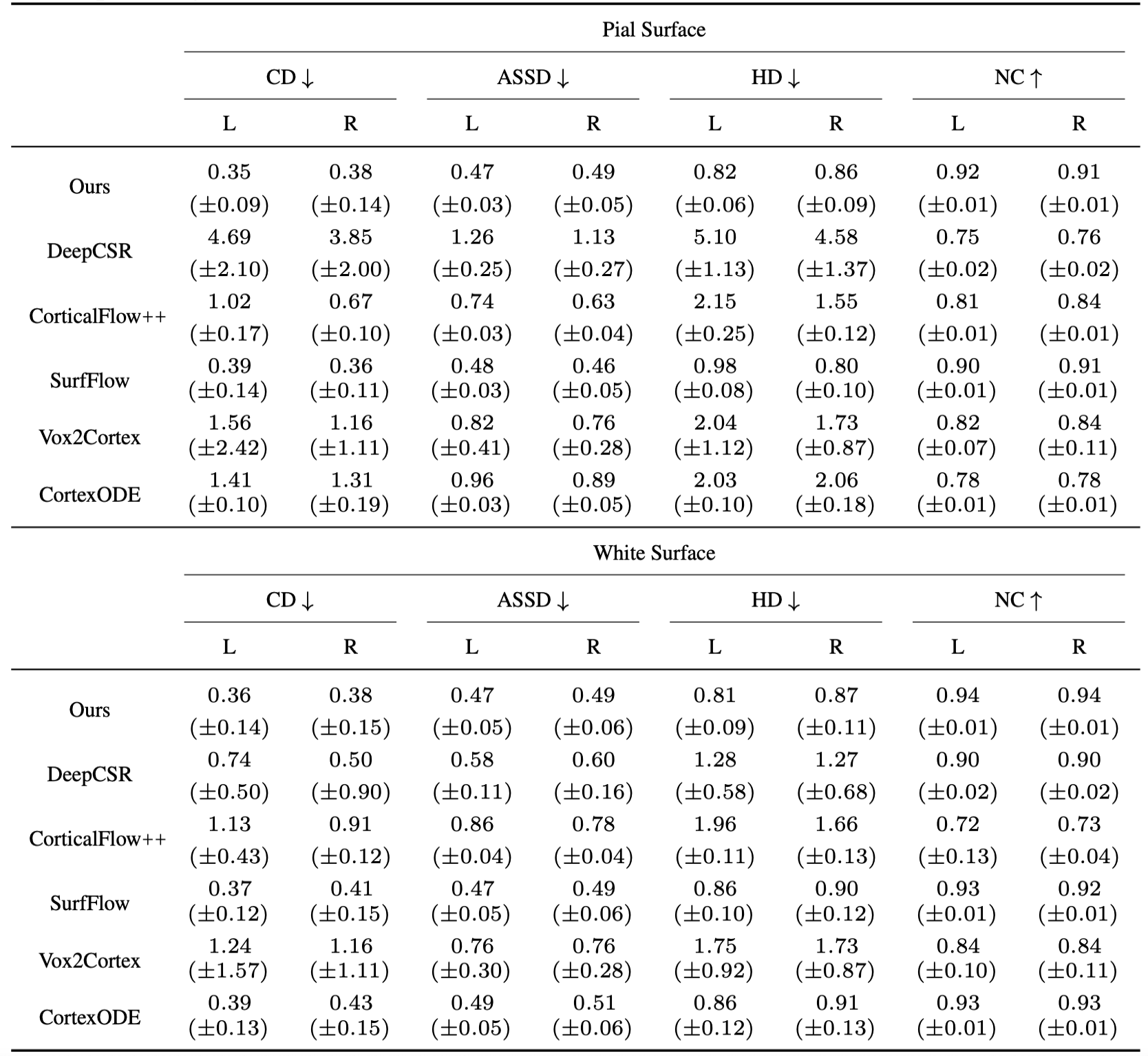
We compared our method with several state-of-the-art methods. Our data comprises 121 subjects from the Baby Connectome Project (BCP) ranging from 2 weeks to 12 months of age. The dataset was partitioned into training, validation and test subsets. The spherical template mesh, which contains ∼164k vertices, was generated by repeatedly subdividing the faces of an icosahedron.Chamfer distance (CD), average symmetric surface distance (ASSD), 90% Hausdorff distance (HD), and normal consistency (NC) were utilized as evaluation metrics. We modified the baseline methods to take both T1w and T2w images to ensure fair comparison. The experimental results are shown in Table 1. Our method outperforms both DeepCSR and CorticalFlow++ by a significant margin on both surfaces. SurfFlow, representing a strong baseline, also does not perform as well as our method, especially in white surface reconstruction.
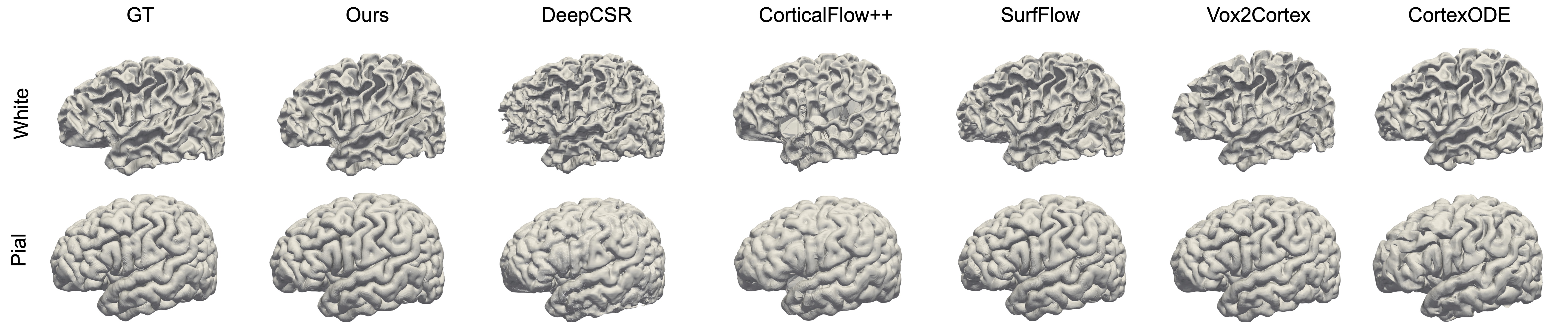
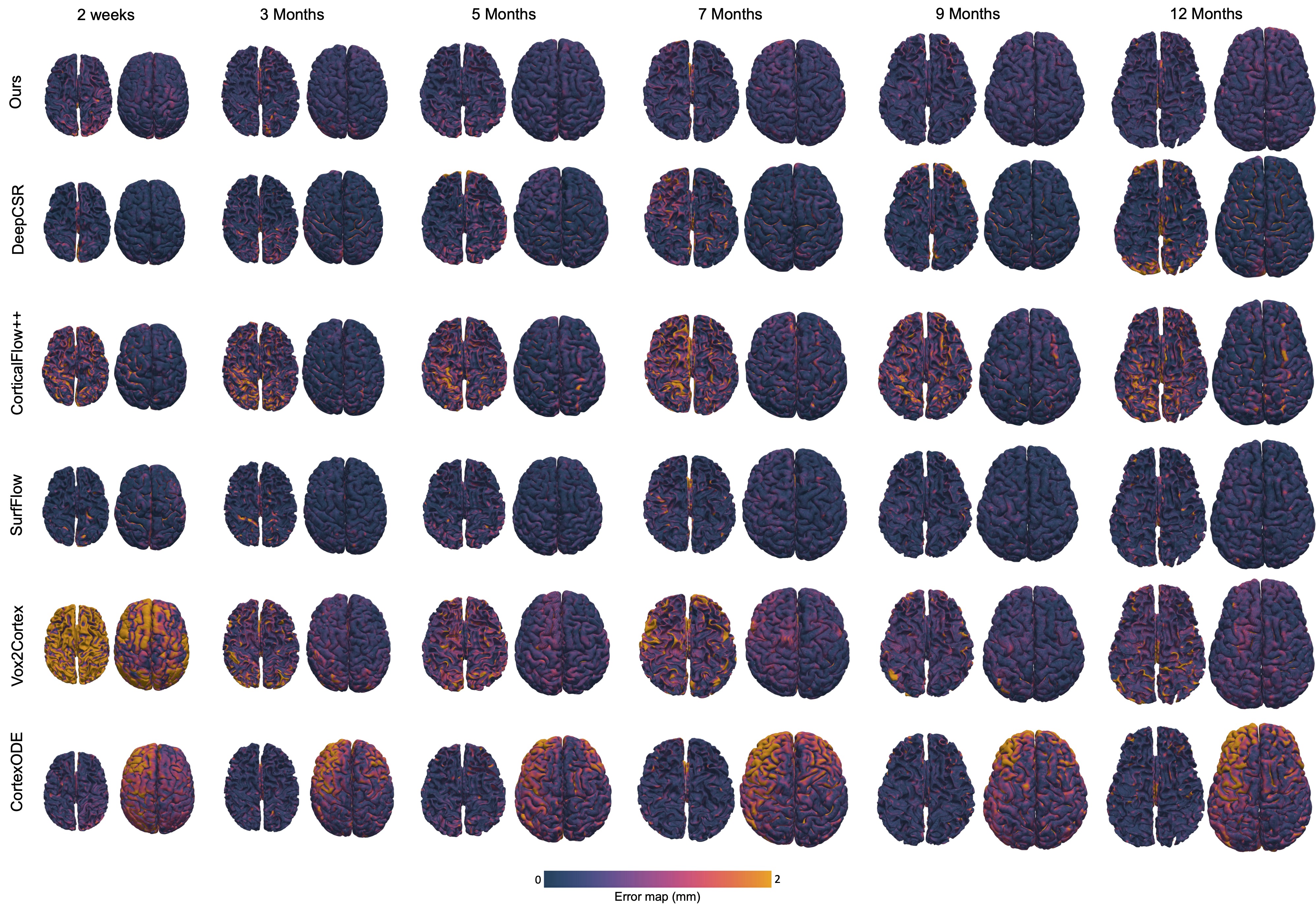
Fig. 2 shows example surfaces predicted by competing methods. Fig. 3 shows the error maps for six subjects of different ages, computed by measuring the distance of each vertex on the predicted surface to its nearest counterpart on the ground truth surface.
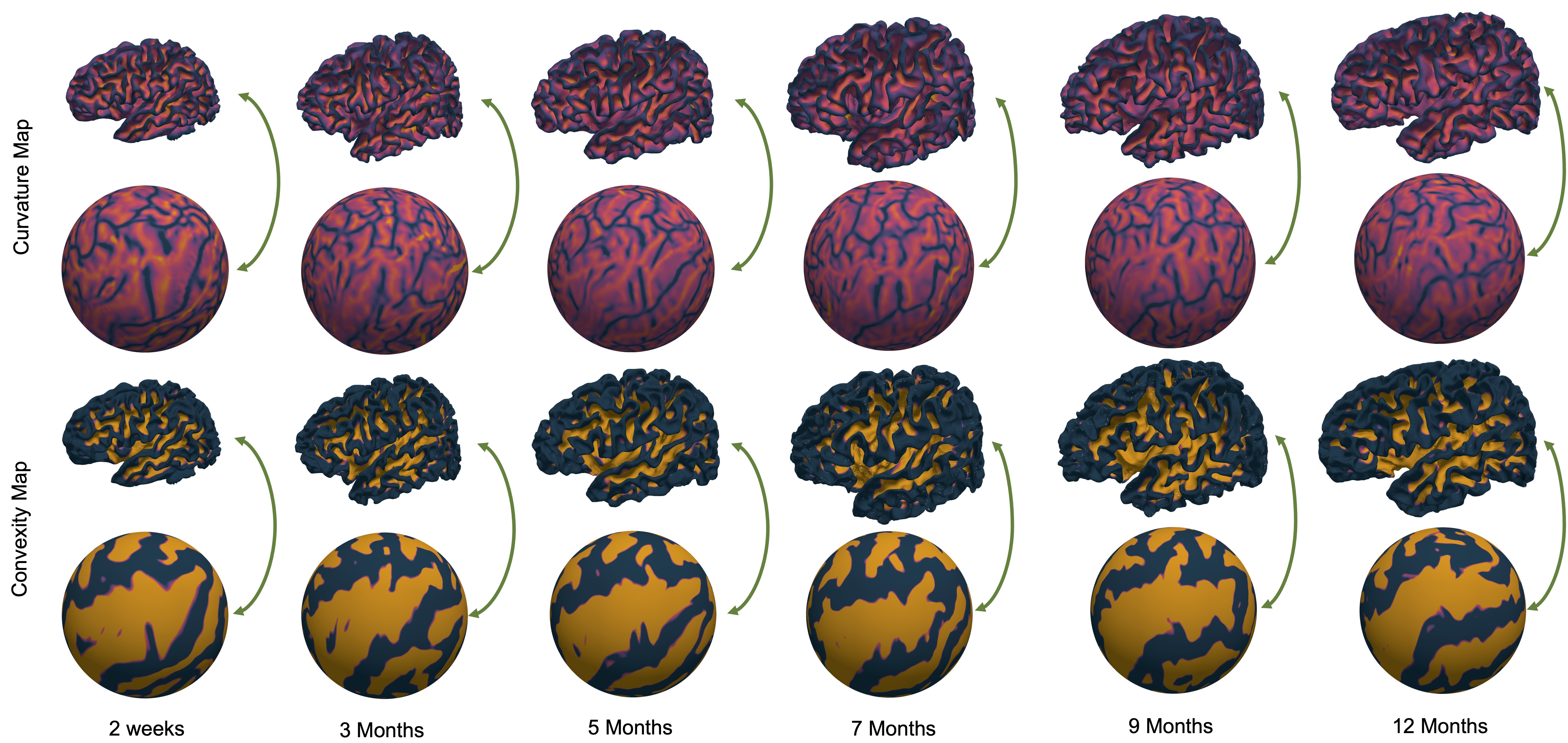
Our approach distinguishes itself from existing methods through its straightforward spherical mapping process by leveraging the inherent one-to-one vertex correspondence between the spherical template mesh and the reconstructed cortical surfaces. We exemplify this advantage by showcasing in Fig. 4 the spherical maps of curvature and convexity computed from the predicted cortical surfaces for six different time points.
Conclusion
In this abstract, we have presented a flow-based approach for efficient CSR and spherical mapping. We propose a recurrent deformation learning strategy to cater to large deformations. Experiments based on infant brain MRI indicate that our method reconstructs surfaces with significantly improved mesh regularity and reduced geometric errors over state-of-the-art approaches.Acknowledgements
This work was supported in part by the United States National Institutes of Health (NIH) through grants MH125479 and EB008374.References
- Brittany R Howell, Martin A Styner, Wei Gao, Pew-Thian Yap, Li Wang, Kristine Baluyot, Essa Yacoub, Geng Chen, Taylor Potts, Andrew Salzwedel, et al. The UNC/UMN baby connectome project (BCP): An overview of the study design and protocol development. NeuroImage, 185: 891–905, 2019.
- Rodrigo Santa Cruz, Leo Lebrat, Pierrick Bourgeat, Clinton Fookes, Jurgen Fripp, and Olivier Salvado. DeepCSR: A 3D deep learning approach for cortical surface reconstruction. In Proceedings of the IEEE/CVF Winter Conference on Applications of Computer Vision, pp. 806–815, 2021.
- Xiaoyang Chen, Junjie Zhao, Siyuan Liu, Sahar Ahmad, and Pew-Thian Yap. SurfFlow: A flow-based approach for rapid and accurate cortical surface reconstruction from infant brain MRI. In Medical Image Computing and Computer-Assisted Intervention (MICCAI). Springer, 2023.
- Rodrigo Santa Cruz, Le ́o Lebrat, Darren Fu, Pierrick Bourgeat, Jurgen Fripp, Clinton Fookes, and Olivier Salvado. CorticalFlow++: Boosting cortical surface reconstruction accuracy, regularity, and interoperability. In Medical Image Computing and Computer-Assisted Intervention (MICCAI), pp. 496–505. Springer, 2022.
- Fabian Bongratz, Anne-Marie Rickmann, Sebastian Po ̈lsterl, and Christian Wachinger. Vox2Cortex: fast explicit reconstruction of cortical surfaces from 3D MRI scans with geometric deep neural net- works. In Proceedings of the IEEE/CVF Conference on Computer Vision and Pattern Recognition (CVPR), pp. 20773–20783, 2022.
- Qiang Ma, Liu Li, Emma C Robinson, Bernhard Kainz, Daniel Rueckert, and Amir Alansary. CortexODE: Learning cortical surface reconstruction by neural ODEs. IEEE Transactions on Medical Imaging, 2022.
Figures