1228
B1 uniformity improvement of a birdcage coil with a chain mail configuration1Departamento de Fisica, UNAM, Mexico City, Mexico, 2Department of Physical Intelligence, Max Planck Institute for Intelligent Systems, Stuttgart, Germany, 3Department of Electrical Engineering, UAM Iztapalapa, Mexico City, Mexico
Synopsis
Keywords: RF Arrays & Systems, RF Arrays & Systems, Birdcage coil
Motivation: The main goal is to enhance the performance of an RF coil used in preclinical MRI imaging, specifically at a field strength of 7 T.
Goal(s): The researchers proposed a modification to a standard birdcage (BC) coil. This modification involves adding a "chain mail layout" to the rungs of the coil.
Approach: The idea for the chain mail layout was inspired by previous low pass wiring schemes used in chain mail coils, as reported by Mansfield. Chain mail refers to a type of flexible armor composed of interlinked metal rings.
Results: Phantom images were acquired and used to compute uniformity profiles.
Impact: These results obtained with the chain mail BC coil contributes to our overarching goal of achieving improved MRI coil performance for preclinical applications at 7 T.
Introduction
Enhancing the performance of RF coils remains a crucial endeavor in the field of preclinical MRI. In this study, we embarked on a quest to improve the performance of a standard birdcage (BC) coil for preclinical applications at 7 Tesla. Our approach involved a unique modification to the BC coil – the addition of a chain mail layout. This innovative concept was inspired by the effective low pass wiring schemes used in chain mail coils, as originally detailed by Mansfield [1]. We coined this modified BC coil the chain mail BC coil and sought to evaluate its feasibility by constructing a coil prototype and acquiring phantom images. The data collected allowed us to calculate uniformity profiles, validate previous simulations, and make performance comparisons with an in-house BC coil and a commercial BC coil.Method
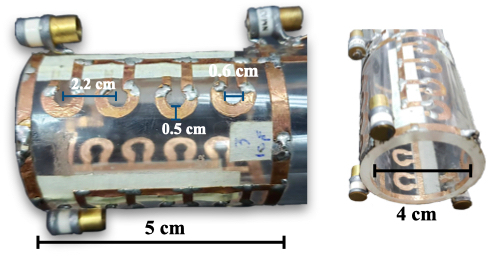
To implement our modification, we built a high-pass birdcage (BC) coil with a 4 cm diameter and 5 cm length, incorporating four rungs to form a chain mail layout, as depicted in Fig. 1. This configuration was chosen because BC coils with fewer rungs typically exhibit low specific absorption rates (SAR) [2], albeit at the cost of poor uniformity. Our approach allowed for the creation of appropriately sized circles within the chain mail layout. These circles were positioned with centers roughly three times further apart than their radii to minimize mutual inductance, as reported in [3]. This coil operated in a quadrature-driven mode, functioning as a transceiver coil, and was tuned to 300 MHz. We also employed an in-house BC coil with dimensions of 5 cm length and 4 cm diameter, featuring four rungs [4], and a commercial BC coil (RF RES 300 1H 075/040 QSN TR, model no.: 1PT13161V3, serial no.: S0121, REV/VEC: 2P01.05, from Bruker BioSpin MRI, GmbH, Germany) of similar dimensions for comparative purposes.To assess the validity of our new coil design, we acquired phantom images using a standard gradient echo sequence. The acquisition parameters were as follows: TE/TR = 4 ms/100 ms, FOV = 40 mm x 40 mm, matrix size = 256 x 256, flip angle = 450, slice thickness = 1 mm, and NEX = 1. Additionally, we acquired phantom images using the other two BC coils for comparison purposes. All MRI experiments were conducted on a 7 T/30 cm Bruker imager (Bruker BioSpin MRI, GmbH, Germany).Results and Discussion
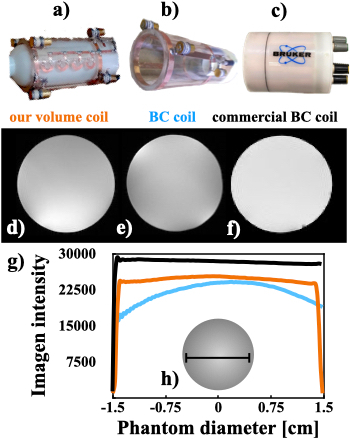
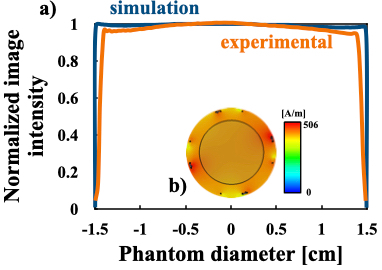
Phantom images acquired with the three BC coils (Fig. 2.d)-f)) exhibited high-quality images. Signal-to-noise ratio (SNR) values were calculated based on the image data, resulting in SNR values of 109 for the chain mail BC coil, 106 for the in-house coil, and 171 for the commercial coil. These results indicate that the chain mail and in-house coils perform similarly, while the commercial coil shows superior performance. Additionally, a uniformity comparison plot (Fig. 2.g)) demonstrated that the chain mail BC coil significantly improved uniformity compared to the in-house volume coil. The uniformity of our volume coil closely aligned with the commercial BC coil, validating the chain mail layout. A comparison of experimental and simulation data (Fig. 3) revealed excellent agreement, affirming the accuracy of our simulations.Conclusions
The chain mail coil introduced in this study notably enhances the uniformity compared to a standard BC coil. The performance of the chain mail coil closely matches that of the in-house BC coil, validating this new coil design. Our experimental and simulation results demonstrate that it is feasible to improve the uniformity of a standard birdcage coil for preclinical applications at high field strengths at 7 T.Acknowledgements
This project received funding from the UAM Division of Basic Science and Engineering under the Special Program for Education and Research (SA-DCBI-SA-409-2023).References
1. Mansfield, P. Surface electrical coil structures. U.S. Patent No 5,143,688, 1 Sept. 1992.
2. Martin, R., Vazquez, J. F., Marrufo, O., Solis, S. E., Osorio, A., Rodriguez, A. O. SAR of a birdcage coil with variable number of rungs at 300 MHz. Measurement, 82;482:2016. http://dx.doi.org/10.1016/j.measurement.2016.01.013.
3. Rodríguez, A. O., Medina, L. Improved SNR of phased-array PERES coils via simulation study. Phys Med Biol. 21;50:N215: 2005. doi: 10.1088/0031-9155/50/18/N01.
4. Solis-Najera, S., Ruiz, R., Martin, R. Vazquez, F., Marrufo, O., Rodriguez, AO. A theoretical and experimental investigation on a volume coil with slotted end-rings for rat MRI at 7 T. Magn Reson Mater Phy. 2023. https://doi.org/10.1007/s10334-023-01096-w
Figures