1222
Travelling wave MRI with a parallel-plate waveguide loaded with a metamaterial at 7 T1Departamento de Fisica, UNAM, Mexico City, Mexico, 2Department of Physical Intelligence, Max Planck Institute for Intelligent Systems, Stuttgart, Germany, 3Department of Electrical Engineering, UAM Iztapalapa, Mexico City, Mexico
Synopsis
Keywords: Non-Array RF Coils, Antennas & Waveguides, Non-Array RF Coils, Antennas & Waveguides, travelling wave MRI
Motivation: The utilization of traveling-wave MRI in conjunction with a parallel-plate waveguide provides an alternative for acquiring images at ultrahigh magnetic fields, circumventing the resonant frequency limitations.
Goal(s): To improve the image quality and to investigate the application of metamaterials within the waveguide to improve performance.
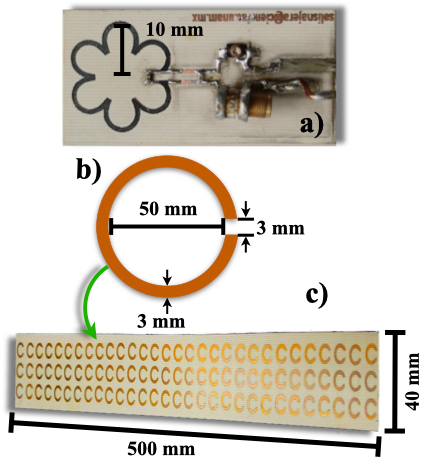
Approach: A bio-inspired surface coil in the transceiver mode and a C-shaped unit metamaterial made from copper sheets laminated onto a nonconductive board within the parallel-plate waveguide filled with a saline solution were used.
Results: Images acquired with the metamaterial-loaded waveguide demonstrated improved signal-to-noise ratio and closely matched the image quality achieved with in-house birdcage coils
Impact: To provide an effective alternative for remote detection in MRI, enabling high-quality image acquisition with efficiency.
Introduction
The traveling-wave MRI (twMRI) technique, combined with a parallel-plate waveguide (PPWG), offers the advantage of obtaining images with a larger field of view at any resonant frequency [1]. However, these images tend to suffer from lower signal-to-noise ratio (SNR) values and reasonable uniformity [2]. This research was motivated by the findings published by Alex-Amo et al. [3] and Zamir et al. [4]. Recent results using a flexible metasurface inserted into a phantom and a PPWG [5] inspired us to further explore the use of metamaterials in twMRI. In this study, we proposed an alternative approach involving a metamaterial-loaded PPWG filled with a saline solution and a transceiver bio-inspired surface coil.Method
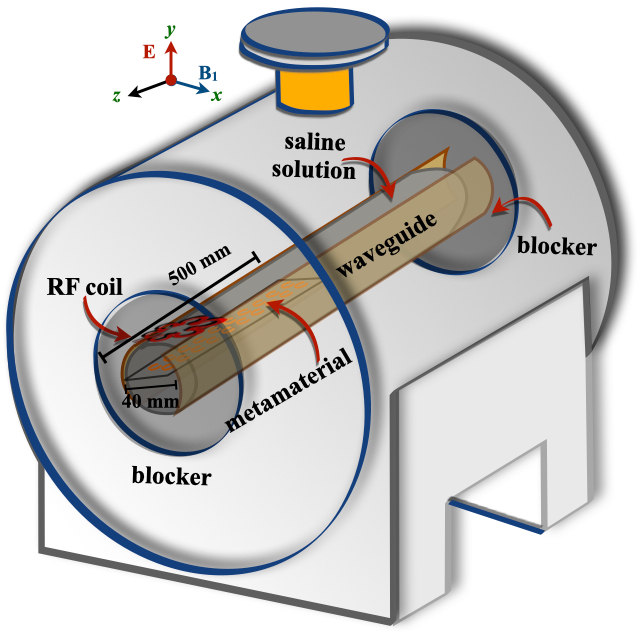
For transmitting the RF signal, we used a bio-inspired surface coil, following the approach described in [2,5]. The metamaterial was created as an array of 3 x 50 C-shaped units, constructed using copper sheets (with a thickness of 35 𝜇m and conductivity 𝜎 = 5.96 × 10⁷ S/m). These copper sheets were laminated onto a nonconductive board (FR4: 𝜖 = 4.35 and tan(𝛿) = 0.008, with a thickness of 1 mm, and dimensions of 500 mm length and 40 mm width). Each C-shaped unit had a diameter of 23 mm, a 2 mm gap, and a 3 mm strip width. Phantom images were acquired using the PPWG filled with saline solution and the metamaterial inserted in the PPWG, with transmission and reception performed by the bio-inspired surface coil located outside the waveguide and parallel to the plates, as shown in Fig. 2. To validate this approach, phantom images were acquired using a standard gradient echo sequence with the following acquisition parameters: TE/TR = 4 ms/100 ms, FOV = 40 mm x 40 mm, matrix size = 256 x 256, flip angle = 45 degrees, slice thickness = 1 mm, and NEX = 1. Additionally, phantom images were acquired without the metamaterial and using a commercial birdcage coil (RF RES 300 1H 075/040 QSN TR, model no.: 1PT13161V3, serial no.: S0121, REV/VEC: 2P01.05, from Bruker BioSpin MRI, GmbH, Ettlingen, Germany) for comparison. All MRI experiments were conducted on a 7T/30 cm Bruker imager from Bruker BioSpin MRI, GmbH, Germany.Results and Discussion
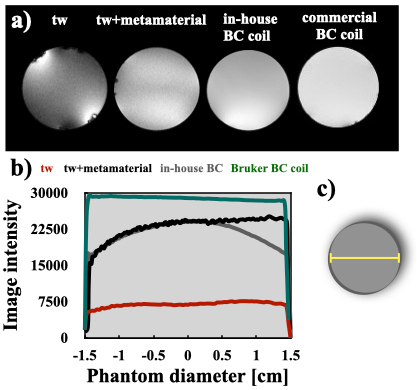
Phantom images acquired with and without the metamaterial demonstrated the feasibility of this approach, as shown in Fig. 3.a). The calculated signal-to-noise ratio (SNR) values and uniformity profiles are presented in Fig. 3.b). The SNR values are as follows: SNRmetasurface = 101, SNRno-meta = 24.5, SNRin-hBC = 106, SNRcomBC = 171. The imaging performance with the metasurface is notably similar to that obtained with the in-house BC coil, which is a significant result, as remote acquisition of MR images often results in lower image quality. All uniformity profiles exhibit a similar pattern, with the profile obtained with the metamaterial having a greater intensity compared to the profile obtained with twMRI without the metamaterial. This demonstrates a substantial improvement in image quality when using the non-tuned metamaterial compared to the standard twMRI approach. These results align with previous findings obtained at 3 T [5] and 15.2 T [1], highlighting the consistency and advantages of this approach. In conclusion, this method offers a practical and effective way to obtain high-quality images.Conclusion
The experimental results confirm that a metamaterial-loaded waveguide filled with a saline solution can produce high SNR images using the traveling-wave approach. This approach surpasses the standard twMRI method at 7 T with a preclinical MR imager, demonstrating its potential for high-quality imaging in this setting.Acknowledgements
This project received funding from the UAM Division of Basic Science and Engineering under the Special Program for Education and Research (SA-DCBI-SA-409-2023).References
1. Vazquez, F., Solis-Najera, S. E., Lazovic, J., Zopf, L. M., Martin, R., Medina, L., Marrufo, O., Rodriguez, A. O. (2021). Remote RF excitation for small-bore MR imager at 15.2 T. Journal of Magnetic Resonance, 323, 106896.
2. Vazquez, F., Marrufo, O., Martin, R., Solis, S., Rodriguez, A. O. (2016). Travelling-wave transmitted with a simple waveguide for rodents Magnetic Resonance Imaging at 9.4 T. 33rd Ann. Meet. ESMRMB, 32, S31-S32.
3. Alex-Amor, A., Valerio, G., Ghasemifard, F., Mesa, F., Padilla, P., Fernández-González, J. M., Quevedo-Teruel, O. (2020). Wave propagation in periodic metallic structures with equilateral triangular holes. Applied Sciences, 10(5), 1600. Zamir, B., & Ali, R. (2011).
4. Zamir, B., & Ali, R. (2011). Wave propagation in parallel-plate waveguides filled with nonlinear left-handed material. Chinese Physics B, 20(1), 014102.
5. Solis-Najera, S., Lazovic, J., Vazquez, F., Rodriguez, AO. Remote detection MRI using a flexible non-selective metamaterial at 7 T. Proc. Intl. Soc. Mag. Reson. Med. Abst No. 3909, 31 (2023).
Figures