1211
The Efficiency Optimization of a Triple-Tuned (2H/23Na/31P) Body Coil at 7T1Department of Radiology, University Medical Center Utrecht, Utrecht, Netherlands, 2Tesla Dynamic Coils, Zaltbommel, Netherlands
Synopsis
Keywords: High-Field MRI, High-Field MRI, multi-tuned body coils, triple-tuned body coils, efficiency improvement
Motivation: Low B1+ field 1)increases the RF pulse duration which jeopardizes SNR in the short T2 of 23Na spins and 2)limits of the excitation bandwidth which might be insufficient to excite the full chemical shift dispersion of 31P spins.
Goal(s): To improve the efficiency of a triple-tuned (2H/23Na/31P) body coil.
Approach: Reducing the total loss on a birdcage design by decreasing the number of multi-tuned circuits.
Results: The 8-rungs (i.e., 16 triple-tuned circuits) design wins 3dB in efficiency against a conventional 24-rungs (i.e., 48 double-tuned circuits) design, while covering one more excitation frequency, and the homogeneity is practically unaffected.
Impact: The high loss of the multi-tuned circuits is a determinant in multi-tuned borecoil designs. Reducing the number of multi-tuned circuits used in the design substantially improves the B1 efficiency of a body coil facilitating even triple tuning.
Introduction
The loss on RF transmit coils directly affects B1+ field and the cost of the RF amplifier. Additionally, the fact that often lower power RF amplifiers are available compared to those for 1H results in 1)increasing the RF pulse duration which jeopardizes SNR in the short T2 of 23Na spins and 2)limiting of the excitation bandwidth which might be insufficient to excite the full chemical shift dispersion. The dominant losses in multi-tuned body coils are the body loss and the loss of the multi-tuned circuits. Our preliminary work showed that the total loss on a birdcage design could be reduced by decreasing the number of multi-tuned circuits1. In this work, the efficiency of a triple-tuned (2H/23Na/31P) body coil was optimized by investigating three different triple-tuned birdcage designs to a level higher than commonly obtained for double-tuned circuits. An existing double-tuned birdcage body coil is used as a reference.Methods
Simulation StudiesA 40cm long 24-leg birdcage coil with a diameter of 59cm was created in a 3D electromagnetic simulation software (Sim4life, ZMT, Switzerland) along with a shield of 63.5cm in diameter. The coil was single-tuned sequentially at three frequencies (i.e., 2H, 23Na, 31P, at 7T) in a classical way (Fig.1a), that is using 48 capacitors in total (48caps). A separate birdcage coil having the same coil parameters and dimensions was created and single-tuned for the same frequencies by a method such that two of every three end-ring segments are shorted (Fig.1b), decreasing the total number of capacitors to 16. The tuning frequencies of 2H, 23Na, and 31P were respectively 45.75MHz, 78.8MHz, and 120.6MHz, at 7T. Rleg, Rendring, and Rcap (Fig.1) were calculated by the same method in1. Different loss cases (Fig.2) were applied to observe their effect on B1+ field. B1+ field intensity at the center of the coil was calculated when the coil was loaded with head, abdomen, and a phantom (σ=0.55S/m, ε=74).
Bench Measurements
Three triple-tuned birdcages, namely, 16caps, classical 8-leg, and thick 8-leg were built with a shield of 64.9cm in diameter. In thick 8-leg design, each leg was represented by three rods placed in parallel2. Each coil was matched to a single frequency when the corresponding efficiency was measured. Coils were loaded with the body phantom (σ=0.34S/m, ε=45 at 120MHz). A pick-up probe was used for the efficiency measurement. The efficiency of a reference double-tuned (2H/31P) bore coil was measured when the phantom was placed inside the scanner.
Phantom and In vivo Experiments
A shield of 61.5cm in diameter was used. The coil was driven by 5KWatt peak RF power for all nuclei at 7T (Philips, Best, The Netherlands). Flip angle series were applied to calculate the corresponding B1+ field strength at all frequencies. A 2-ch double-tuned (2H/31P) receive surface coil (WaveTronica,B.V.,Netherlands) was used for 2H-31P phantom imaging, and 2H in vivo imaging. A quintuple-tuned whole brain coil (1H/19F/31P/23Na/13C)3 was used as a receiver for 23Na phantom imaging and 23Na-31P in vivo imaging. Scan parameters are given in Fig.4.
Results
The triple-tuned thick 8-leg birdcage yielded 3 dB (for 31P and 23Na) or 0 dB (2H) higher efficiency than a 24-leg double-tuned birdcage (Fig.3). After insertion in the MRI system for the phantom and in vivo experiments, the S11_2H, S11_23Na, and S11_31P of the triple-tuned thick 8-leg birdcage were -7.7dB, -8.9dB, and -7.7dB, respectively, whereas, S22_2H, S22_23Na, and S22_31P were -7.7dB, -8dB, and -7dB, respectively when the coil was loaded with the body phantom.The flip angle required to apply an equivalent-to-90° flip angle for 2H, 23Na, and 31P was 300, 420, and 210 degrees, respectively (Fig.5). The calculated B1+ field strength of 2H, 23Na, and 31P was 2.4μT, 3.85μT, and 4.2μT, respectively.
2H FID peak was obtained from the liver of a healthy male volunteer (Fig.5). 23Na FID and 31P CSI were obtained from the brain of a healthy female volunteer.
Discussion
This work proposed an efficient triple-tuned birdcage design at 7T without compromising on homogeneity. As demonstrated in1, the loss of triple-tuned circuits is a determinant in the efficiency and coil parameters. Decreasing the total loss on a multi-tuned birdcage can be achieved by reducing the number of multi-tuned circuits from 48 to 16. Our results show that the gain in efficiency allowed us to add an extra resonance without any compromise for 2H and even an extra 3 dB gain for 31P and 23Na, supported by in vivo results from different body parts.Acknowledgements
This study is co-funded through the European Research Council (ERC) HORIZON-EIC-2021-TRANSITIONOPEN-01 program.
References
1. Kahraman-Agir B, Welting D, Gosselink M, Klomp D. Understanding Loss Mechanisms in Double-Tuned Body Coils To Improve B1 Efficiency. In: Proc. Intl. Soc. Mag. Reson. Med. . ; 2023:4084.
2. Xu Y, Wen Q, Yang H, Zhong K. Multiple Parallel Round Leg Design for Quadrature Birdcage Coil in Ultrahigh-Field MRI. Appl Magn Reson. 2018;49(2). doi:10.1007/s00723-017-0963-0
3. Dai J, Gosselink M, van der Velden TA, Meliadò EF, Raaijmakers AJE, Klomp DWJ. An RF coil design to enable quintuple nuclear whole-brain MRI. Magn Reson Med. 2023;89(5). doi:10.1002/mrm.29577
Figures
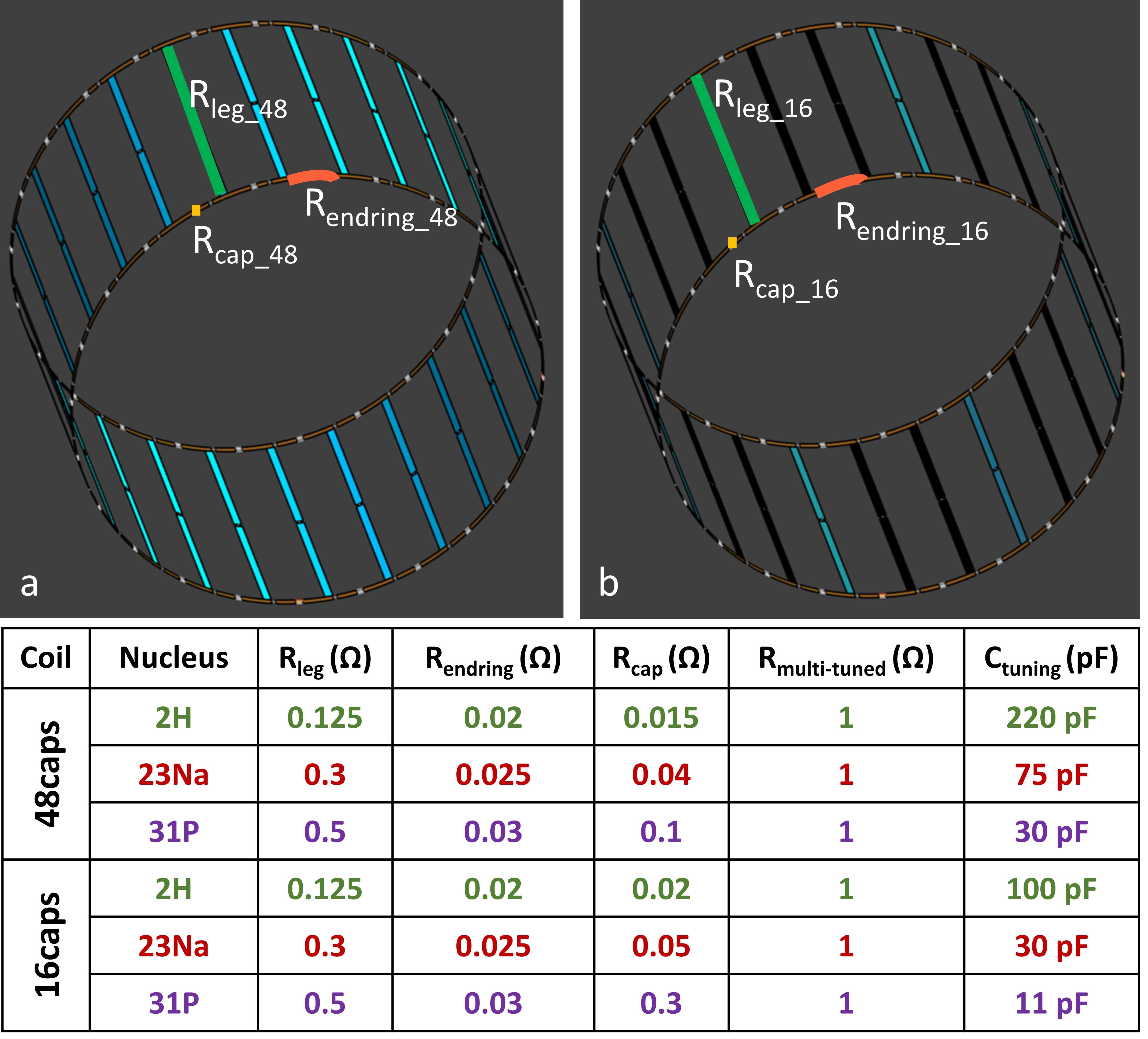
Figure 1: The design of 48caps (a) and 16caps (b), representation of Rleg, Rendring, and Rcap on the designs, and the corresponding values of Rleg, Rendring, Rcap, Rmulti-tuned, and Ctuning at 2H, 23Na, and 31P frequencies.
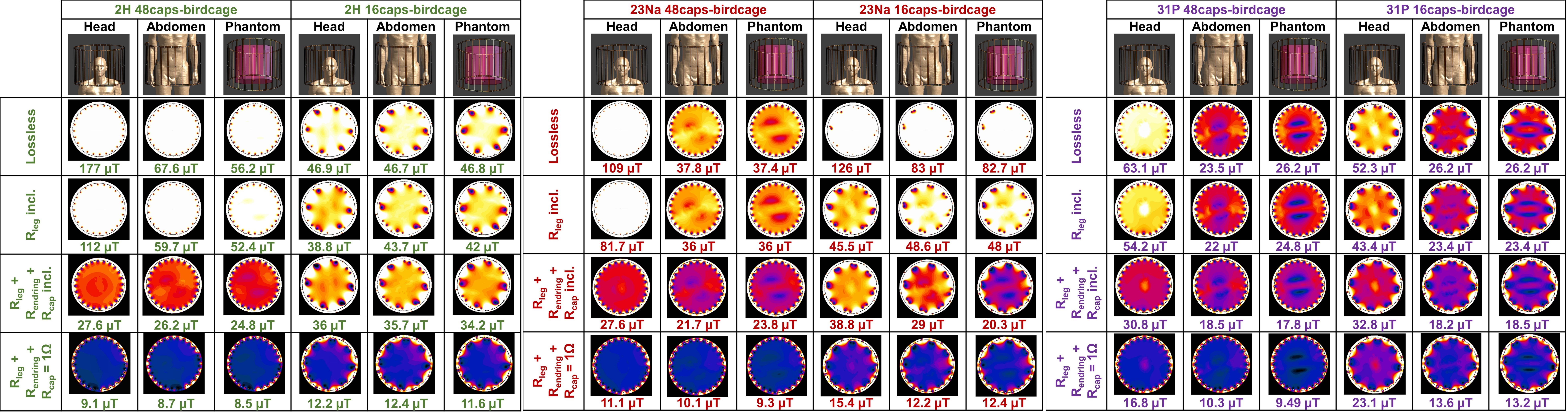
Figure 2: Simulation results of 48caps and 16caps at 2H, 23Na, and 31P frequencies when different loss cases were applied.
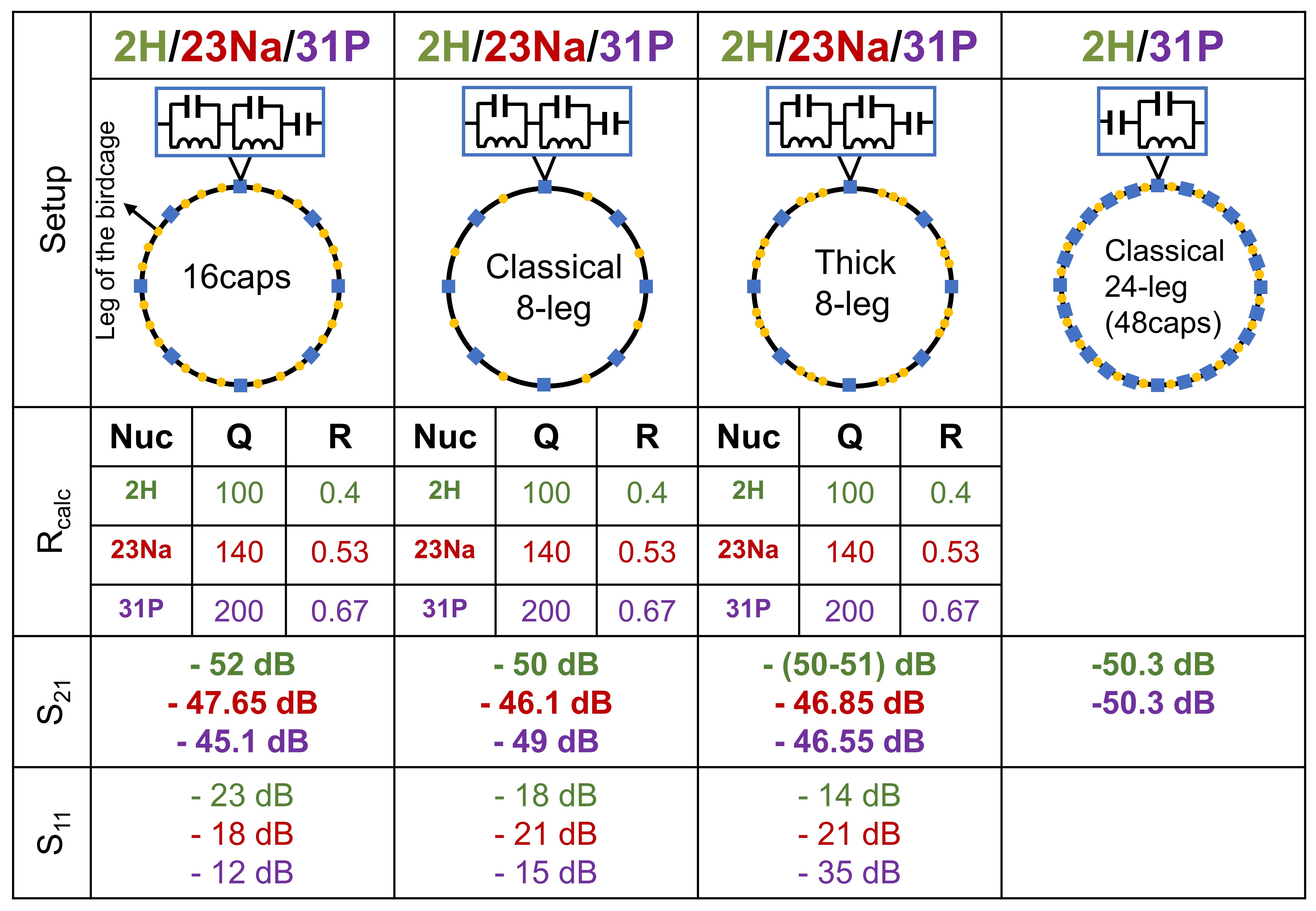
Figure 3: The efficiency measurements of the triple-tuned 16caps, the triple-tuned classical 8-leg, the triple-tuned thick 8-leg, and the classical double-tuned 24-leg borecoils.
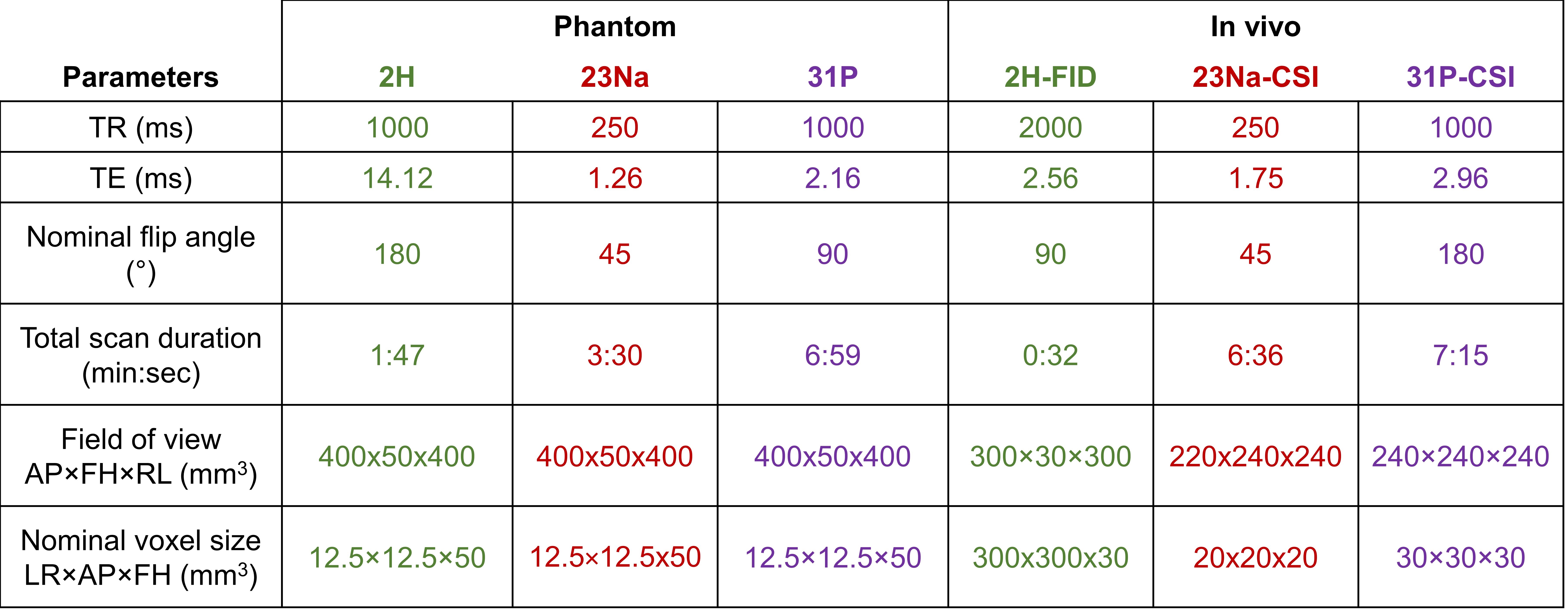
Figure 4: Scan parameters for phantom and in vivo imaging for all nuclei.
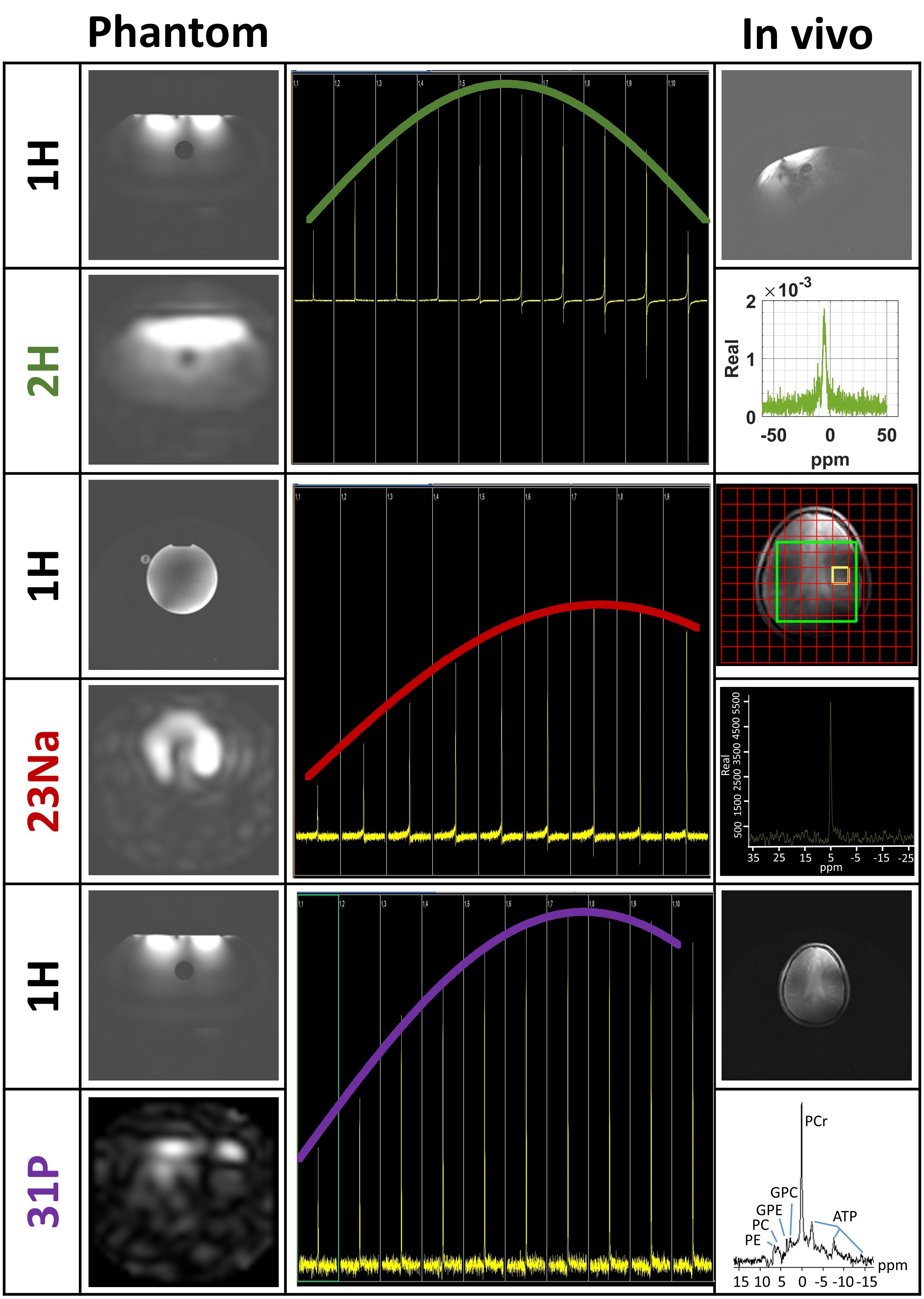
Figure 5: Phantom and in-vivo images of all nuclei. 2H-FID was acquired from a healthy male volunteer (using a simple surface receiver), whereas, 23Na-FID and 31P-CSI were acquired from a healthy female volunteer.