1157
Association of glymphatic and white matter impairment with outcomes of paediatric hydrocephalus after ventriculoperitoneal shunt1Department of Radiology, The First Affiliated Hospital of Xi'an Jiaotong University, Xi'an, China, 2Department of Radiology, Shenzhen Children’s Hospital, Shenzhen, China, 3China Medical University-The Queen's University of Belfast Joint College, China Medical University, Shenyang, China, 4Department of Neurosurgery, Shenzhen Children’s Hospital, Shenzhen, China, 5Department of Radiology, Shenzhen Second People’s Hospital, The First Affiliated Hospital of Shenzhen University Health Science Center, Shenzhen, China, 6Children’s Healthcare & Mental Health Center, Shenzhen Children’s Hospital, Shenzhen, China, 7Shaanxi Engineering Research Center of Computational Imaging and Medical Intelligence, The First Affiliated Hospital of Xi'an Jiaotong University, Xi’an, China
Synopsis
Keywords: Neuro, Brain
Motivation: Whether there exist association between glymphatic/white matter impairment and postoperative outcomes of paediatric hydrocephalus.
Goal(s): We tried to investigate the glymphatic and white matter abnormalities in paediatric hydrocephalus using MRI metrics.
Approach: Fifty-five children with hydrocephalus who underwent MRI and ventriculoperitoneal shunt surgery were prospectively enrolled. DTI metrics were analyzed.
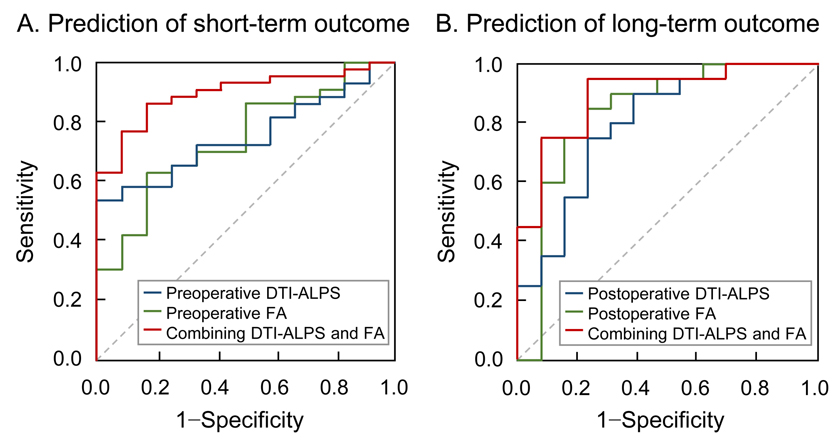
Results: Compared with controls, DTI-ALPS index decreased before surgery and recovered after surgery. The preoperative and postoperative DTI-ALPS index and FA in association fibres could predict the short-term motor and long-term cognition outcomes, respectively.
Impact: The DTI-ALPS index and FA could be a sensitive biomarker of underlying neuroanatomical changes and developmental outcomes, which would benefit the decision-making of treatment plans.
Introduction
The CSF shunt is the main strategy of treatment for hydrocephalus (1, 2). As a certain failure rate exists with shunts, alternative treatments have been proposed that may improve quality of life. Many studies have been conducted in an effort to identify risk factors that could be modified to reduce shunt failure (3). However, little progress has been made. The postoperative incidence of motor dysfunction is reported to be 46.5% and that of cognitive impairment to be 47.6% (4). Progress will depend on continued efforts to improve our understanding of the pathophysiology. The glymphatic system has been identified as a brain-wide pathway that facilitates cerebrospinal fluid (CSF) flow through the brain parenchyma and clearance of interstitial solutes. AQP4 of glymphatic system may become a target for glymphatic drug therapy (5). We hypothesized that the glymphatic system dysfunction and impaired white matter structure might be detected in pediatric hydrocephalus. Therefore, this study used diffusion tensor imaging along the perivascular space (DTI-ALPS) (6-11) to investigate glymphatic system function and obtained MR metrics using DTI in longitudinal study of pediatric hydrocephalus before and after shunt surgery. We expect our results can help management of this disorder and provide a basis for finding alternative treatment methods for hydrocephalus.Methods
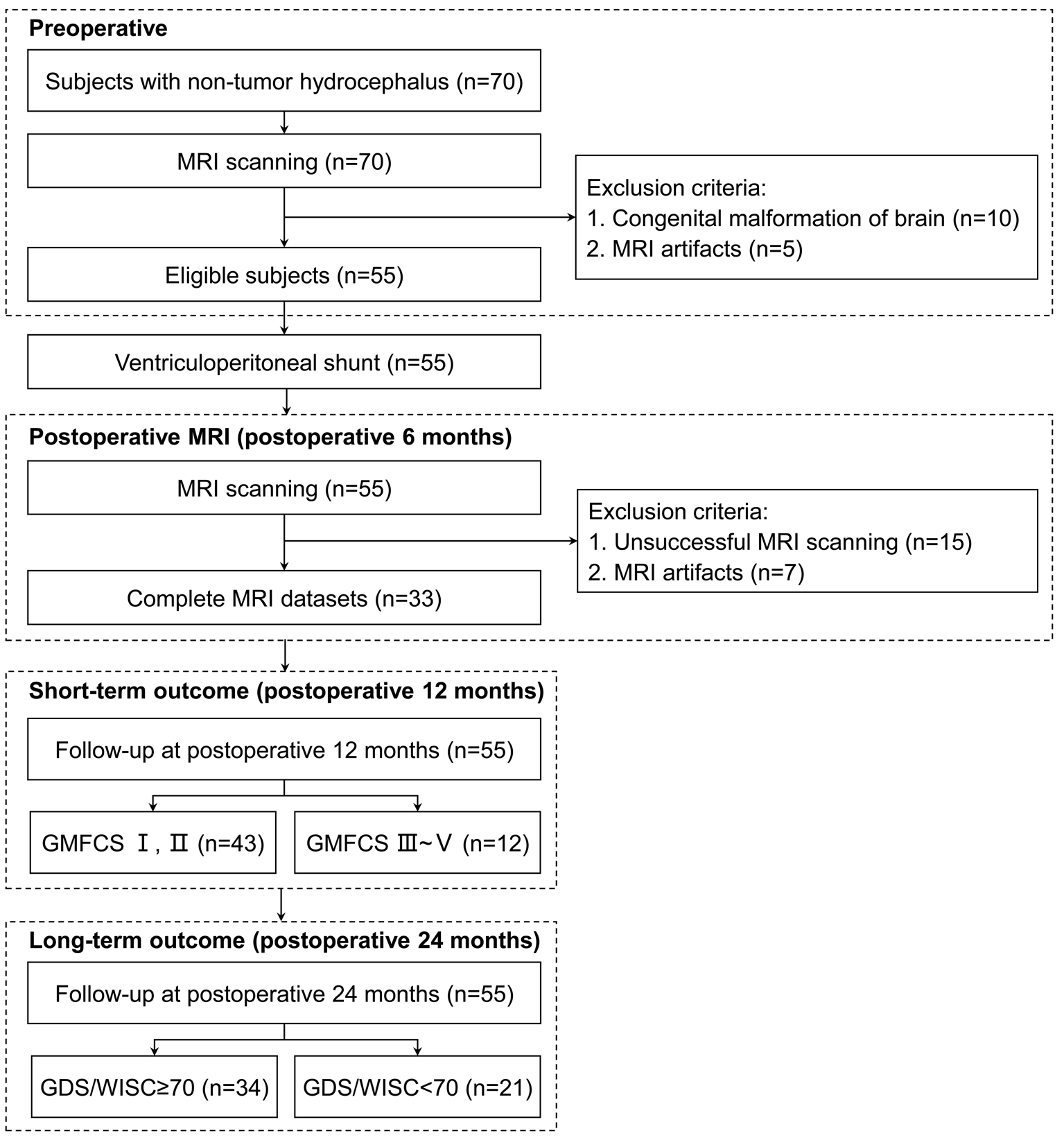
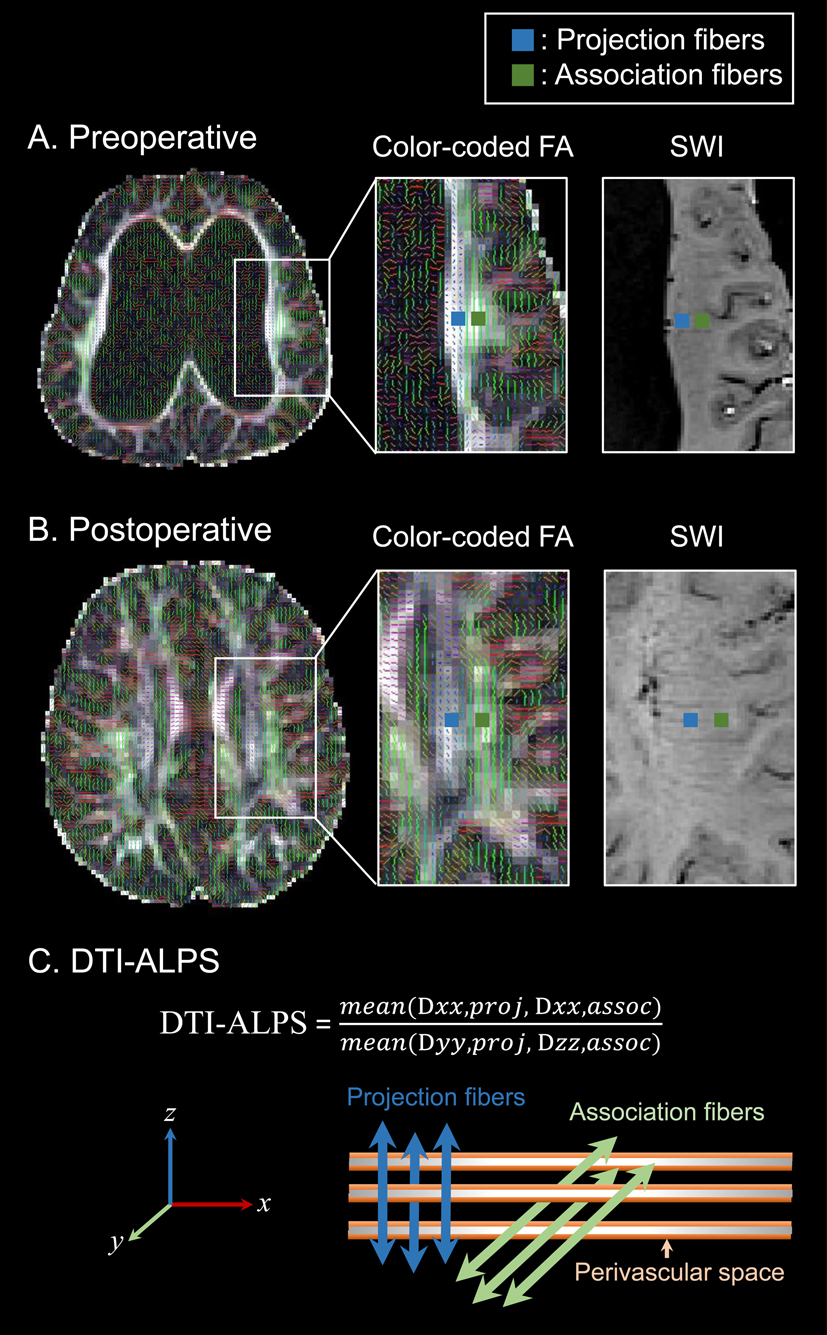
Fifty-five children with hydrocephalus who underwent MRI and ventriculoperitoneal shunt surgery were prospectively enrolled. MRI was performed at 6 months postoperatively in 33 of the 55 children (Fig. 1). A total of 92 controls matched for age and sex were enrolled and divided into preoperative and postoperative control groups. We calculated the DTI-ALPS index (as a proxy for glymphatic function) (Fig. 2), the Evans’ index, and DTI metrics. The ability of various metrics to predict postoperative outcomes was assessed using receiver-operating characteristic curve analysis.Results
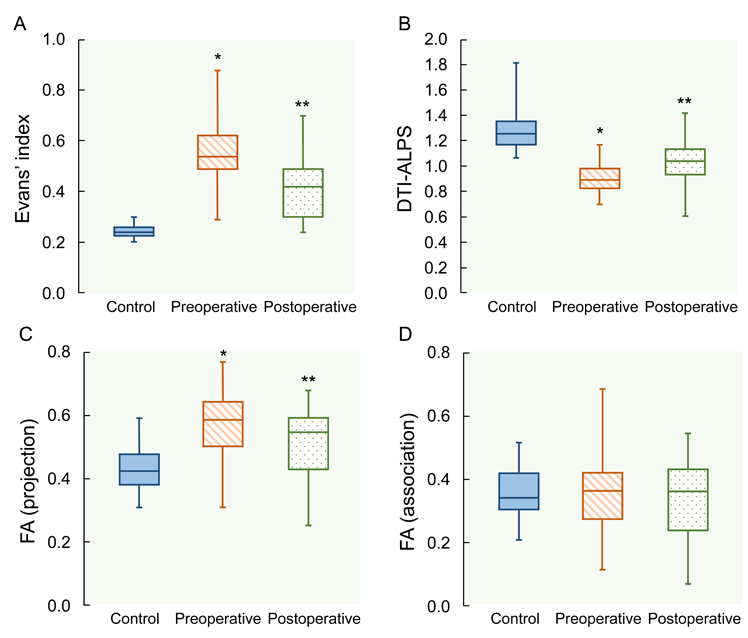
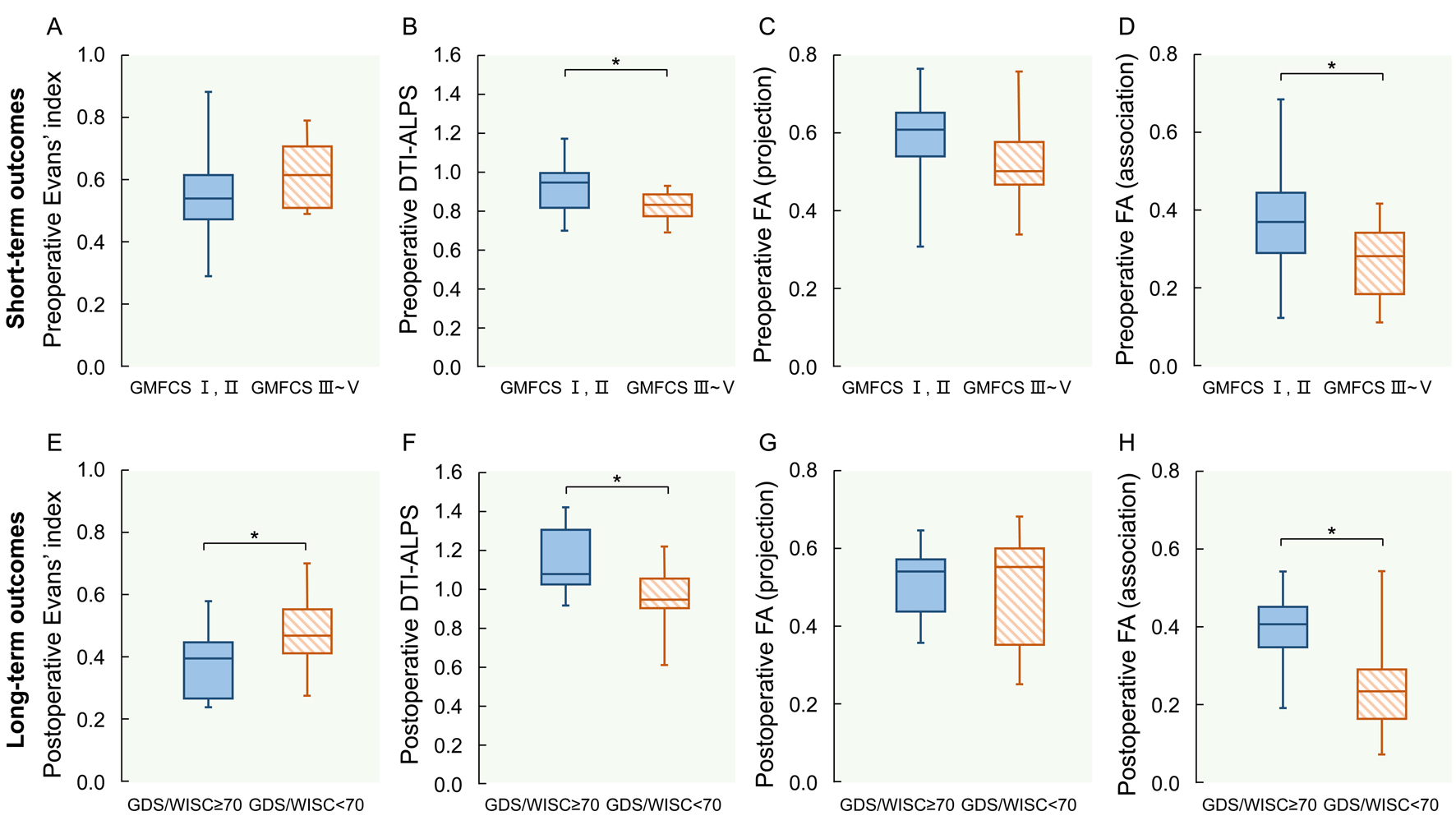
The DTI-ALPS index was significantly lower in patients with hydrocephalus than in controls (P<0.05) (Fig. 3). The abnormal DTI-ALPS index trended towards the normal range after surgery. Patients with a lower preoperative DTI-ALPS index, lower fractional anisotropy (FA), and higher radial diffusivity in association fibres had less favourable short-term motor outcomes (Fig. 4 A-D). Patients with worse long-term cognition outcomes had a lower postoperative DTI-ALPS index, a higher postoperative Evan’s index, and lower FA and higher radial diffusivity in association fibres (Fig. 4 E-H). Predictive performance was better when the DTI-ALPS index and FA in association fibres were used in combination than when either of these parameters was used alone (Fig. 5).Discussion
Our finding that the DTI-ALPS decreased preoperatively and improved after surgery suggests a relationship between hydrocephalus and impaired function of the glymphatic system. Result that DTI-ALPS is improved postoperatively further confirms the effect of hydrocephalus on the glymphatic system. Our results showed that the preoperative DTI-ALPS and FA in association fibres could predict short-term motor outcomes. This indicates that the previous damage to the glymphatic system still has some influences on the short-term motor outcome even after shunting. We found that the postoperative DTI-ALPS and FA in association fibres could predict the long-term cognitive outcomes. The findings suggest that postoperative recovery of glymphatic function is a determinant of neurodevelopment in children with hydrocephalus. Preoperative factors seem to be unimportant in the long-term cognitive outcome because they can be adjusted by shunting. These results indicate that the glymphatic system is involved in the pathophysiology of hydrocephalus.Conclusion
Longitudinal analysis showed signs of recovery of glymphatic function after CSF shunt surgery. The DTI-ALPS index and FA in association fibres are helpful for assessing neuroanatomical changes and developmental outcomes. This would benefit the decision-making of treatment plans.Acknowledgements
This work was supported by the National Natural Science Foundation of China (82272618, 81971581, 82271517) and Shenzhen Fundamental Research Program (JCYJ20180228175428243). Please address correspondence to Jian Yang, e-mail: yj1118@mail.xjtu.edu.cn and Xianjun Li, e-mail: xianj.li@mail.xjtu.edu.cn.References
[1] Rekate HL (2009) A contemporary definition and classification of hydrocephalus. Semin Pediatr Neurol 16:9-15.
[2] MacAulay N, Keep RF, Zeuthen T (2022) Cerebrospinal fluid production by the choroid plexus: a century of barrier research revisited. Fluids Barriers CNS 19:26.
[3] Riva-Cambrin J, Kestle JRW, Holubkov R, et al. Risk factors for shunt malfunction in pediatric hydrocephalus: a multicenter prospective cohort study. J Neurosurg Pediatr 2016;17:382-90.
[4] Vinchon M, Baroncini M, Delestret I (2012) Adult outcome of pediatric hydrocephalus. Childs Nerv Syst 28:847-854.
[5] Infantile and Childhood Hydrocephalus.W. Whitehead and H. Weiner.The New England journal of medicine 2022 Vol. 387 Issue 22 Pages 2067-2073.
[6] Yokota H, Vijayasarathi A, Cekic M et al (2019) Diagnostic performance of glymphatic system evaluation using diffusion tensor imaging in idiopathic normal pressure hydrocephalus and mimickers. Curr Gerontol Geriatr Res 2019:5675014.
[7] Bae YJ, Choi BS, Kim JM, Choi JH, Cho SJ, Kim JH (2021) Altered glymphatic system in idiopathic normal pressure hydrocephalus. Parkinsonism Relat Disord 82:56-60.
[8] Taoka T, Masutani Y, Kawai H et al (2017) Evaluation of glymphatic system activity with the diffusion MR technique: diffusion tensor image analysis along the perivascular space (DTI-ALPS) in Alzheimer's disease cases. Jpn J Radiol 35:172-178.
[9] Chen HL, Chen PC, Lu CH et al (2021) Associations among cognitive functions, plasma DNA, and diffusion tensor image along the perivascular space (DTI-ALPS) in patients with Parkinson's disease. Oxid Med Cell Longev 2021:4034509.
[10] Steward CE, Venkatraman VK, Lui E et al (2021) Assessment of the DTI-ALPS parameter along the perivascular space in older adults at risk of dementia. J Neuroimaging 31:569-578.
[11] Carotenuto A, Cacciaguerra L, Pagani E, Preziosa P, Filippi M, Rocca MA (2021) Glymphatic system impairment in multiple sclerosis: relation with brain damage and disability. Brain. 145(8):2785-2795.
Figures