1152
Automated Sequence Design using Neural Architecture Search: Reliability and Reproducibility1Department of Electrical and Computer Engineering, Seoul National University, Seoul, Korea, Republic of
Synopsis
Keywords: Pulse Sequence Design, Pulse Sequence Design, Machine Learning/Artificial Intelligence
Motivation: An automated sequence design framework utilizing neural architecture search was proposed, and successfully designed optimal sequences for given properties and target objectives without any prior knowledge of MR physics.
Goal(s): We aimed to explore the reliability and reproducibility of this method.
Approach: The reliability of the method was evaluated by adjusting the weights of the desired objectives for sequence design. The reproducibility was tested through multiple runs of the design process.
Results: Our method exhibited reasonable reliability within a certain range of loss weights. Also, it demonstrated reasonable reproducibility in designing SE sequences; however, it exhibited less robustness when designing IR sequences.
Impact: Our previous work, an automated sequence design framework utilizing neural architecture search, is further explored. Our methodology successfully designed sequences with reasonable reliability and reproducibility, despite designing without prior knowledge of MR physics.
Introduction
Developing a sequence requires a deep understanding of MR physics, often constraining design within the bounds of human intuition. However, recent advancements in AI have spurred the development of automated design methods across various fields1-3. In the field of automated sequence design, methods have been introduced for designing sequences tailored to target objects4-6 or optimizing pre-existing sequences6. Our previous work7, an automated sequence design framework utilizing neural architecture search (NAS), successfully designed sequences suitable for desired objectives without any prior knowledge of MR physics. In this work, we aimed to verify the reliability and reproducibility of our framework.Methods
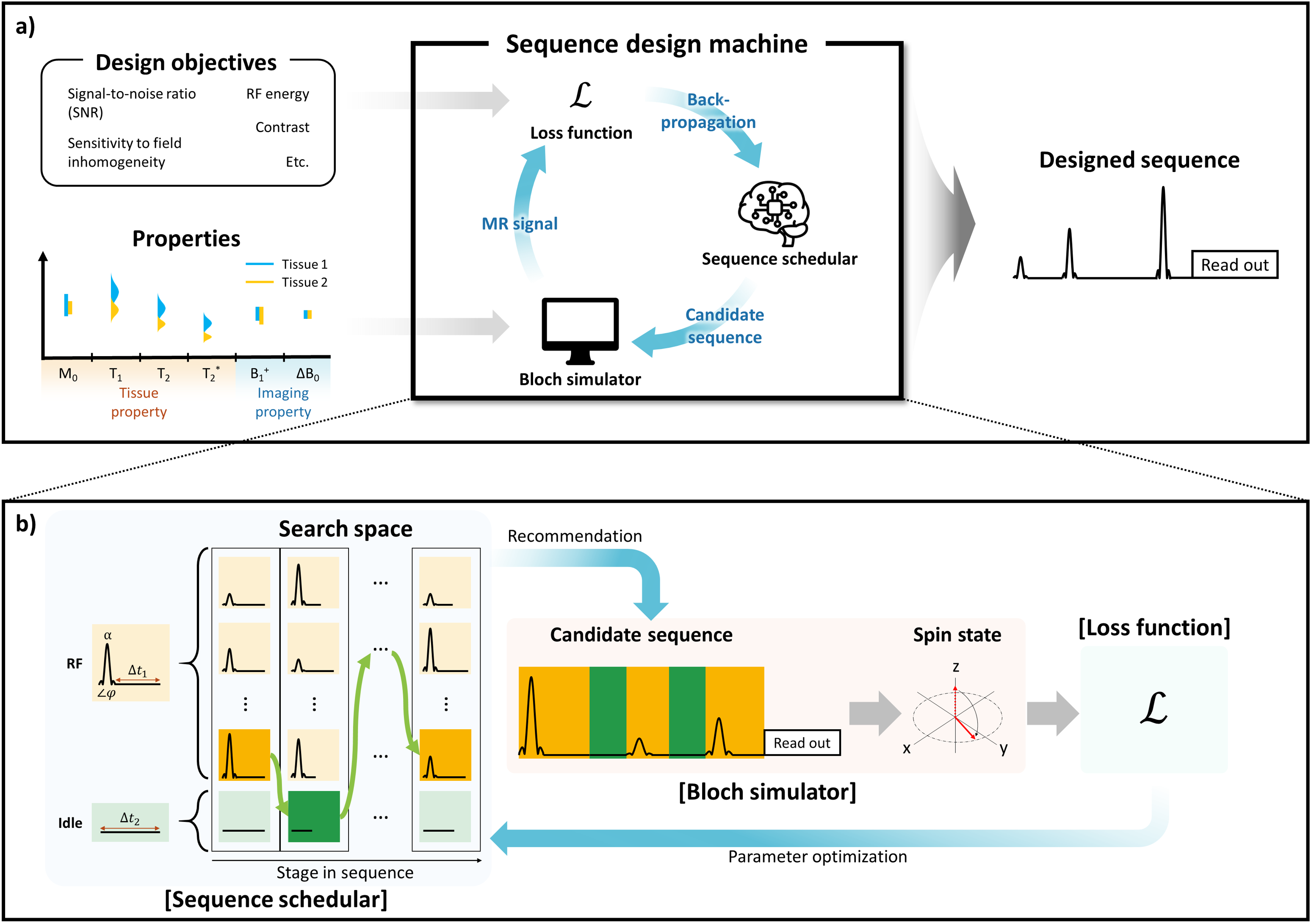
[Sequence design machine] Three components – sequence scheduler, Bloch simulator, and loss function – interact iteratively to design a sequence based on given tissue properties, imaging properties, and desired objectives (Fig. 1). Based on given properties, the Bloch simulator simulates MR signals, which are then used to calculate the loss function defined by the objective for optimization. Then the optimization process determines the sequence design (e.g., flip angle, phase, idle duration) using NAS. ProxylessNAS8 was utilized to optimize the sequence by substituting a neural architecture and its weight parameters with an operation (i.e., RF pulse or idle) and its scan parameters, respectively.[Experiments] To validate the applicability of our framework, three experiments were conducted as follows:
1. Design a sequence to enhance the T2 contrast between WM and GM.
2. Design an IR sequence aimed at nullifying the signal from CSF while maximizing signals from WM and GM.
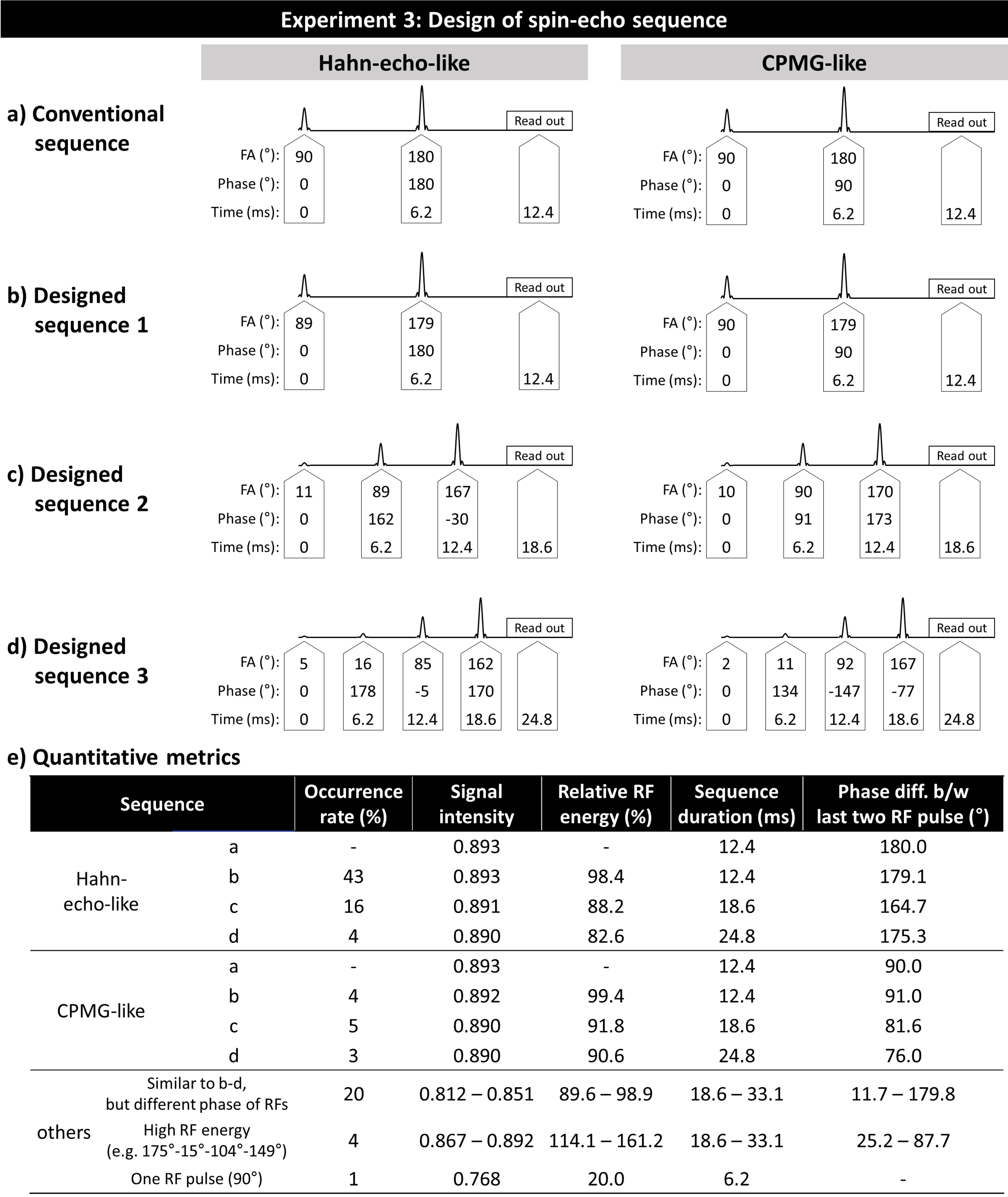
3. Design a SE sequence but with a lower SAR.
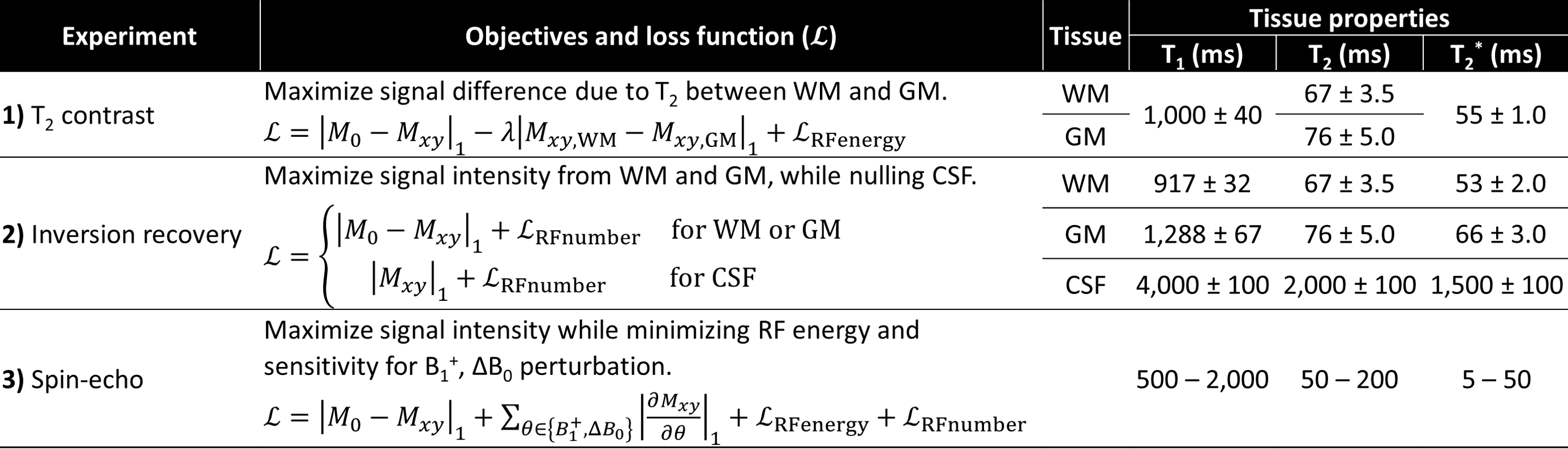
We set the tissue properties, imaging properties, and target objectives as a loss function, which are detailed in Fig. 2. During the experiments, various sequences were developed via repetition, with those termed "successful sequences" being the ones that exhibited deviation less than 5% from the minimum loss value.
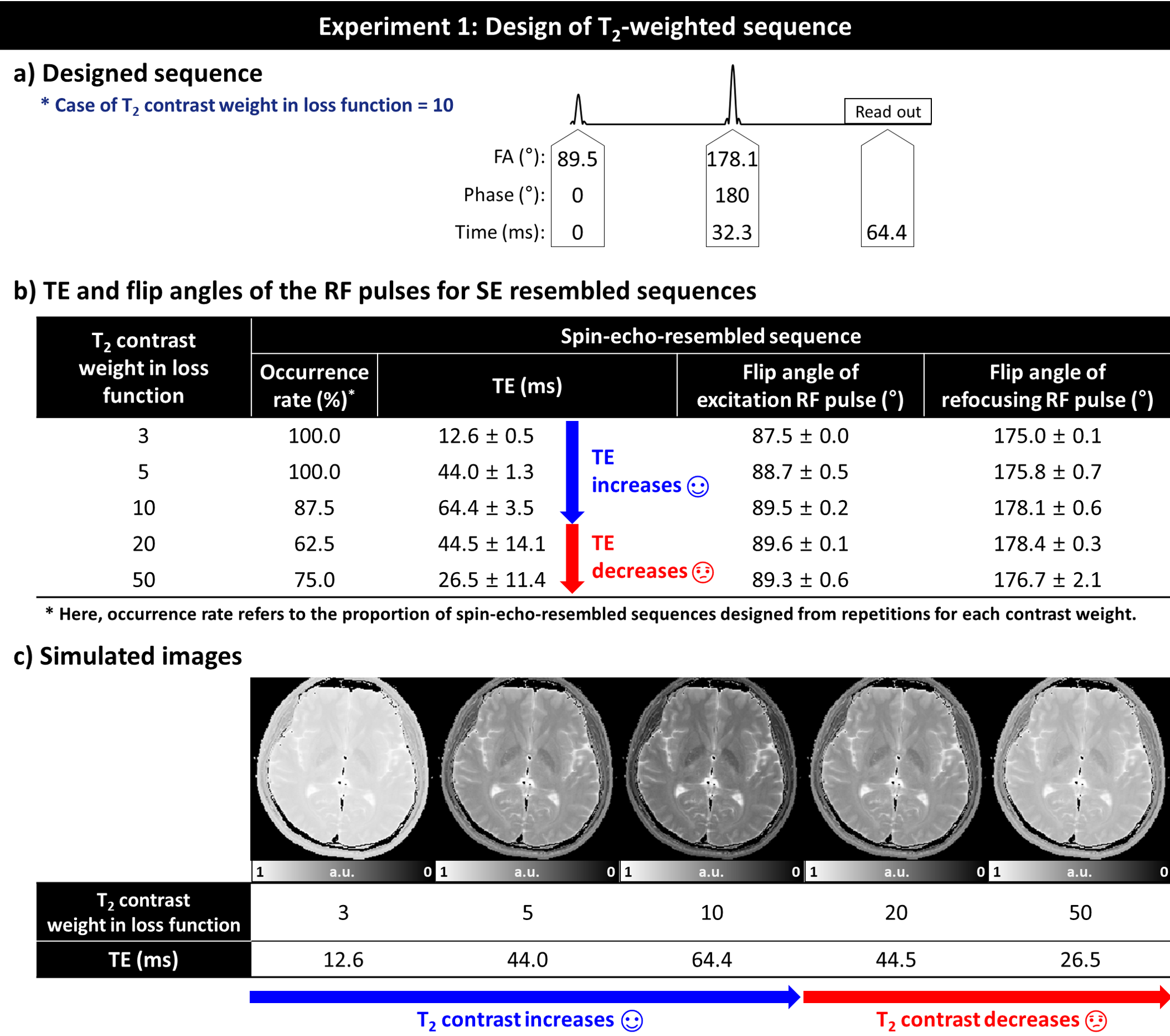
[Reliability study] To evaluate the reliability of our method, in Experiment 1, T2-weighted sequences were designed with different weights of contrast loss term. The maximum number of RFs was constrained to two.
[Reproducibility study] To examine the reproducibility of our method, we performed 100 repetitions of designs in Experiments 2 and 3. The designed sequences were benchmarked against conventional ones (180°-90° IR for Experiment 2; Hahn-echo and Carr-Purcell-Meiboom-Gill (CPMG) for Experiment 3). The maximum number of RFs in a sequence was limited to five.
Results
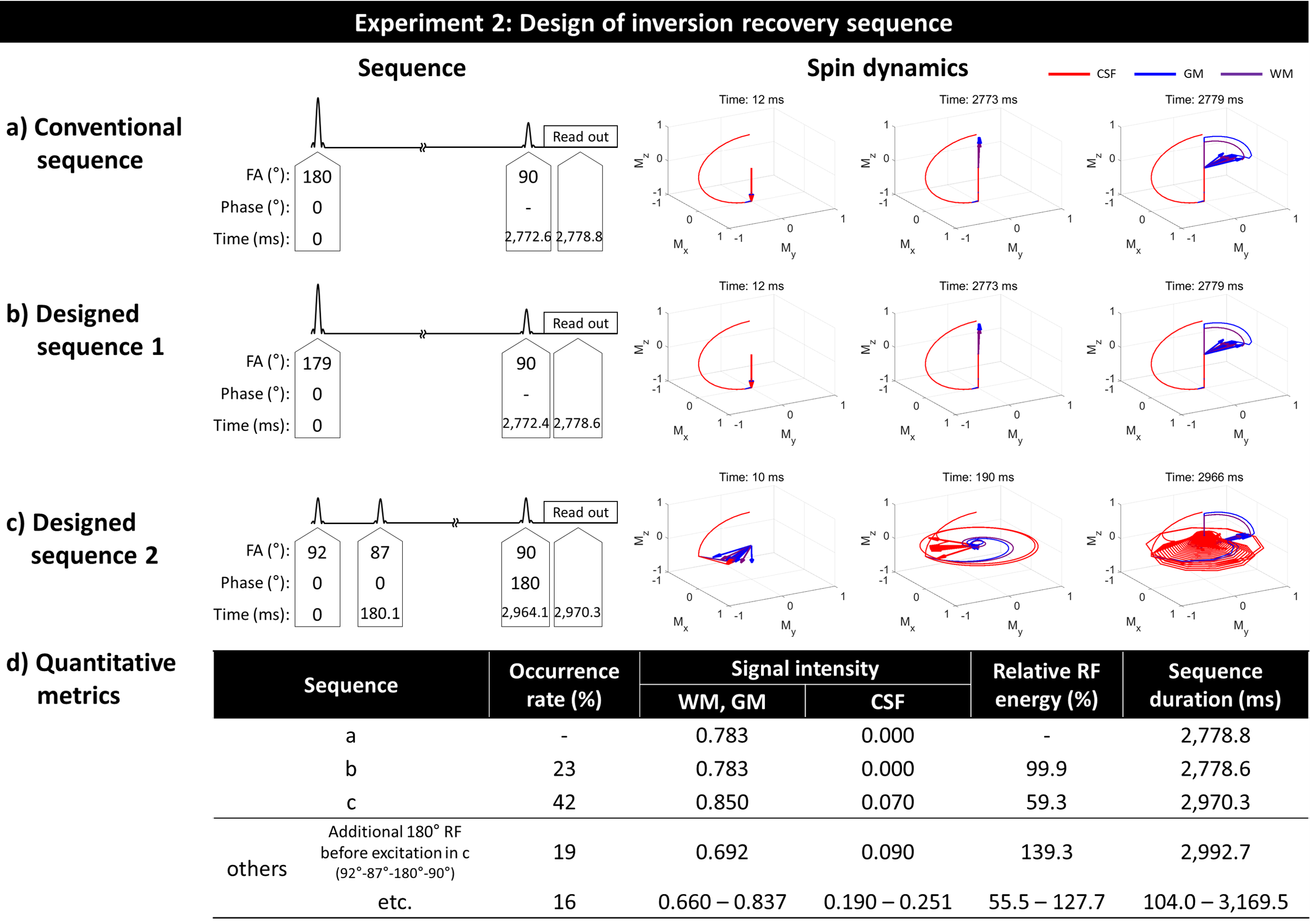
The results of Experiment 1 are shown in Fig. 3. The designed sequences mainly resembled a SE sequence. As the T2 contrast weight increased from 3 to 10, the contrast increased as expected, facilitated by longer TEs. Yet, when the weight further increased, the contrast no longer increased, demonstrating the sensitivity of the weight setting.In Experiment 2, the designed sequences demonstrated a 65% success rate (Fig. 4). Two main outcomes were produced: one was a sequence that matched the conventional IR sequence, and the other was a 92°-87°-90° sequence. 92°-87°-90° sequence used less RF energy (59.3%) and yielded a higher signal intensity for WM and GM (0.850 vs. 0.783 M0) compared to the conventional sequence. However, it had a residual CSF signal (0.070 M0) and exhibited a longer sequence time (2.97 vs. 2.78 sec). Other various sequences including 92°-87°-180°-90° were also designed.
In Experiment 3, our method showed reasonable robustness (75% success), and generated various results: a Hahn-echo-like sequence, a CPMG-like sequence, and other less-intuitive sequences comprised of three or four RFs (Fig. 5). Refocusing characteristics showed that 63% of sequences were similar to Hahn-echo, while 12% showed patterns like CPMG. The less-intuitive sequences demonstrated lower RF energy compared to the conventional sequence (see Fig. 5e), at the cost of a longer sequence duration. Additionally, 25% of other sequences (with unsuitable refocusing phases, requiring high RF energy, composed of a single 90° RF pulse) were designed.
Discussion and Conclusion
Our method demonstrated effectiveness within a specific range of loss weights. Conversely, the decrease in convergence and failure to achieve desired objectives were observed when loss weights increased beyond a certain threshold. It underscores the significance of proper loss design to reach desired objectives. Additionally, our method showed reasonable reproducibility across repetitions, yet the robustness varied depending on the sequence design target. Notably, our method created non-intuitive sequences beyond conventional sequences. This finding proposes the potential for uncovering new possibilities that surpass human intuition in the realm of automated sequence design.Acknowledgements
This work was supported by the National Research Foundation of Korea (NRF) grant funded by the Korea government (MSIT) (No. NRF-2022R1A4A1030579), Brain Korea 21 Plus Project in 2023, and Institute of New Media and Communications (INMC) at Seoul National University.References
- D. Shin, Y. Kim, C. Oh, H. An, J. Park, J. Kim, and J. Lee, “Deep reinforcement learning-designed radiofrequency waveform in MRI,” Nat. Mach. Intell., vol. 3, no. 11, pp. 985–994, Nov. 2021.
- A. Mirhoseini, A. Goldie, M. Yazgan, J. W. Jiang, E. Songhori, S. Wang, Y.-J. Lee, E. Johnson, O. Pathak, A. Nazi, J. Pak, A. Tong, K. Srinivasa, W. Hang, E. Tuncer, Q. V. Le, J. Laudon, R. Ho, R. Carpenter, and J. Dean, “A graph placement methodology for fast chip design,” Nature, vol. 594, no. 7862, pp. 207–212, 2021.
- Y. Wang, H. Tang, L. Huang, L. Pan, L. Yang, H. Yang, F. Mu, and M. Yang, “Self-play reinforcement learning guides protein engineering,” Nat. Mach. Intell., vol. 5, no. 8, pp. 845–860, 2023.
- S. Walker-Samuel, “Using deep reinforcement learning to actively, adaptively and autonomously control a simulated MRI scanner,” in Proceedings of the ISMRM 27th Annual Meeting & Exhibition, 2019.
- B. Zhu, J. Liu, N. Koonjoo, B. R. Rosen, and M. S. Rosen, “AUTOmated pulse SEQuence generation (AUTOSEQ) using Bayesian reinforcement learning in an MRI physics simulation environment,” in Proceedings of the Joint Annual Meeting ISMRM-ESMRMB, 2018.
- A. Loktyushin, K. Herz, N. Dang, F. Glang, A. Deshmane, S. Weinmüller, A. Doerfler, B. Schölkopf, K. Scheffler, and M. Zaiss, “MRzero ‐ Automated discovery of MRI sequences using supervised learning,” Magn. Reson. Med., vol. 86, no. 2, pp. 709–724, 2021.
- H. An, S. Ji, D. Shin, S. Oh, J. Kim, and J. Lee, “Automated sequence design using neural architecture search,” in Proceedings of the Joint Annual Meeting ISMRM-ESMRMB 2022 & ISMRT Annual Meeting, 2022.
- H. Cai, L. Zhu, and S. Han, “ProxylessNAS: Direct Neural Architecture Search on Target Task and Hardware,” in 7th International Conference on Learning Representations, 2019, pp. 1–13.
Figures