1151
Motion-insensitive heavily T2-weighted phase-based imaging using readout alternation technique1Department of Radiology, University of Wisconsin-Madison, Madison, WI, United States, 2Department of Medical Physics, University of Wisconsin-Madison, Madison, WI, United States, 3Department of Biomedical Engineering, University of Wisconsin-Madison, Madison, WI, United States, 4Department of Medicine, University of Wisconsin-Madison, Madison, WI, United States, 5Department of Emergency, University of Wisconsin-Madison, Madison, WI, United States
Synopsis
Keywords: Pulse Sequence Design, Motion Correction
Motivation: Heavily T2-weighted (T2W) imaging plays a central role in many fluid-sensitive applications. Drawbacks of T2W conventional methods include relatively long acquisition times and motion sensitivity.
Goal(s): The goal of this study is to evaluate the feasibility of a novel approach using Heavily T2weighted Phase-Based (HT2WPB) imaging with readout alternation (ROA) to achieve motion-insensitive imaging.
Approach: Phantom and in vivo experiments where used to demonstrate the feasibility of heavily T2W using HT2WPB with ROA.
Results: Results from this work showed that PBT2W with ROA enabled heavily T2-weighted contrast for improved visibility of fluid containing anatomical structures with reduced motion sensitivity.
Impact: The use of heavily T2-weighted phase-based imaging with ROA in MR imaging is a promising method to improve visibility of fluid-containing anatomical structures. This technique has the potential to enhance diagnostic accuracy for the evaluation of various pathologies.
Introduction
Heavily T2-weighted imaging plays a pivotal role in fluid-sensitive applications, including magnetic resonance cholangiopancreatography (MRCP)1 and cerebrospinal fluid (CSF) imaging2. Traditionally, these applications utilize 2D and 3D fast spin-echo (FSE)-based strategies3. However, a drawback of these methods is their long acquisition time and sensitivity to motion. This can limit their effectiveness and efficiency in the clinical setting.Recently, a phase-based heavily T2-weighted (HT2WPB) imaging using RF phase-modulated gradient echo (GRE) method has been proposed4. Although it achieves fast 3D acquisition, image degradation due to physiological motion remains a persistent issue.
In this study, we propose a HT2WPB method using a novel readout alternation (ROA) technique to achieve fast, motion-insensitive heavily T2-weighted imaging.
Theory
RF phase-modulated GREHT2WPB is achieved by utilizing a phase-based imaging approach5, which enables the encoding of T2 information into the signal phase of the GRE image. The acquisition of the GRE is executed with a quadratically incremented RF phase (θ). The use of a small θ less than 1° has been demonstrated to effectively encode long T2 species to signal phase4. As shown in Figure 1a, T2-weighted images (S') can be derived from two GRE images (S±) that are acquired using opposite RF phase increments (±θ) and described with the following equations6:
$$S'=Re(e^{jψ}∙S_++e^{-jψ}∙S_-),$$
where ψ is a constant phase modulation that can be used to control T2-weighted contrast. Figure 1b shows signal response of S’ with variable phase modulation as a function of T1 and T2 with TR=6ms, FA=25°, and θ=0.5°. Phase modulation of ~12-24° facilitates heavily T2-weighted contrast while higher phase shifts lead to more heavily T1-weighted contrast.
Readout alternation technique for motion-insensitive imaging
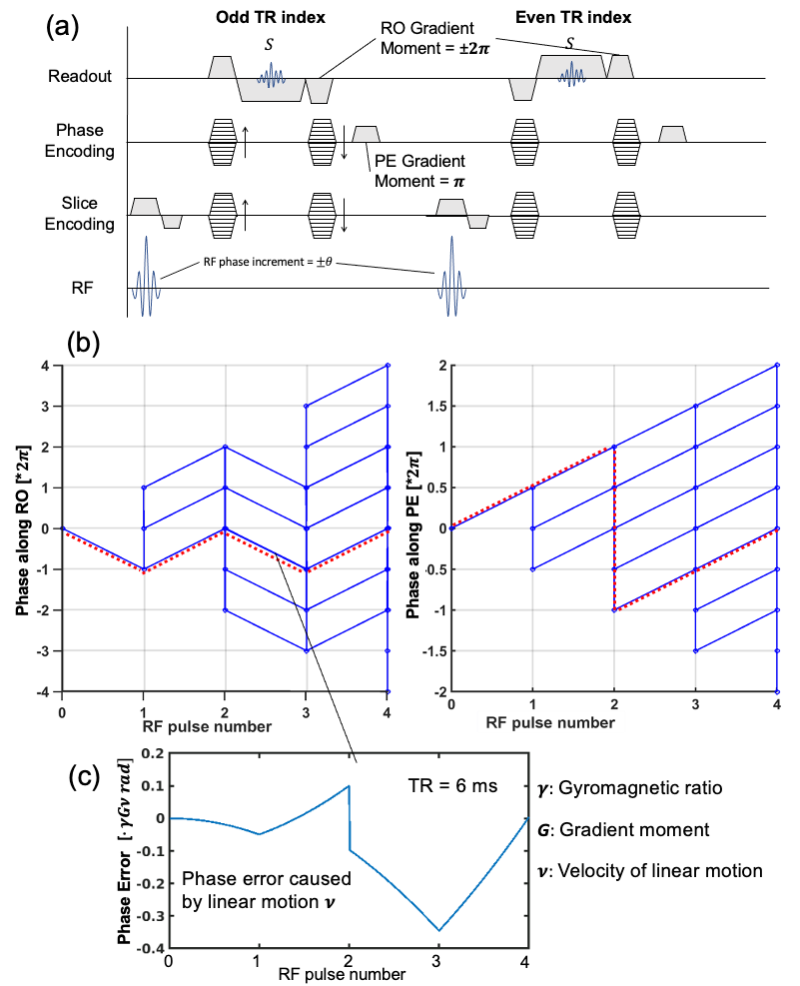
To achieve motion-insensitive imaging, we use a recently described ROA approach7. ROA involves inverting the polarity of gradient pulses in the readout axis in every TR (Figure 2a). The motion-insensitivity of ROA can be attributed to its ability to cancel phase errors caused by linear motion. An example of a phase graph along the readout and phase-encoding directions of GRE with ROA is shown in Figure 2b. To simplify our explanation, four consecutive RF excitations with a phase increment of 0° were assumed. The plot indicates ROA provides complicated pathways where only a few pathways rephase and create coherent echoes, while the remainder of the signal dephases. Phase errors that occur within a major pathway (red dot line) due to linear motion are effectively nullified (Figure 2c).
Methods
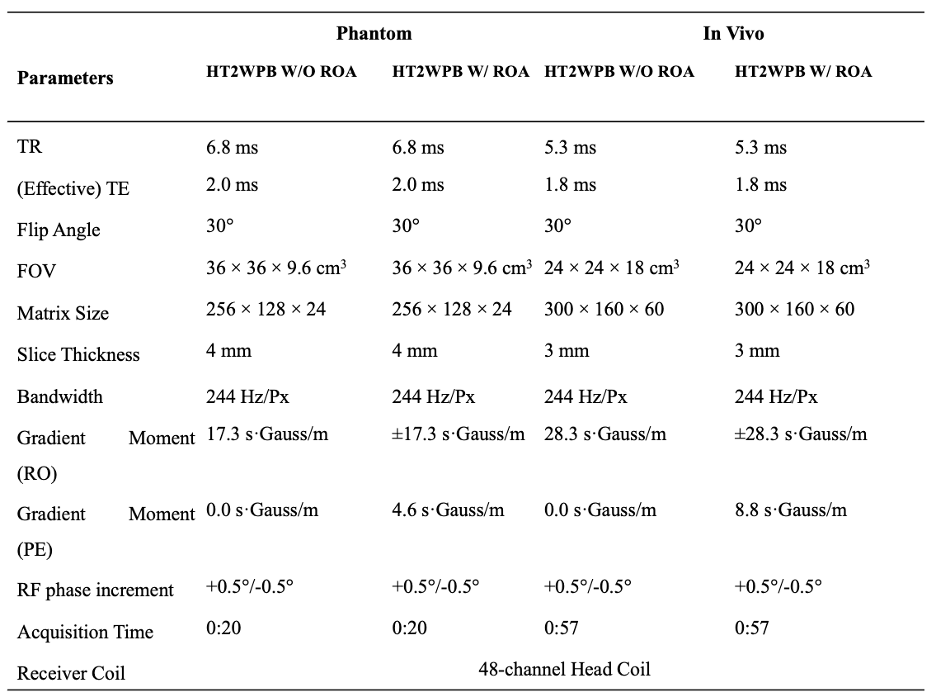
This study performed phantom and in vivo experiments to demonstrate the feasibility of the HT2WPB with ROA. The parameters used in the experiments are listed in Table 1. Flip angle and RF phase increment were determined based on the previous study4. Image acquisition was performed on a clinical 3.0T MRI system (Signa Premier, GE Healthcare, Waukesha, WI, USA).Phantom Experiments
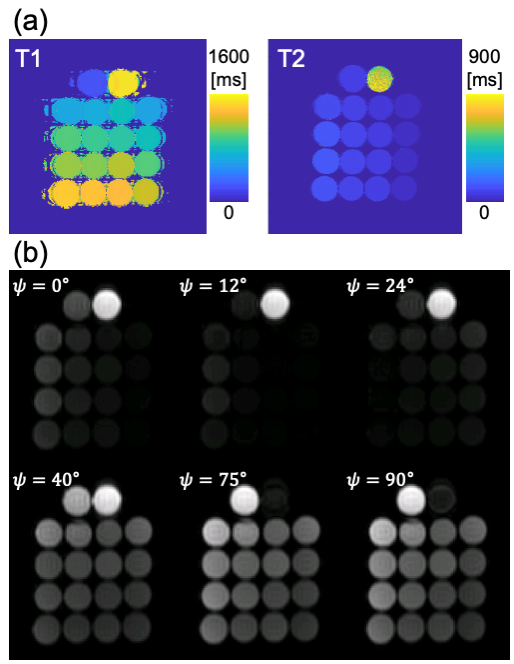
MR images of a phantom (Figure 3a) consisting of 18 vials that have different T1 (280-1550ms) and T2 (43-832ms) values were acquired using HT2WPB with ROA. T2-weighted images were generated using equation 1 with phase modulations of 0-90° to optimize image contrast.
In vivo
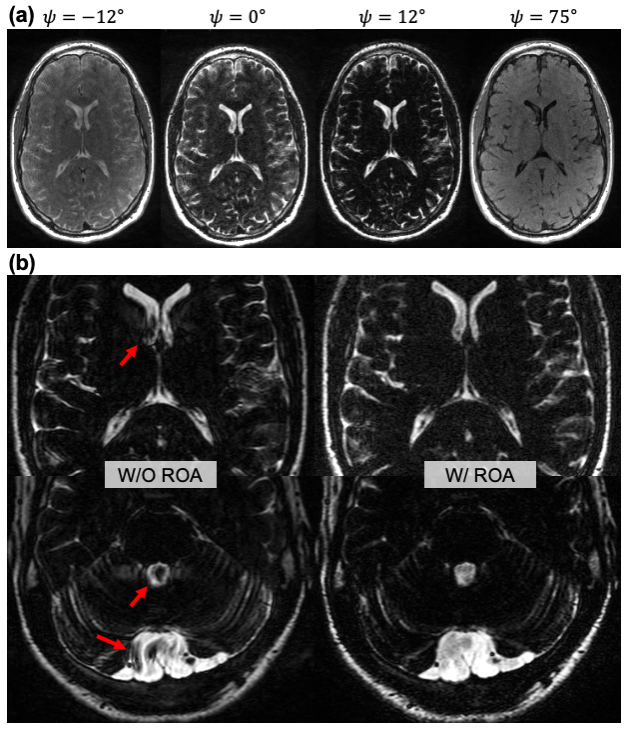
To demonstrate the clinical feasibility of the proposed method, the brain of a healthy volunteer was imaged using HT2WPB with and without ROA. A phase modulation of 12° was used, based on the phantom experiment.
Results
Phantom images acquired using the HT2WPB with ROA indicated that a phase modulation of 12° effectively maximized the contrast between the highest and lowest T2 vials , as shown in Figure 3b. On the other hand, as phase modulation increases, image contrast becomes more T1-weighted.As shown in Figure 4a, a phase modulation of 12° effectively provides heavily T2-weighted contrast. In the images obtained without using ROA, there are noticeable flow artifacts within the ventricles and retrocerebellar subarachnoid space, as indicated by the red arrows. However, these artifacts were substantially mitigated by using ROA although there was a slight decrease in SNR compared to HT2WPB without ROA.
Discussion
In this study, we demonstrated the feasibility of HT2WPB with ROA in both phantom and in vivo experiments. The results showed that ROA enables motion-robust heavily T2-weighted imaging.Using phase modulation in combination with HT2WPB and ROA enables heavily T2-weighted contrast, whereas altering the phase modulation yields a corresponding change in image contrast retrospectively. This indicates that the proposed method can be customized to achieve desired image contrast for specific application needs.
In conclusion, the use of HT2WPB with ROA in MRI imaging has shown the feasibility of achieving heavily T2-weighted contrast and improving motion-induced artifacts. Additional work is needed to validate and optimize the proposed method for clinical use.
Acknowledgements
Dr. Reeder is the John. H Juhl Endowed Chair of Radiology.References
1. Griffin N, Charles-Edwards G, Grant LA. Magnetic resonance cholangiopancreatography: the ABC of MRCP. Insights Imaging 2012;3(1):11-21.
2. Zur Y, Wood M, Neuringer L. Motion‐insensitive, steady‐state free precession imaging. Magnetic resonance in medicine 1990;16(3):444-459.
3. Coates GG, Borrello JA, McFarland EG, Mirowitz SA, Brown JJ. Hepatic T2‐weighted MRI: A prospective comparison of sequences, including breath‐hold, half‐Fourier turbo spin echo (HASTE). Journal of Magnetic Resonance Imaging 1998;8(3):642-649.
4. Kargar S, Tamada D, Navaratna R, Weaver JM, Reeder SB. Heavily T2-weighted Imaging with Phase-Based RF Modulated GRE Imaging. 2021 15-20, May, 2021. p 0241.
5. Wang X, Hernando D, Reeder SB. Phase‐based T2 mapping with gradient echo imaging. Magnetic Resonance in Medicine 2019.
6. Tamada D, Field AS, Reeder SB. Simultaneous T1- and T2-Weighted 3D MRI Using RF Phase-Modulated Gradient Echo Imaging. Magnetic Resonance in Medicine 2021;Accepted on October 25, 2021.
7.Tamada D, Reeder SB. Motion insensitive dual-echo steady-state T2-weighted imaging for the liver using alternating readout gradients. 2022 May 12, 2022; London, UK. p 0758.
Figures
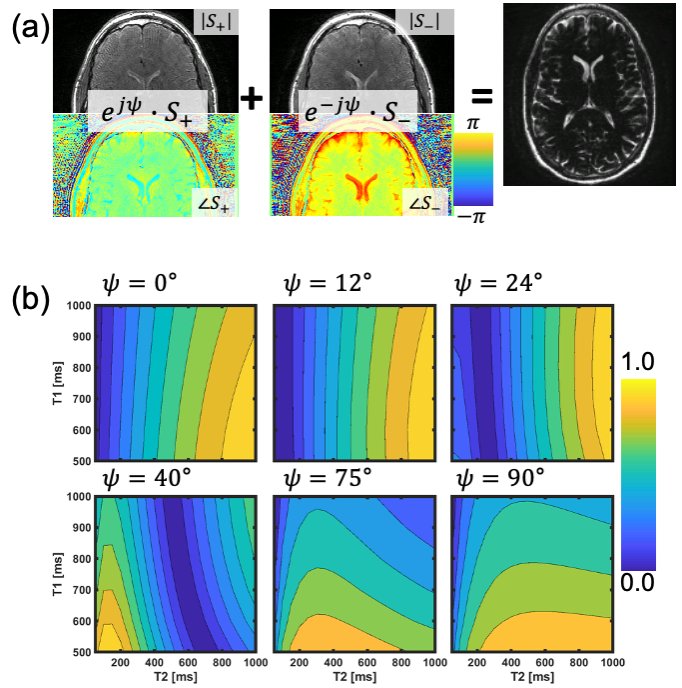
Figure 1: Heavily T2W contrast can be achieved by using phase-based imaging approach. (a) T2W images can be derived from two GRE images acquired using opposite RF phase increments (θ). (b) The signal response of the real part of GRE imaging with a variable phase modulation, as a function of T1 (500-1000 ms) and T2 (50-1000 ms). The parameters used for this plot include TR = 6ms, FA = 25, and θ = ±0.5°. The signal intensity is normalized by its maximum value. By using phase modulation, heavily T2-weighted contrast can be achieved with small ψ and more pronounced T1-weighted contrast with larger ψ.