1149
pTx Pulseq in hybrid sequences Universal Pulses, made Truly Universal1Department of Radiology, High Field MRI group, University Medical Center Utrecht, Utrecht, Netherlands
Synopsis
Keywords: Pulse Sequence Design, Parallel Transmit & Multiband
Motivation: Advancing MRI sequence development by integrating parallel transmit capabilities with the open-source and widely-used Pulseq framework.
Goal(s): To integrate pTx capabilities into the Pulseq framework, facilitating the design of universal pTx pulses that enhance imaging homogeneity and quality.
Approach: Development of 'pTx-Pulseq' as a backwards-compatible extension, validated through single-channel control and complex sequence operation, culminating in a hybrid sequence that enhances a native MP-RAGE with Pulseq flexibility.
Results: Effective control of pTx channels using pTx-Pulseq, yielding uniform imaging results and demonstrating the potential of hybrid sequencing for improved MRI applications.
Impact: 'pTx-Pulseq' empowers researchers to universally and easily harness pTx technology, allowing for the creation of truly universally pTx pulses that reduce the burden of B1+ inhomogeneity and elevate the quality of high-field MRI.
Introduction
At high field strengths, parallel transmit systems (pTx) with multiple independent transmit channels can alleviate the inhomogeneous B1+ and the resulting undesired contrast and SNR variations1-5. pTx can be used for shimming - or for pTx pulses. Tailored pTx pulses, such as kT-points, can create homogenous flip angles but take time to compute. Universal pTx pulses, optimized over a group, can speed up the workflow and are transferable between different sites, however, thus far not between different MR scanner platforms4,5.Open-source frameworks like Pulseq enable hardware- and software-independent sequence development in MATLAB or Python6-11. However, Pulseq does not support pTx in the current specification. Recent work proposed a modification of the Pulseq specification to allow for RF shimming, but that does not work for universal pulses12.
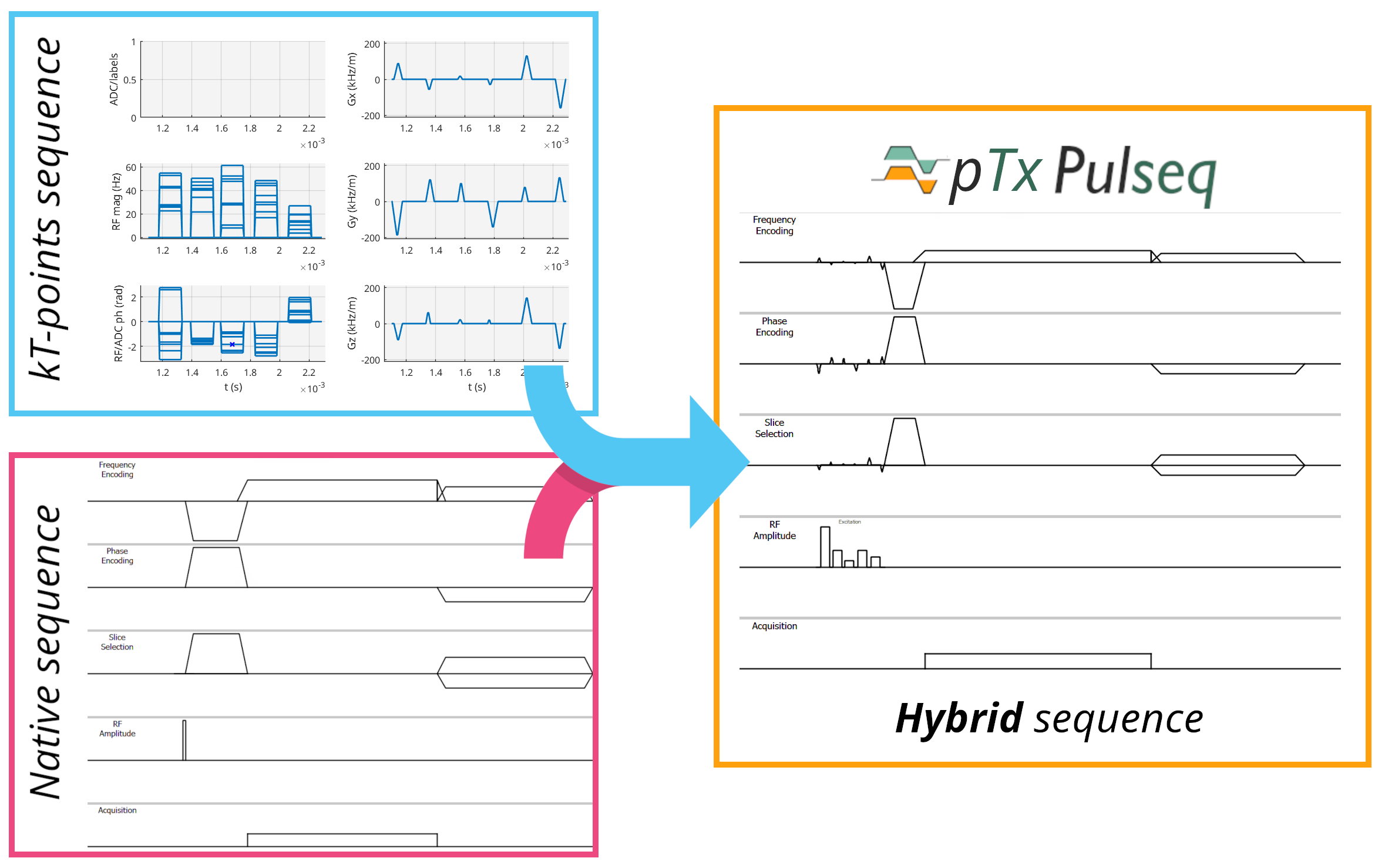
This work introduces ‘pTx-Pulseq’, an extension of the specification, allowing pTx in a manner that does not break the specification or current interpreters. Since it is useful to use optimized native sequences and only share pTx pulses or contrast sequence modules, we also introduce hybrid sequences, in which part of the native sequence is replaced by Pulseq.
Methods
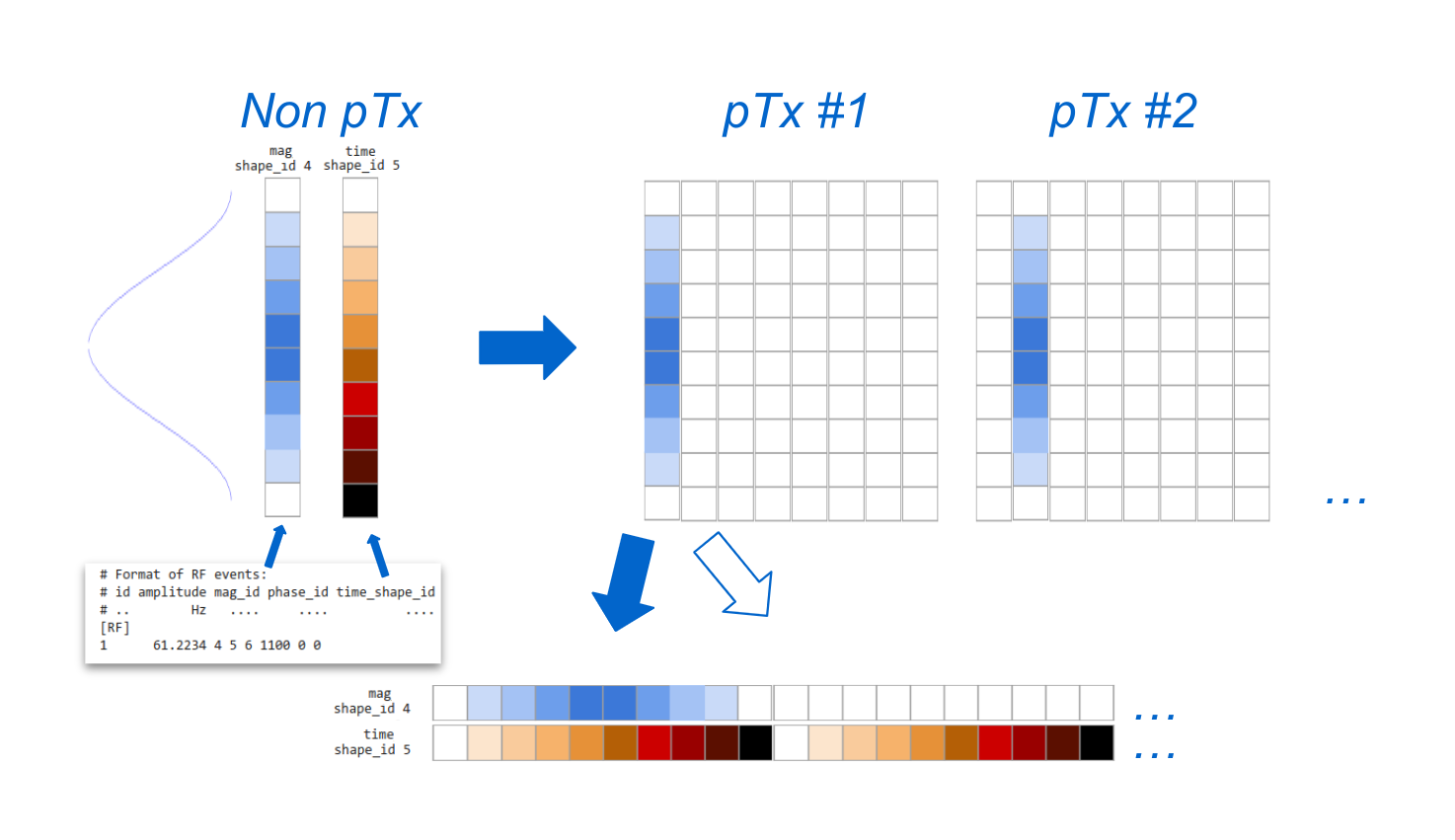
pTx Pulseq formatPulseq RF events support one shape for magnitude, phase, and time. The latter is normally used to efficiently store pulses, but can also be used to repeat time points. By repeating the entire time range for the amount of Tx channels, the magnitude and phase shapes can store all channels consecutively, as depicted in figure 1.
Validation
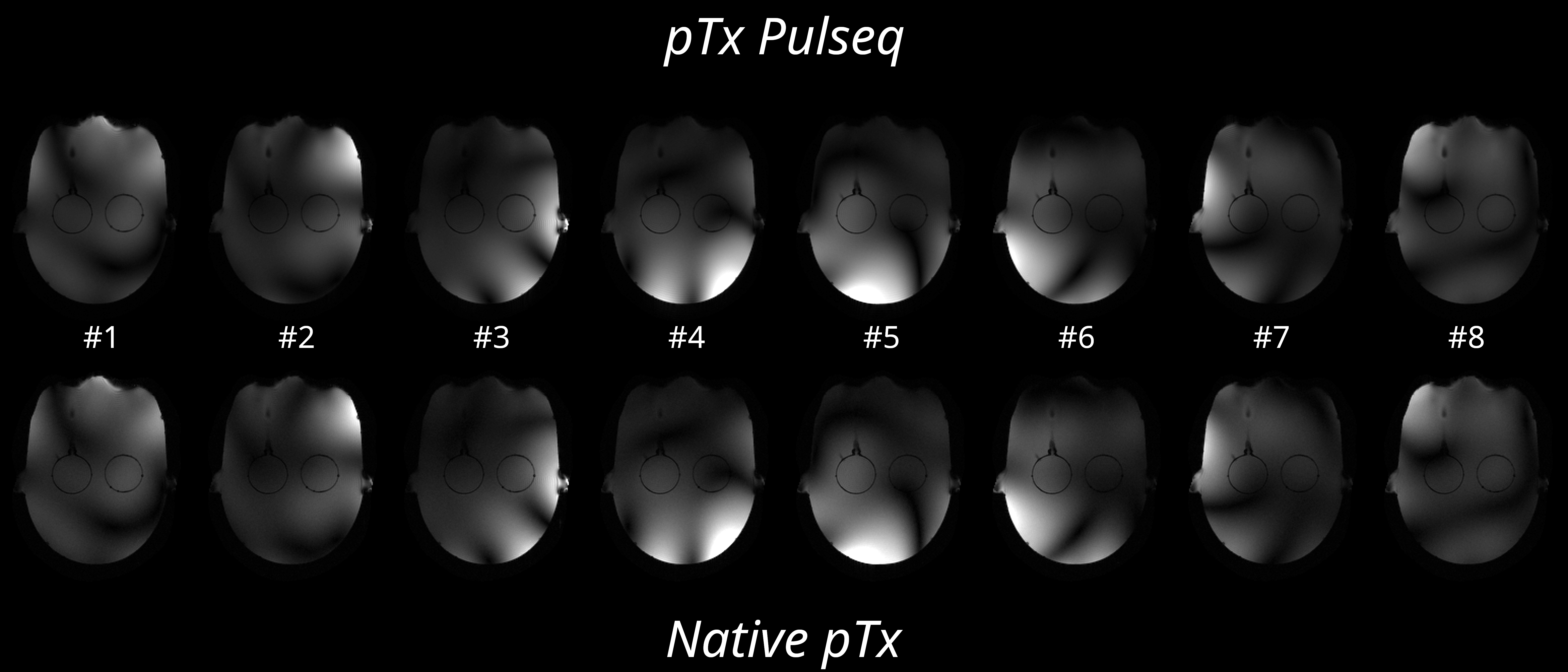
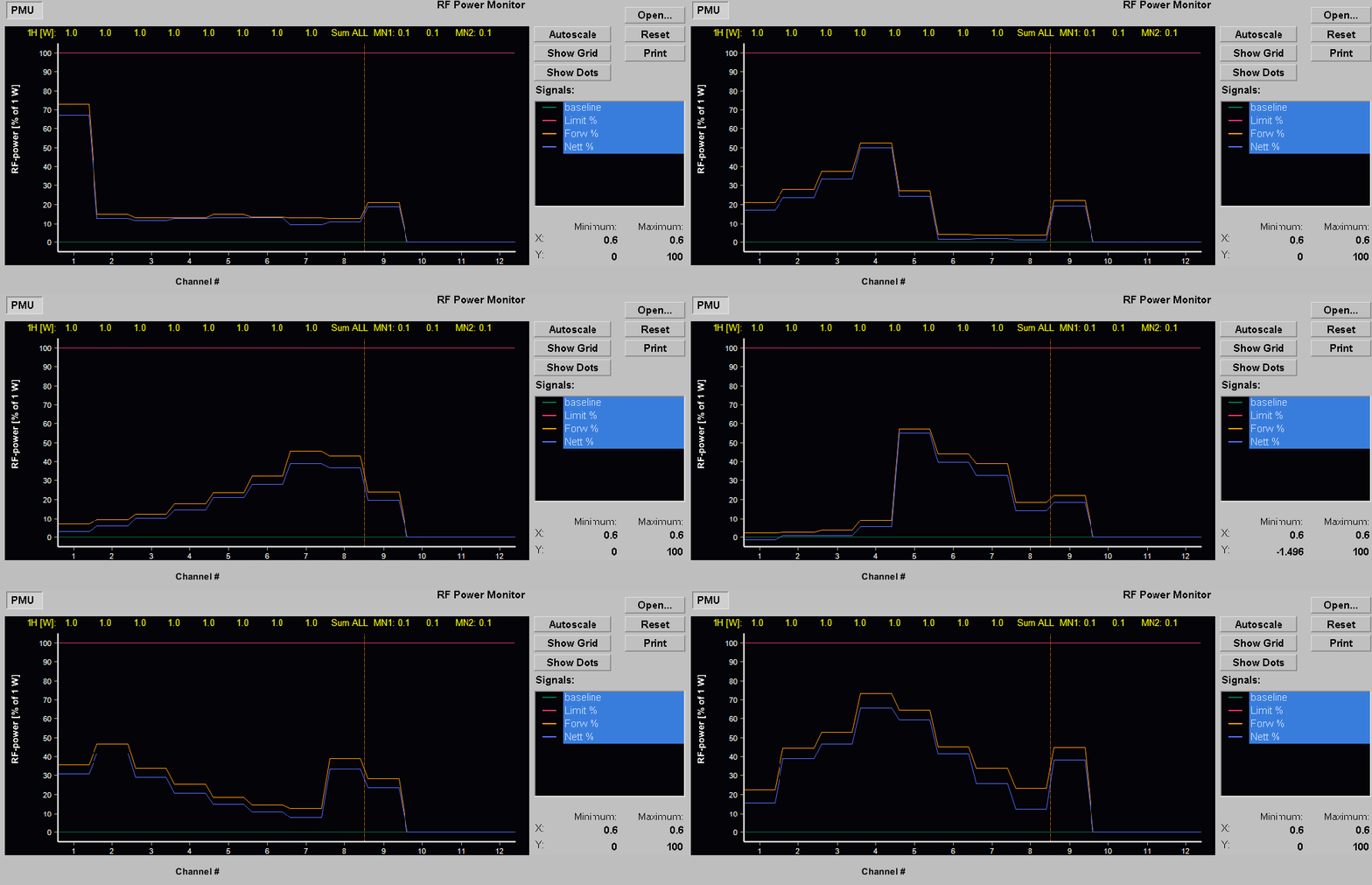
To validate control over all channels, a 2D GRE with 8 slices, each with only single Tx-channel active, were acquired using Pulseq and native pTx functionality13. Additionally, the Pulseq sequence was extended with more slices that employ two channels simultaneously, to visualize pTx control and validate power monitoring.
Hybrid scan
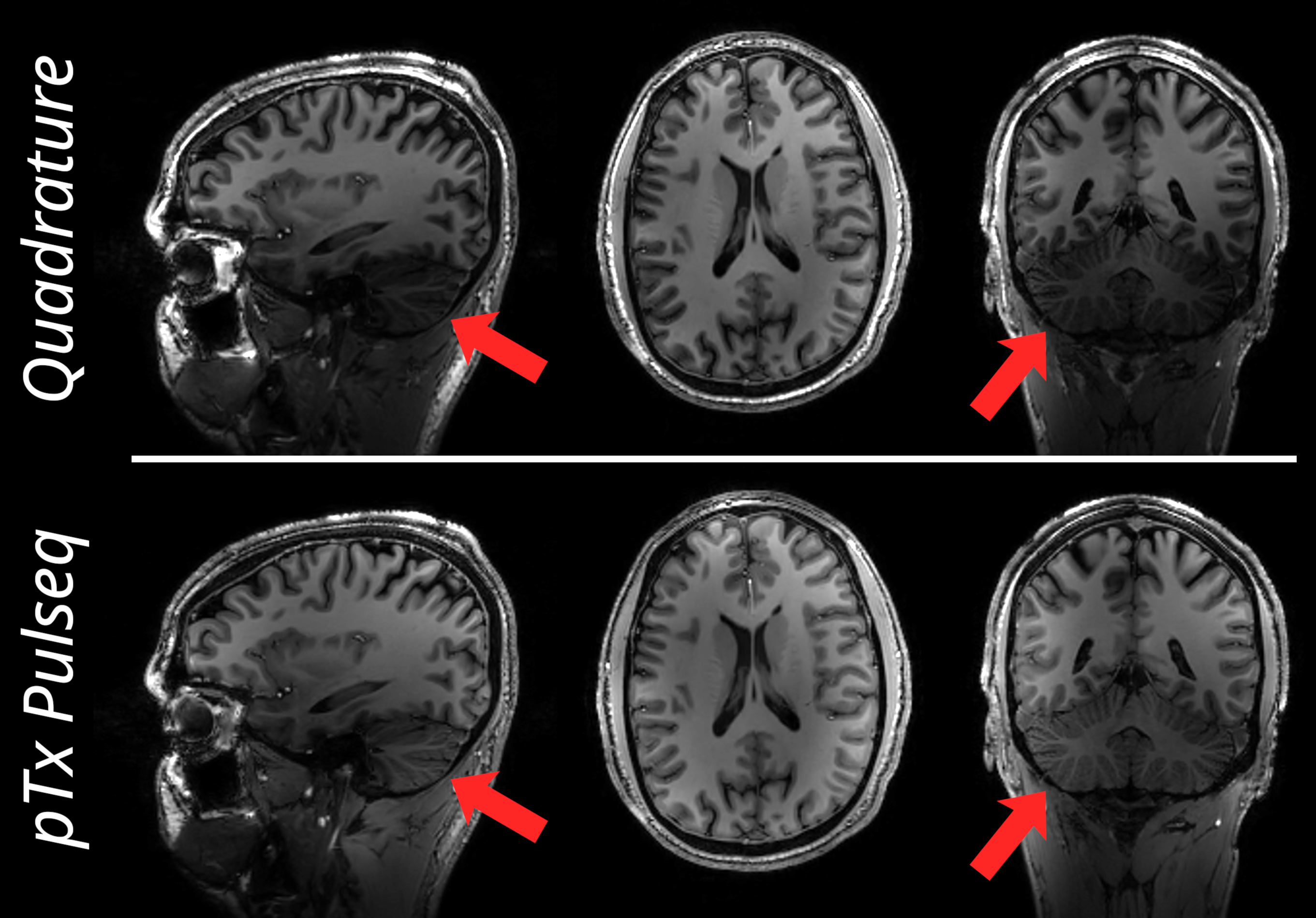
A tailored kT-points pulse was computed for a volunteer, from a B0 map and a 12-mode Phase Encoded DREAM B1+ map, using the interleaved greedy-local algorithm3,14. This pTx-Pulseq pulse was then used to enhance a native MP-RAGE, by using our Pulseq interpreter for Philips in the hybrid mode. This mode removes the vendor's native excitation and replaces it with a pTx-Pulseq sequence. A schematic representation of this hybrid sequence is shown in Figure 4.
The 3D MP-RAGE was acquired using a 7T Achieva MRI (Philips, The Netherlands) with a 8Tx40Rx head coil (Nova Medical, USA) and has a FOV of 256x240x192mm3 at 1mm3 (with TE/TR/α/BW=3.3ms/9ms/6°/250Hz/px and R=4 using CS).
Results
Figure 3 shows single transmit-channel 2D GRE scans acquired with both a pTx-Pulseq sequence and with a native implementation. The spatially identical B1+ patterns indicate that pTx-Pulseq correctly controls all channels individuallyThe animation in Figure 4 shows the real-time RF-power monitoring during a scan with a more complicated pTx sequence. This highlights the dynamic pTx control that is enabled by pTx-Pulseq
In Figure 5, the effect of replacing the non-selective excitation of a native MP-RAGE scan with a kT-points pulse, using our Pulseq interpreter in hybrid mode is shown. The pTx pulse improved the overall homogeneity of the image, while not impacting the rest of the scan.
Discussion
We implemented an extension to the Pulseq framework that enables dynamic control of separate pTx-channels, which allows for both Pulseq-based RF-shimming and universal/tailored RF-pulses.While we used pTx-Pulseq with a single-subject tailored kT-points pulse, instead of a universal pulse, the demonstrated technique is similarly applicable to universal pulses. The extension to a universal pulse requires the acquisition of and optimisation over a training set (of a larger population), which is beyond the scope of this work4,5. Universal pulses created on one MRI vendor might need adaptations to function on another, due to for example different B0 magnetic field orientations, but these should be minor and could be handled by the interpreter itself.
The hybrid integration of (pTx-)Pulseq sequence modules into native vendor sequences, introduces the Pulseq features and flexibility, while maintaining the usage of all vendor optimized encoding and image reconstruction functionality. This not only ensures optimized image quality, but also makes Pulseq more accessible, since researchers do not need to create their own sequences from scratch, nor do they need to reconstruct the raw data offline.
Conclusion
pTx-Pulseq enables the seamless integration of full parallel transmit (pTx) capabilities within the open-source Pulseq framework, while maintaining backwards compatibility. This opens the possibility for the MRI community to design and optimize truly universal pTx pulses.The demonstrated hybrid sequence approach leverages the strengths of native sequences with the added flexibility of Pulseq, enhancing image homogeneity and quality without the need for complete sequence redevelopment.
Acknowledgements
The authors gratefully acknowledge funding from the Dutch Research Council (NWO), as this publication is part of the project “Silent MRI with the speed of CT and richer metabolic information than PET” (with project number 18361) of the research programme “Talent Programme Vidi TTW 2019” which is (partly) financed by the (NWO).
The authors would also like to thank the Spinoza Centre for Neuroimaging (Amsterdam, The Netherlands) for their provided computational facilities.
References
Padormo, Francesco, Arian Beqiri, Joseph V. Hajnal, and Shaihan J. Malik. "Parallel transmission for ultrahigh‐field imaging." NMR in Biomedicine 29, no. 9 (2016): 1145-1161.
Cloos, M. A., N. Boulant, M. Luong, G. Ferrand, E. Giacomini, Denis Le Bihan, and A. Amadon. "kT‐points: short three‐dimensional tailored RF pulses for flip‐angle homogenization over an extended volume." Magnetic Resonance in Medicine 67, no. 1 (2012): 72-80.
Grissom, William A., Mohammad‐Mehdi Khalighi, Laura I. Sacolick, Brian K. Rutt, and Mika W. Vogel. "Small‐tip‐angle spokes pulse design using interleaved greedy and local optimization methods." Magnetic resonance in medicine 68, no. 5 (2012): 1553-1562.
Gras, Vincent, Alexandre Vignaud, Alexis Amadon, Denis Le Bihan, and Nicolas Boulant. "Universal pulses: a new concept for calibration‐free parallel transmission." Magnetic resonance in medicine 77, no. 2 (2017): 635-643.
Gras, Vincent, Markus Boland, Alexandre Vignaud, Guillaume Ferrand, Alexis Amadon, Franck Mauconduit, Denis Le Bihan, Tony Stöcker, and Nicolas Boulant. "Homogeneous non-selective and slice-selective parallel-transmit excitations at 7 Tesla with universal pulses: A validation study on two commercial RF coils." PloS one 12, no. 8 (2017): e0183562.
Layton, Kelvin J., Stefan Kroboth, Feng Jia, Sebastian Littin, Huijun Yu, Jochen Leupold, Jon‐Fredrik Nielsen, Tony Stöcker, and Maxim Zaitsev. "Pulseq: a rapid and hardware‐independent pulse sequence prototyping framework." Magnetic resonance in medicine 77, no. 4 (2017): 1544-1552.
Nielsen, Jon‐Fredrik, and Douglas C. Noll. "TOPPE: A framework for rapid prototyping of MR pulse sequences." Magnetic resonance in medicine 79, no. 6 (2018): 3128-3134.
Jochimsen, Thies H., and Michael Von Mengershausen. "ODIN—object-oriented development interface for NMR." Journal of Magnetic Resonance 170, no. 1 (2004): 67-78.
Magland, Jeremy F., Cheng Li, Michael C. Langham, and Felix W. Wehrli. "Pulse sequence programming in a dynamic visual environment: SequenceTree." Magnetic resonance in medicine 75, no. 1 (2016): 257-265.
Cordes, Cristoffer, Simon Konstandin, David Porter, and Matthias Günther. "Portable and platform‐independent MR pulse sequence programs." Magnetic resonance in medicine 83, no. 4 (2020): 1277-1290.
Ravi, Keerthi Sravan, Sneha Potdar, Pavan Poojar, Ashok Kumar Reddy, Stefan Kroboth, Jon-Fredrik Nielsen, Maxim Zaitsev, Ramesh Venkatesan, and Sairam Geethanath. "Pulseq-Graphical Programming Interface: Open source visual environment for prototyping pulse sequences and integrated magnetic resonance imaging algorithm development." Magnetic resonance imaging 52 (2018): 9-15.
Freudensprung, M., S. Weinmüller, J. Endres, A. M. Nagel, and M. Zaiss. "A simple pTx Pulseq extension for pulse-specific B1 shimming." (2023): S68-S69.
"writeGradientEcho - Pulseq." https://pulseq.github.io/writeGradientEcho.html. Accessed 27 Sep. 2023.
Runderkamp, Bobby A., Thomas Roos, Wietske van der Zwaag, Gustav J. Strijkers, Matthan WA Caan, and Aart J. Nederveen. "Whole‐liver flip‐angle shimming at 7 T using parallel‐transmit k T‐point pulses and Fourier phase‐encoded DREAM B 1+ mapping." Magnetic resonance in medicine (2023).
Figures