1147
Simultaneously multi-parameter mapping via SSFP multiple overlapping‑echo acquisition and deep learning reconstruction1Xiamen University, Xiamen, China, 2Department of Radiology, Zhongshan Hospital(Xiamen) Fudan University, Xiamen, China, 3Clinical & Technical Solutions, Philips Healthcare, Beijing, China
Synopsis
Keywords: Pulse Sequence Design, Quantitative Imaging, multi-parametric quantification
Motivation: Multi-parametric quantitative magnetic resonance imaging provides a comprehensive and detailed characterization of tissue properties, enhancing the diagnostic accuracy and potential for scientific research. However, the long acquisition time limits its widespread application.
Goal(s): To provide a method that can quickly realize multi-parametric quantitative magnetic resonance imaging.
Approach: We designed a fast multi-parametric quantitative magnetic resonance imaging method which combines balanced steady-state free precession sequence with multiple overlapping echo detachment imaging technique.
Results: Experimental results show that the proposed method can simultaneously obtain accurate T1, T2, T2*, proton density (PD), B0, and B1 parametric maps.
Impact: The proposed method can simultaneously obtain accurate T1, T2, T2*, PD, B0, and B1 maps without distortion or artifacts, and no registration is needed. It has great potential for clinical application.
Introduction
Multi-parametric quantitative MRI provides a comprehensive understanding of tissue characteristics, promising applications in medical diagnosis and research.1 However, the long acquisition time limits its widespread application. Fast quantitativeMRI methods based on overlapping echoes with EPI readout have been developed,2,3 but the collected magnetic resonance images have deficiencies such as distortion and eddy current artifacts. To overcome these problems, we design a method SSFP-MOLED, which combines balanced steady-state free precession (bSSFP) sequence with multiple overlapping echo detachment (MOLED) imaging technique. Experiments confirm its ability to simultaneously yield precise T1, T2, T2*, PD, B0, and B1 maps.Methods
Pulse sequence designFigure 1 shows the proposed sequence, which consists of two consecutive SSFP-MOLED sequences. In Sequence 1, the pulse flip angle starts from α0 and gradually decreases by a step size of ∆α. It decreases to the minimum angle α0-n∆α after n TRs, then gradually increases to α0 and remains at α0, making the magnetization gradually enter a steady state. After Sequence 1 ends, an IR module is inserted, followed by the second SSFP-MOLED sequence, where the pulse flip angle remains at α0. Throughout the sequence, the phase of each flip angle alternates between 0° and 180°.
Figure 1(b) shows the sequence in a TR period of Sequence 1. Based on the bSSFP sequence, a pair of echo-shifting gradients GRO1 and GPE1 is added to the frequency-encoding and phase-encoding dimensions, respectively. Due to the echo-shifting gradients, the time to form an echo is advanced or delayed, making the echo to be separated in the readout dimension. Figure 1(c) shows the sequence in a TR period of Sequence 2. It applies two pairs of echo-shifting gradients (GRO2, GRO3, GPE2, and GPE3) on the frequency-encoding and phase-encoding dimensions respectively.
The SSFP-MOLED sequence yields 6 k-spaces totally (Figure 1(d)). By applying echo-shifting gradients, several overlapping echoes will form in each k-space. The location of each echo in the k-space is determined by the size and direction of each echo-shifting gradient, and different echoes in each k-space have different parameter weightings. The three k-spaces of Sequence 1 have different T2* weightings, which can achieve T2* and B0 quantification. The equivalent flip angles of different echoes in each k-space are different, which collects different T2/T1 weighted echo signals and can achieve B1 mapping. The echoes in the three k-spaces of Sequence 2 have different T1 weightings, and each echo in one k-space experiences different equivalent inversion time, which can achieve T1 quantification. After T1 is quantified, T2 and PD maps can be further obtained.
Synthetic Data and Network training
Figure 2 shows the process of data synthesis and network training. Templates that contain different parametric maps were used for data synthesis. The Bloch simulation was performed to synthesize the SSFP-MOLED images using MRiLab.4 Then the synthetic SSFP-MOLED images and corresponding template were combined into a training sample pair. U-net was used for image reconstruction. The inputs were the amplitudes and phases of SSFP-MOLED images, and the outputs were parametric maps.
Experiments
Experiments were conducted on a 3T scanner (Ingenia CX, Philips Healthcare). SSFP-MOLED imaging parameters: flip angle α0 = 35°, ∆α = 0.25°, field of view = 22×22 cm2, matrix size = 256×256. For Sequence 1: TR1 = 40 ms, TE = 10/20/30 ms, GRO1 = 0.2´Aro, GPE1=0.2´Ape. For Sequence 2: TR2 = 11.12 ms, TE =2.78/5.56/8.34 ms, GRO2 =-0.15´Aro, GRO3 = 0.3´Aro, GPE2 = 0.15´Ape, GPE3 = -0.3´Ape. Here Ape is twice the minimum Gpp gradient's absolute value,and Aro is the area ofreadout gradient. Single slice scan time of SSFP-MOLED was 13.1 s. Reference T1 maps were acquired using multi-shot IR-SE-EPI, T2 and PD maps were acquired using SE, T2* and ∆B0 maps were acquired using multi-echo GRE, and B1 maps were acquired using double angle SE-EPI.
Results
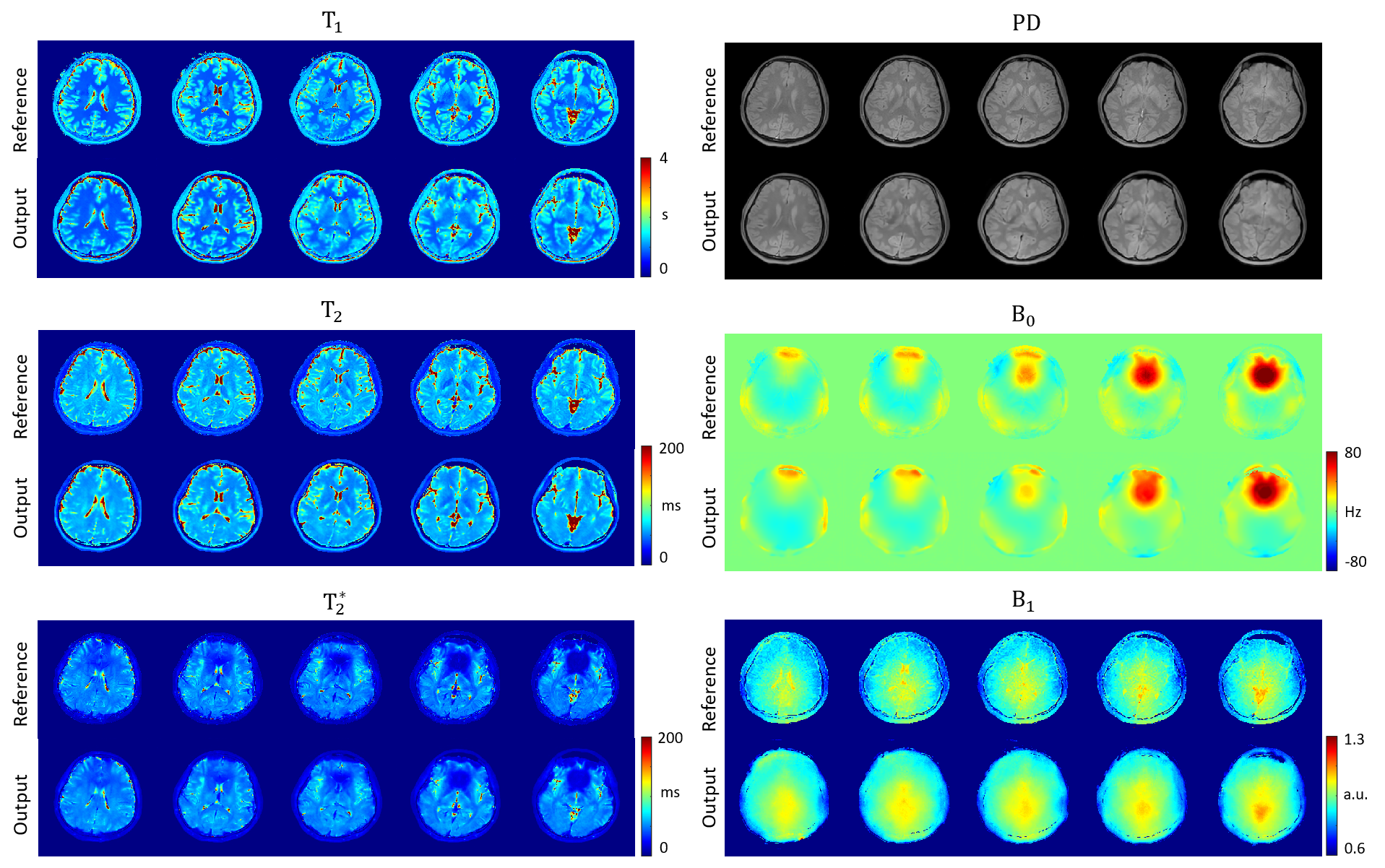
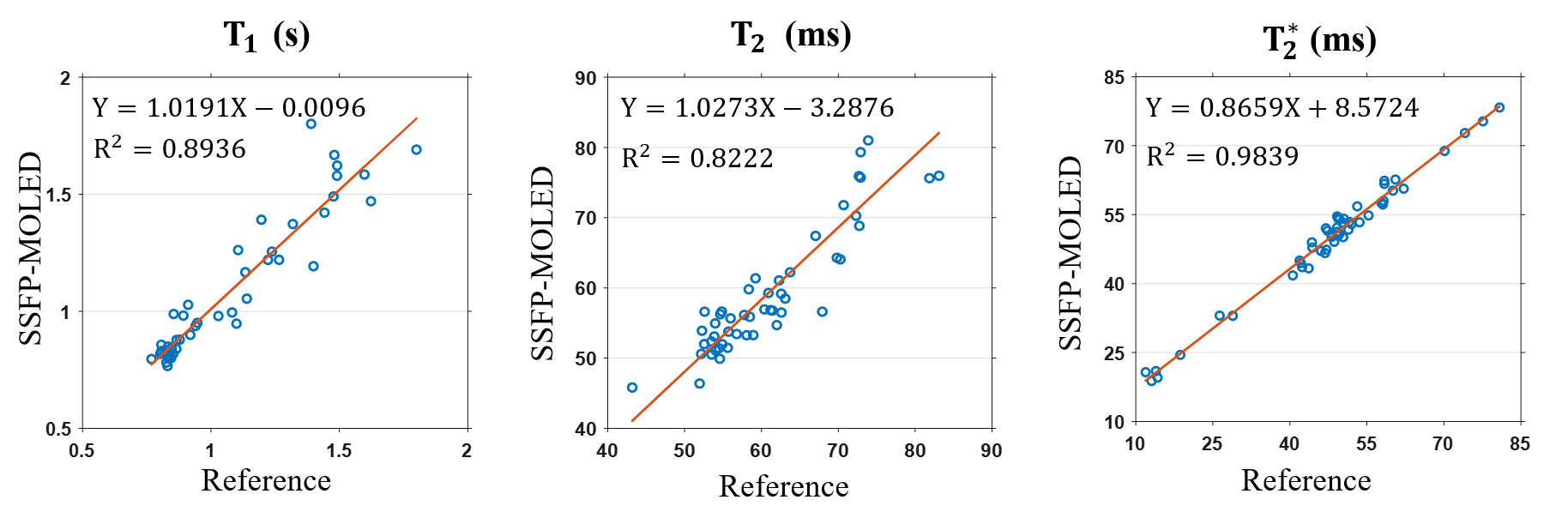
Figure 3 shows the results of a healthy volunteer. The parametric maps from SSFP-MOLED are consistentwith the reference counterparts. Figure 4 shows the statistical results of 50 ROIs (10 per slice). The T1 (R2 = 0.8936), T2 (R2 = 0.8222), and T2* (R2 = 0.9839) values from SSFP-MOLED and reference measurements are highly correlated.Discussion and conclusion
We propose a new method for multi-parametric quantitativeMRI. It collects multiple k-spaces in one scan, and each k-space contains multiple echo signals with different parameter weightings. It can obtain accurate T1, T2, T2*, PD, B0, and B1 parametric maps simultaneously. The proposed method has the advantages of being fast, accurate, distortion-free, artifact-free, and no need for registration, and has great potential for clinical application.Acknowledgements
This work was supported by the National Natural Science Foundation of China under grant numbers 82071913 and 12375291.
References
1. Wang L, Gaddam S, Wang N, et al. Multiparametric mapping magnetic resonance imaging of pancreatic disease. Front Physiol. 2020; 11:8.
2. Cai CB, Wang C, Zeng YQ, et al. Single‐shot T2 mapping using overlapping‐echo detachment planar imaging and a deep convolutional neural network. Magn Reson Med. 2018; 80(5): 2202-2214.
3. Zhang J, Wu J, Chen SJ, et al. Robust single-shot T2 mapping via multiple overlapping-echo acquisition and deep neural network. IEEE Trans Med Imaging. 2019; 38(8): 1801-1811.
4. Liu F, Velikina JV, Block WF, et al. Fast realistic MRI simulations based on generalized multi-pool exchange tissue model. IEEE Trans Med Imaging. 2016; 36: 527-537.
Figures
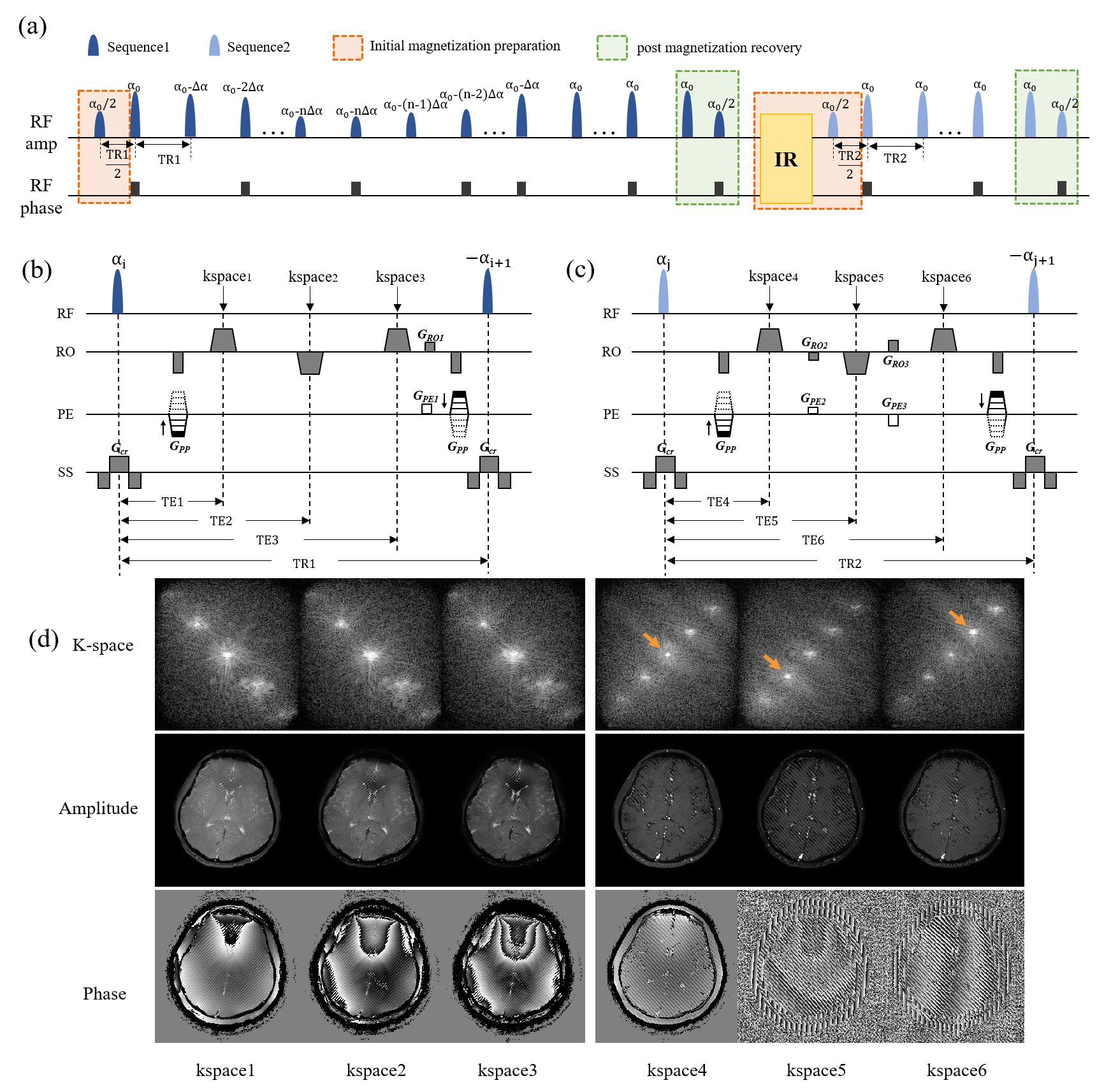
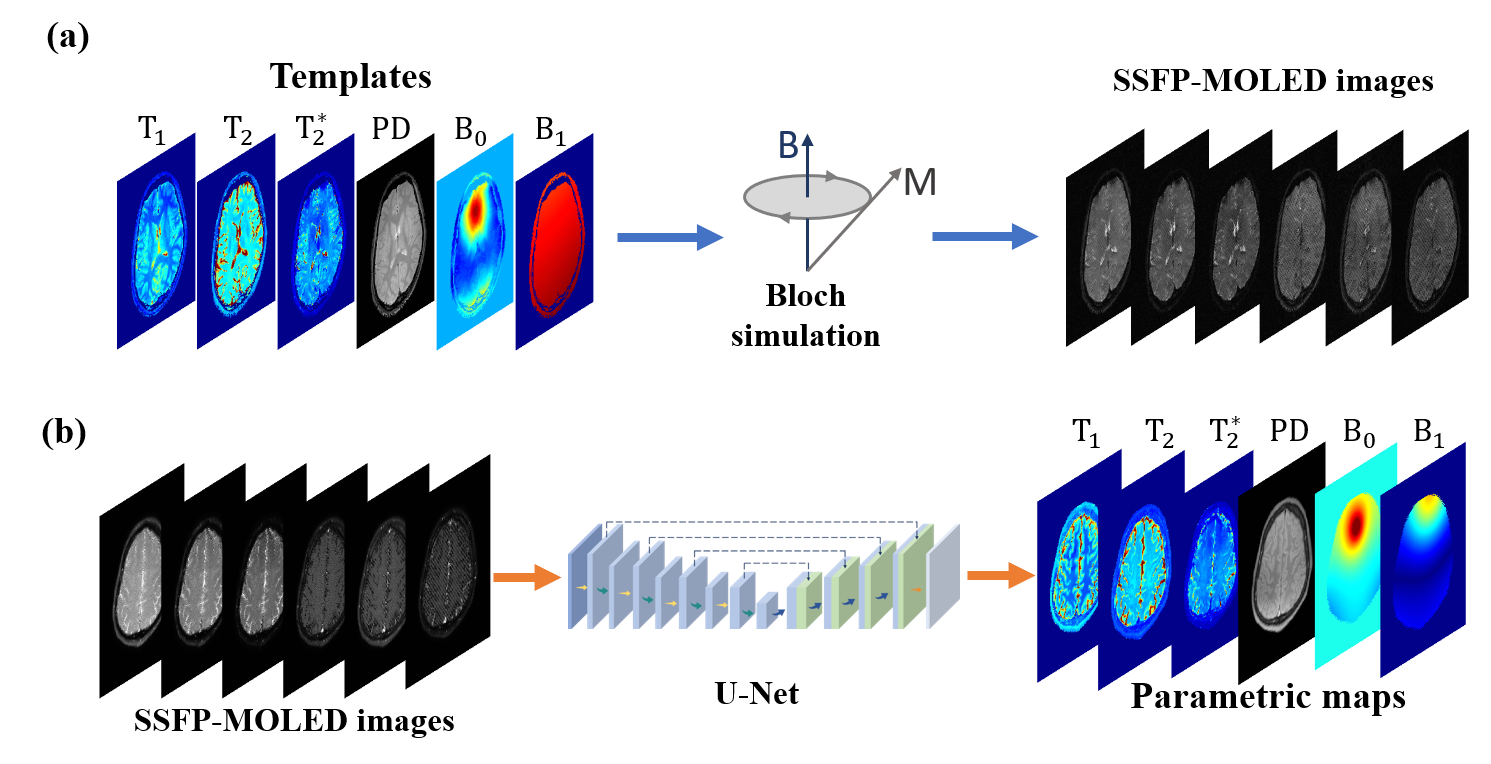
Figure 2 (a) The process of data synthesis. (b) The process of network training.