1109
Instant modulatory effects of transcutaneous vagus nerve stimulation in patients with Parkinson disease.1Department of Rehabilitation, Sir Run Run Shaw Hospital,School of Medicine, Zhejiang University, Hangzhou, China, 2the Second Affiliated Hospital of Guangzhou University of Chinese Medicine, Guangzhou, China, 3Guangzhou University of Chinese Medicine, Guangzhou, China, 4Philips Healthcare, Guangzhou, China, 5Philips Healthcare, Shanghai, China
Synopsis
Keywords: fMRI Analysis, fMRI (resting state), ALFF, taVNS
Motivation: A growing body of evidence suggests that taVNS may improve the motor function of PD patients whereas little is known about the neuropathologic mechanism.
Goal(s): To explore the potential mechanism of taVNS in treating PD by rs-fMRI.
Approach: Fifty patients with PD underwent three times fMRI scanning. And the difference in ALFF among the baeline state,real taVNS and sham taVNS state were investigated.
Results: Compared with baseline and sham taVNS state, the ALFF value showed a significant decrease in 5 clusters. Pearson correlation analysis indicated ALFF of SPL_r in real taVNS condition was negatively correlated with the total UPDRS score, UPDRS-Ⅲscore and PDQ.
Impact: The taVNS may produce treatment effects by modulating the abnormal ALFF of sensorimotor network,salience network and visual network. This may shed light on the neural mechanisms underlying taVNS treatment of PD.
Introduction
Parkinson's disease (PD) is the fastest growing neurodegenerative disease in prevalence, disability, and deaths which led to the global burden of PD increased more than doubled in the past 20 years [1,2]. Consequently, to address this great health burden, it requires action aimed at delaying the development of exacerbation and improving the quality of life of patients. Transcutaneous auricular vagus nerve stimulation (taVNS) is a non-invasive brain stimulation technique which can regulate the function of brain by stimulating the cervical or auricular branch of vagus nerve. Some studies have evaluated the feasibility of taVNS in improving motor function of PD patients and found it might be useful [3,4,5]. However, the underlying neural mechanism of taVNS in treating PD is still not fully clarified. Resting-state functional magnetic resonance imaging (rs-fMRI) is a potential neuroimaging technique which is used to study the intrinsic neurological activity of human-race. Therefore, this study aimed to explore the potential mechanism of taVNS in treating PD by rs-fMRI.Methods
A total of 50 participants diagnosed with PD were included in the study from April 2021 to October 2022. All participants were assessed using Movement Disorder Society Unified Parkinson’s Disease Rating Scale (MDS-UPDRS). In addition, quality of life and non-motor symptoms were evaluated by Parkinson's Disease questionnaire (PDQ), and non-motor symptoms scale (NMSS) respectively. To complete the experimental paradigm, we used an electric device (Hwato, SDZ-IIB, Suzhou, China) with an improved stimulator. All participants underwent 3D high resolution T1-weighted sequence and three times fMRI scan (Figure 1) on a 3.0-T Philips Ingenia MR scanner with a standard 32-channels head coil. Functional images were obtained with the following parameters: (acquisition time = 486 s, matrix = 64 × 61 × 38 slices, TR = 2000 ms, TE = 30 ms, slice gap = 0.25 mm, dynamic scans = 240, flip angle=90°, FOV = 240 × 240 × 142, voxel size = 3.75 × 3.75 × 3.5 mm). Functional images were preprocessed by CONN 21.0. After the preprocessing, a band-pass filter (0.01-0.08 Hz) was applied to extract the time series of each voxel and converted them to frequency domain using fast Fourier transform. The amplitude of low frequency fluctuation (ALFF) value is defined as the square root of the power spectrum. Lastly, a Z-score transformation was used to the ALFF for following statistical analysis. One-way ANOVA was used to evaluate difference of ALFF among the conditions. The statistical significance threshold was defined as p < 0.001 (voxel level, uncorrected) and p < 0.05 (cluster level, GRF corrected). Then, we extracted ALFF value of each cluster in every condition for post-hoc in SPSS 24.0. Only the cluster whose ALFF value in real taVNS condition had statistical difference with both sham taVNS and baseline, we would analyze the correlation between the ALFF value and clinical scales using Pearson correlation. A threshold of p < 0.05 (Bonferroni corrected) was applied for multiple comparisons in correlation analysis.Results
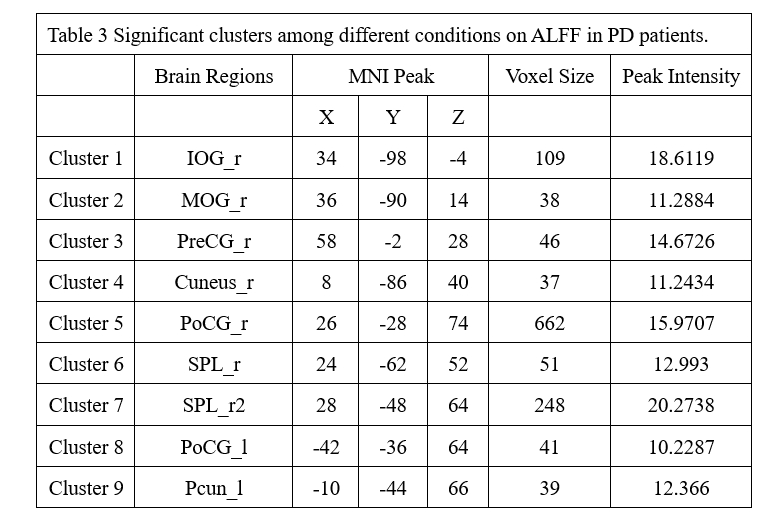
After conducting one-way ANOVA, a total of 9 clusters with significant difference among the conditions were found (Table 1). Then, we extracted the ALFF value of each cluster in every condition to perform post-hoc. The results showed that compared with baseline condition and sham taVNS condition, the ALFF value of 5 clusters showed a significant decrease in real taVNS condition including right middle occipital gyrus (MOG_r), right precentral gyrus (PreCG_r), right postcentral gyrus (PoCG_r), right superior parietal Lobule (SPL_r), and right cuneus (Cuneus_r) (Figure 2, Figure 3). Pearson correlation analysis indicated ALFF of SPL_r in real taVNS condition was negatively correlated with the total UPDRS score (r=-0.380, P=0.008, Bonferroni corrected), UPDRS-Ⅲ score (r=-0.417, P=0.004, Bonferroni corrected), and PDQ (r=-0.381, P=0.008, Bonferroni corrected) (Figure 4).Discussion
To the best of our knowledge, this is the first study to explore the instant modulatory effects of transcutaneous vagus nerve stimulation on patients with Parkinson disease. We found taVNS can decrease the ALFF value of right SPL, right PreCG, right PoCG, right MOG and right cuneus in patients with PD. Meanwhile, the ALFF value of right SPL in real taVNS condition was negatively correlation to UPDRS total score, UPDRS-Ⅲ score and PDQ score.These results suggest that real taVNS may effectively relieve motor symptoms of PD by modulating network overavtivity, which widely involved the sensorimotor network, salience network and visual network.Conclusion
The taVNS may produce treatment effects by modulating the abnormal ALFF of sensorimotor network, salience network and visual network. This may shed light on the neural mechanisms underlying taVNS treatment of PD.Acknowledgements
We would like to acknowledge the generous support and contribution of all our trial participants.References
1. Bloem, BR, Okun, MS, Klein, C. Parkinson's disease. LANCET. 2021; 397 (10291): 2284-2303. doi: 10.1016/S0140-6736(21)00218-X.
2. Vijiaratnam, N, Simuni, T, Bandmann, O, et al. Progress towards therapies for disease modification in Parkinson's disease. LANCET NEUROL. 2021; 20 (7): 559-572. doi: 10.1016/S1474-4422(21)00061-2.
3. Farrand, AQ, Helke, KL, Gregory, RA, et al. Vagus nerve stimulation improves locomotion and neuronal populations in a model of Parkinson's disease. BRAIN STIMUL. 2017; 10 (6): 1045-1054. doi: 10.1016/j.brs.2017.08.008.
4. Lench, DH, Turner, TH, McLeod, C, et al. Multi-session transcutaneous auricular vagus nerve stimulation for Parkinson's disease: evaluating feasibility, safety, and preliminary efficacy. Front Neurol. 2023; 14 1210103. doi: 10.3389/fneur.2023.1210103.
5. Abdelnaby, R, Elsayed, M, Mohamed, KA, et al. Vagus nerve ultrasonography in Parkinson's disease: A systematic review and meta-analysis. AUTON NEUROSCI-BASIC. 2021; 234 102835. doi: 10.1016/j.autneu.2021.102835.
Figures
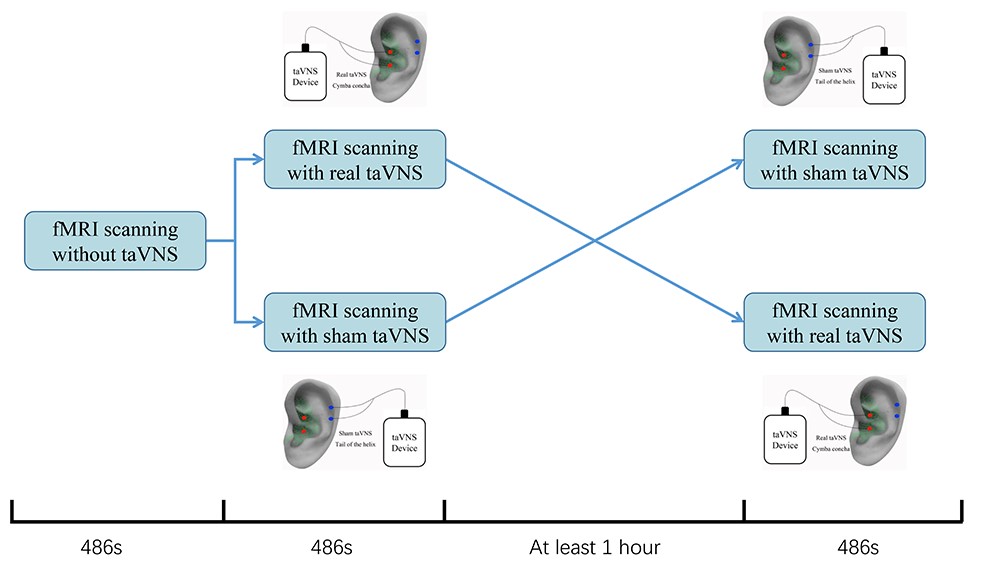
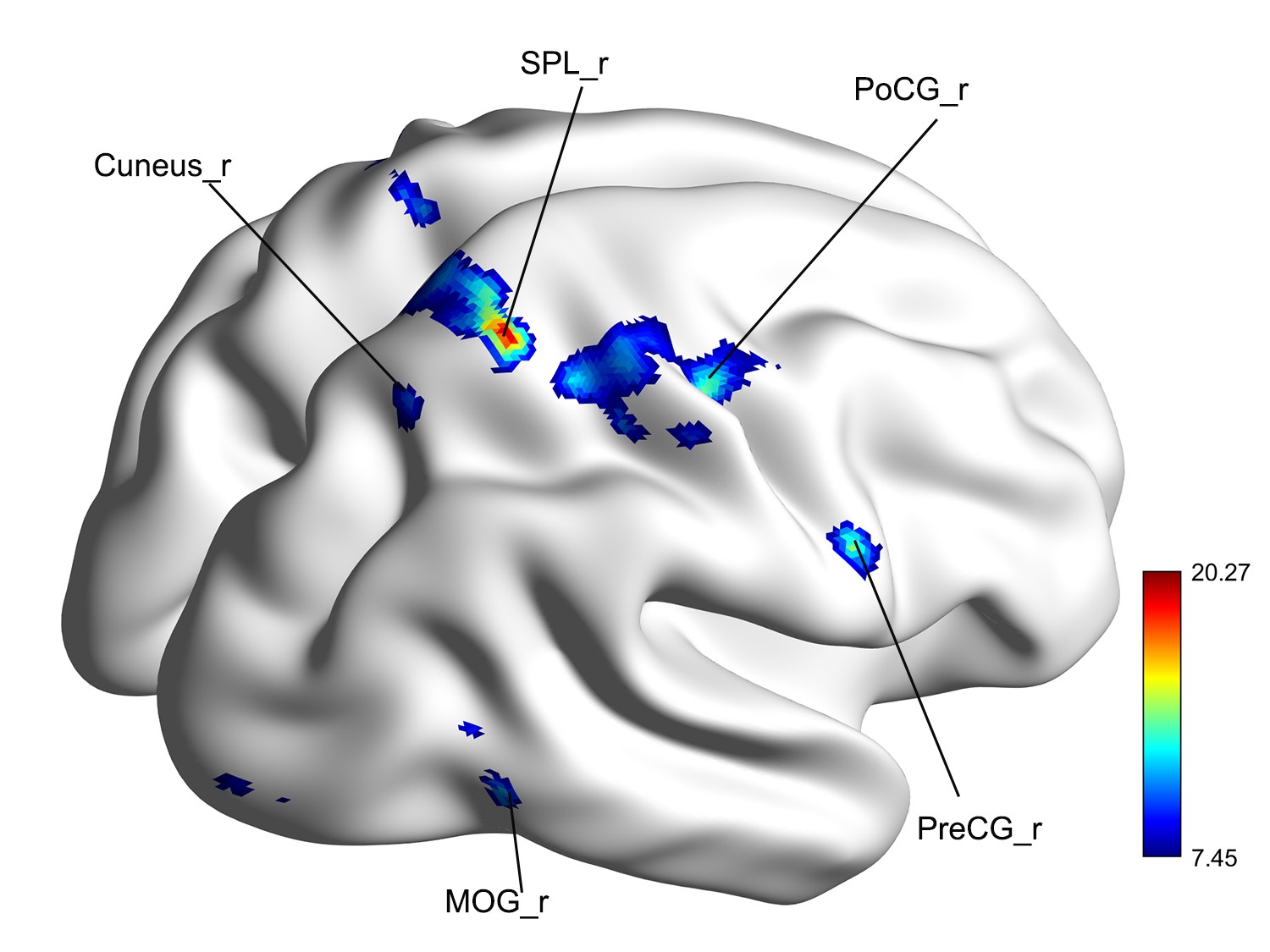
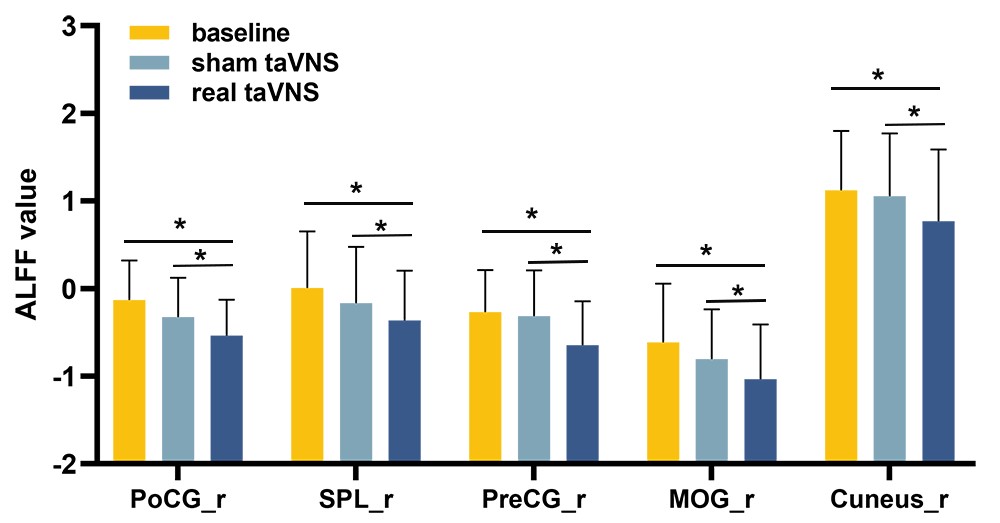
Figure 3. Comparision of the amplitude of low frequency fluctuation (ALFF) among the baseline condition, sham taVNS condition, and the real taVNS condition group in 5 clusters. Abbr: MOG_r: right middle occipital gyrus, PreCG_r: right precentral gyrus, PoCG_r: right postcentral gyrus, PoCG_r: right superior parietal Lobule, and Cuneus_r:right cuneus.
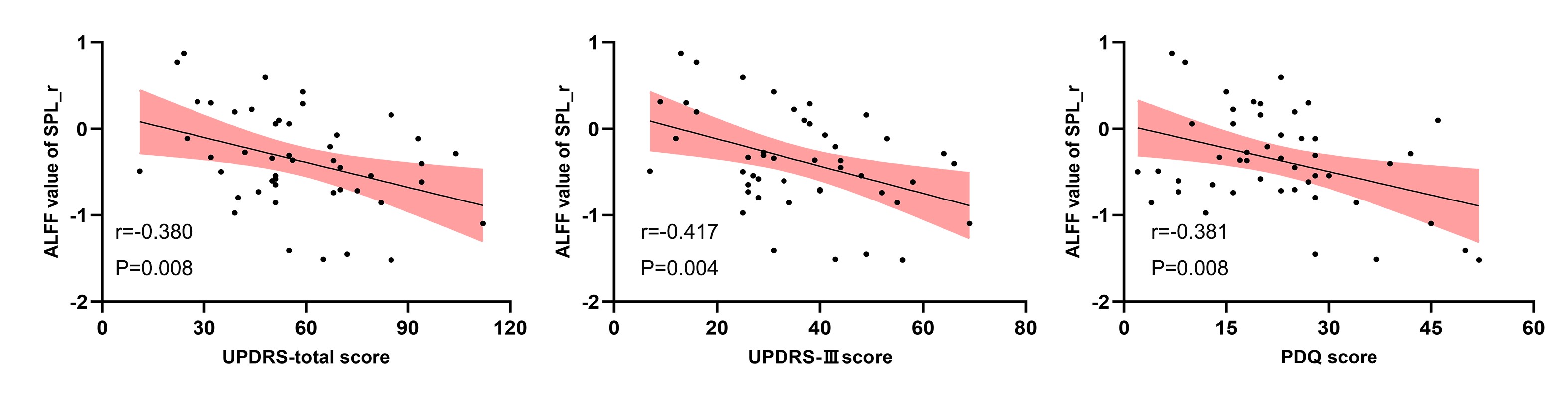
Figure 4. Results of Pearson correlation analysis between the ALFF of SPL_r in real taVNS condition and the total UPDRS score, UPDRS-Ⅲ score and PDQ, respectively. Abbr: SPL_r:right superior parietal Lobule, ALFF: the amplitude of low frequency fluctuation, PDQ: Parkinson's Disease questionnaire. Note: Movement Disorder Society Unified Parkinson’s Disease Rating Scale (MDS-UPDRS) which includes 4 parts reflecting non-motor experiences of daily living (UPDRS-Ⅰ), motor experiences of daily living(UPDRS-Ⅱ); motor examination (UPDRS-Ⅲ) and motor complications(UPDRS-Ⅳ).