1091
Large-shift, Rapid Exchange Endogenous CEST Contrast for Reporter Gene Product Design1Radiology, Athinoula A. Martinos Center, Massachusetts General Hospital, Charlestown, MA, United States, 2Michigan State University, East Lansing, MI, United States, 3Radiology and Radiological Sciences, F.M. Kirby Research Center for Functional Brain Imaging, Kennedy Krieger Institute, Baltimore, MD, United States
Synopsis
Keywords: CEST / APT / NOE, CEST & MT
Motivation: Endogenous CEST contrast from reporter gene products would benefit from exchangeable protons resonating above 3.5 ppm and exchanging rapidly.
Goal(s): We sought to characterize high-shift CEST contrast in tryptophan-enriched peptide sequences to design a highly specific and selective reporter gene protein product.
Approach: We performed CEST z-spectroscopy and QUESP analysis on several tryptophan-containing peptide sequences with variations on a WDWEQ motif.
Results: We identified a CEST z-peak at 5.5 ppm exchanging at 250-350 s-1. Surprisingly, we also discovered a new fast-exchanging (ksw ~ 1800 s-1) CEST resonance at 4.4 ppm in one peptide. Both improve our ability to generate unique CEST contrast.
Impact: Developing selective and specific MRI-detectable CEST contrast will greatly benefit noninvasive assessment of viral and cell based therapies. Our work in high-shift CEST contrast shows great potential to improve our ability to reliably monitor these therapies.
Introduction
Monitoring the spread and persistence of cell- and viral-based therapeutics is essential to unlocking their potential and revolutionizing the treatment of many diseases. One excellent means of assessing treatment efficacy without administering exogenous contrast agents is optimizing MRI-sensitive chemical exchange saturation transfer (CEST) contrast via a reporter gene protein product. We have previously designed lysine-rich proteins (LRP)1,2 as well as machine learning-optimized protein sequences3,4 for applications in imaging oncolytic virotherapy5 as well as cardiac gene transfer therapy. However, to date our contrast has been limited to amide proton exchange at 3.5 ppm, whereas exchangeable protons with larger chemical shifts and higher exchange rates would improve selectivity and specificity. Here we present peptide CEST contrast arising from saturation at 4.4 ppm or higher which is more easily separated from endogenous amide contrast.Methods
4.5 mg of each peptide were ordered from GenScript, resuspended in 1x phosphate-buffered saline (PBS), and titrated to pH 7.3 at room temperature. 1H NMR was performed on a 14 T scanner with the sample kept at 37 °C. Ultrafast z-spectroscopy6 was performed using saturation powers ranging from 1-5 mT. Exchange rates were quantified by the Quantification of Exchange via Saturation Power (QUESP)7 method using the processed z-spectral parameters and the T1 time constant measured via inversion-recovery for each sample. Data were processed using custom MATLAB scripts, and peptide structure predictions were performed using AlphaFold.Results and Discussion
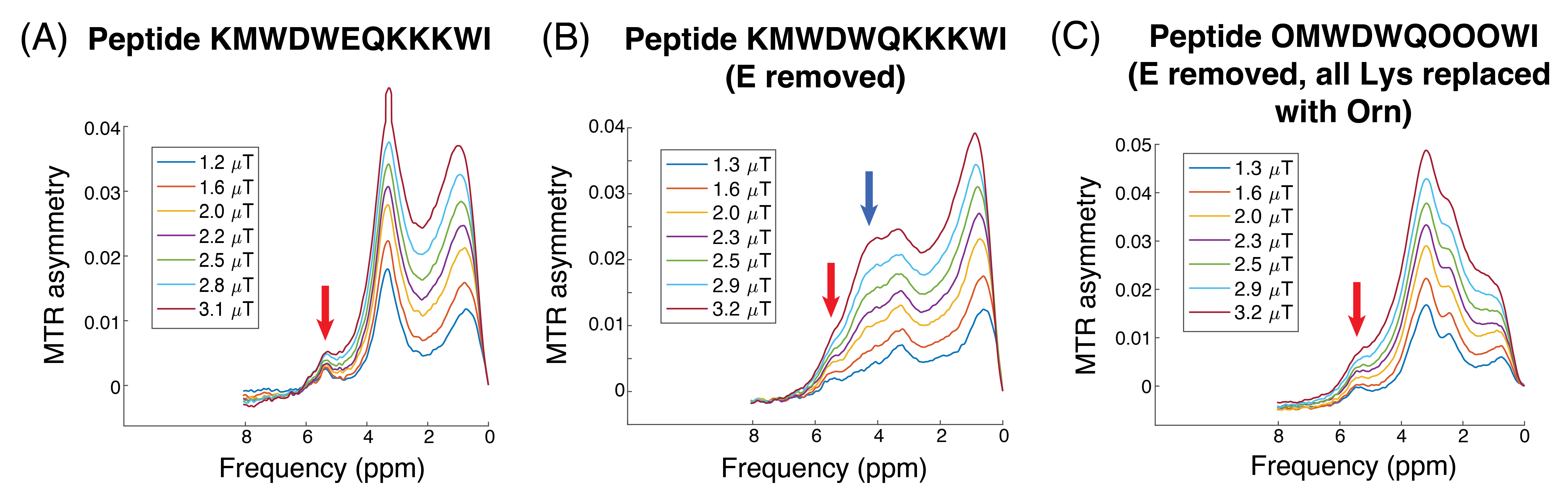
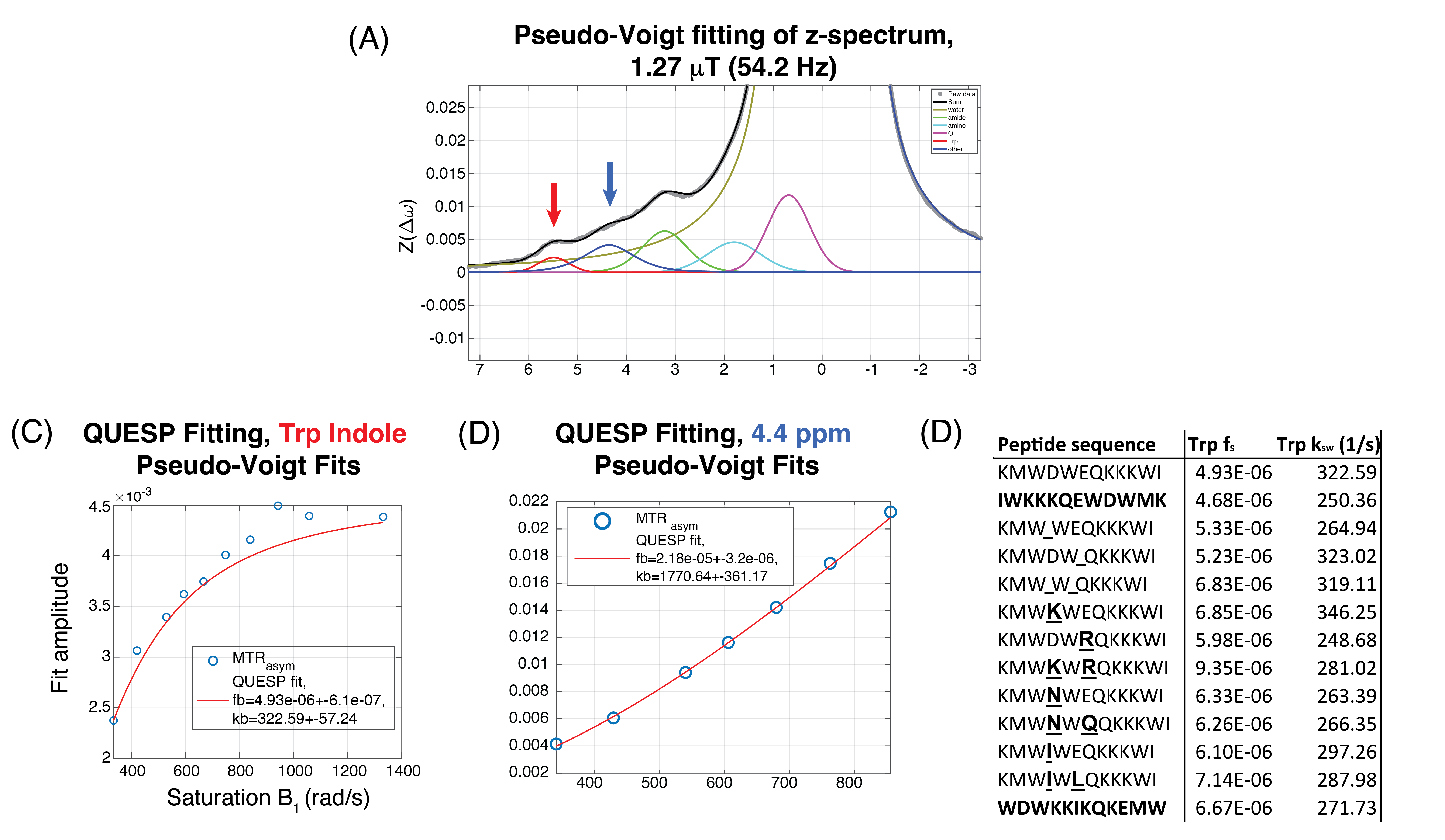
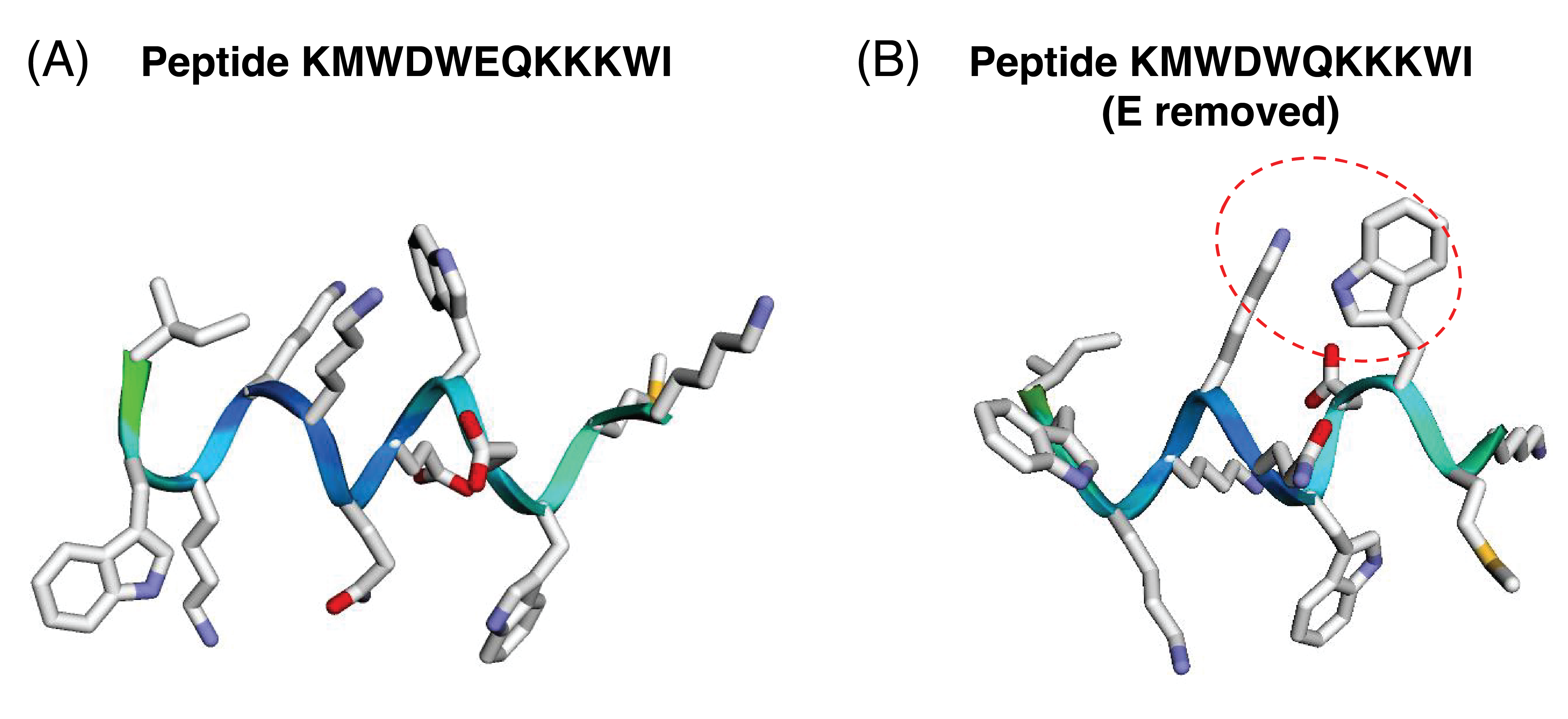
We have recently discovered tryptophan-containing peptides with a WDWEQ amino acid motif that provide 5.5 ppm CEST contrast at pH 7.3 and 37 °C, attributed to the indole NH ring protons of tryptophan (Figure 1A). One variation of this peptide motif (KMWDWQKKKWI), in which the glutamate (E) amino acid was removed, interestingly displayed an additional CEST peak centered at 4.4 ppm chemical shift (Figure 1B). A fast exchange rate of ~1800 s-1 was measured for this new 4.4 ppm peak, faster than the exchange tryptophan exchangeable protons which vary between 250-350 s-1 (Figure 2). We have begun experiments to try and identify the exchangeable proton that is the source of this new signal. Molecular modeling of the structure of this peptide indicated a close interaction between the lysine side-chain amine group and one of the tryptophan phenol rings (Figure 3). This suggests that the peak at 4.4 ppm could be the lysine side chain amine group, which is usually not observed due to its extremely fast exchange rate. In support of this hypothesis, we found that a peptide in which the lysines were changed to ornithine, an unnatural amino acid in which the lysine sidechain group is shortened by one carbon, lead to loss of the 4.4 ppm signal (Figure 1C). The large chemical shift (4.4 ppm) of this putative amine proton and the fast exchange rate (1800 s-1) make this an ideal candidate for a new class of reporter proteins with both increased specificity, due to the large chemical shift, and increased sensitivity, due to the fast exchange rate. We are currently exploring modifications to this peptide sequence to precisely identify the lysine that is giving rise to this new signal by reintroducing lysines into the ornithine peptide sequence one at a time. We will then work on optimizing larger peptides and reporter proteins that are built with this WDWQK motif.Acknowledgements
No acknowledgement found.References
1. Gilad, A. A. et al. Artificial reporter gene providing MRI contrast based on proton exchange. Nat. Biotechnol. 25, 217–219 (2007).
2. Perlman, O. et al. Redesigned reporter gene for improved proton exchange-based molecular MRI contrast. Sci. Rep. 10, 20664 (2020).
3. Bricco, A. R. et al. A Genetic Programming Approach to Engineering MRI Reporter Genes. ACS Synth. Biol. 12, 1154–1163 (2023).
4. Fillion, A. J. et al. Development of a synthetic biosensor for chemical exchange MRI utilizing in silico optimized peptides. NMR Biomed. n/a, e5007 (2023).
5. Farrar, C. T. et al. Establishing the Lysine-rich Protein CEST Reporter Gene as a CEST MR Imaging Detector for Oncolytic Virotherapy. Radiology 275, 746–754 (2015).
6. Xu, X., Lee, J.-S. & Jerschow, A. Ultrafast Scanning of Exchangeable Sites by NMR Spectroscopy. Angew. Chem. Int. Ed. 52, 8281–8284 (2013).
7. McMahon, M. T. et al. Quantifying exchange rates in chemical exchange saturation transfer agents using the saturation time and saturation power dependencies of the magnetization transfer effect on the magnetic resonance imaging signal (QUEST and QUESP): Ph calibration for poly-L-lysine and a starburst dendrimer. Magn. Reson. Med. 55, 836–847 (2006).
Figures