1088
Rapid and simplified post-processing for B0 and B1 mapping with WASABI-RADISH in the application of CEST at 7T1Department of Biomedical Engineering, University of Melbourne, Parkville, Australia, 2Melbourne Brain Centre Imaging Unit, University of Melbourne, Parkville, Australia, 3Spinoza Centre for Neuroimaging, Royal Netherlands Academy of Sciences, Amsterdam, Netherlands, 4Department of Computational Cognitive Neuroscience & Neuroimaging, Netherlands Institute for Neuroscience, Royal Netherlands Acadamy of Arts and Sciences, Amsterdam, Netherlands, 5Central Clinical School, Department of Neuroscience, Monash University, Melbourne, Australia
Synopsis
Keywords: CEST / APT / NOE, CEST & MT, B1, B0, WASABI, data processing, UHF, 7T, tools
Motivation: WASABI provides high fidelity B0 and B1 maps necessary for CEST correction yet suffers from prolonged post-processing incompatible with clinical use.
Goal(s): Our goal was to design an optimisation-free method to expedite map estimations.
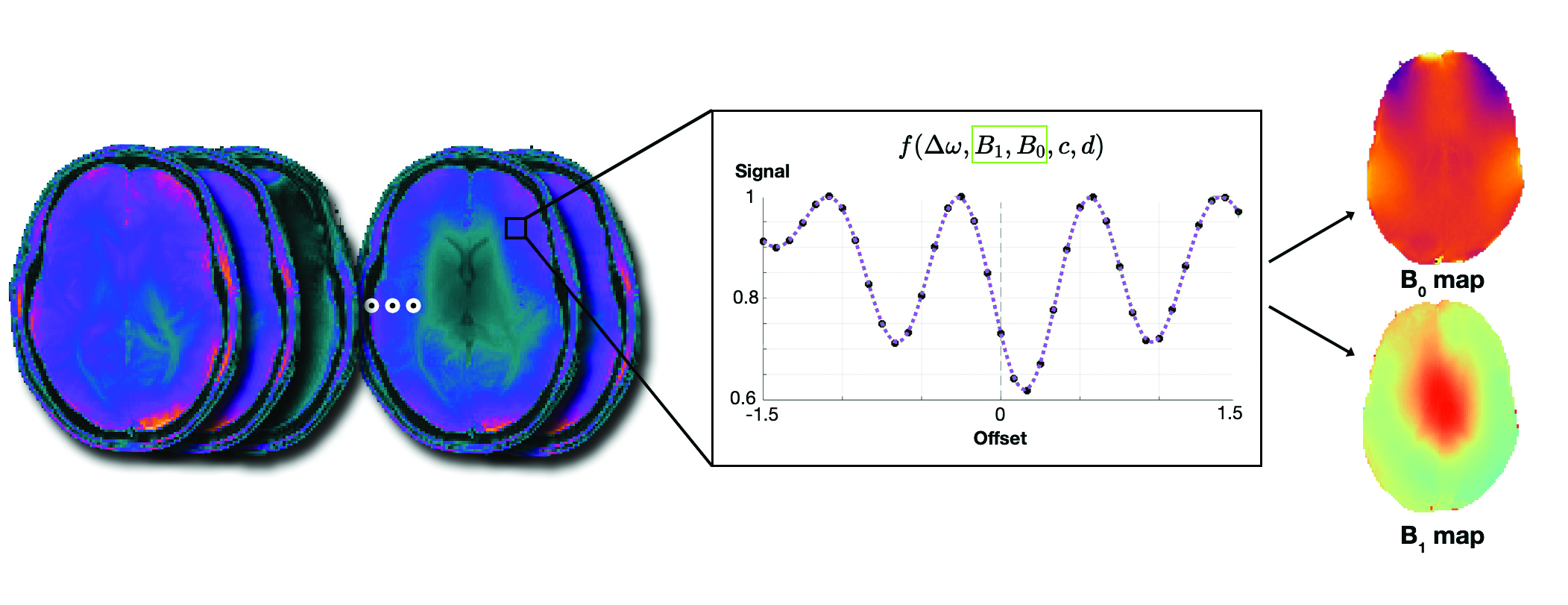
Approach: A direct relationship was derived between B0 and B1 and information in WASABI Z-spectra.
Results: The proposed approach accelerated post-processing by a factor of 80, with improved estimation in brain regions that are noisy and/or have unpredictable initial magnetisation.
Impact: Improvement in speed and accuracy provided by RADISH has the ability to make WASABI, and quantitative CEST at ultra-high-field in general, more reliable and clinically feasible.
Introduction
Chemical exchange saturation transfer (CEST) benefits from improved signal-to-noise ratio at 7T, enabling increased spectral and spatiotemporal resolutions. However, its implementation is hindered by confounds introduced by increased B0 and B1 inhomogeneities inherent at ultra-high-field. WASABI (Water Shift And B1)1 was introduced to provide simultaneous estimation of B0 and B1 maps for correction, achieving results consistent with reference techniques WASSR2 and Bloch-Siegert shift3 respectively. Similar to WASSR, WASABI employs a specialised CEST sequence to acquire images at off-resonant frequencies, creating a Z-spectrum for each voxel that is fitted by a model based on Rabi oscillations to deduce the corresponding B1 and B0 values. The technique’s dependency on non-linear least squares fitting using the Levenberg-Marquardt algorithm (LMA) leads to sensitivity to local minima and prolonged processing. We propose a significantly faster post-processing approach using a Rabi Distance Search (RADISH) algorithm to bolster WASABI’s utility. The original and proposed methods will be referred to as WASABI-LMA and (WASABI-)RADISH, respectively.Method
Schuenke et al.1 introduced the following model to describe Z-spectra when sampling around the water resonance frequency, with four free parameters, $$$B_1$$$ (effective B1), $$$\delta\omega$$$ (B0 shift), $$$c$$$, and $$$d$$$:$$Z(\Delta\omega) =\left|c-d\cdot \sin^2\left(\tan^{-1}\left(\frac{\gamma B_1}{\Delta \omega-\delta\omega}\right)\right)\cdot\sin^2\left(\frac{t_p}{2}\cdot \sqrt{(\gamma B_1)^2+(\Delta\omega - \delta\omega)^2} \right) \right| \ \ \ \ \ (1) $$
$$
B_1=\frac{\omega_0}{\gamma}\cdot\sqrt{\left(\frac{n}{\omega_0\cdot t_p}\right)^2-\frac{R^2}{4}}\ \ \ \ \ \ \
\text{where n} = \begin{cases} 1 &\text{if } R\le \frac{2}{\omega _0 \cdot t_p} \\ 2 &\text{otherwise} \end{cases} \ \ \ \ (2)
$$
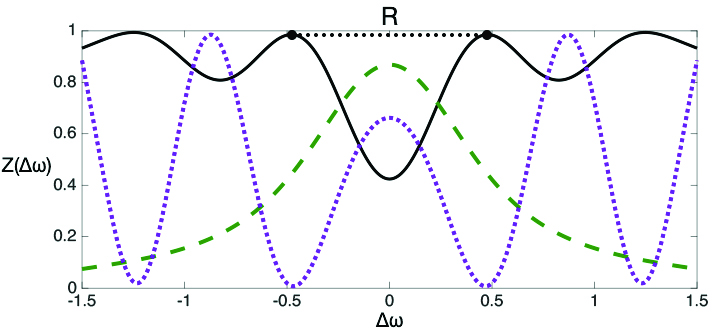
Here $$$R$$$ denotes the distance in p.p.m. between the two peaks immediately surrounding the water offset (Figure 2), ω0 is the scanner frequency in MHz, $$$\gamma$$$ the gyromagnetic ratio, and $$$t_p$$$ the pulse duration in seconds. The B0 shift is inferred from the peaks’ locations. Using this relationship, the RADISH algorithm searches voxel-wise for the pair of B1 and δω that provides the best match to the Z-spectrum’s gradient curve. The use of the gradient as the objective function reduces contributions by $$$c$$$ and $$$d$$$, and enables robust estimation across a wide range of initial magnetization and relaxation effects. RADISH is available for use in both MATLAB and Python 3.
Phantom and in vivo scans were acquired on an investigational MAGNETOM 7T scanner (Siemens Healthineers, Erlangen, Germany), using an 8Tx-32Rx head coil (Nova Medical Inc., Wilmington, MA, USA) in CP mode. The following parameters were used for the WASABI protocol1 using a 3D spiral readout with MIMOSA4: noffsets = 49 (-1.5 to 1.5 ppm), B1 = 3.7 μT, flip angle = 6°, tp = 5 ms, trec = 5 s, td = 100 ms, tsat = 5 ms, TR = 7.4 ms, TE = 3.61 ms, matrix = 128 × 128, voxel size = 1.7 × 1.7 × 5 mm3, slices = 12. Pre-processing included motion correction using ANTs5 and normalisation using the CEST-eval toolbox6. Testing of WASABI-LMA and RADISH was performed using MATLAB r2023b on an 8-core computer with 16GB memory.
Results
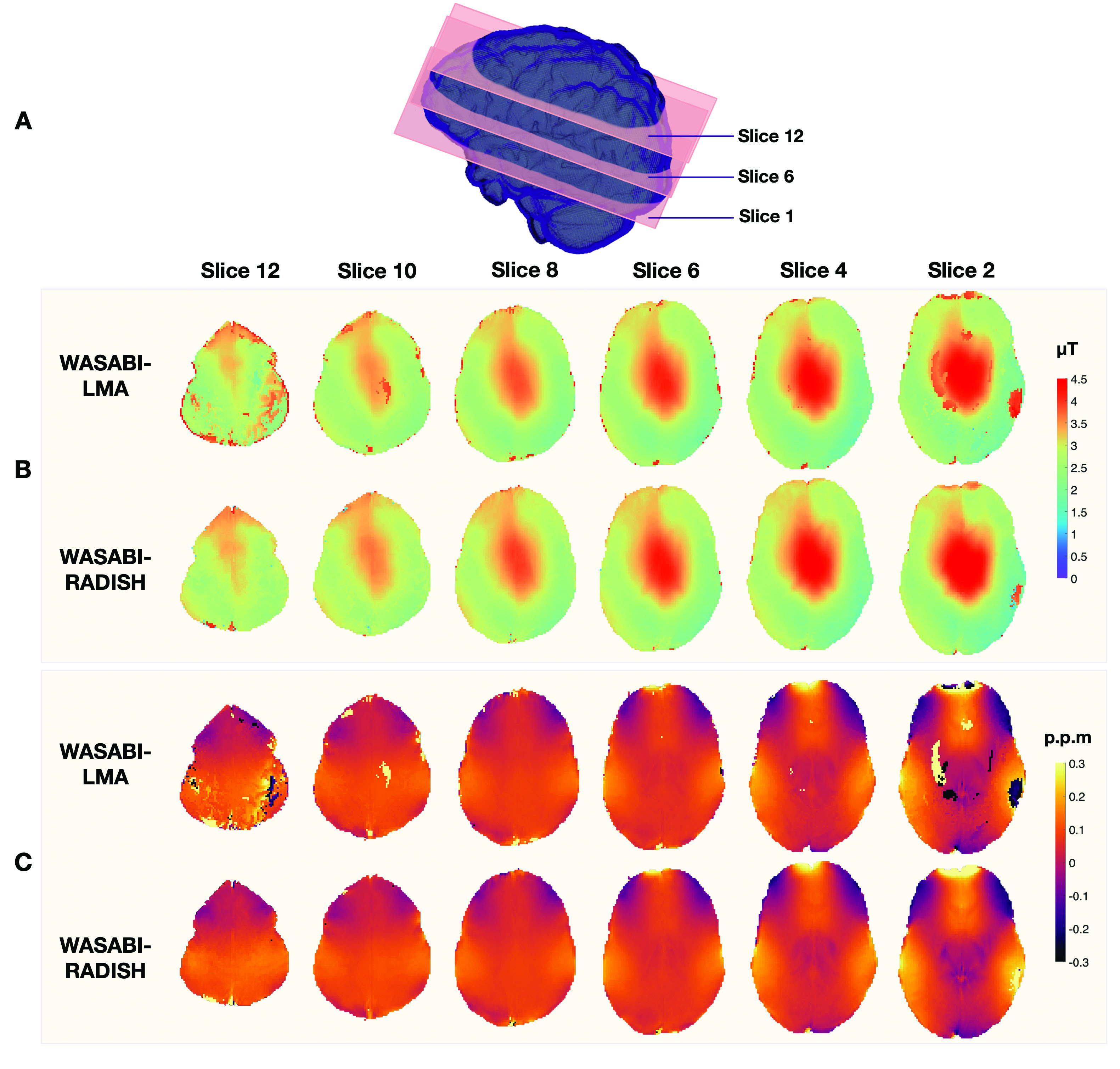
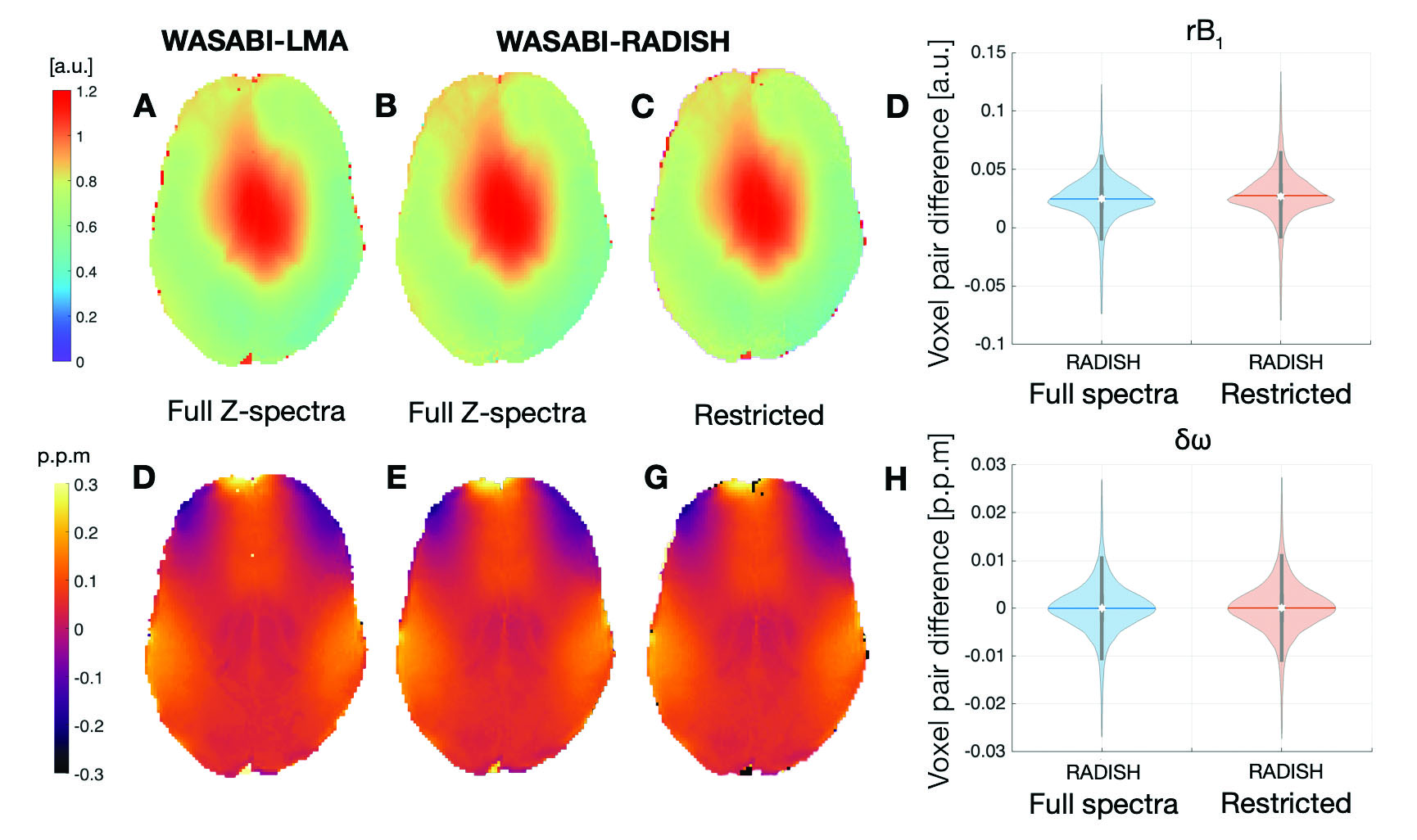
RADISH provided smooth B0 and B1 maps insensitive to relaxation effects that are consistent with those generated by the original LMA approach (Figure 3). In areas with significant noise, unpredictable magnetisation or motion artefacts, notably toward inferior and superior extremes, RADISH outperformed LMA in robustness. Accuracy remained when Z-spectra were retrospectively restricted to -1 to 1 p.p.m (33 offsets) (Figure 4), providing another scheme to reduce scan time.The average processing speeds per voxel were 0.84 ms for RADISH and 66 ms for WASABI-LMA, providing acceleration of almost two orders of magnitude. Across 12 slices, this translated to a reduction in post-processing from 72 minutes to just under 1 minute.
Discussion
LMA’s reliance on choice of starting parameters necessitates a look-up step wherein each spectrum is compared to 36,800 curves; any expansion to cases to be considered increases processing time. Our use of a direct graph-based approach simplifies the analysis, and in so-doing, accelerates mapping significantly to a speed on par with another fast WASABI mapping method7 without re-polarisation or fitting steps. As a bonus, Z-spectra need not be symmetrical for accurate estimation, providing robustness in non-ideal scanning conditions.While its intended use is in the correction of CEST data, WASABI-RADISH can be used for general mapping cases where high accuracy and/or T1 insensitivity are required. RADISH can also be incorporated into the recently introduced WASABITI8 workflow to reduce the number of unknowns to one.
Conclusion
We propose RADISH, a method to accelerate WASABI post-processing for B1 and B0 mapping. Results showed expedited post-processing time without compromising accuracy, and increased robustness in areas with significant noise. This contributes toward clinically practical CEST neuroimaging at ultra-high-field.Acknowledgements
We acknowledge the facilities and scientific and technical assistance of the National Imaging Facility, a National Collaborative Research Infrastructure Strategy (NCRIS) capability, at the Melbourne Brain Centre Imaging Unit, University of Melbourne. We also acknowledge funding from the Melbourne Research Scholarship and the Graeme Clark Institute Top-Up Scholarship. We thank Prof. Dr. Moritz Zaiss for providing the MIMOSA sequence.References
1. Schuenke, P., Windschuh, J., Roeloffs, V., Ladd, M. E., Bachert, P., & Zaiss, M. (2017). Simultaneous mapping of water shift and B1 (WASABI)-Application to field-Inhomogeneity correction of CEST MRI data. Magnetic resonance in medicine, 77(2), 571–580.
2. Kim, M., Gillen, J., Landman, B. A., Zhou, J., & van Zijl, P. C. (2009). Water saturation shift referencing (WASSR) for chemical exchange saturation transfer (CEST) experiments. Magnetic resonance in medicine, 61(6), 1441–1450.
3. Sacolick, L. I., Wiesinger, F., Hancu, I., & Vogel, M. W. (2010). B1 mapping by Bloch-Siegert shift. Magnetic resonance in medicine, 63(5), 1315–1322.
4. Liebert, A., Zaiss, M., Gumbrecht, R., Tkotz, K., Linz, P., Schmitt, B., Laun, F. B., Doerfler, A., Uder, M., & Nagel, A. M. (2019). Multiple interleaved mode saturation (MIMOSA) for B1+ inhomogeneity mitigation in chemical exchange saturation transfer. Magnetic resonance in medicine, 82(2), 693–705.
5. Avants, B. B., Tustison, N. J., Song, G., Cook, P. A., Klein, A., & Gee, J. C. (2011). A reproducible evaluation of ANTs similarity metric performance in brain image registration. NeuroImage, 54(3), 2033–2044.
6. Zaiss M and Windschuh J. Cest-sources. GitHub. Online access: https://github.com/cest-sources
7. Papageorgakis, C., Firippi, E., Gy, B., Boutelier, T., Khormi, I., Al-iedani, O., Lechner-Scott, J., Ramadan, S., Liebig, P., Schuenke, P., Zaiss, M. & Casagranda, S. (2023). Fast WASABI post-processing: Access to rapid B0 and B1 correction in clinical routine for CEST MRI.
8. Schuenke, P., Zimmermann, F. F., Kaspar, K., Zaiss, M., Kolbitsch, C. (2023). An Analytic Solution for the Modified WASABI Method: Application to Simultaneous B0, B1 and T1 Mapping and Correction of CEST MRI. Proc. Intl. Soc. Mag. Reson. Med. 31, 0906.
Figures