1066
ABRICOTINE MRI: Enhancing Sparsity Across the Three Dimensions of the Fourier Domain in Cartesian Sampling1Advanced Clinical Imaging Technology, Siemens Healthineers International AG, Lausanne, Switzerland, 2Center for Biomedical Imaging (CIBM), Geneva, Switzerland, 3Department of Radiology, Lausanne University Hospital and University of Lausanne, Lausanne, Switzerland, 4LTS5, Ecole Polytechnique Fédérale de Lausanne (EPFL), Lausanne, Switzerland, 5Siemens Healthcare GmbH, Erlangen, Germany, 6Human Neuroscience Platform, Fondation Campus Biotech Geneva, Geneva, Switzerland
Synopsis
Keywords: New Trajectories & Spatial Encoding Methods, Sparse & Low-Rank Models, Sparse sampling
Motivation: With the increasing demand for high-resolution and short MRI exams, especially at high and ultra-high field, there is a need for fast acquisition techniques.
Goal(s): To improve highly accelerated compressed-sensing by introducing a novel sampling named Alternating Basis Readout Imaging with COmpressed$$$\,$$$sensing with Three-dImensioNal Encoding (ABRICOTINE).
Approach: ABRICOTINE incorporates sparse phase-encoding in three orthogonal directions, achieving true three-dimensional undersampling of the Fourier domain. This differs from conventional compressed$$$\,$$$sensing, which only undersamples within two phase-encoding dimensions.
Results: We demonstrate significant enhancements in brain image quality through both simulations and true ABRICOTINE-accelerated acquisitions. It surpasses conventional compressed$$$\,$$$sensing methods and enables 0.5mm isotropic imaging in 4min.
Impact: ABRICOTINE allows for a substantial improvement in compressed-sensing acceleration compared to traditional sparse sampling techniques, especially when high acceleration factors are required. It thus shows great potential for further accelerating high resolution MRI acquisitions.
Introduction
Compressed sensing (CS) reconstructions in MR exploit random undersampling of the k-space, coupled with a constrained reconstruction algorithm relying on the sparsity of natural images. This approach accelerates image acquisition beyond the capabilities of traditional parallel imaging. This acceleration is accomplished through incoherent undersampling of the k-space, coupled with a constrained reconstruction algorithm that relies on natural image sparsity. In the context of 2D or 3D MRI, the traditional CS approach focuses on undersampling the phase-encoding directions while fully sampling the frequency-encoding/readout direction.[1] More optimal sparse sampling can be obtained with non-Cartesian trajectories, encompassing undersampling across all spatial dimensions.[2] However, these non-Cartesian samplings may introduce additional artifacts due to imaging imperfections and require specialized reconstruction techniques. With ABRICOTINE, we introduce a new sampling pattern that integrates sparsely sampled Cartesian acquisitions in three orthogonal readout directions.Methods
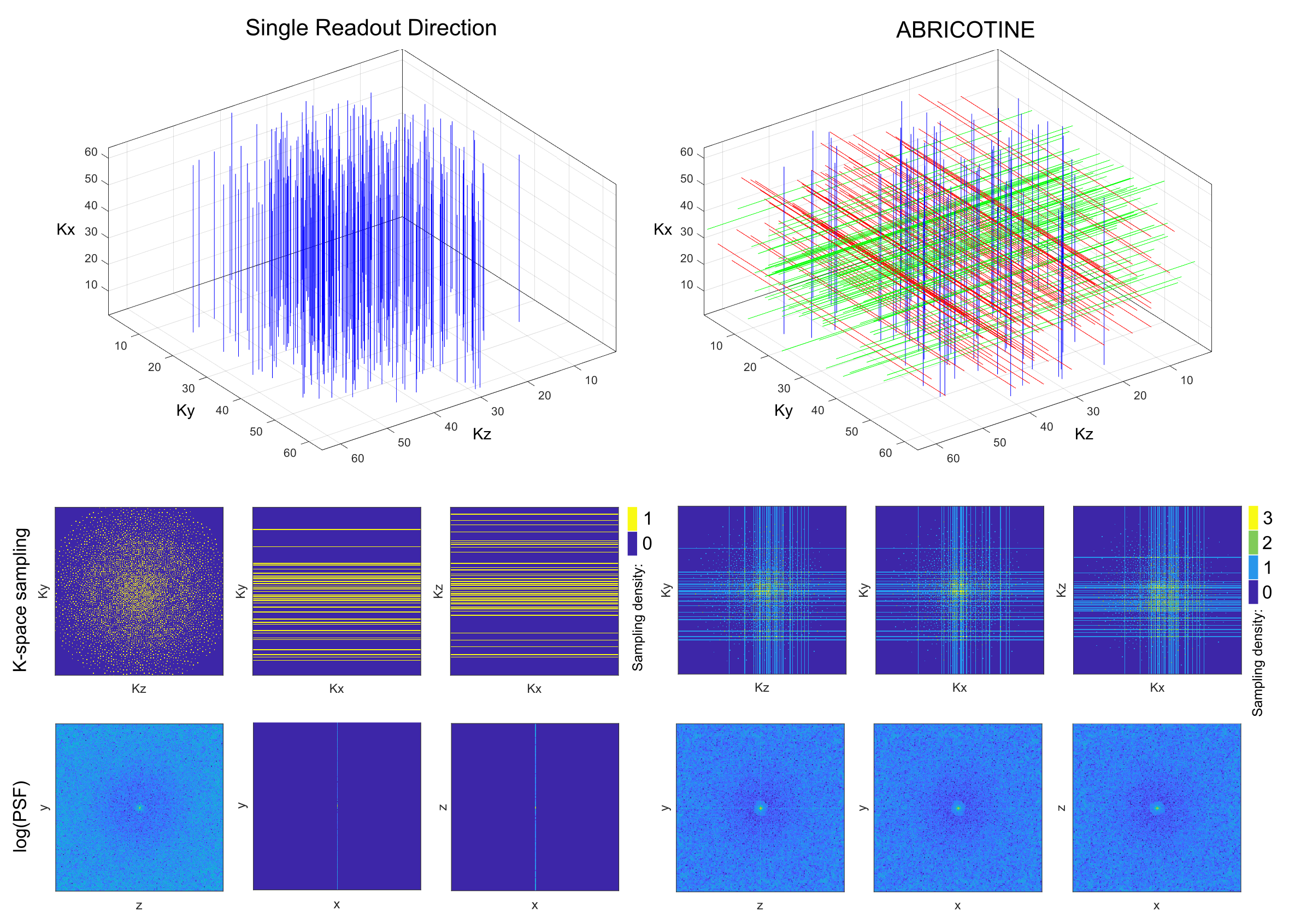
ABRICOTINE integrates three Cartesian acquisitions with sparse phase-encoding performed in orthogonal directions. This approach enables Cartesian sparse sampling along all three k-space dimensions (Fig.1). While conventional 3D CS acquisitions with a single readout direction (SRD) can be independently reconstructed over the readout direction, ABRICOTINE, owing to its inherent 3D sparse sampling, requires a true 3D reconstruction. The ABRICOTINE reconstruction is formulated with three distinct consistency terms, each associated with a specific readout direction:$$\underset{m}{\text{arg}\:\text{min}}\:\:{\sum_{c,\omega}{\|d_{c,\omega}-\mathcal{F}_\omega\,\mathcal{C}_c\,m\|_2}+\lambda\|\Psi\,m\|_1}$$where$$$\:\omega\:$$$is an index running over the three orthogonal directions and$$$\:c\:$$$is the coil element index.$$$\:d_{c,\omega}\:$$$stands for the 3D measured data from specific direction and coil element with$$$\:\mathcal{F}_\omega\:$$$the corresponding encoding operator and$$$\:\mathcal{C}_c\:$$$the coil sensitivity profiles. The L1-norm of the 3D wavelet coefficient$$$\:(\Psi\,m)\:$$$is applied as constraint.Simulation:
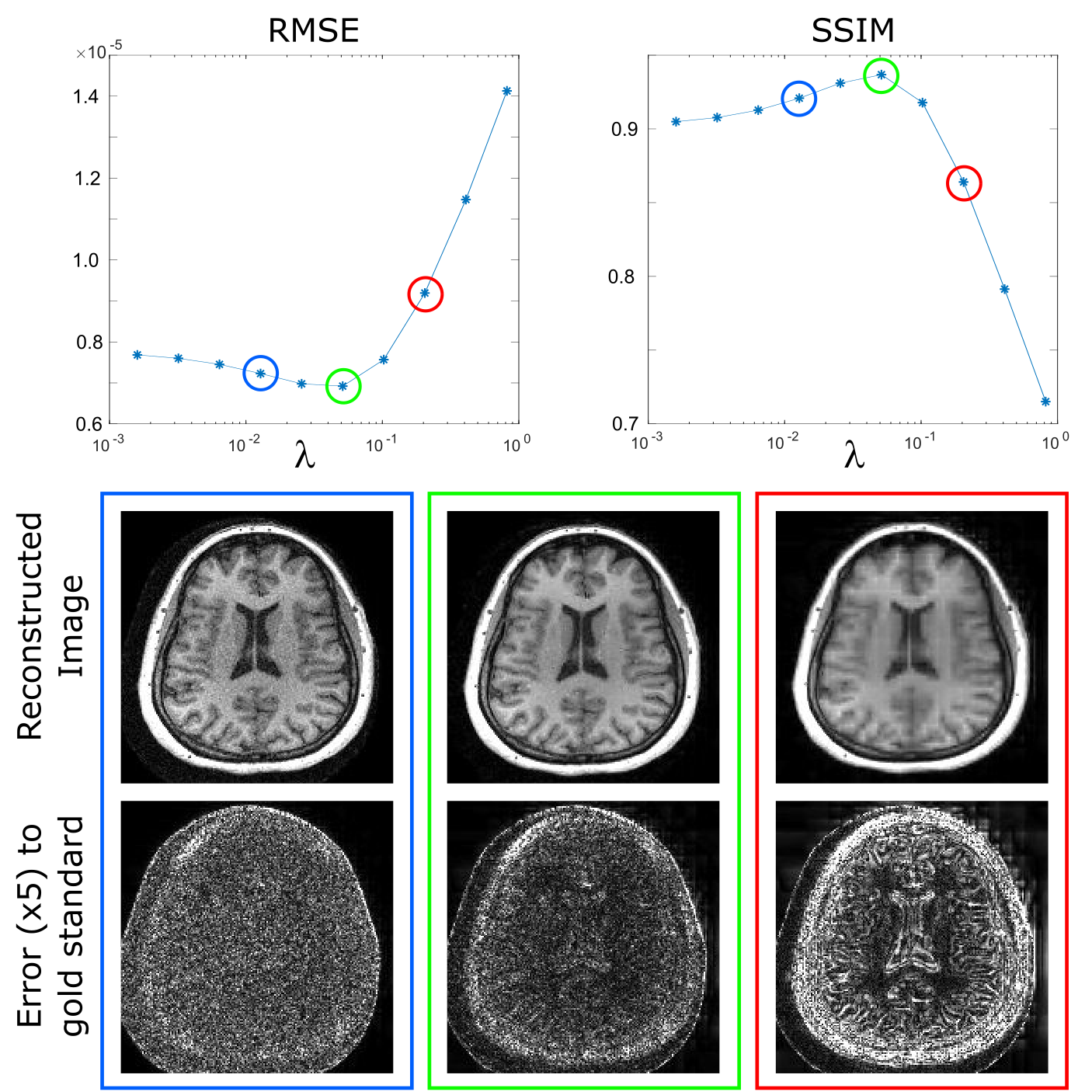
To assess and compare the ABRICOTINE against traditional SRD, as well as a fully sampled reference, retrospective undersampling experiments were conducted from fully sampled 3D MPRAGE[3] head scans (sagittally oriented,1mm isotropic,$$$\,$$$TE=2.9ms/TI=900ms/TR=2300ms/TA=9m10s). Three healthy volunteers were scanned at 3T$$$\,$$$(MAGNETOM$$$\,$$$Prisma,$$$\,$$$Siemens$$$\,$$$Healthcare,$$$\,$$$Erlangen,$$$\,$$$Germany) with a 64ch head coil. Sampling masks were created using a Poisson-disc distribution [4] across a range of acceleration factors (AF=4,5,6,7,8,9,10) for both the SRD and ABRICOTINE sampling patterns with matched number of lines. Subsequently, the fully sampled dataset was masked in k-space to match the desired pattern and reconstructed with varying levels of L1-wavelet regularization. The fully sampled reference images were reconstructed identically but without any regularization ($$$\lambda=0$$$). The optimal regularization parameter was determined for each AF by minimizing the root-mean-square error (RMSE) and maximizing the Structural Similarity Index (SSIM), when comparing the reconstructed images of ABRICOTINE and SRD to GS (see Fig.2). Finally, RMS and SSIM were computed across different AF with optimal regularization for ABRICOTINE and SRD.
Acquisition:
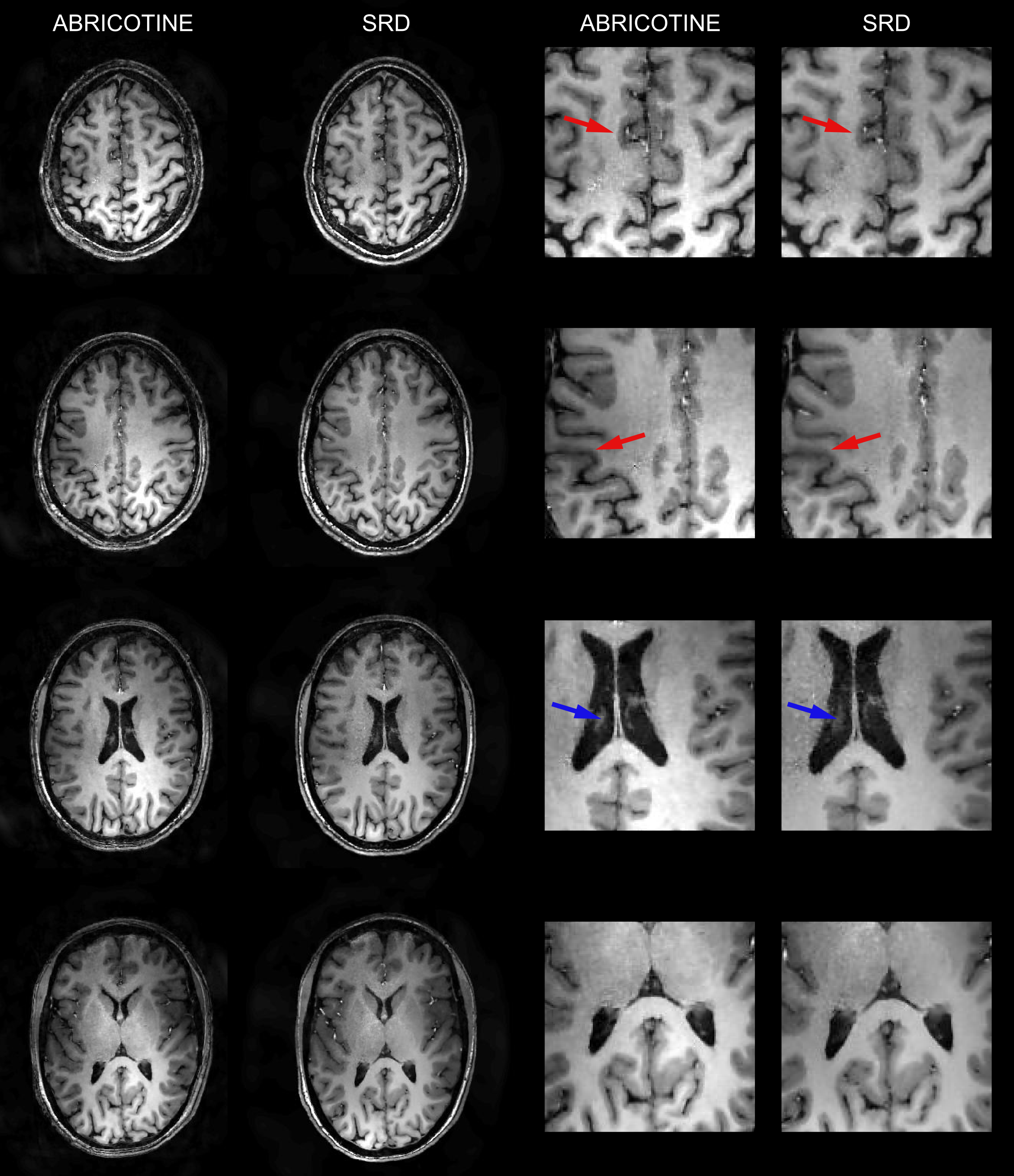
To demonstrate the performance of ABRICOTINE with prospective undersampling, we conducted an acquisition using a highly accelerated (AF=10) high-resolution 3D MPRAGE sequence (0.5mm isotropic, TE=3.5ms/TI=1500ms/TR=4000ms/TA=4m5s). A single healthy volunteer was scanned at 7T$$$\,$$$(MAGNETOM$$$\,$$$Terra.X$$$\,$$$Siemens$$$\,$$$Healthcare,$$$\,$$$Erlangen,$$$\,$$$Germany) with a 1Tx/32Rx head coil (NovaMedical,USA,$$$\,$$$1Tx/32Rx). The ABRICOTINE acquisition comprised three consecutive CS-accelerated scans with orthogonal directions, each with AF=30 using a Poisson-disc sampling pattern. Combining these acquisitions yields the 3D ABRICOTINE sampling pattern, achieving a net AF=10. We compared this ABRICOTINE acquisition to the same acquisition but using SRD with AF=10 and sagittally oriented. The regularization parameter for the reconstructions of both sampling patterns was meticulously adjusted to achieve a matching level of residual noise.
Results
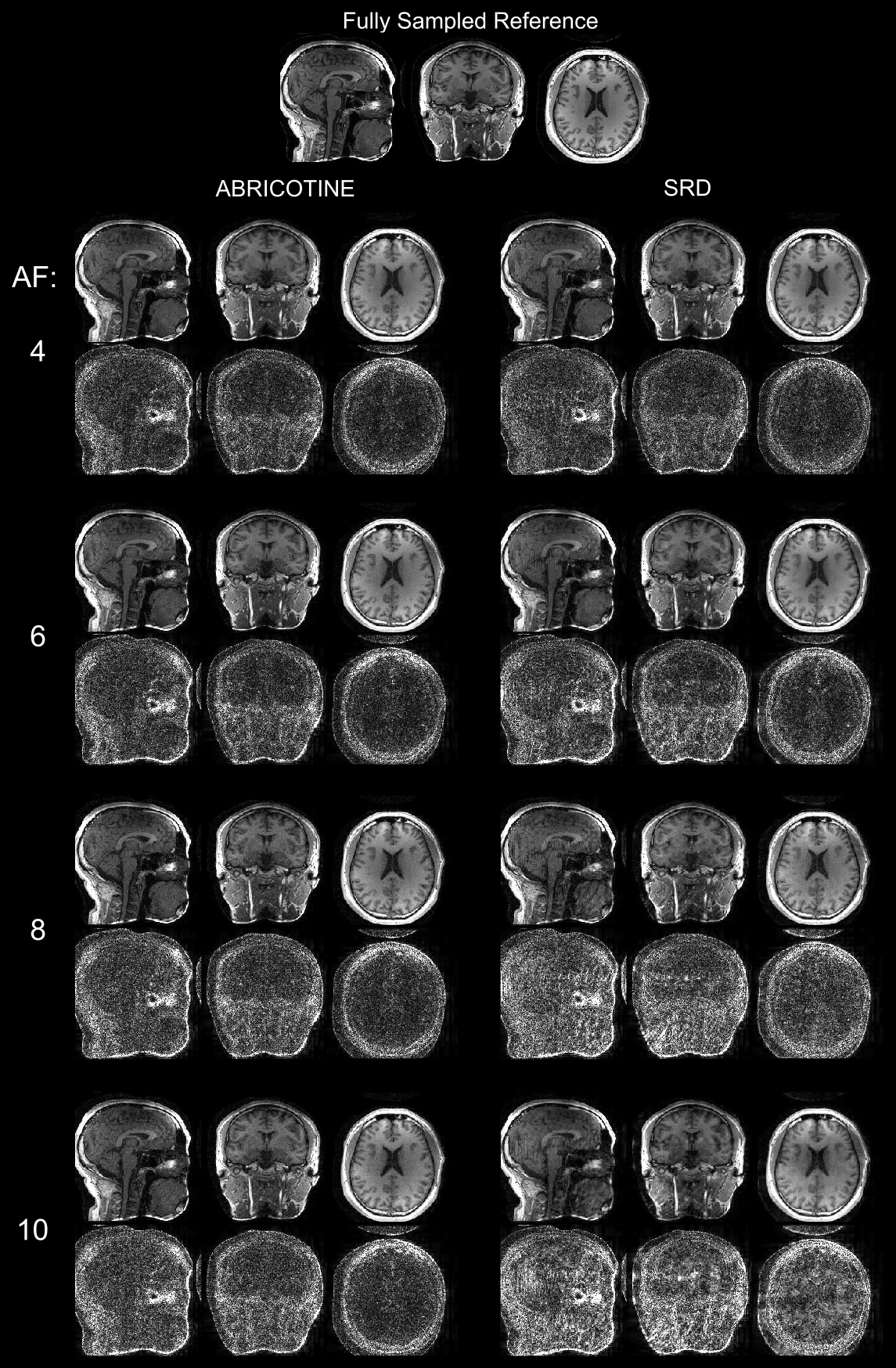
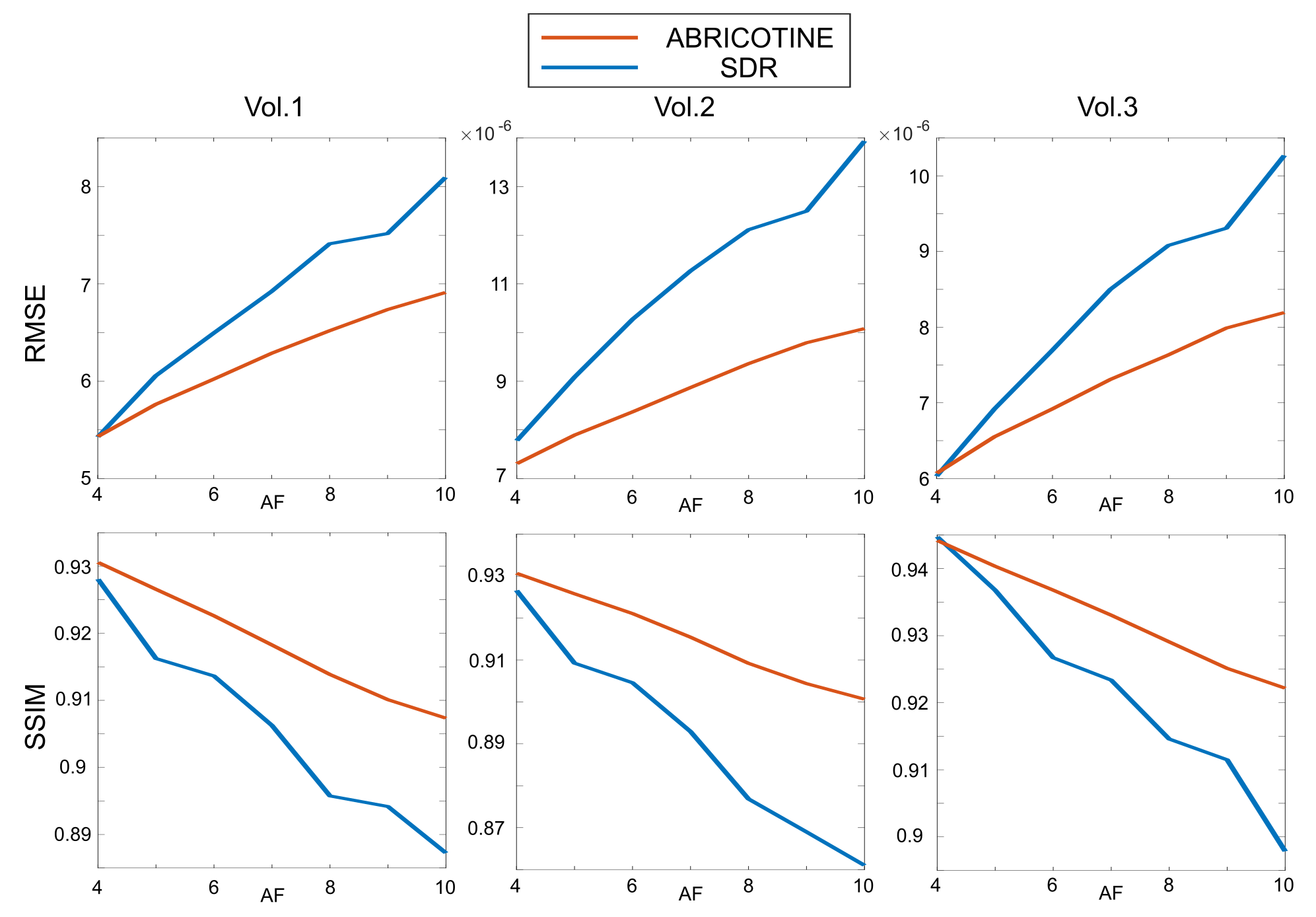
The retrospective undersampling experiments demonstrate improved performance of ABRICOTINE when compared to the SDR pattern. The improvement can be noticed in image quality (Fig.3) and is supported by the improved RMSE and SSIM values (Fig.4). These results are consistent across the volunteers and are especially pronounced for acceleration factors$$$\:>6$$$. The prospective ABRICOTINE sampling (Fig.5) resulted in enhanced image quality with sharper brain structure contours. While this improvement is less pronounced than for retrospective undersampling, it follows a similar trend.Discussion and Conclusion
The ABRICOTINE sampling pattern exhibits superior performance to SRD CS, particularly in scenarios of high acceleration. This result can be intuitively attributed to the unbalanced sampling nature of SRD at high acceleration, where the phase-encoded directions are highly undersampled while the readout direction is fully sampled. In contrast, ABRICOTINE achieves a more uniform distribution of undersampling across k-space dimensions. Furthermore, the ABRICOTINE sampling remains Cartesian, ensuring both fast reconstruction and accurate imaging. In future investigations, we anticipate that the orthogonal readout directions may effectively mitigate aliasing artifacts and diminish flow artifacts along the phase-encoding direction. However, spatial distortions due to $$$B_0$$$ inhomogeneity might occur in all directions with ABRICOTINE potentially explaining why simulations show greater improvements than the prospectively undersampled data. In conclusion, the ABRICOTINE sampling allows for higher acceleration factors than conventional SRD sampling and thus could enable high resolution imaging in clinical acceptable times (e.g., 0.5mm isotropic MPRAGE in 4m05s).Acknowledgements
No acknowledgement found.References
[1] Lustig, M., Donoho, D., & Pauly, J. M. (2007). Sparse MRI: The application of compressed sensing for rapid MR imaging. Magnetic Resonance in Medicine, 58(6), 1182–1195. https://doi.org/10.1002/mrm.21391 [2] Baron, C. A., Dwork, N., Pauly, J. M., & Nishimura, D. G. (2018). Rapid compressed sensing reconstruction of 3D non-Cartesian MRI. Magnetic Resonance in Medicine, 79(5), 2685–2692. https://doi.org/10.1002/mrm.26928 [3] Brant-Zawadzki, M., Gillan, G. D., & Nitz, W. R. (1992). MP RAGE: a three-dimensional, T1-weighted, gradient-echo sequence--initial experience in the brain. Radiology, 182(3), 769–775. https://doi.org/10.1148/radiology.182.3.1535892 [4] Dwork, N., Baron, C. A., Johnson, E. M. I., O’Connor, D., Pauly, J. M., & Larson, P. E. Z. (2021). Fast variable density Poisson-disc sample generation with directional variation for compressed sensing in MRI. Magnetic Resonance Imaging, 77, 186–193. https://doi.org/10.1016/j.mri.2020.11.012Figures