1057
High-resolution mapping of hand innervation: novel approaches at 7T MRI1Image guided Interventions Laboratory (949), Faculty of Medicine, University of Geneva, Geneva, Switzerland, 2Radiology Department, University Hospitals of Geneva, Geneva, Switzerland, 3Fondation Campus Biotech Geneva, Geneva, Switzerland, 4Advanced Clinical Imaging Technology, Siemens Healthineers International AG, Lausanne, Switzerland, 5CIBM Centre for Biomedical Imaging, Geneva, Switzerland
Synopsis
Keywords: Peripheral Nerves, Nerves, Pacinian corpuscles
Motivation: Exploit the high resolution provided by the 7T MRI technology to detect fine structures in the hand.
Goal(s): To create an atlas of hand structures, with a specific focus on nerves and Pacinian corpuscles. This atlas is intended to serve both diagnostic purposes and to support reconstructive surgical procedures.
Approach: An ethics committee was obtained to scan volunteers using 7T MRI. Post-processing was carried out to delineate the nerve fiber network and mechanoreceptors.
Results: We successfully reconstruct and describe the anatomy of all nerve fibers from the carpus to the digital nerve division, as well as the Pacinian corpuscles, for three healthy volunteers.
Impact: A visual interactive “Hand Nerves Atlas” matching morphology and fiber tracking of hand nerves on high-field will be delivered to the scientific community for fundamental research, to clinicians for microscopic surgery of nerves, and for educational purposes in medical schools.
Introduction
The human hand comprises an exceedingly complex nerve network essential for sensitivity, motricity, and proprioception. However, visualizing this complex network with conventional clinical MRI proves challenging due to the multiplanar nature of nerve pathways, which necessitates time-consuming three-dimensional (3D) imaging. Beyond understanding nerve morphology, quantifying nerve structures is imperative for comprehending nerve transmission and precise anatomical distribution. For this purpose, the emergence of ultra-high-field MRI offers the potential to explore fine anatomical structures within the hand, such as distality of collateral nerves and Pacinian corpuscles, which hold significant utility in the context of microsurgery involving nerves. We are aiming to assess the sensory and motor nerve structures of the hand in healthy adults. An initial feasibility study for the detection of Pacinian corpuscles was carried out by Germann and al. [1], using a 28-element receive, single-transmit coil without explicit nerve tracking in fingers. Here, a multi-transmit coil was used, aiming for a more homogeneous signal.Material & Method
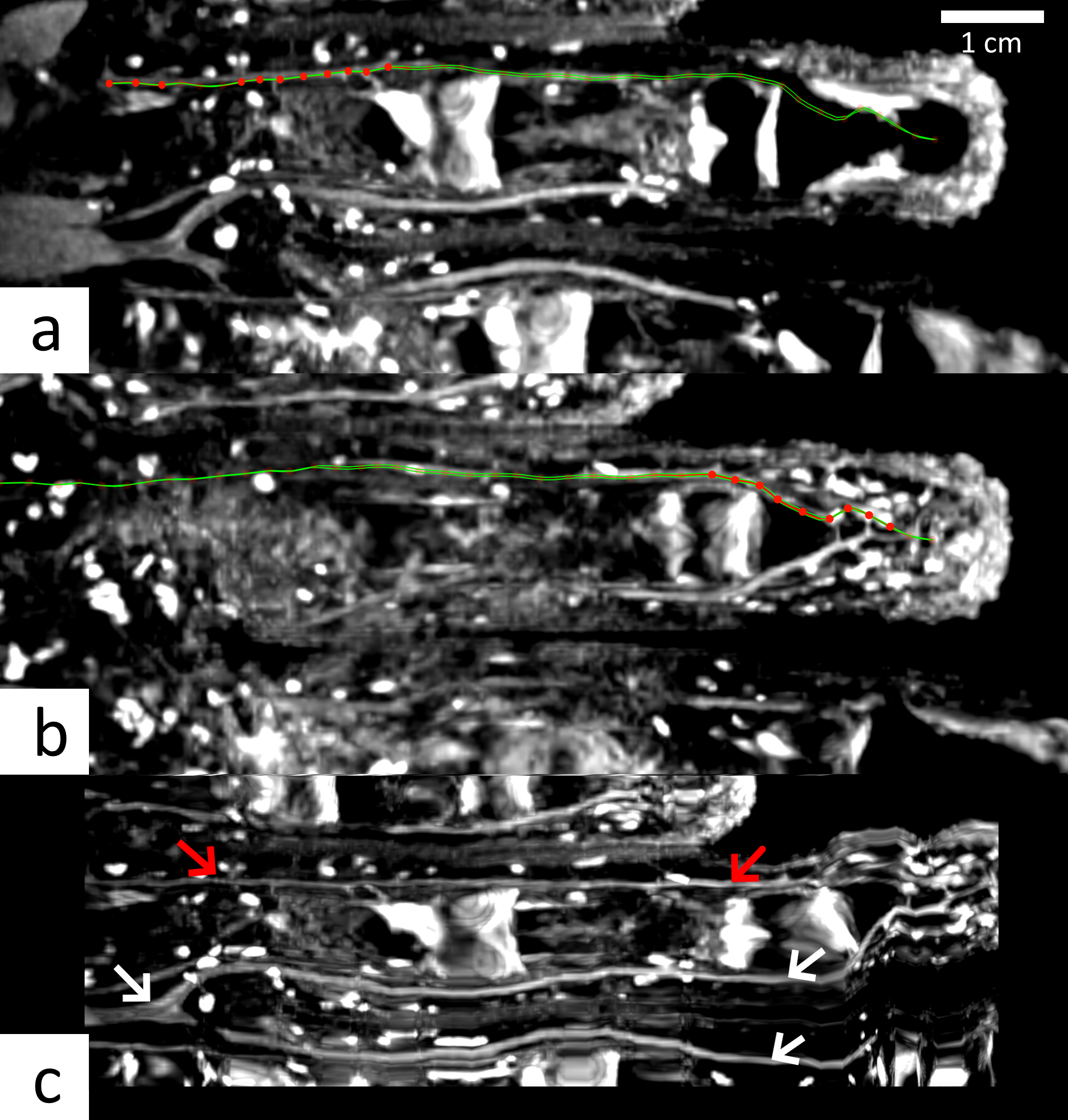
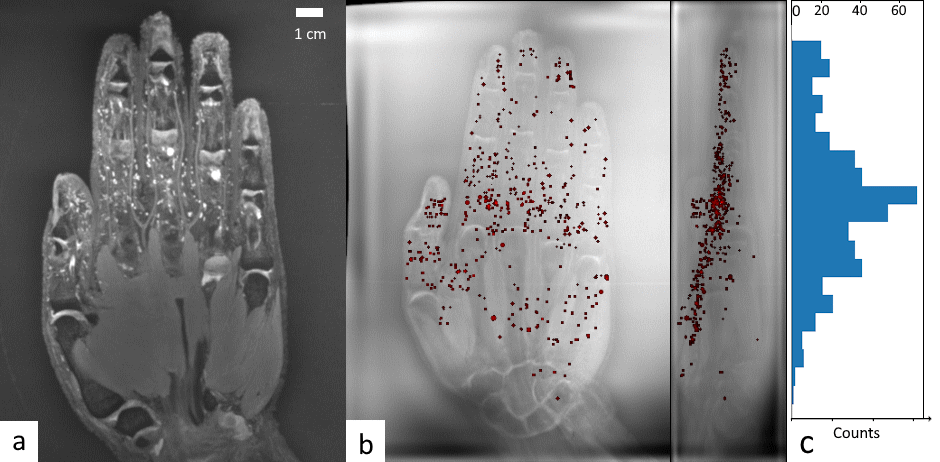
Three volunteers (6 hands) were recruited for bilateral hand imaging and were examined using a 7T MRI (MAGNETOM Terra.X, Siemens Healthcare, Erlangen, Germany). The coil used for our study is a head coil with 32 receive elements and 8 transmit channels with independent control. As this coil was not designed specifically for the hand, a special setup was used. The subject’s hand was attached to a plastic plate to keep it still and flat in a strictly horizontal position. Furthermore, the patient's hand was inserted into a silicon balloon filled with 2mm polypropylene pellets to ensure passive B0 shimming. Three optimized sequences were performed: a multi-slice 2D Proton Density (PD) fat saturated TSE (TE: 22ms, TR: 14480ms, flip angle: 130°, R:0.2x0.2x1.5, BandWidth: 300Hz/px, TA:10:23min, Turbo Factor:7), the same PD sequences without FatSat, and a 3D T2 DESS sequence (TE: 5.22ms, TR: 11.06ms, flip angle: 18°, BandWidth:376Hz/px, TA:10:23min, R:0.4x0.4x0.5, B1 shim volume selective).For the three volunteers, the four nerves of each long finger were manually tracked using Osirix's 3D Curved MPR function (CMPR, Osirix Dicom viewerR, Switzerland) on the T2 DESS, which locally unfolds the nerve’s tortuosity. This allows reformation and visualization of a Curved Planar Reformation (CPR) image of an individual nerve within a single slice (see Fig. 1), yielding a linear-like structure. This was used to take several measurements to characterize the size of the nerve from the base of the 1st metacarpal to the head of the distal phalanx and the distance of the nerve from the skin and from the joints (according to anatomic atlases). Additionally, Pacinians corpuscles were semi-automatically segmented in 3D on the T2 DESS using 3DSlicer with an adapted threshold, followed by automated quantification of the corpuscle distribution using a home-written Matlab (The Mathworks, USA) script (see Fig. 2).
Results
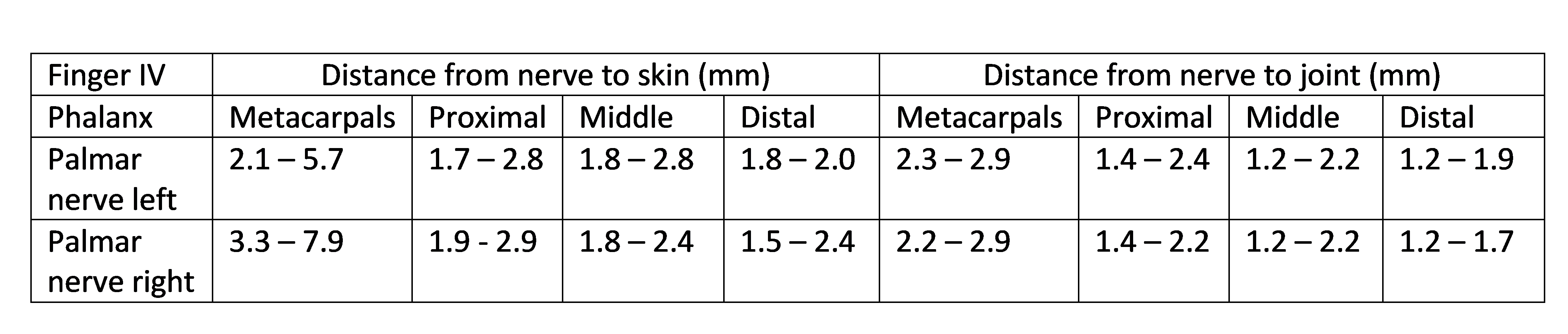
The PD sequences demonstrated excellent homogeneity of the fat suppression (see Fig. 3), confirming the performance of the active and passive Bo shimming.Using the T2 DESS sequence, it was possible to accurately reconstruct all the digital nerves (Fig. 1) and provide further anatomical description. Segmentation was notably simplified due to differing signal intensities: bones averaged 34.5, muscles 62.8, nerves 100.78, and Pacinian corpuscles 178. Moreover, sharp delineation of nerve fascicles was demonstrated, with the perineurium of each fascicle distinctly identified. Table 1 records the sizes and distances to joints and skin for two palmar nerves in finger IV of the right hand of a volunteer. For all the volunteers, digital nerves were found, on average, between 2 and 3 mm deep, except within flexion folds, where the nerve was approximately 1.5 mm from the skin. The average distance from digital nerves to joints was about 1.8 mm.
Pacinian corpuscles segmented for the six cases are most tightly grouped in the metacarpals zone, located on the palmar side and on the surface of the tendinous, muscular, and bone structures (Fig. 2). Moreover, the number of Pacinian corpuscles appears to be highly subject-dependent: volunteer two had 623 corpuscles for the right hand and 715 for the left, whereas volunteer three had 398 corpuscles for the right hand and 423 for the left. The diameters of the Pacinian corpuscles ranged from 1 to 5 mm.
Conclusion
Our study demonstrated the feasibility of high-resolution 7T MRI imaging for examining nerve fascicles. It was possible to reconstruct and describe the anatomy of all nerve fibers from the carpus to the digital nerve division, as well as the Pacinian corpuscles. This advancement is expected to enable the visualization of microstructural distal traumatic lesions in the peripheral nervous system, with improvements in anatomical and tractographic sequences.Acknowledgements
The authors thank the Foundation of Campus Biotech Switzerland, for providing access to the MR imaging infrastructure.References
1. Germann, C., Sutter, R. & Nanz, D. Novel observations of Pacinian corpuscle distribution in the hands and feet based on high-resolution 7-T MRI in healthy volunteers. Skeletal Radiol 50, 1249–1255 (2021)Figures