1034
The Impacts of High Permittivity Materials on Various Multichannel Transceiver Arrays for Human Head Imaging at 10.5 Tesla1Center for Magnetic Resonance Research, University of Minnesota, Minneapolis, MN, United States, 2HyQ Research Solutions, LLC, College Station, TX, United States, 3Penn State University, State College, PA, United States
Synopsis
Keywords: RF Arrays & Systems, RF Arrays & Systems
Motivation: Since RF power requirements increase with operating frequency, SAR levels at UHF represent practical limitations. Here we evaluate possible improvements in overall transmit efficiency and SNR of array coils for the human head at 10.5T through the utilization of high permittivity materials.
Goal(s): Our goal was to evaluate the impact of high permittivity materials (HPM) on the transmit efficiency and SNR for various transceiver array designs.
Approach: We experimentally evaluated four multichannel transceiver arrays of different architectures with and without a formfitting HPM former.
Results: The HPM coil former achieved improvements in transmit efficiency and SNR compared to a typical polycarbonate coil former.
Impact: Incorporating high permittivity dielectric materials into the design and fabrication of pTx-capable transceiver array coils demonstrated improved transmit efficiency and SNR. This technology has the potential to improve imaging and spectroscopic applications in the human head at 10.5T and beyond.
Introduction
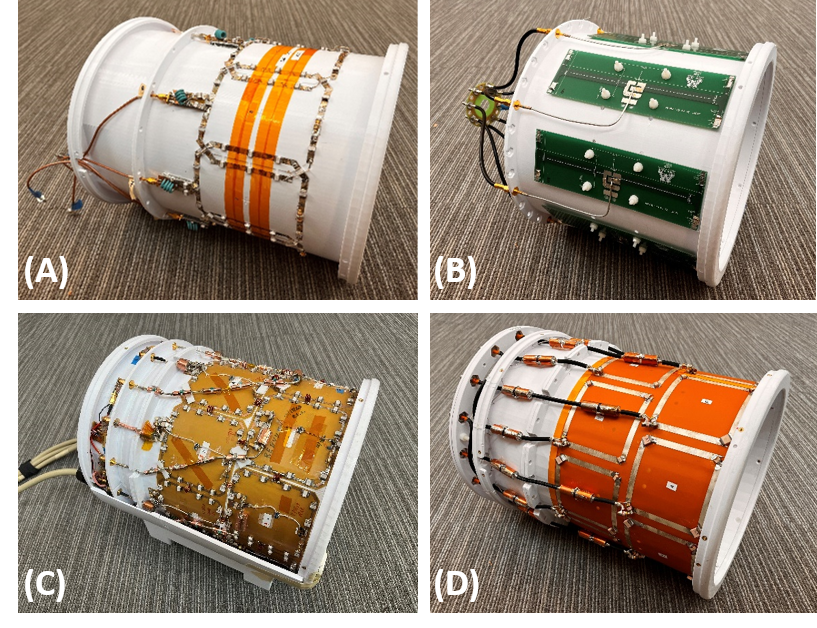
It has been shown that the introduction of high permittivity materials (HPM) into radio frequency (RF) coils used at ultrahigh field (UHF) of 7T and above can enhance both transmit efficiency and receive sensitivity1-3. The presence of the high dielectric constant material between the RF coil and the subject can additionally increase the B1+ field homogeneity while also reducing SAR levels within the subject4. Here we experimentally investigate both the transmit efficiency and receive sensitivity impacts of an integrated novel slim coil former fabricated from HPM when inserted into four different transceiver array types: an 8-channel loop array (8L), an 8-channel dipole array (8D), a 16-channel transformer decoupled loop array (16XD), and a 16-channel self–decoupled element array (16SD).Methods
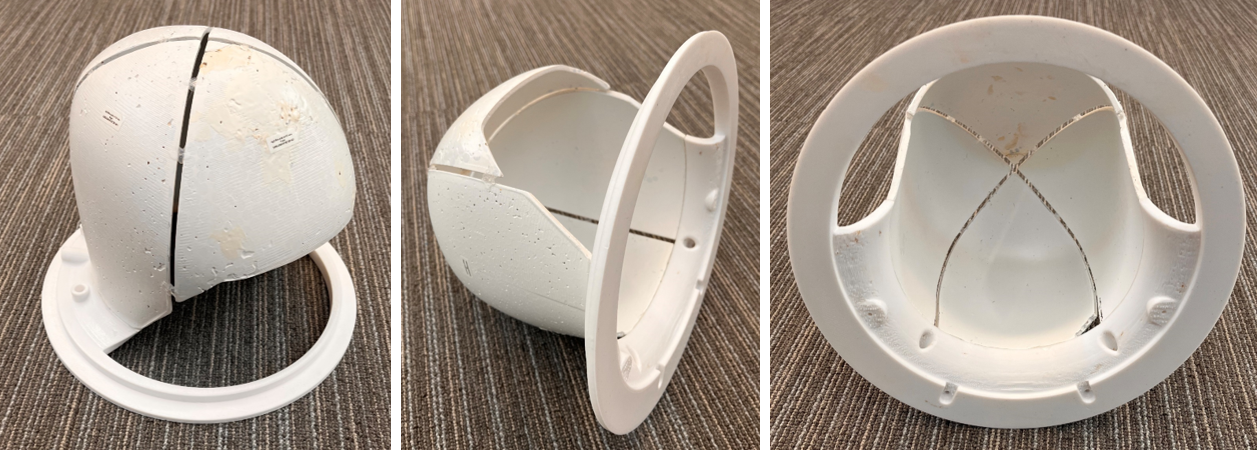
A 5mm thick HPM low-loss ceramic coil former (HyQ Research Solutions, College Station, TX) with a relative permittivity (Ɛr) of ~100 was designed using a novel fabrication methodology to exactly match the shape and form of our typical 10.5T head receivers5,6. The resulting HPM former had internal dimensions measuring ~23 cm anterior-to-posterior, ~18.5 cm left-to-right, and ~20 cm deep and replaced the existing inner former of four existing transceiver array head coils7 and allowed us to assess the impact of HPM on the transmit efficiency and receive sensitivity. The HPM ceramic former was segmented into four sections in order to break up large displacement currents within the HPM. All four transmit array coil configurations were built on to a 27.5 cm 3D printed former using a polyethylene terephthalate glycol (PETG) filament (Atomic Filament, Kendallville, IN). Each of the four transmit arrays were tested in two configurations: with its original PETG inner former and with the HPM former.All 10.5T data were acquired on a MAGNETOM (Siemens Healthineers, Erlangen, Germany) console interface to an 88 cm bore magnet (Agilent Technologies, Oxford, UK). The RF chain consisted of 16 independent 2 kW RF power amplifiers with full pTx capability and recently we extended the console to support 128 receiver channels8.
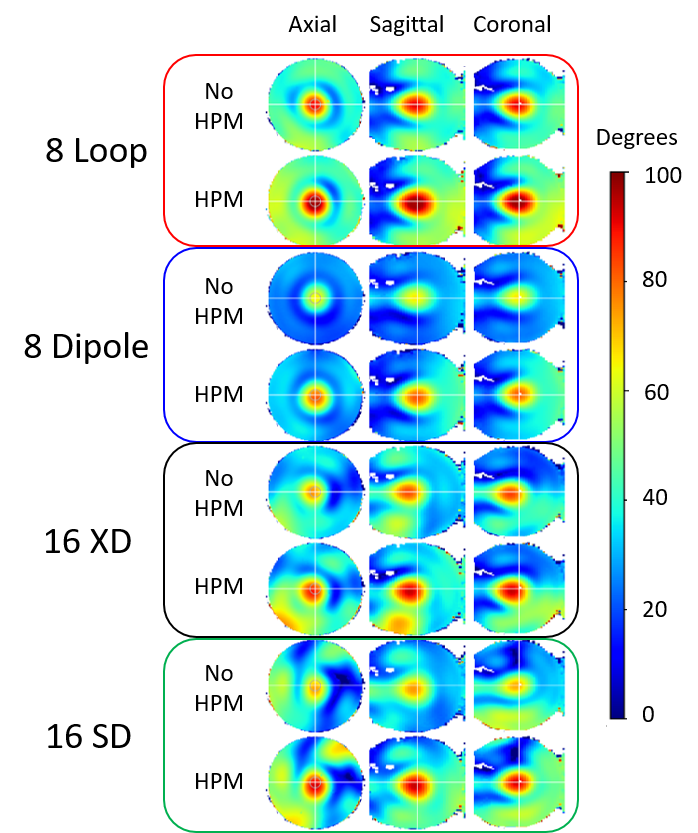
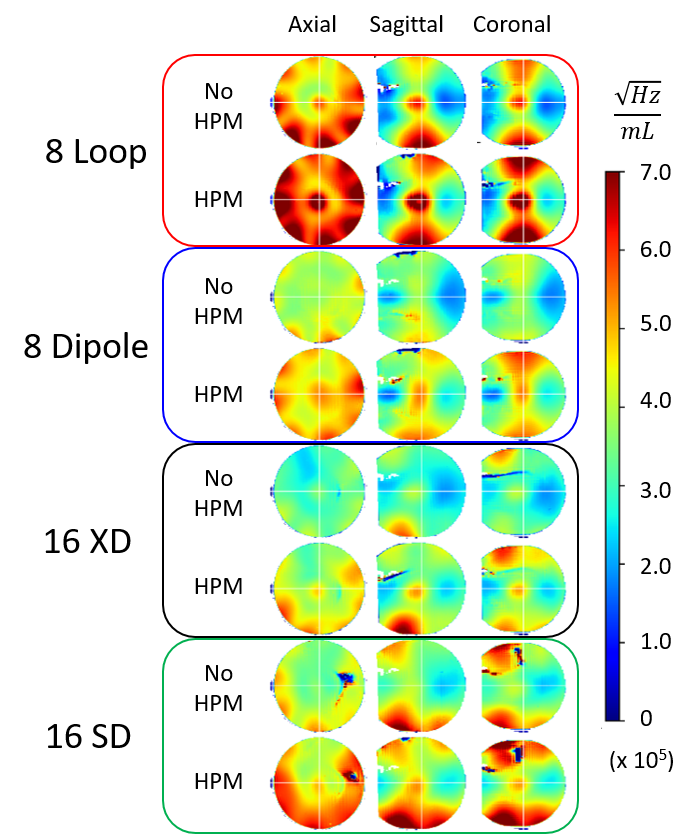
In order to assess B1+ efficiency between the four coils, an Actual Flip-angle Imaging sequence9 was performed while the coils were loaded with the lightbulb-shaped polyvinylpyrrolidone (PVP) filled phantom with dielectric properties to match that of the human tissue at 10.5T. Using a dielectric probe (DAKs 12, Schmid & Partner Engineering AG, Zurich, Switzerland) both the conductivity and relative permittivity of the phantom were measured at 447 MHz to be σ = 0.67 S/m and Ɛr = 49.2, respectively. A fully relaxed 2D-GRE sequence was performed with flip angle = 90 and 0 to assess receive sensitivity while the coils were loaded with the same phantom. Intrinsic SNR data were calculated following Ugurbil (2019)10.
Results
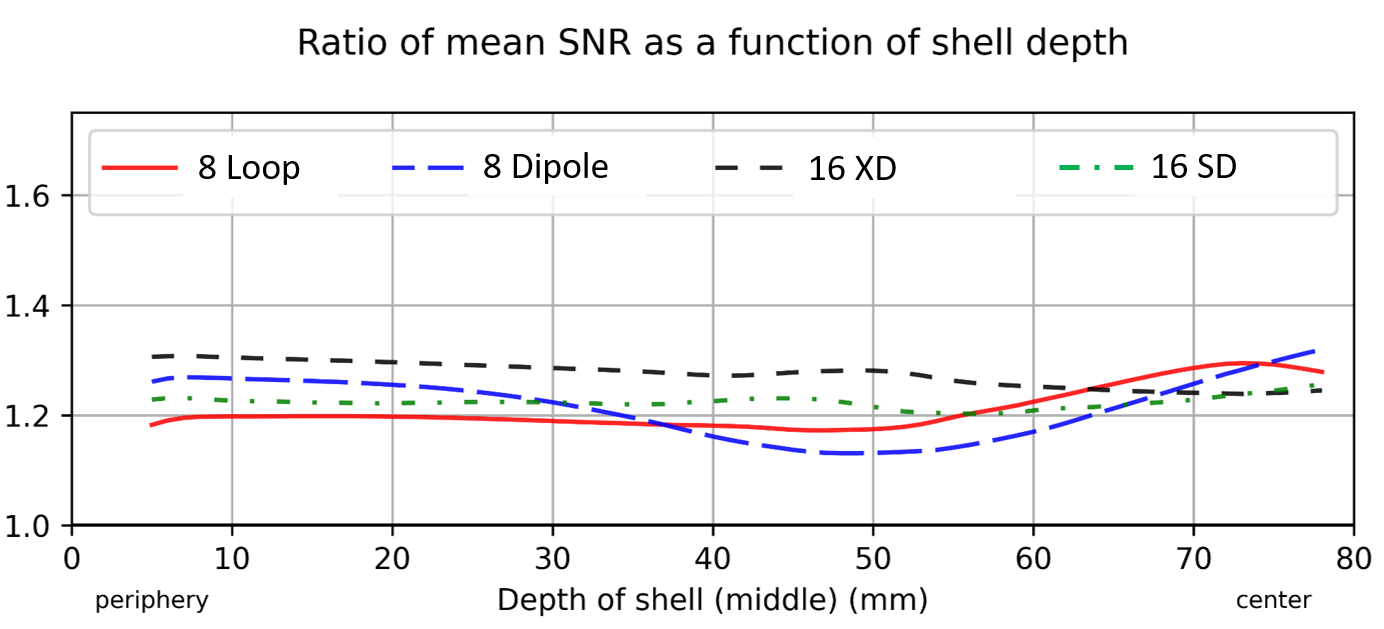
The presence of the HPM former demonstrated transmit efficiency improvements in all four transmit array coil designs. Figure 3 shows B1+ field maps of the four coils with and without the HPM former. When measured in a small circular region of interest (ROI) in the center of the axial plane we observe improvements of ~23% in the 8-channle loop array, ~32% in 8-channel dipole array, ~21% in the 16-channel XD array, and ~30% in the 16-channel SD array.Receive sensitivity enhancements were also observed with the presence of the HPM former. Figure 4 shows SNR maps of the four coils in all three orthogonal imaging planes within the PVP phantom with and without the HPM former. These sensitivity improvements can be quantified and plotted by shelling the phantom into 1 cm thick layers. The line plots in Figure 5 demonstrate the ratios of sensitivity enhancements from the presence of the HPM former in all four coil architectures as function depth, ~18-30% in the 8-channel loop array, ~13-33% in 8-channel dipole array, ~25-33% in the 16-channel XD array, and ~20-26% in the 16-channel SD array.
Discussion & Conclusion
We have experimentally evaluated the impacts of an integrated HPM coil former to both transmit efficiency and receive sensitivity of four different transceiver array configurations at 10.5T. The presence of the HPM demonstrated improvements in transmit efficiency and SNR throughout the phantom in all four array configurations. Our future work will include optimizing a high density, high channel count receive-only array for the HPM former, safety validation for any transceiver arrays we wish to continue to pursue, as well as potential optimization of the HPM former shape and size for various application-specific ROI’s.Acknowledgements
This study was supported by National Institute of Health Grants U01 EB025144, P41 EB027061 and S10 RR029672
References
1. Lakshmanan, K., et al., Improved whole-brain SNR with an integrated high-permittivity material in a head array at 7T. Magn Reson Med, 2021. 86(2): p. 1167-1174.
2. Gandji, N.P., et al., Displacement current distribution on a high dielectric constant helmet and its effect on RF field at 10.5 T (447 MHz). Magn Reson Med, 2021.
3. Sadeghi-Tarakameh, A., et al., A nine-channel transmit/receive array for spine imaging at 10.5 T: Introduction to a nonuniform dielectric substrate antenna. Magn Reson Med, 2022. 87(4): p. 2074-2088.
4. Vaidya, M.V., et al., Improved detection of fMRI activation in the cerebellum at 7T with dielectric pads extending the imaging region of a commercial head coil. J Magn Reson Imaging, 2018. 48(2): p. 431-440.
5. Tavaf, N., et al., A self-decoupled 32-channel receive array for human-brain MRI at 10.5 T. Magn Reson Med, 2021. 86(3): p. 1759-1772.
6. Tavaf, N., et al. A Self-decoupled 64 Channel Receive Array for Human Brain MRI at 10.5T. in Proc. Intl Soc Mag Reson Med 29. 2021.
7. Waks, M., et al. A 16-channel splitable non-overlapped self-decoupled loop transmitter for 10.5 Tesla human head imaging. in Proc. 2022 ISMRM. 2022. London.
8. Lagore, R., et al. A 128-channel receive array for 10.5T human head imaging. in Proc Intl Soc Mag Reson Med 29. 2021. Vancouver.
9. Yarnykh, V.L., Actual flip-angle imaging in the pulsed steady state: a method for rapid three-dimensional mapping of the transmitted radiofrequency field. Magn Reson Med, 2007. 57(1): p. 192-200.
10. Ugurbil, K., et al., Brain imaging with improved acceleration and SNR at 7 Tesla obtained with 64-channel receive array. Magn Reson Med, 2019. 82(1): p. 495-509.
Figures